

Key Takeaways
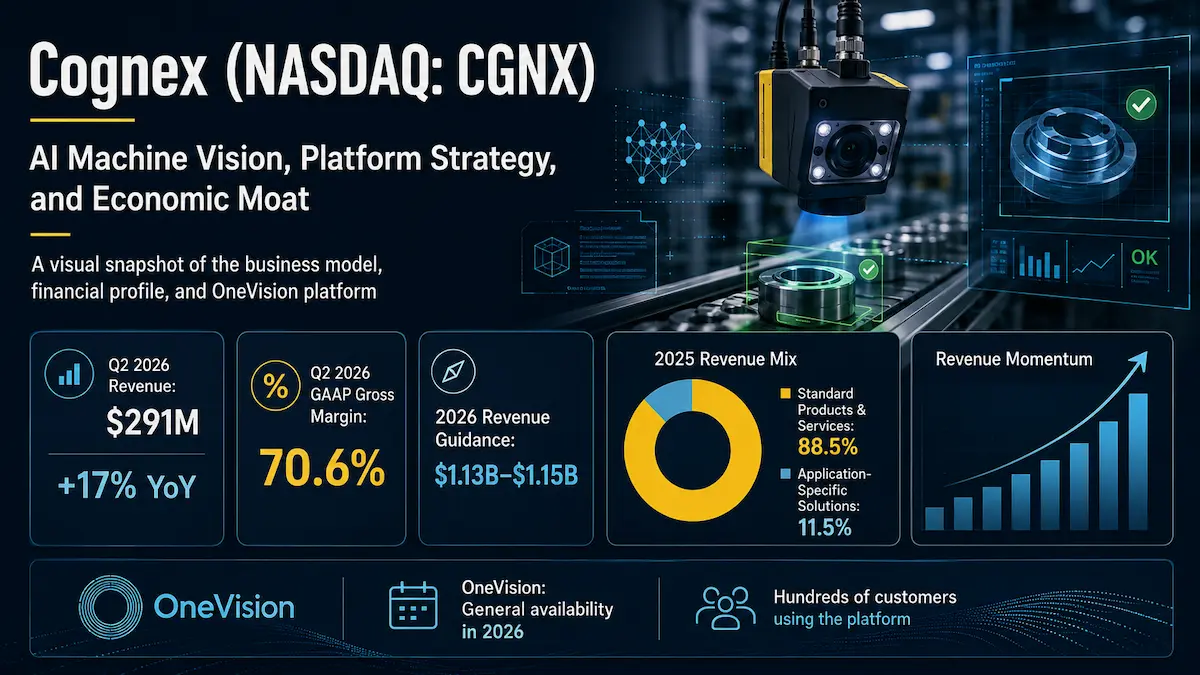
- Cognex monetizes industrial machine vision primarily through high-value vision systems, sensors, barcode readers, optics, and related software rather than through a pure recurring-revenue model. In 2025, standard products and services represented about 88.5% of revenue, while application-specific customer solutions represented about 11.5%; service revenue remained below 10% of total revenue.
- The economic engine is attractive because Cognex sells software-intensive automation products into applications where inspection accuracy, uptime, and deployment speed matter more than raw component cost. This supports a structurally high gross-margin profile, although margins still move with end-market mix, volume, inventory actions, tariffs, and product transitions.
- The strongest moat is not simply brand or scale. It is the combination of proprietary vision algorithms, accumulated application know-how, a broad hardware-software ecosystem, and application-layer switching costs once Cognex is validated inside production workflows. These advantages are strongest in complex, multi-line deployments and weaker in simpler vision-sensor use cases.
- OneVision changes the strategic architecture by adding a cloud-to-edge control layer for AI model development, governance, and deployment across Cognex devices. The platform has subscription mechanics, but Cognex does not separately disclose OneVision revenue, so it is premature to treat the company as a SaaS story.
- The principal risks are end-market cyclicality, customer concentration, rapid AI commoditization, execution risk in the salesforce and operating-model transformation, and the possibility that customers standardize on competing or internally developed vision stacks rather than Cognex.
1. Business Model Breakdown
Cognex Corporation is best understood as a software-rich industrial automation company whose primary monetization vehicle is still physical machine vision equipment. Its systems give factories and distribution centers the ability to locate, identify, inspect, measure, classify, and guide objects at production speed. The commercial value is therefore tied less to the bill of materials inside a camera and more to the cost of the manufacturing error, labor bottleneck, false reject, line stoppage, or traceability failure that the vision system prevents.
The revenue model has three practical layers. First, Cognex sells standard machine vision products and related services, including In-Sight vision systems and sensors, DataMan barcode readers, VisionPro software, cameras, controllers, lenses, lighting, and other accessories. Second, it delivers application-specific customer solutions in which hardware, software, engineering, and validation are combined around a defined production task. Third, it sells maintenance, support, consulting, and training. According to the 2025 Form 10-K, standard products and services generated $880.0 million of the company’s $994.4 million of revenue, while application-specific customer solutions generated $114.3 million. Services accounted for less than 10% of total revenue.
This matters because the Cognex business model should not be analyzed like an enterprise software company whose economics are dominated by annual recurring revenue. The core profit pool remains product-led. However, those products embed proprietary software and are increasingly organized around common development environments and AI tooling, allowing software to influence product selection, customer standardization, and lifetime economics even when the initial revenue event is a hardware sale.
The manufacturing model also helps explain the economics. Most vision systems, sensors, and barcode readers are assembled by third-party contract manufacturers, while Cognex controls product design, approved components, software loading, image alignment, quality processes, and key intellectual property. Following the Moritex acquisition, Cognex also manufactures optical components such as lenses and lighting in its own plants in China and Vietnam. This is not a fully asset-light software model, but it concentrates Cognex’s internal resources on engineering, algorithms, product architecture, application support, and system-level quality rather than on owning every stage of electronics manufacturing.
The result is a business capable of high gross margins when mix and utilization are favorable. Cognex reported a 67% GAAP gross margin in 2025, despite an inventory charge associated with a strategic portfolio review. In the second quarter of 2026, gross margin rose to 70.6%, driven primarily by favorable end-market mix and higher volume. The important analytical point is that this margin structure reflects differentiated system value and software content, but it is not immune to product mix, excess inventory, tariffs, supply-chain disruptions, or pricing pressure.
The Platform Strategy: From Point Products to a Vision Stack
Cognex’s current platform strategy is to make the hardware portfolio behave more like a unified automation stack. The stack starts with image acquisition through cameras, lenses, and lighting; moves through embedded In-Sight systems, barcode readers, and PC-based VisionPro software; and increasingly extends upward into OneVision, a cloud-based environment for developing, training, governing, and deploying AI vision applications.
OneVision is strategically important because it addresses one of industrial AI’s hardest problems: scaling a model beyond a single successful pilot. Cognex’s cloud-to-edge architecture centralizes image curation, labeling, model training, version control, and cross-site management in the cloud, while inference remains on edge devices for low-latency factory operation. This allows a customer to develop and govern an inspection model centrally, then deploy it across plants without requiring cloud connectivity for runtime inspection.
Cognex documentation confirms that OneVision is sold with subscription-based resource limits for users, compute, and storage. That creates a recurring monetization vector. Yet the company does not currently disclose OneVision revenue separately, and service revenue is still less than 10% of company sales. The commercially relevant thesis today is therefore not “Cognex becomes SaaS,” but rather “software increases the strategic value and standardization potential of the Cognex hardware fleet.” If OneVision becomes the control plane through which customers manage AI inspection globally, it can raise hardware attach rates, reduce churn, expand share of wallet, and create a higher-quality recurring software layer around the installed product base.
The go-to-market model is being redesigned around that platform logic. Cognex now separates sales coverage into market creation and expansion, market penetration, and partner enablement. The first motion seeks new customers with easier-to-use AI-enabled products; the second uses more technically advanced sales engineers to expand within existing accounts; the third works with system integrators, machine builders, and automation partners. Management’s stated objective is to double the customer base within five years, making sales productivity and partner leverage as important as raw headcount growth.
2. Deep Dive into Economic Moats
Intangible Assets: The Strongest Moat
Cognex’s most defensible advantage is its accumulated intellectual and application capital rather than any single patent. The company explicitly states that no individual patent, trademark, copyright, or other intellectual property right is material to the business as a whole. That is an important distinction: the moat is not a single legal monopoly. It is the accumulated system of algorithms, vision tools, datasets and training methods, optical expertise, product architectures, engineering workflows, and application knowledge built over decades of solving real industrial inspection problems.
This capability has been reinforced by sustained research and development. Cognex spent approximately $139 million on research, development, and engineering in 2025, equal to about 14% of revenue, and employed 575 people in those functions at year-end. The company has also been investing in common platforms intended to let engineering teams reuse software and architecture across multiple products, which can shorten development cycles and improve R&D productivity.
A key turning point in this intangible-asset base came in 2017, when Cognex acquired ViDi Systems, then a specialist in deep learning software for industrial machine vision. The strategic logic was not simply to add another software SKU. It brought example-based learning into a company historically associated with deterministic, rule-based vision. That broadened the addressable problem set from highly structured inspections to defects and visual variations that are difficult to enumerate in advance. The significance of that move is visible today: Cognex now describes AI leadership as one of its three core strategic objectives and has converted nearly a decade of industrial deep-learning experience into edge-learning products and the OneVision platform.
For a competitor to replicate this moat, buying equivalent camera hardware is not enough. It must reproduce algorithm quality across a wide variety of lighting conditions, materials, defect types, production speeds, and factory environments; build reliable deployment tools; accumulate application engineering experience; support customers globally; and prove performance in production. That requires sustained R&D, time in the field, and customer access. The cost is measured not only in engineering dollars but in years of iterative exposure to edge cases.
Switching Costs: Real, but Uneven
Cognex also benefits from switching costs, although they should be described as application-layer and workflow switching costs rather than contractual lock-in. A machine vision system can become embedded in a manufacturing cell through inspection recipes, PLC communications, robot interfaces, operator workflows, validation procedures, quality-control thresholds, and maintenance processes. Replacing it may require retuning optical parameters, rewriting logic, retraining models, revalidating quality performance, retraining employees, and accepting production risk during the transition.
These costs rise materially when a customer standardizes across multiple lines or factories. OneVision is designed to amplify this dynamic by centralizing AI model development, version control, and deployment across fleets of Cognex systems. If a manufacturer stores its validated inspection standards, workflows, and AI lifecycle inside OneVision and deploys them broadly, switching away becomes an organizational project rather than a simple camera replacement.
However, switching costs are not uniformly high. Simple presence/absence sensors, basic barcode reading, or greenfield installations can be more contestable, particularly where multiple vendors can meet the performance specification. That is why Cognex’s moat is strongest in technically demanding applications and enterprise standardization programs, not across every unit sold.
Network Effects: Weak
Cognex does not currently have a classic network effect in the Buffett-style sense. One customer buying a Cognex camera does not directly make another customer’s camera more valuable. OneVision can improve collaboration within an enterprise, but its value is primarily driven by workflow standardization and tooling rather than by a cross-customer network whose utility rises automatically with each new participant.
There may be data and learning advantages from operating across a large installed ecosystem, but Cognex has not disclosed a business model in which customer data is pooled to create a compounding shared-data network. Investors should therefore resist labeling the installed base itself as a network effect.
Cost Advantages: Helpful Economics, Not the Core Moat
The company’s use of third-party contract manufacturers can support flexible capacity and avoid the fixed-cost burden of fully integrated electronics manufacturing. Moritex also gives Cognex internal capability in higher-end lenses and lighting, reducing dependence on third-party optical components and broadening the system offering. These are economically useful choices.
They are not, by themselves, a durable structural cost advantage. Competitors can also outsource manufacturing, source components globally, or vertically integrate selected optical elements. Cognex’s competitive strength comes more from the value generated by its software, vision performance, application expertise, and customer standardization than from being the lowest-cost producer.
Can the Moat Support Long-Term Excess Returns?
The combination of intangible assets and switching costs is strong enough to support attractive economics, but the moat should be described as durable rather than impregnable. Machine vision remains fragmented and competitive, AI tools are becoming more accessible, open-source models can reduce barriers to entry, and sophisticated customers can develop internal solutions. Cognex itself acknowledges competition from machine vision vendors, sensor and component manufacturers, system integrators, internal customer engineering teams, and open-source AI tools.
The best evidence that the moat is economically meaningful is not simply Cognex’s market position; it is its ability to sustain high gross margins while continuing to spend heavily on R&D and support a large global customer base. The counterweight is concentration and cyclicality. Cognex’s four largest end markets—logistics, packaging, consumer electronics, and automotive—represented about 85% of 2025 revenue, and a single customer represented 15%. Those exposures can temporarily overpower company-specific execution and make reported growth more volatile than the underlying moat might suggest.
3. Business Inflection Points & Future Catalysts
The Strategic Inflection Point: The 2017 ViDi Acquisition
The most consequential strategic inflection point for the modern Cognex earnings model was the 2017 acquisition of ViDi Systems. Before that transaction, Cognex was already a highly capable machine vision company, but the ViDi acquisition brought deep-learning expertise directly into the core Vision Products organization. It expanded the range of solvable applications from deterministic pattern recognition toward inspection problems defined by uncertain or highly variable visual defects.
The strategic payoff has compounded over time. Deep learning evolved into easier-to-deploy edge learning; AI moved from a premium tool for difficult applications toward a broader portfolio feature; and OneVision now attempts to industrialize the entire AI application lifecycle. In other words, the 2017 acquisition did not merely add revenue—it changed the direction of the product architecture. The company’s current ambition to be the leading provider of AI technology for industrial machine vision is a direct continuation of that capability build.
Catalyst 1: OneVision Converts AI Pilots into Enterprise Standardization
The mechanism is straightforward. If OneVision reduces the engineering effort required to train, validate, govern, and deploy AI inspections, customers can justify more machine vision projects and roll successful applications across more lines and facilities. That can create three layers of economic benefit for Cognex: subscription revenue from the cloud platform, higher attach rates for compatible Cognex vision systems, and higher switching costs as customers standardize workflows and models across the Cognex ecosystem.
The early adoption signal is encouraging but should not be over-extrapolated. Cognex said in May 2026 that more than 100 customers had used OneVision since its June 2025 beta launch, and its August 2026 second-quarter release described hundreds of customers using the platform. The observable indicators over the next 12 to 24 months are the number of paid enterprise deployments, expansion from single-site to multi-site use, growth in subscription or deferred-revenue disclosures, the number of supported hardware platforms, customer references showing repeat deployments, and evidence that OneVision increases Cognex share of wallet.
The main failure modes are also clear. Customers may like the development environment but decline to pay meaningful recurring fees; data-governance concerns may slow cloud adoption; competing vendors may offer sufficiently good AI development tools; open-source models may compress software differentiation; or customers may insist on hardware-neutral platforms. If OneVision becomes a useful feature rather than a decision-making control plane, its impact on lifetime economics will be smaller.
Catalyst 2: Operating-Model Leverage Becomes Structural Rather Than Cyclical
Cognex entered 2026 with a deliberate effort to improve sales productivity, simplify the product portfolio, reuse common platforms across R&D, and manage operating expenses more tightly. The second quarter of 2026 showed what the financial model can look like when revenue growth and operating discipline coincide: revenue increased 17% year over year to a record $291 million, GAAP gross margin reached 70.6%, and GAAP operating margin expanded to 29.4% from 17.4% a year earlier.
Management’s full-year 2026 guidance calls for $1.13 billion to $1.15 billion of revenue and a 29% to 31% adjusted EBITDA margin. The transmission mechanism is operating leverage: if the new platform architecture lowers incremental R&D duplication, the salesforce generates more revenue per employee, and portfolio pruning improves mix, revenue can grow faster than operating expenses.
The indicators to monitor are R&D and SG&A as percentages of revenue, gross margin excluding unusual inventory or tariff effects, sales growth excluding currency and one-time partnership revenue, new-customer additions, partner-sourced business, and the persistence of margin expansion through weaker quarters. The principal risk is that expense discipline becomes underinvestment. Machine vision is a fast-moving technology market; cutting engineering or field support too aggressively could slow product releases, weaken technical differentiation, or damage the customer experience that the strategy is intended to improve.
Catalyst 3: Broader End-Market Recovery Reduces Dependence on a Few Large Programs
Cognex’s 2026 momentum is broadening beyond a single end market. In the second quarter, management reported strength across most major end markets. Greater China revenue grew particularly quickly on higher consumer electronics and semiconductor demand, while logistics and packaging improved in Europe and semiconductor demand supported other parts of Asia. A more balanced recovery matters because Cognex historically experiences volatility when a handful of large consumer electronics, logistics, or automotive programs move between years.
The transmission mechanism is mix and utilization. A diversified increase in factory automation projects raises unit volume, improves absorption of fixed costs, and can improve gross margin if growth is weighted toward higher-value vision applications. It also gives the salesforce more opportunities to cross-sell optics, software, AI tools, barcode readers, and application-specific solutions.
Observable indicators include constant-currency growth by region, semiconductor and consumer electronics trends, automotive order stabilization, logistics project activity, the share of revenue from the largest customer, and whether growth continues without relying on one-time commercial partnerships. The risk is macroeconomic and geopolitical: industrial capital spending can reverse quickly, customer procurement can shift geographically, tariffs can affect cost and demand, and a single large customer can materially change annual growth. Cognex’s 2025 disclosure that one customer represented 15% of revenue is a reminder that diversification remains a work in progress.
4. Key FAQs
How does Cognex make money from machine vision and AI?
Cognex makes most of its money by selling machine vision systems, sensors, industrial barcode readers, optics, accessories, and software used in factory and warehouse automation. It also earns revenue from application-specific solutions and a smaller base of maintenance, support, consulting, and training. In 2025, about 88.5% of revenue came from standard products and services and about 11.5% from application-specific customer solutions. AI is monetized both inside Cognex hardware and software products and increasingly through the OneVision cloud platform, but Cognex does not yet disclose AI or OneVision revenue as a separate material segment.
Is Cognex OneVision a SaaS business or mainly a hardware platform?
OneVision has SaaS-like subscription mechanics because Cognex documentation shows that purchased subscriptions determine user, compute, and storage quotas. However, Cognex as a whole remains a product-led machine vision company, not a SaaS company. Service revenue is below 10% of total sales, and OneVision revenue is not separately reported. The more important strategic role of OneVision today is to become the cloud-to-edge development and governance layer that increases adoption and standardization of Cognex vision hardware.
What is Cognex’s biggest competitive advantage versus other machine vision vendors?
The most defensible advantage is the combination of industrial vision know-how and workflow embedding. Cognex has spent decades building proprietary vision tools, AI capabilities, optical expertise, and application engineering knowledge, then integrating them across cameras, smart vision systems, barcode readers, software, and now OneVision. Once a customer validates those tools inside production lines and standardizes models and workflows across sites, replacement can require re-engineering and revalidation rather than a simple hardware swap. That advantage is meaningful in complex applications, although it is weaker in basic sensors and other more commoditized use cases.
5. Conclusion
Cognex’s corporate DNA is built around converting visual perception into an industrial productivity tool. The company’s historical strength was not merely selling cameras; it was packaging difficult image-processing technology into systems that engineers could trust on production lines. The 2017 ViDi acquisition extended that DNA from deterministic machine vision into deep learning, and the current OneVision strategy is attempting to turn that accumulated AI capability into a scalable enterprise platform.
The business model remains economically attractive because the value of a successful inspection system is determined by avoided defects, higher throughput, lower labor intensity, and better traceability—not by the cost of the camera alone. That value orientation, combined with proprietary software and application expertise, supports high gross margins. The strongest moat is therefore intangible know-how reinforced by switching costs after deployment, not network effects or an unassailable manufacturing cost advantage.
The next phase of the story depends on whether Cognex can convert platform strategy into repeatable customer expansion. OneVision must move from adoption evidence to measurable monetization and fleet standardization; the salesforce transformation must add customers without rebuilding the old cost structure; and operating leverage must persist through normal industrial cycles. If those pieces hold, Cognex can evolve from a premium machine vision product vendor into a broader AI-enabled industrial vision platform. If they do not, the company will remain a high-quality but cyclical hardware-and-software supplier whose results continue to depend heavily on large programs and end-market timing.
Sources
- Cognex Corporation 2025 Form 10-K — U.S. Securities and Exchange Commission
- Cognex Corporation Q2 2026 Form 10-Q — U.S. Securities and Exchange Commission
- Cognex Reports Second Quarter 2026 Results — SEC-filed Company Release
- Cognex OneVision Adoption Ramps as Manufacturers Scale AI Vision Globally — Cognex Investor Relations
- OneVision Usage Limits and Subscription Documentation — Cognex
- Cognex Acquires ViDi Systems — Cognex Investor Relations
- Cognex to Acquire Moritex Corporation — Cognex Investor Relations
Disclaimer: This article is intended solely for business logic discussion and corporate research purposes, and does not constitute investment advice of any kind.