


Key Takeaways
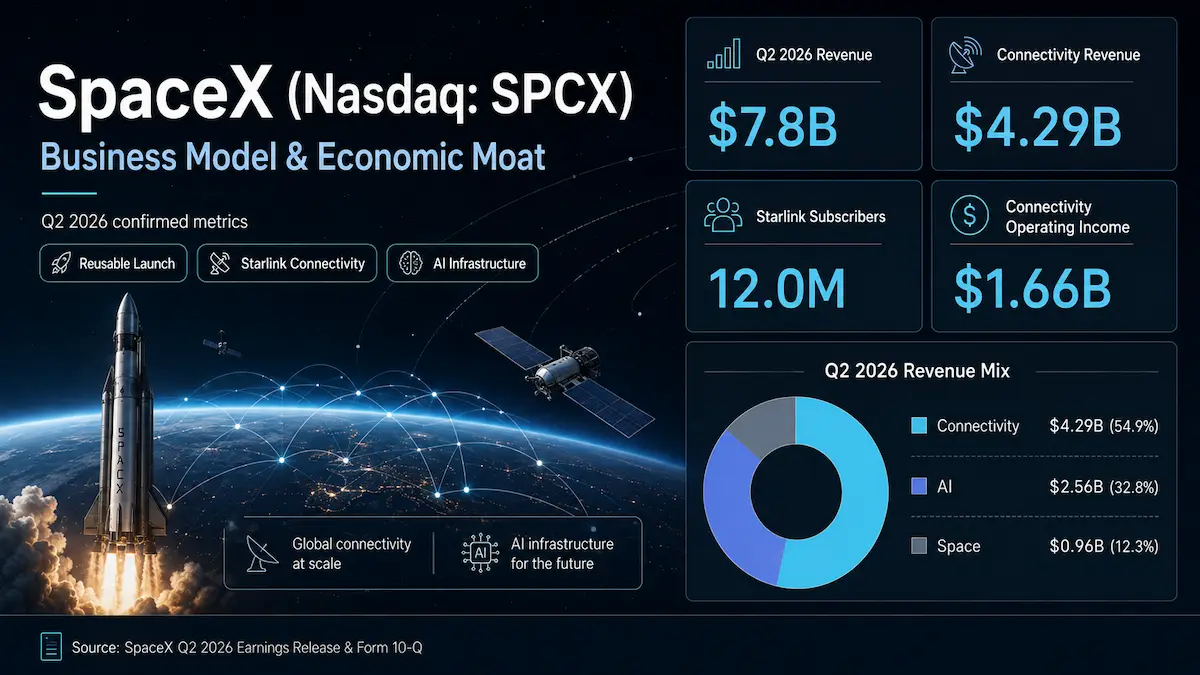
- SpaceX is no longer economically best understood as a launch contractor. In Q2 2026, Connectivity generated $4.29 billion, or roughly 55% of consolidated revenue, and $1.66 billion of operating income. The recurring service layer built on top of launch infrastructure is now the clearest source of demonstrated operating economics.
- The most defensible part of the SpaceX business model is its cost-and-speed flywheel: reusable launch vehicles, high launch cadence, in-house manufacturing, and large internal demand from Starlink allow the company to learn, deploy and replenish orbital infrastructure at a tempo competitors must finance before they can match.
- AI has become a material third pillar following SpaceX’s acquisition of xAI, effective February 2, 2026. Q2 AI revenue reached $2.56 billion, but the segment still posted a $1.26 billion GAAP operating loss and consumed $15.83 billion of capital expenditures in the quarter. Rapid growth should therefore not be confused with proven full-cycle returns on capital.
- SpaceX’s strongest moat categories are Cost Advantages and, secondarily, Intangible Assets tied to spectrum, launch heritage, regulatory permissions and government-grade operating credentials. Classic Network Effects are weaker than the narrative often implies: adding broadband subscribers does not automatically make the network better for existing users.
- The next 12 to 24 months are likely to be defined by three execution tests: Starship/V3 deployment economics, Starlink Mobile and enterprise monetization, and whether AI infrastructure can convert extraordinary capital intensity into durable GAAP profitability. Each catalyst has measurable milestones and material failure modes.
Scope note: SPCX currently refers to Space Exploration Technologies Corp. (SpaceX), whose Class A shares began trading on Nasdaq on June 12, 2026. The ticker had previously been used by an unrelated SPAC-focused ETF, which changed its symbol before the SpaceX IPO. This article analyzes the current listed company, not the former ETF.
Evidence convention: Statements described as confirmed facts are drawn from SpaceX filings, SpaceX investor-relations materials, or official SpaceX/Starlink pages. Statements attributed to management are presented as management claims or targets rather than established outcomes. Analytical inferences are explicitly labeled as such. Market expectations that cannot be verified from primary sources are not treated as facts.
1. Business Model Breakdown
From Rocket Manufacturer to Vertically Integrated Infrastructure Platform
Founded in 2002, SpaceX initially attacked one bottleneck: the cost, reliability and cadence of access to orbit. The key technical milestone was not simply building another rocket, but proving reusable orbital-class launch economics. SpaceX’s official mission history records the December 2015 return and landing of a Falcon 9 first stage after an orbital mission. Starlink then changed the economic architecture of the company. Beginning with constellation deployment in 2019, SpaceX increasingly became its own largest source of launch demand, converting launch capacity into a communications network that could be monetized repeatedly rather than only once per mission.
Analytical inference: That internal-demand loop is the core corporate gene. Instead of waiting for enough third-party payloads to create launch scale, SpaceX manufactures downstream demand for its own upstream infrastructure. Starlink satellites fill launches; launches expand Starlink capacity; more capacity supports subscribers, enterprise contracts and mobile services; those cash flows help finance the next generation of launch and network infrastructure. The 2026 combination with xAI extends the same architecture into compute: launch, connectivity, information distribution and AI are being assembled as layers of one capital-intensive platform rather than managed as unrelated businesses.
SpaceX currently reports three operating segments: Space, Connectivity and AI. For the six months ended June 30, 2026, consolidated revenue was $12.51 billion, of which $11.67 billion came from services. In other words, approximately 93% of first-half revenue was service revenue rather than product revenue. That mix matters because the company’s economic objective is increasingly to monetize installed infrastructure repeatedly through access, bandwidth, contracts, subscriptions and compute, while hardware often functions as the enabling layer.
Space: Launch Is Both a Revenue Stream and an Internal Cost Center
The Space segment earns revenue primarily from Launch Services and Launch & Development. Launch Services deploy commercial and government payloads, while Launch & Development includes longer-duration spacecraft development, launch and mission work for government programs. In Q2 2026, the segment generated $962 million of revenue: $648 million from Launch Services and $314 million from Launch & Development.
The financial statements understate the strategic value of launch if one looks only at segment revenue. SpaceX does not recognize inter-segment revenue when Falcon launches deploy Starlink satellites; those launch costs are instead capitalized into satellite assets. During the first half of 2026, 60 of 77 Falcon launches were internal, and 908 of 1,041 metric tons sent to orbit were internal payloads. The Space segment therefore functions partly as infrastructure for Connectivity, and management has stated that it expects to allocate meaningful launch capacity to AI in the future.
Confirmed fact: Space is not currently the earnings engine. It posted a $542 million operating loss in Q2 2026 as R&D spending rose to $1.08 billion, largely to support Starship development. That creates a useful distinction: Falcon’s mature operating system is a demonstrated competitive asset, while Starship remains a development program whose ultimate unit economics have not yet been established at commercial scale.
Connectivity: The Proven Monetization Engine
Connectivity is the most economically mature part of the present-day SpaceX business model. It sells Starlink consumer subscriptions and kits, while also serving enterprise and government customers across aviation, maritime, mobility, fixed-site and national-security use cases. Q2 2026 Connectivity revenue was $4.29 billion, up 66% year over year, and operating income was $1.66 billion. That equates to an operating margin of roughly 39% for the quarter before considering corporate-level items outside the segment.
Consumer revenue reached $2.49 billion in Q2, while Enterprise & Government revenue reached $1.81 billion. Starlink ended the quarter with 12.0 million subscribers, double the prior-year level. However, Starlink subscriber ARPU was $66 per month versus $85 a year earlier. SpaceX attributed the decline primarily to international expansion and lower-priced service plans.
Commercial interpretation: The ARPU decline is not automatically negative if lower pricing expands the addressable market and increases utilization of a network whose economics improve with denser monetization of deployed capacity. But the burden of proof is margin retention. The relevant test is whether subscriber growth, enterprise mix and satellite productivity can offset lower consumer ARPU without forcing disproportionately higher constellation capex. Q2 Connectivity operating income growth of 79% indicates that this trade-off was favorable in the latest reported quarter, but one quarter does not establish a permanent trend.
Enterprise and government connectivity also changes the quality of revenue. Aviation installations, maritime fleets, government networks and secure national-security programs can involve longer sales cycles and more integration than residential broadband, but they may also create stronger switching costs and larger contract values. SpaceX reported major airline wins and more than $6 billion of multi-year U.S. government awards for Starshield in its Q2 update. Those contracts are commercially important because they monetize the same launch and satellite manufacturing stack across higher-value use cases.
AI: Rapid Monetization, Extraordinary Capital Intensity
SpaceX acquired xAI effective February 2, 2026. As a result, the AI segment now includes Grok, X, AI solutions, advertising, subscriptions and compute infrastructure. Q2 2026 AI revenue was $2.56 billion, including $2.19 billion from AI Solutions & Infrastructure and $367 million from advertising. SpaceX said new cloud-service agreements contributed $1.6 billion of incremental AI infrastructure revenue in the quarter.
The growth rate is striking, but the quality of the economics requires careful separation of GAAP and non-GAAP measures. The AI segment reported a $1.26 billion GAAP operating loss in Q2, even though Segment Adjusted EBITDA was positive $1.15 billion. The gap is economically meaningful because depreciation and share-based compensation are large in a business consuming enormous amounts of capital. AI capex was $15.83 billion in Q2 and $23.55 billion for the first half of 2026.
SpaceX reported 1.4 gigawatts of nameplate compute draw at quarter-end and $14.1 billion of contracted sales under several Cloud Services Agreements. The company has also signed an agreement to acquire Anysphere, the company behind Cursor, for $60 billion. Management said in its Q2 materials that it expected the transaction to close in Q3 2026. That timing is a management expectation, not a completed fact as of the latest filing cited here.
The Platform Strategy: Own the Bottleneck, Then Build the Market Above It
The platform strategy can be expressed as a sequence. SpaceX first owns the launch layer, which lowers the cost and increases the speed of deploying orbital assets. It then owns a large portion of the satellite and terminal stack through Starlink, allowing it to sell recurring broadband, mobile and government services. Through X and Grok, it also owns a large real-time information distribution surface and an AI application layer. Through rapidly expanding data-center infrastructure, it is attempting to own more of the compute layer as well.
Analytical inference: The important strategic property is not simply vertical integration. Vertical integration can destroy value when internal assets are subscale or inferior to external suppliers. SpaceX’s version becomes economically powerful only where the upstream capability is itself scarce and advantaged. Launch is the clearest example: the company can use internally controlled launch capacity to deploy assets on schedules that do not depend on a third-party launch provider. That can compress product cycles, reduce coordination costs and allow the company to create markets that would be uneconomic if every orbital deployment had to be purchased externally at a higher cost or lower cadence.
Management ambition, not established fact: SpaceX has extended this logic to orbital AI compute, arguing that reusable launch, satellite manufacturing and solar power could eventually make space-based compute economically attractive. The thesis is strategically coherent with SpaceX’s asset base, but commercial orbital AI economics have not yet been proven. It should therefore be treated as an option on future infrastructure economics, not as a present moat contribution.
2. Deep Dive into Economic Moats
Moat #1: Cost Advantages — The Most Defensible Layer
Under a Buffett-style moat framework, SpaceX’s strongest competitive barrier is Cost Advantages. The critical point is not that SpaceX is large or famous; it is that its architecture can reduce the unit cost and cycle time of putting mass into orbit and then reusing that capability for its own downstream businesses.
Falcon reuse is already a demonstrated operating system rather than a laboratory concept. The company has paired reusable boosters with high flight cadence, in-house manufacturing and a dense internal launch manifest. During the first half of 2026, most Falcon launches and the vast majority of mass to orbit were for internal payloads. This creates a learning-curve advantage that a competitor cannot replicate merely by designing a technically comparable rocket. A challenger also needs launch sites, manufacturing throughput, recovery operations, regulatory approvals, flight heritage, a sufficiently large launch manifest and enough capital to survive the period before utilization reaches economic scale.
That internal utilization is especially important. A conventional launch provider can suffer from a chicken-and-egg problem: prices fall only after cadence rises, but cadence rises only if enough external demand exists at current prices. SpaceX partially breaks that loop because Starlink supplies a recurring payload base. The network becomes a demand anchor for the launch business, while launch becomes a cost advantage for the network.
Confirmed fact versus management claim: SpaceX’s Q2 filing shows the current launch cadence and internal payload mix. Management separately states that Starship could reduce cost to orbit by 99% or more relative to the historical average. The former is demonstrated operating data; the latter is a forward-looking management belief. The long-term moat would strengthen materially if Starship achieves full, rapid and reliable reuse at high cadence, but that outcome should not be embedded as a certainty.
Durability assessment: The cost moat appears structurally durable at the Falcon layer because competitors must replicate a system, not a single product. It can still erode if competing reusable vehicles reach comparable reliability and cadence, if SpaceX’s internal demand weakens, or if Starship development absorbs capital without producing a commensurate cost advantage. The durability of a cost moat is ultimately measured in sustained unit economics, not launch counts alone.
Moat #2: Intangible Assets and Regulatory Position — Strong but Not Absolute
SpaceX’s second meaningful barrier is a collection of Intangible Assets: spectrum rights and authorizations, flight heritage, software and hardware know-how, government security credentials, and regulatory permissions accumulated across multiple jurisdictions. These are not all equally durable, but together they raise the cost and time required for a competitor to reproduce a comparable service footprint.
The most concrete current example is spectrum. SpaceX agreed to acquire EchoStar spectrum assets in a transaction with approximately $19.6 billion of total consideration under the latest 10-Q. The FCC approved the spectrum transfer in May 2026, and the first transfer step has occurred, but the final Spectrum Acquisition Closing has not yet occurred. SpaceX currently expects that closing around November 2027, subject to remaining conditions and approvals. The distinction matters: regulatory approval has advanced the asset position, but the full transaction is not yet complete.
Starshield adds a different kind of intangible asset: mission assurance and government trust. SpaceX said it received more than $6 billion of multi-year U.S. government awards, primarily tied to Space Force communications and sensing constellations. A competitor can invest in hardware, but it cannot instantly buy a long record of operating missions, integrating with government systems and satisfying security requirements. That history can shorten future procurement cycles and increase the cost of switching for mission-critical customers.
Durability assessment: Spectrum and government credentials can support excess returns because access is scarce and qualification takes time. However, they should not be treated as permanent monopoly rights. Regulators can authorize rivals, governments can dual-source critical capabilities, and spectrum economics depend on the ability to turn licenses into commercially attractive services.
Switching Costs: High in Selected Enterprise Verticals, Low in Consumer Broadband
Switching Costs are real but uneven. A residential Starlink customer can generally switch if an attractive terrestrial or satellite alternative becomes available, so consumer broadband does not exhibit unusually strong contractual lock-in. The picture is different in aviation, maritime, government and secure communications, where hardware installation, certification, operational integration and contractual commitments can raise migration costs.
Analytical inference: The enterprise mix can therefore improve the quality of the moat even if it is not the largest source of subscribers. The best evidence to watch is not brand awareness but renewal behavior, contract duration, customer concentration and enterprise revenue growth. SpaceX does not yet provide enough public cohort or retention data to quantify these switching costs precisely, so they should be viewed as moderate rather than assumed to be exceptional.
Network Effects: Frequently Overstated
Classic Network Effects are not SpaceX’s primary moat. More broadband subscribers do not automatically increase the utility of the network for every other subscriber; without matching capacity additions, congestion can do the opposite. Starlink therefore behaves more like a capital-intensive network with density and scale economies than a pure two-sided marketplace.
There may be secondary data and distribution effects inside the AI/X ecosystem, and Starlink Mobile may benefit from a growing roster of carrier partnerships. Yet public filings do not establish that these effects are the dominant source of current returns. The stronger institutional conclusion is that SpaceX’s defensibility comes from cost, speed, vertical control and regulated infrastructure, not from a textbook user-to-user network effect.
Can These Moats Support Long-Term Excess Returns?
Potentially, but the answer depends on capital discipline. A company can possess genuine technological advantages and still fail to generate excess returns if the capital required to defend and extend those advantages grows faster than the cash economics they produce. SpaceX invested $28.48 billion of capex in the first half of 2026, mostly in AI infrastructure. That amount dwarfed first-half consolidated revenue growth in absolute dollars.
The moat case is therefore strongest where the company has already demonstrated both differentiation and monetization: Falcon-enabled deployment economics and Starlink Connectivity. It is less proven in AI, where revenue growth is rapid but GAAP operating losses and capex remain substantial. The next phase of the SpaceX story is not about proving that the company can build difficult systems; it is about proving that the expanded system can generate attractive returns on an increasingly large capital base.
3. Business Inflection Points & Future Catalysts
The Most Important Strategic Inflection: Starlink Turned Launch Into a Flywheel
The single most important economic inflection in SpaceX’s history was the shift from selling launch as an external service to using launch as the foundation for an internally owned network. The 2019 Starlink deployment phase transformed launch from a transaction business into a platform input. That change created recurring subscription and enterprise revenue, provided a persistent internal launch manifest, and made each improvement in launch cost economically valuable to a much larger downstream profit pool.
Q2 2026 provides the clearest evidence that this inflection worked economically: Connectivity was roughly 55% of consolidated revenue and generated $1.66 billion of operating income, while the Space segment itself remained loss-making because of Starship R&D. In effect, the economic payoff from launch innovation is increasingly captured downstream through connectivity rather than only through launch pricing.
The February 2026 xAI acquisition is the newest strategic inflection, but it is best understood as an extension of the Starlink playbook rather than a replacement for it. SpaceX is again attempting to use advantaged infrastructure to create an internal demand loop—this time linking compute, AI applications, distribution and, eventually, orbital infrastructure. The financial outcome is not yet proven.
Catalyst 1: Starship V3 and Starlink V3 Capacity Economics
Transmission mechanism: If Starship reaches reliable, high-cadence operations and can deploy larger volumes of V3 satellites per launch, SpaceX could reduce the cost of adding network capacity while increasing capacity per satellite. That would potentially support more Starlink subscribers, higher-value enterprise traffic and better capex efficiency. It could also free Falcon capacity for paying third-party missions or reduce the marginal cost of future internal orbital projects.
What is already confirmed: SpaceX reported that Starship Flight 13 in July 2026 achieved its stated flight objectives and deployed 20 production V3 satellites. The company also said that V3 development is intended to produce meaningful increases in broadband capacity and data density.
What management claims: SpaceX believes Starship can ultimately reduce cost to orbit by 99% or more relative to the historical average. That is a target, not an achieved commercial cost curve.
Observable indicators: Investors and corporate researchers should track Starship launch cadence; successful recovery and reuse of both stages; kilograms of internal payload per launch; the number of V3 satellites placed into service; Starlink subscriber growth; ARPU; Connectivity operating margin; and Connectivity capex per unit of incremental network capacity. The most important evidence will be economic throughput, not a single spectacular test flight.
Execution risks: Reuse may take longer than expected, regulatory constraints may limit cadence, launch failures could interrupt constellation deployment, and higher physical capacity may not translate into attractive revenue if competition forces prices down faster than unit costs.
Catalyst 2: Starlink Mobile, Spectrum Control and Enterprise/Government Mix
Transmission mechanism: Starlink Mobile expands the addressable market from dedicated satellite terminals to standard mobile devices through carrier partnerships. Enterprise aviation, maritime and government deployments monetize the same core network in use cases where availability and global coverage can be more valuable than in residential broadband. Additional spectrum can improve SpaceX’s ability to control capacity and service design rather than relying only on partner spectrum.
What is already confirmed: SpaceX reported Enterprise & Government revenue of $1.81 billion in Q2 2026, up 108% year over year. It also disclosed new airline and international carrier partnerships, more than $6 billion of multi-year U.S. government Starshield contracts, and FCC approval of the EchoStar spectrum transfer. The related spectrum acquisition has not fully closed.
Observable indicators: Enterprise & Government revenue growth; the number and scope of Starlink Mobile carrier partnerships; active mobile devices and countries served when disclosed; airline fleet activations; government backlog; regulatory approvals; and completion of the Spectrum Acquisition Closing.
Execution risks: The final spectrum closing remains conditional, national regulators can delay service expansion, mobile network operators may preserve bargaining power, and terrestrial networks or competing satellite systems can pressure pricing. The spectrum transaction also requires very large consideration, so the strategic value must ultimately exceed both the purchase price and the capital required to deploy the network around it.
Catalyst 3: AI Infrastructure Monetization and the Proposed Cursor Acquisition
Transmission mechanism: SpaceX is spending aggressively to build compute capacity. The bull case for the business logic is straightforward: if contracted cloud demand fills that capacity rapidly, fixed infrastructure can be monetized sooner, reducing the time between capex and revenue. Grok and X provide internal workloads and distribution, while the proposed Cursor acquisition could add a high-value enterprise application and developer workflow through which SpaceX can sell AI capabilities.
What is already confirmed: Q2 AI Solutions & Infrastructure revenue reached $2.19 billion. SpaceX reported $14.1 billion of contracted cloud-services sales, 1.4 gigawatts of nameplate compute draw, and $1.6 billion of incremental Q2 AI infrastructure revenue from new cloud agreements. The company has signed an agreement to acquire Cursor for $60 billion; the transaction was not yet closed in the latest quarterly materials.
Observable indicators: AI Solutions & Infrastructure revenue; consolidated backlog; nameplate compute capacity; AI GAAP operating margin; AI capex relative to incremental revenue; depreciation growth; customer concentration; and whether the Cursor transaction closes and contributes measurable revenue without materially worsening returns on capital.
Execution risks: AI capex was $23.55 billion in the first half of 2026, and the segment still recorded a $3.73 billion first-half operating loss. One customer represented 19.5% of consolidated Q2 revenue and was associated with the AI segment, although the 10-Q does not identify that customer. This makes utilization, contract durability and concentration material risks. Additional risks include GPU and power availability, rapid model commoditization, integration complexity and the possibility that adjusted EBITDA improves while depreciation-intensive GAAP economics remain weak.
Balance-Sheet Capacity Is a Catalyst Enabler, Not a Moat
SpaceX exited Q2 with approximately $100 billion of cash, cash equivalents and marketable securities after raising roughly $85.7 billion of net IPO proceeds and issuing $25 billion of senior notes. It also reported $47.46 billion of backlog. This gives the company unusual capacity to fund Starship, satellites, spectrum and AI infrastructure simultaneously.
Analytical inference: Financial capacity can accelerate a moat, but it is not itself a moat. The relevant question is whether SpaceX can convert this capital into assets whose incremental returns exceed their cost. A large balance sheet reduces financing risk; it does not eliminate execution risk or protect shareholders from poor capital allocation.
4. Key FAQs
How does SpaceX make money from Starlink, launches and AI in 2026?
SpaceX makes money through three operating segments. Space earns launch-service and government development revenue. Connectivity earns recurring Starlink consumer service revenue, Starlink kit sales, and enterprise/government revenue across aviation, maritime, mobility and secure networks. AI earns revenue from cloud and AI infrastructure, Grok/X subscriptions and advertising. In Q2 2026, Connectivity was the largest segment at $4.29 billion of revenue, followed by AI at $2.56 billion and Space at $962 million. The deeper business logic is that launch infrastructure supports the deployment of the assets that generate recurring Connectivity revenue and may later support AI infrastructure.
Is Starlink the main source of SpaceX revenue and operating profit?
Yes, based on the latest reported quarter. Connectivity represented roughly 55% of Q2 2026 revenue and generated $1.66 billion of operating income. Space and AI both reported GAAP operating losses in the same quarter. This makes Starlink and related enterprise/government connectivity the clearest current economic engine, even though launch remains the foundational infrastructure advantage that helps make the Connectivity economics possible.
What is SpaceX’s strongest economic moat after the 2026 IPO?
The strongest moat is a cost-and-cycle-time advantage built around reusable launch, high cadence, internal Starlink demand and vertical integration. The advantage is difficult to copy because competitors must reproduce an operating system spanning rockets, engines, manufacturing, launch sites, recovery, regulation, flight heritage and enough payload demand to keep the system utilized. Spectrum and government credentials add a second layer of defensibility. Network effects are less important than commonly assumed, and Starship’s projected cost reductions should still be treated as management targets until demonstrated at commercial scale.
5. Conclusion
The defining corporate gene of SpaceX is not simply engineering ambition; it is the repeated conversion of an upstream physical cost advantage into internally owned downstream markets. Falcon created cheaper and more frequent access to orbit. Starlink turned that access into recurring connectivity revenue and supplied the internal launch demand that reinforced Falcon’s scale. The resulting system is more defensible than either a stand-alone launch provider or a stand-alone satellite ISP because each layer can improve the economics of the others.
The evidence is strongest in Connectivity. Twelve million Starlink subscribers, rapidly growing enterprise/government revenue and a roughly 39% Q2 segment operating margin show that SpaceX has already converted orbital infrastructure into a large profit pool. The moat is therefore less about brand prestige than about cost, cadence, vertical control, spectrum, operating history and the ability to deploy network capacity on an internally controlled schedule.
The unresolved question is whether the same playbook scales into Starship and AI without diluting returns on capital. Full rapid Starship reuse, orbital AI compute and the long-term economics of the xAI/Cursor stack remain partly or largely unproven. SpaceX’s latest financials show both sides of the thesis at once: exceptional revenue growth and balance-sheet capacity, but also extreme AI capex, meaningful GAAP losses and customer concentration. The quality of the business over the next several years will be determined by whether infrastructure integration produces lower unit costs and higher recurring cash generation faster than the capital base expands.
Primary and Official Sources
- U.S. SEC — SpaceX Form 10-Q for the quarter ended June 30, 2026
- U.S. SEC — SpaceX Q2 2026 Earnings Release, Exhibit 99.1
- U.S. SEC — SpaceX Final IPO Prospectus, Form 424B4
- SpaceX Investor Relations — Investor Overview and Quarterly Materials
- SpaceX Investor Relations — IPO and Ticker FAQ
- SpaceX — Mission and Reusability History
- SpaceX — Starship Official Vehicle Page
- Starlink — Version 3 Satellites Official Update
- Starlink — Starlink Mobile Official Business Page
- SpaceX — Starshield Official Overview
Research date: August 10, 2026. All forward-looking statements are identified as management expectations or analytical inferences where applicable. No unverified third-party market forecast is presented as fact.
Disclaimer: This article is intended solely for business logic discussion and corporate research purposes, and does not constitute investment advice of any kind.