



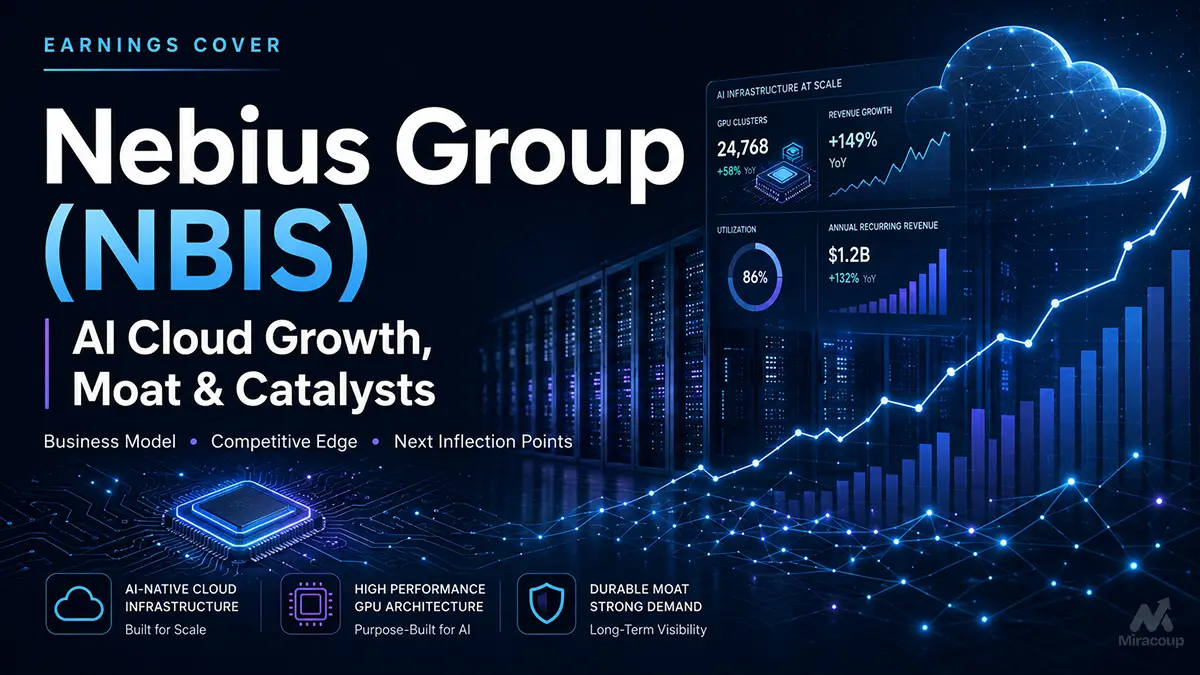
⚡ Key Takeaways
- Nebius monetizes scarce AI infrastructure at multiple layers. GPU compute remains the revenue anchor, but the economic model increasingly includes storage, networking, managed cloud services, inference, agentic search, capacity reservations, licensing and infrastructure-partner revenue.
- Its strongest emerging moat is a contract-capital-capacity flywheel. Long-term agreements with investment-grade customers help Nebius finance new GPU clusters on more attractive terms, while its in-house hardware and software stack is designed to extract more output from every deployed GPU.
- The company has evolved beyond a conventional “GPU rental” thesis. Nebius is attempting to become an AI-native operating layer spanning training, inference and production deployment, while a new asset-light partnership model could expand capacity without requiring Nebius to fund every data center itself.
1. Business Model Breakdown
From Yandex Parent Company to AI Infrastructure Pure Play
Nebius Group’s corporate history matters because the company did not begin as a typical venture-backed AI cloud startup. Its predecessor was Yandex N.V., the Dutch parent company of the former Yandex group. In July 2024, the company completed the sale of its Russia-based businesses at an agreed valuation of approximately $5.4 billion, receiving roughly $2.8 billion in cash as well as shares that were placed in treasury.
That transaction severed the company’s remaining ties with Russia and left the Dutch-listed entity with capital, experienced engineering teams and a portfolio of international technology assets. The company subsequently changed its name to Nebius Group N.V., adopted the NBIS ticker and resumed Nasdaq trading in October 2024.
This was not merely a corporate rebranding exercise. It was a strategic reset that converted the remains of a geographically constrained internet conglomerate into a well-capitalized AI infrastructure platform. Nebius retained institutional knowledge in distributed systems, data-center operations, machine learning, cloud software and custom hardware design—capabilities that would normally take a new infrastructure provider years to assemble.
What Does Nebius Actually Sell?
Nebius’s core product is a full-stack AI cloud designed for computationally intensive training, fine-tuning and inference workloads. Customers can purchase GPU compute on a pay-as-you-go basis or reserve capacity under fixed contracts. The cloud platform also provides storage, high-speed networking, Kubernetes infrastructure, orchestration tools, managed services and software that helps customers move models from experimentation into production.
The business therefore sits between two less attractive extremes. Nebius is not simply a data-center landlord leasing powered space, and it is not merely a software vendor renting capacity from third parties. It owns or controls critical infrastructure while developing the software layer that determines GPU utilization, workload performance and cost per token.
The company’s revenue architecture can be divided into four principal engines:
- AI compute and reserved capacity: Customers pay for access to GPU clusters through on-demand consumption, reserved-capacity agreements and large dedicated infrastructure contracts. Long-duration arrangements provide greater revenue visibility than purely transactional cloud usage.
- Value-added cloud services: Storage, networking, managed Kubernetes, data operations, model operations, security, governance and workload orchestration increase revenue per customer and make Nebius more than a commodity compute provider.
- Managed inference and agentic infrastructure: Nebius Token Factory allows customers to deploy and optimize open-source or custom models in production. Tavily adds real-time search for AI agents, while Eigen AI and Clarifai technology strengthen model optimization, inference execution and compute orchestration.
- Infrastructure partnerships: Under the business model introduced in July 2026, external partners can finance, own and operate AI data centers built to Nebius specifications. Nebius contributes the systems architecture, hardware design, software stack, supply-chain relationships, customer demand and service layer.
The New Asset-Light Revenue Stream
The infrastructure-partner model may become one of the most consequential additions to the NBIS business model. Partners fund the physical facility and hardware, while Nebius transforms that capacity into a production-ready cloud and sells it through its global commercial organization.
Nebius expects these arrangements to include licensing fees, commissions, revenue-sharing structures and committed-capacity agreements. Strategically, this model could decouple capacity expansion from Nebius’s own balance sheet. It also creates the possibility of higher-margin revenue because Nebius can monetize its architecture and software without supplying all of the underlying capital.
The model is still new and should not yet be treated as a proven earnings engine. Its success will depend on partner execution, consistent service levels and Nebius’s ability to maintain a uniform customer experience across owned, colocated and partner-operated infrastructure.
Current Revenue Mix and Operating Economics
Nebius AI cloud has become the overwhelming economic center of the group. In the first quarter of 2026, Nebius Group generated $399.0 million of consolidated revenue, of which $389.7 million—approximately 98%—came from the AI cloud segment. AI cloud revenue increased 841% year over year as additional capacity came online and utilization remained strong.
The operating leverage was equally important. Cost of revenue declined from 49% of revenue in the first quarter of 2025 to 26% in the first quarter of 2026. Nebius AI cloud produced $174.0 million of adjusted EBITDA during the quarter, compared with an adjusted EBITDA loss one year earlier.
However, investors should distinguish unit-level cloud economics from consolidated accounting profitability. Nebius Group still reported a $128.0 million operating loss in the first quarter, including $212.0 million of depreciation and amortization. GPU servers and data-center equipment require heavy upfront investment, making depreciation, financing costs and future hardware replacement central to the real economics of the business.
The company’s reported first-quarter net income was also boosted by a $780.6 million non-cash gain from revaluing its ClickHouse investment. That gain reflects the rising estimated value of a strategic equity stake, not profit generated by operating the AI cloud. For analytical purposes, cloud revenue growth, utilization, adjusted EBITDA, capital expenditures and cash returns on deployed infrastructure are more informative than headline net income.
How the Profit Flywheel Works
The underlying earnings logic is straightforward but execution-intensive:
- Nebius secures power, land, GPU supply and financing.
- It builds or accesses high-density AI data-center capacity.
- Long-term contracts establish a base level of utilization and revenue visibility.
- The sales organization fills additional capacity with AI-native and enterprise customers.
- Software optimization increases throughput per GPU and lowers the customer’s cost per token.
- Higher utilization and software attach rates improve the return generated by each infrastructure dollar.
- Contracted cash flows can support additional debt financing, which funds the next wave of capacity.
This flywheel explains why hyperscaler contracts are more than simple revenue wins. They can also function as financing instruments. In July 2026, Nebius completed an approximately $775 million secured facility backed by deployed GPU infrastructure and contracted cash flows. The facility was priced at SOFR plus 2.50%, and the company said the financing and customer cash flows together covered more than 100% of the capital expenditure associated with the underlying deployment.
Other Businesses and Strategic Assets
Nebius Group also owns Avride, an autonomous-driving and delivery-robotics platform, and TripleTen, an online technology education business. TripleTen generates tuition revenue, while Avride currently makes only a limited contribution to group revenue and remains an investment-intensive technology platform.
The group also retains significant stakes in ClickHouse and Toloka. These holdings provide strategic and financial optionality, but they should not be confused with recurring AI cloud earnings. ClickHouse valuation gains can materially affect reported net income, while Toloka is accounted for as an equity investment rather than a consolidated operating segment.
2. Deep Dive into Economic Moats
Moat One: Systems-Level Cost Advantage
Nebius’s most credible economic moat is its attempt to optimize the entire AI infrastructure system rather than competing at a single layer. The company designs elements of its servers, racks, data-center configuration, cloud control plane, networking, storage and workload-management software in-house.
This matters because the relevant cost metric in AI infrastructure is not simply the purchase price of a GPU. Customers care about training time, cluster reliability, model throughput, utilization, energy efficiency and cost per generated token. A provider that can extract more productive output from the same number of GPUs can either charge a premium, offer a lower effective price or earn a higher margin.
Infrastructure expertise also shortens deployment cycles. Nebius’s team has experience designing and operating high-density data centers, while its relationship with NVIDIA provides technical collaboration across AI factory design, accelerated computing and inference software. NVIDIA’s $2 billion investment in Nebius and its commitment to support early adoption of new computing platforms strengthen the company’s supply-chain credibility and technical positioning.
This advantage is difficult—but not impossible—to replicate. CoreWeave, Crusoe, Lambda and the major hyperscalers are also investing aggressively in specialized AI infrastructure. Nebius must therefore demonstrate that its integrated engineering produces sustainably better utilization, performance or cost economics rather than simply matching competitors during a period of industry-wide capacity scarcity.
Moat Two: The Contract-Capital-Capacity Flywheel
Nebius’s second barrier is the interaction among customer contracts, capital access and scarce infrastructure capacity. Large agreements with Microsoft and Meta provide contracted demand from investment-grade counterparties. The expanded Meta agreement announced in March 2026 carries a potential value of approximately $27 billion over five years, including $12 billion of dedicated capacity and up to another $15 billion of capacity that Nebius can initially market to third-party cloud customers.
That structure is economically powerful. Nebius retains the opportunity to sell capacity to higher-value cloud customers while Meta acts as a contractual backstop for qualifying unsold capacity. This can improve financing terms, reduce utilization risk and give lenders greater confidence in the cash flows supporting new infrastructure.
The result is a reinforcing loop:
- Strategic customers validate Nebius’s technical capabilities.
- Contracted revenue supports cheaper asset-level financing.
- Lower-cost capital accelerates capacity deployment.
- More capacity attracts additional AI-native and enterprise workloads.
- A broader customer base supports greater software development and procurement scale.
The July 2026 secured financing provides an early demonstration of this mechanism. Nebius indicated that it had more than $40 billion of additional customer commitments that could support similar financing structures in the future.
Switching Costs: Emerging, but Not Yet Entrenched
Nebius is building switching costs through managed inference, security controls, data-transfer tools, Kubernetes integrations, model optimization and enterprise governance. Once a customer has tuned models, integrated identity systems, established data pipelines and configured production endpoints around the Nebius environment, migration becomes more disruptive.
Token Factory could deepen those switching costs. Customers using Nebius not only for raw GPUs but also for model serving, autoscaling, fine-tuning, retrieval and agentic workflows have more operational dependencies than customers renting bare-metal servers.
Nevertheless, the switching-cost moat remains under construction. AI developers frequently use open-source tools, containerized workloads and multi-cloud architectures specifically to preserve portability. Nebius must continue improving its software layer without creating friction that drives customers toward larger cloud ecosystems.
Network Effects: Limited Evidence
Nebius does not currently possess a classic network effect. One customer joining the platform does not directly make the service more valuable to every other customer in the way that participation strengthens a marketplace, payments network or social platform.
Scale can still improve procurement, utilization, product feedback and financing access, but those are economies of scale rather than true network effects. Investors should avoid labeling every AI infrastructure growth loop as a network moat.
Intangible Assets and Technical Credibility
Nebius’s engineering talent, accumulated infrastructure know-how, NVIDIA relationship and acquired inference intellectual property constitute meaningful intangible assets. The additions of Tavily, Eigen AI and Clarifai personnel and technology expand Nebius’s capabilities in agentic search, model optimization and inference orchestration.
Yet Nebius does not possess the global cloud brand, developer ecosystem or enterprise distribution of AWS, Microsoft Azure or Google Cloud. Its intangible-asset moat is therefore technical rather than commercial. The company must convert engineering credibility into sustained customer retention and software adoption before this advantage can be considered fully institutionalized.
Buy-Side Moat Verdict
Nebius currently has a narrow but widening economic moat—not a mature wide moat. Its two strongest barriers are systems-level infrastructure optimization and the contract-backed capital flywheel. Both could become durable if Nebius consistently delivers clusters on schedule, maintains high utilization, expands software revenue and finances growth without excessive dilution or balance-sheet stress.
The principal threats are equally clear: hyperscaler competition, rapid GPU obsolescence, customer concentration, power constraints, construction delays, debt accumulation, convertible dilution and AI compute price compression. Microsoft and Meta are valuable customers, but they also operate competing cloud platforms and possess substantial bargaining power.
3. Business Inflection Points & Future Catalysts
The Defining Strategic Inflection Point
The July 2024 divestiture of the Russia-based businesses was the decisive inflection point in Nebius’s development. It removed a major geopolitical overhang, released billions of dollars of liquidity and allowed management to redirect retained engineering talent toward global AI infrastructure.
Before the transaction, the publicly listed entity was defined by regulatory uncertainty and a suspended Nasdaq listing. After the transaction, it became a capital-rich AI infrastructure company with a clean operating mandate. Few early-stage cloud challengers begin with Nebius’s combination of public-market access, institutional engineering experience and deployable capital.
A second strategic inflection occurred during 2025 and 2026, when Nebius moved from proving that it could build an AI cloud to demonstrating that hyperscalers would sign multiyear contracts on its infrastructure. The company is now entering a third phase: converting contracted demand, power commitments and capital into operating capacity without sacrificing returns.
Catalyst One: Converting Gigawatts into Revenue
Nebius had secured more than 3.5 gigawatts of contracted power by the first-quarter 2026 reporting date, with owned capacity representing more than 75% of the total. Management raised its year-end 2026 contracted-power target to more than 4 gigawatts and expected approximately 800 megawatts to 1 gigawatt of connected power by year-end.
The distinction between contracted and connected power is critical. Contracted power represents future capacity rights; connected power can support operating GPU infrastructure and revenue. The principal catalyst is therefore not another power announcement, but the successful construction, energization and utilization of those sites.
Large owned projects in Missouri and Pennsylvania are scheduled to add capacity beginning in 2027. The Pennsylvania site has secured up to 1.2 gigawatts, while the planned Meta capacity is expected to include early large-scale deployment of NVIDIA’s Vera Rubin platform.
Catalyst Two: Software and Inference Mix Expansion
Training demand created the first wave of AI infrastructure spending, but inference is likely to determine the long-duration economics of AI cloud platforms. Training jobs are large but episodic. Production inference can generate continuous usage as models serve consumers, enterprises and autonomous agents.
Nebius is positioning Token Factory as the bridge from infrastructure to recurring production workloads. Eigen AI improves model-level inference performance, Clarifai strengthens system-level orchestration and Tavily adds real-time search infrastructure for agents. Aether 3.6 adds enterprise governance, encryption controls and developer tooling intended to make the platform more suitable for sensitive production environments.
The critical metric will be software attach rate: how much storage, networking, inference, orchestration and agentic-service revenue Nebius generates for every dollar of GPU compute. A rising software mix could improve margins, reduce commoditization risk and increase customer switching costs.
Catalyst Three: Asset-Light Global Expansion
The infrastructure-partner model could materially improve Nebius’s return on invested capital. Instead of funding every data center with its own equity, convertible debt or secured borrowing, Nebius can provide architecture, software and customer access while partners supply physical capital.
This strategy could also accelerate entry into regions where local permitting, power procurement, government relationships and data-residency requirements favor domestic infrastructure owners. If the model succeeds, Nebius can become the technology and commercial layer across a distributed network of independently financed AI factories.
The risk is consistency. An AI cloud is judged by reliability, networking performance, security and service-level execution. Nebius must ensure that partner-operated sites perform like first-party infrastructure, or the model could weaken rather than strengthen the brand.
Catalyst Four: Diversification Beyond Hyperscalers
Microsoft and Meta provide validation and revenue visibility, but a healthier long-term business requires a broad mix of AI-native developers, software companies and enterprises. A Reuters-reported agreement worth more than $1 billion with Reflection AI through 2029 indicates that Nebius is also competing for frontier-model developers rather than relying exclusively on hyperscaler outsourcing.
Customer diversification matters because large strategic buyers possess negotiating leverage and may demand dedicated infrastructure with economics that differ from the higher-value, multi-tenant cloud platform. The best outcome would be to use hyperscaler contracts to finance capacity while filling incremental supply with customers consuming the complete Nebius software stack.
Catalyst Five: Financial Guidance Conversion
As of its first-quarter update, Nebius maintained 2026 guidance for $3.0 billion to $3.4 billion of revenue, $7 billion to $9 billion of year-end annualized run-rate revenue and an adjusted EBITDA margin of approximately 40%. These targets imply a dramatic acceleration from the $529.8 million of consolidated revenue reported for 2025.
Meeting those objectives would demonstrate that contracted capacity is converting into revenue at attractive utilization and pricing. Missing them could expose construction delays, customer concentration, slower capacity activation or weaker economics than implied by current demand.
The next scheduled financial validation point is Nebius Group’s second-quarter 2026 earnings release on August 12, 2026. Investors should focus less on headline net income and more on connected capacity, AI cloud revenue, customer advances, capital expenditures, depreciation, interest expense, utilization and the composition of adjusted EBITDA.
4. Key FAQs
How does Nebius Group (NBIS) make money from AI infrastructure?
Nebius earns revenue by selling GPU compute, reserved AI infrastructure capacity, storage, networking, managed cloud services and production inference. Customers can pay for on-demand usage or sign fixed and multiyear capacity contracts. Nebius is also adding licensing, commissions and revenue sharing through an asset-light infrastructure-partner model.
What is Nebius Group’s economic moat versus CoreWeave, AWS and Microsoft Azure?
Nebius’s primary advantage is its vertically integrated, AI-native architecture spanning data-center design, custom hardware, cloud software, orchestration and inference. Its long-term contracts also support asset-level financing, creating a potential capital-cost advantage. However, its ecosystem, brand and enterprise distribution remain smaller than those of the hyperscalers, while specialized competitors such as CoreWeave are pursuing similar AI-focused strategies.
Is NBIS a pure-play AI cloud stock or a diversified technology holding company?
Economically, NBIS is increasingly an AI cloud investment because Nebius AI cloud represented approximately 98% of first-quarter 2026 group revenue. Legally and structurally, however, Nebius Group is not a perfect pure play. It also owns Avride and TripleTen and retains significant equity interests in ClickHouse and Toloka.
Disclaimer: This article is intended solely for business logic discussion and corporate research purposes, and does not constitute investment advice of any kind.