



⚡ Key Takeaways
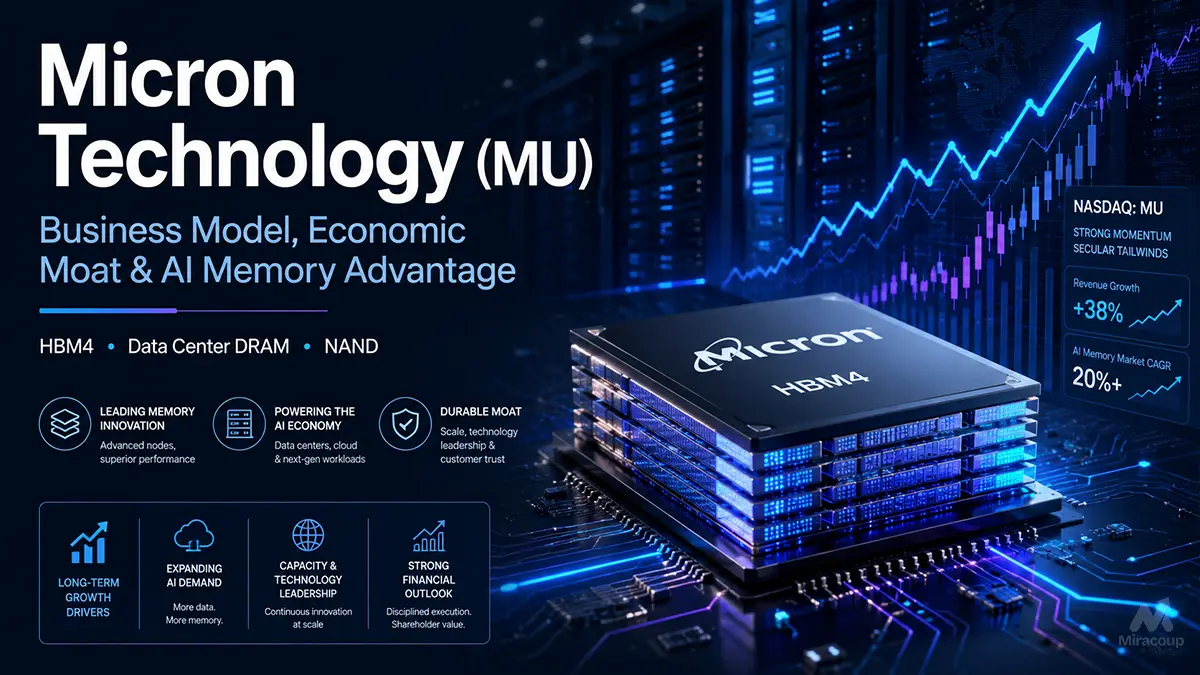
- Micron monetizes the exponential growth of data: Its earnings are driven by memory bit shipments, average selling prices, manufacturing cost per bit, and an increasingly valuable mix of HBM, server DRAM, enterprise SSDs, mobile memory, and automotive products.
- Its real moat is process execution, not branding: Leading-edge DRAM nodes, semiconductor yields, advanced packaging, qualification expertise, and enormous capital requirements form a barrier that very few companies can cross.
- AI is changing the quality of the business: HBM4, low-power server memory, strategic customer agreements, and customized HBM4E programs could make Micron less dependent on undifferentiated commodity pricing, although they do not eliminate memory cyclicality.
1. Business Model Breakdown
Micron Technology is not simply a manufacturer of interchangeable memory chips. Its corporate DNA is built around a more precise economic mission: increase the amount of commercially useful data that can be stored or moved on every wafer while lowering the cost, power consumption, and physical footprint of each bit.
The company began in 1978 as a four-person semiconductor design operation in Boise, Idaho. From its earliest products, Micron competed through smaller die sizes, manufacturing efficiency, and memory density. That engineering culture remains visible in the modern Micron business model. The company continually reinvests cash into process technology, fabrication equipment, packaging, testing, firmware, and system-level product development. The objective is to generate more valuable bits from an extraordinarily expensive manufacturing base.
What Does Micron Actually Sell?
Micron generates revenue from three principal technology categories:
- DRAM: Volatile, high-speed working memory used in AI accelerators, servers, PCs, smartphones, graphics systems, vehicles, and industrial equipment. High-bandwidth memory, or HBM, is an advanced three-dimensional form of DRAM designed for extreme bandwidth and energy efficiency.
- NAND: Non-volatile storage used in data center SSDs, client devices, smartphones, vehicles, industrial systems, and high-capacity storage platforms.
- NOR and other products: Specialized non-volatile memory used primarily for reliable code storage in automotive, embedded, industrial, and consumer applications.
In fiscal 2025, Micron reported approximately $28.58 billion of DRAM revenue and $8.50 billion of NAND revenue on total company revenue of $37.38 billion. DRAM therefore represented roughly 76% of annual revenue, while NAND accounted for approximately 23%. The remaining contribution came primarily from NOR and related products.
This mix makes DRAM the core earnings engine. More importantly, an increasing share of DRAM is moving toward premium applications such as HBM, high-capacity server modules, low-power data center memory, automotive memory, and advanced graphics products. These products are more technically demanding and generally provide stronger economics than standardized commodity memory.
How Micron Organizes Its Revenue Engine
Micron currently reports four business units:
- Cloud Memory Business Unit: HBM for data center customers and memory products for hyperscale cloud platforms.
- Core Data Center Business Unit: Server memory for enterprise, OEM, and mid-tier cloud customers, plus data center SSDs.
- Mobile and Client Business Unit: Memory and storage for smartphones, PCs, gaming, graphics, and consumer computing devices.
- Automotive and Embedded Business Unit: Long-lifecycle memory and storage for vehicles, industrial systems, connected devices, and embedded applications.
By fiscal Q3 2026, the Cloud Memory and Core Data Center units together generated approximately 61% of quarterly revenue. That represents a meaningful change in Micron’s economic center of gravity. The company is becoming more exposed to hyperscale infrastructure and AI capital expenditure than to the traditional replacement cycles of PCs and smartphones.
The Underlying Profit Formula
Micron’s earnings power can be reduced to four variables:
Revenue = bit shipments × average selling price × product mix.
Gross profit = revenue − manufacturing cost per bit − packaging and product costs.
Micron can improve profitability through several operating levers:
- Moving production to a more advanced node, increasing the number of bits produced per wafer.
- Improving manufacturing yields so that a greater percentage of each wafer becomes saleable product.
- Shifting capacity toward higher-value products such as HBM, high-capacity DIMMs, SOCAMM modules, and enterprise SSDs.
- Restricting supply growth when industry inventories are elevated.
- Securing price and volume commitments from strategic customers.
The operating leverage is unusually powerful. Fabrication plants carry enormous fixed costs, but the incremental cost of selling additional qualified output can be much lower once utilization, pricing, and yields improve. The reverse is also true: when supply exceeds demand, average selling prices can fall faster than manufacturing costs, causing margins and cash flow to collapse.
Micron’s fiscal Q3 2026 performance illustrates the upside of this structure. The company reported $41.46 billion in quarterly revenue, an 84.6% GAAP gross margin, and $18.3 billion in adjusted free cash flow. These figures demonstrate the extraordinary financial impact of supply scarcity and premium AI-memory demand. They should not, however, be treated automatically as normalized mid-cycle earnings power.
Unlike a software company, Micron does not collect subscription revenue. Its products must be redesigned, fabricated, qualified, and shipped continuously. The investment case therefore depends on whether the company can convert technological leadership into a sustainably richer product mix—not merely whether memory prices are temporarily high.
2. Deep Dive into Economic Moats
Under Warren Buffett’s economic-moat framework, Micron does not possess a traditional consumer brand moat or a meaningful network effect. Buyers do not purchase HBM because other customers use Micron HBM, and mainstream memory remains sensitive to price, supply, and technical specifications.
Micron’s economic moat instead rests on two interconnected barriers: manufacturing cost advantage and technical switching costs.
Moat One: Process Technology, Yield Learning, and Capital Scale
Advanced memory production requires far more than access to semiconductor equipment. A viable competitor must develop proprietary cell architecture, process recipes, materials integration, circuit design, testing methodology, firmware, packaging, and yield-management expertise. These capabilities must then be transferred into factories operating around the clock with microscopic tolerances.
Micron manufactures across a global network that includes Taiwan, Singapore, Japan, the United States, Malaysia, China, and India. Its fabrication plants primarily use 300-millimeter wafers and require sustained multibillion-dollar investments. The scale of this infrastructure excludes nearly all potential entrants.
The cost advantage emerges when a new process node increases bit density per wafer or reduces power consumption without sacrificing yield and reliability. A node that looks superior in a laboratory has limited economic value if it cannot achieve high-volume manufacturing yields. Micron’s accumulated process data and production learning therefore function as an intangible asset that cannot be replicated simply by purchasing the same lithography tools.
The company had received more than 60,000 lifetime patents by 2025 and owned approximately 22,500 active U.S. and foreign patents. The patent count is not itself the moat. The deeper barrier is the combination of intellectual property, tacit manufacturing knowledge, yield history, and the organizational ability to move a process from development into profitable mass production.
Micron’s 1-gamma DRAM and G9 NAND ramps are strategically important for this reason. Successful transitions can lower cost per bit, release additional effective capacity, and improve performance without requiring a proportional increase in wafer starts.
Moat Two: Qualification and Co-Engineering Switching Costs
Memory can appear commoditized at the component level, but advanced products are deeply integrated into customer systems. HBM must be engineered around specific accelerator architectures, power envelopes, thermal limits, interconnects, and packaging configurations. Server modules and enterprise SSDs require extensive validation for performance, reliability, firmware, endurance, and compatibility.
Qualification can take months or years. Once a Micron product has been designed into a hyperscale platform, automotive architecture, or AI accelerator, switching suppliers is not a frictionless purchasing decision. A replacement component may require new validation cycles, firmware changes, system testing, and supply-chain risk assessment.
This is particularly important in HBM. Micron’s HBM4 uses vertically stacked DRAM dies, through-silicon vias, a logic base die, advanced metallization, specialized testing, and complex packaging. Micron began high-volume shipments of its 36GB 12-high HBM4 product for the NVIDIA Vera Rubin platform in calendar Q1 2026. The product delivers more than 2.8 terabytes per second of bandwidth and over 20% better power efficiency than Micron’s comparable HBM3E implementation.
Micron is also developing customized HBM4E products for expected volume production in 2027. Customization can deepen switching costs because the supplier becomes part of the customer’s architecture-development process rather than a vendor selected only after the system has been designed.
Strategic customer agreements reinforce this mechanism. Micron has moved beyond traditional agreements that left pricing and volume subject to frequent renegotiation. Its newer multi-year arrangements include more specific customer commitments, potentially giving Micron better demand visibility while giving customers greater supply certainty.
How Wide Is the Moat?
Micron’s moat should be evaluated by product category rather than with a single company-wide label.
- HBM, advanced server memory, automotive products, and enterprise SSDs: Potentially strong moat characteristics due to qualification costs, reliability requirements, packaging complexity, and customer co-development.
- Standard DRAM and commodity NAND: Narrower moat because price, industry supply, and competitor capacity remain dominant purchasing factors.
The company’s long-term competitive “water level” rises when premium products represent a larger share of output, customer contracts become more durable, and node transitions lower cost per bit. It falls when undisciplined capacity expansion creates oversupply.
Micron also faces formidable competitors, including Samsung Electronics, SK hynix, Kioxia, Sandisk, CXMT, and YMTC. Samsung and SK hynix possess significant manufacturing resources and HBM capabilities, while Chinese entrants may apply aggressive pricing or receive government support. Micron’s advantage is therefore real but contested—not absolute.
3. Business Inflection Points & Future Catalysts
The Strategic Turning Point: Building Global DRAM Scale
The most important structural turning point in Micron’s modern history was its 2013 acquisition of Elpida Memory and Rexchip, followed by the 2016 acquisition of Inotera Memories.
These transactions expanded Micron’s DRAM manufacturing footprint, mobile-memory exposure, engineering talent, customer relationships, and global scale. They transformed Micron from a smaller U.S. memory producer into one of the few companies capable of competing across multiple memory generations and end markets.
That scale created the foundation for today’s HBM opportunity. Advanced AI memory requires leading DRAM dies, packaging expertise, reliable high-volume manufacturing, and the balance sheet to fund multiple technology generations before revenue arrives. Without the consolidation of the prior decade, Micron’s present HBM position would have been far more difficult to establish.
The Current Earnings Inflection: From Commodity Memory to AI Infrastructure
The second transformation began between 2023 and 2026. Micron sampled its first 24GB HBM3E product in 2023, achieved production-capable 12-high HBM3E in 2024, shipped HBM4 to customers in 2025, and entered high-volume HBM4 production in 2026.
This sequence matters because it shifts Micron closer to the economic bottleneck of AI computing. Accelerators cannot monetize their theoretical processing power if memory cannot supply data at sufficient bandwidth. As model sizes, context windows, inference workloads, and agentic systems expand, memory capacity and bandwidth become constraints on token production, latency, power consumption, and total data center economics.
Micron is no longer selling only storage density. It is increasingly selling usable accelerator performance.
Key Catalysts for the Next One to Two Years
1. HBM4 volume growth and HBM4E customization
HBM4 shipments for next-generation AI platforms are the most visible catalyst. The product offers more than twice the bandwidth of Micron’s comparable HBM3E stack and is designed to support NVIDIA’s Vera Rubin architecture. HBM4E, expected to enter volume production in 2027, could introduce further customer-specific design opportunities and higher content per accelerator.
Micron has also shipped samples of a 48GB 16-high HBM4 stack, increasing capacity per HBM placement by approximately 33% compared with its 36GB 12-high product. Higher stack capacity can expand Micron’s dollar content per AI system without requiring a proportional increase in the number of physical HBM placements.
2. Expansion across the entire AI memory hierarchy
HBM receives the most attention, but AI infrastructure requires multiple layers of memory and storage. Micron is building a portfolio that includes HBM4, DDR5 RDIMMs, low-power SOCAMM2 modules, G9 NAND, PCIe Gen6 data center SSDs, and ultra-high-capacity QLC SSDs.
This creates a broader wallet-share opportunity. HBM feeds accelerators, DDR and SOCAMM memory support CPUs and orchestration workloads, performance SSDs handle high-speed data access, and capacity SSDs store large model datasets and persistent inference caches.
Micron’s 9650 data center SSD entered high-volume production as an early commercially available PCIe Gen6 product, offering up to 28GB per second of sequential-read throughput. Its 245TB QLC SSD addresses hyperscale customers seeking higher rack density and lower power consumption than hard-drive-based architectures.
3. Strategic customer agreements
Multi-year agreements with price and volume commitments could materially improve the quality of Micron’s earnings. Historically, memory suppliers added capacity with limited visibility, creating repeated cycles of shortages and oversupply. Longer agreements can improve capital-planning discipline, reduce customer panic buying, and create a more rational relationship between supply additions and committed demand.
These contracts will not eliminate the cycle, but they may lower its amplitude.
4. 1-gamma DRAM and G9 NAND cost reductions
Technology-node transitions remain central to Micron’s profitability. The 1-gamma DRAM ramp is expected to drive a growing share of bit output, while G9 is becoming the company’s primary NAND growth node. Better density and yields can offset inflation, support competitive pricing, and release more saleable capacity from the existing fabrication footprint.
5. AI moving from the cloud to the edge
AI memory demand is broadening beyond hyperscale data centers. AI PCs, premium smartphones, vehicles, robotics, industrial systems, and intelligent edge devices require more DRAM capacity, faster storage, and lower-power operation. Micron’s LPDDR, GDDR, LPCAMM2, automotive UFS, and client SSD portfolio gives it exposure to this second phase of AI adoption.
What Could Break the Thesis?
The largest risk is confusing scarcity-driven earnings with permanent economics. Micron remains a capital-intensive manufacturer operating in markets with powerful competitors. If industry capacity grows faster than AI and conventional memory demand, average selling prices could decline sharply.
Customer concentration is another material consideration. More than half of Micron’s fiscal 2025 revenue came from its ten largest customers, while approximately half of annual revenue was exposed to the data center market. A major architecture change, qualification loss, inventory correction, or capital-spending slowdown at a hyperscaler could affect results disproportionately.
Additional risks include execution problems during node transitions, lower HBM yields, aggressive investment by competitors, Chinese memory expansion, export restrictions, geopolitical exposure in Taiwan, and the enormous capital requirements associated with new fabrication capacity.
The central analytical question is therefore not whether AI creates more memory demand. It almost certainly does. The more important question is whether Micron can preserve supply discipline and retain a differentiated share of that demand after competitors expand capacity.
4. Key FAQs
How does Micron Technology make money from artificial intelligence and HBM?
Micron sells high-bandwidth memory, server DRAM, low-power data center modules, and enterprise SSDs used in AI training and inference systems. AI raises both the quantity and value of memory required per server. HBM is especially attractive because its bandwidth, packaging complexity, and qualification requirements support higher revenue per bit than standard DRAM.
What is Micron’s strongest economic moat versus Samsung and SK hynix?
Micron’s strongest moat is the combination of leading-edge process technology, manufacturing yields, advanced packaging, customer qualification, and cost-per-bit execution. Its HBM and server products can create switching costs once qualified, but the advantage is continuously contested by Samsung and SK hynix and must be renewed with every technology generation.
Is Micron still a cyclical memory company despite HBM4 and AI demand?
Yes. HBM4 and strategic customer agreements may improve pricing visibility, product differentiation, and margin durability, but Micron remains exposed to semiconductor supply cycles. Investors and corporate researchers should separate normalized earnings from periods of extreme shortage pricing and evaluate whether high-value products are structurally increasing Micron’s through-cycle returns on capital.
Disclaimer: This article is intended solely for business logic discussion and corporate research purposes, and does not constitute investment advice of any kind.