


Key Takeaways
- Rigetti’s revenue mix is changing materially. In the first half of 2026, sales of quantum computers and quantum components generated $7.144 million, compared with $2.251 million from collaborative research and professional services and only $143,000 from access to quantum computing systems. The near-term monetization engine is therefore hardware and systems delivery, not cloud subscription revenue.
- The company’s strongest potential economic moat is intangible and process-based: proprietary chiplet architecture, fabrication know-how, calibration expertise, control-system integration, patents, and a rapid design-fabricate-test loop inside Fab-1. Rigetti reported 121 issued patents and 160 pending patents as of December 31, 2025.
- Switching costs are emerging but not yet dominant. On-premises customers can become embedded in Rigetti’s QCS Outpost operating environment, calibration tooling, control stack, upgrade path, and hybrid HPC workflows, but the company deliberately supports open modular integration and distributes hardware through third-party clouds, limiting classic software lock-in.
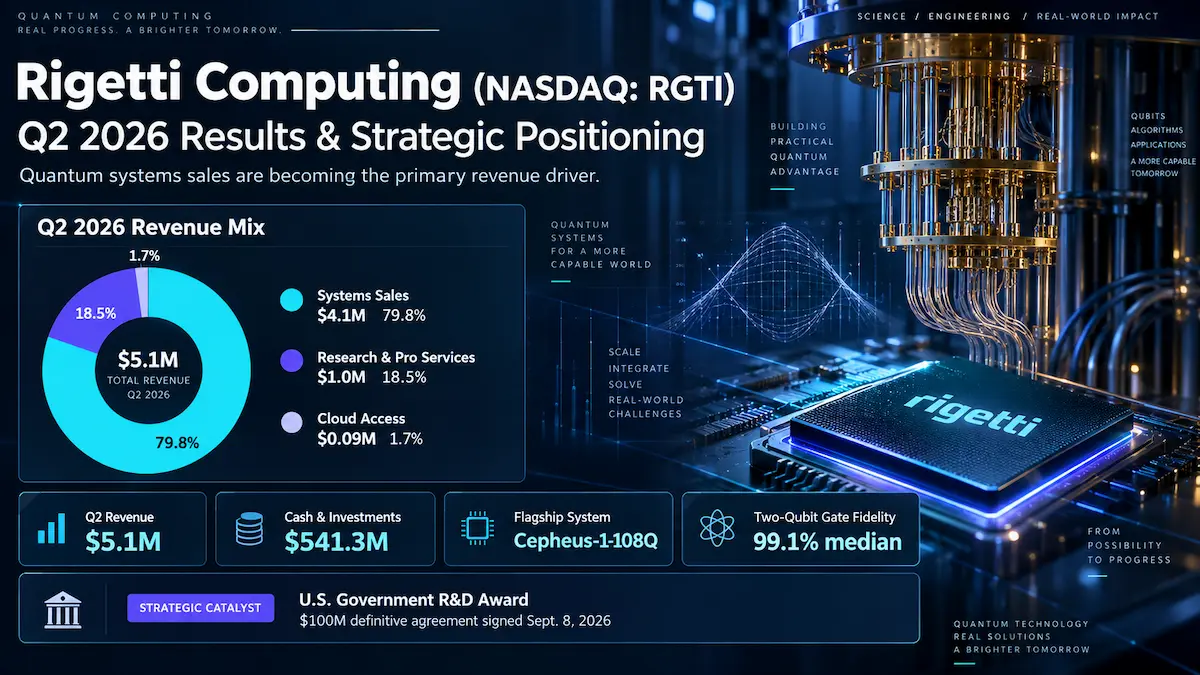
- The most important execution test is whether Rigetti can preserve performance while scaling. Cepheus-1-108Q was generally available in April 2026 and was operating at approximately 99.1% median two-qubit gate fidelity and roughly 60-nanosecond gate speeds as of the second-quarter update. Management is targeting 99.5% median two-qubit fidelity on that system and, over roughly three years, a path toward approximately 1,000 qubits, approximately 99.9% two-qubit fidelity, and sub-50-nanosecond gate speeds.
- The September 2026 U.S. Department of Commerce agreement can accelerate R&D, but it is not free capital. Up to $100 million is staged across milestone-based tranches, while Rigetti is issuing 7,739,938 shares to the Department and accepting government rights and restrictions affecting funded intellectual property, domestic production, security, and certain foreign relationships.
1. Business Model Breakdown
From Quantum Research Contractor to Productized Systems Vendor
Rigetti was founded in 2013, began operating quantum computers over the cloud in 2017, and has generated revenue since 2018. Its original commercial logic was familiar to many frontier-technology companies: use government agencies, national laboratories, and large enterprises as development partners while the underlying technology remains too immature for broad product-market fit. Those contracts provided revenue, customer access, technical problem sets, and partial funding for R&D, but they did not create a scalable software-like business model.
The company began selling quantum computers to end users in 2023 and launched Novera, its first commercially available QPU, in December 2023. That was a strategically important change in the monetization architecture. Instead of monetizing only remote compute access or bespoke research engagements, Rigetti could sell a physical QPU or full system into a customer’s own laboratory, data center, or research environment. The Novera product was explicitly designed to integrate with commercially available dilution refrigerators and control systems, allowing research organizations to buy the quantum processor while retaining flexibility across other parts of the stack.
By 2026, that productization effort had become economically visible. Rigetti’s second-quarter 2026 Form 10-Q reported $5.138 million of quarterly revenue, including $4.098 million from sales of quantum computers and quantum components, $952,000 from collaborative research and professional services, and $88,000 from access to quantum computing systems. For the first six months of 2026, hardware and component sales totaled $7.144 million out of $9.538 million of total revenue. Rigetti also stated that a significant portion of first-half revenue came from on-premises 9-qubit Novera systems and related products, which carried a higher gross-margin profile than collaborative research and professional services.
This is the core change in the Rigetti Computing business model: the company is trying to move from being paid primarily to participate in quantum R&D toward being paid to deliver quantum infrastructure.
Revenue Engine One: On-Premises QPUs and Full Quantum Systems
The most important near-term revenue stream is the sale of quantum processing units and complete quantum computing systems. Rigetti currently sells systems spanning 9 qubits to 108 qubits under the Novera and Cepheus families. Novera addresses research customers that want direct access to a high-performance superconducting QPU and can integrate it with their own cryogenic, control, or software environment. Cepheus addresses customers seeking a more complete Rigetti system built around the company’s modular chiplet architecture and control electronics.
The commercial attraction of on-premises hardware is straightforward. A research institution, national laboratory, sovereign computing program, or HPC center may value physical access, direct experimentation, customized calibration, system-level control, security, and integration more highly than low-cost shared cloud access. That can support larger contract values and deeper technical relationships. Rigetti disclosed approximately $5.7 million of purchase orders for two Novera systems received in 2025, while India’s Centre for Development of Advanced Computing placed an approximately $8.4 million order for a 108-qubit system scheduled for deployment in the second half of 2026.
The weakness is revenue lumpiness. These are not yet standardized, high-volume servers. Revenue recognition can depend on delivery, acceptance, milestones, customer facility readiness, and the specific scope of installation and support. A small number of deployments can therefore create large quarterly swings. In the second quarter of 2026, one customer represented 64% of revenue and another represented 16%. That concentration means headline growth can overstate the degree of diversification in the underlying customer base.
Revenue Engine Two: Development Contracts and Professional Services
Development contracts remain strategically important even as their relative revenue contribution declines. Rigetti describes these arrangements as generally multi-year, non-recurring programs under which it provides collaborative research, quantum application development, algorithm work, foundry services, or other technical capabilities. Contracts may be time-and-materials, cost-sharing, or fixed-price milestone arrangements, which makes revenue timing inherently uneven.
Economically, this business behaves less like software and more like funded R&D. The direct margin can be lower than product sales because engineers, program managers, subcontractors, facilities, and materials are tied to delivery. However, the strategic value can exceed the reported gross profit. Government agencies and national laboratories expose Rigetti to difficult technical requirements in quantum networking, error correction, cryogenic integration, fabrication, and hybrid computing. If those engagements produce reusable intellectual property, improved fabrication processes, or validated system architectures, the development-contract business can subsidize capability creation for future products.
The investor-grade question is therefore not whether services revenue grows every quarter. It is whether each program produces technology that can be reused across a broader installed base.
Revenue Engine Three: QCaaS and QCS
Rigetti Quantum Cloud Services, or QCS, is the company’s proprietary environment for accessing and operating quantum computers through public, private, or hybrid cloud infrastructure. QCS includes the software and orchestration layer around the QPU, while QCS Outpost extends that environment into customer-owned systems for administration, calibration, user access, compilation, scheduling, execution, and HPC integration.
Strategically, QCS is important. Financially, it is still small. First-half 2026 revenue from access to quantum computing systems was only $143,000. That makes it inaccurate to frame Rigetti today as a high-margin cloud-subscription company. QCS currently functions more as a control plane, distribution layer, customer-development environment, and ecosystem bridge than as the primary source of earnings power.
Its distribution model is deliberately two-sided. Rigetti can sell direct access to enterprise and government users, but it also distributes access through third-party platforms. The company has disclosed relationships with Amazon Braket and Microsoft Azure Quantum, and its June 2026 Form 10-Q stated that Cepheus-1-108Q was also available through Azure Quantum and qBraid. This increases reach and reduces customer friction, but it also gives hyperscale cloud platforms leverage over customer ownership, pricing, and discovery.
Platform Strategy: Control the Critical Layers, Stay Open at the Edges
Rigetti’s platform strategy is not pure vertical integration. It is selective vertical integration around the technical layers management believes determine quantum performance, combined with openness where third-party ecosystems can accelerate adoption.
Rigetti designs the quantum processor, fabricates chips in Fab-1, engineers quantum hardware and control systems, operates QCS, and sells both cloud access and on-premises systems. At the same time, it supports modular integration with third-party cryogenic systems, control electronics, software, HPC infrastructure, error-correction stacks, and cloud distribution. The company’s Novera partner program, collaborations with Riverlane and HPE, and relationships with AWS and Azure all fit that architecture.
The logic is commercially sensible for an immature market. A closed stack can maximize control but force the vendor to solve every component problem. An open stack can accelerate ecosystem development but risks commoditizing the core hardware. Rigetti is attempting to occupy the middle: protect the processor, fabrication process, chiplet interconnect, calibration, and high-speed control layers while allowing customers and partners to attach complementary technologies.
What the P&L Says About the Economic Model
Rigetti remains an early-stage, loss-making hardware company. Second-quarter 2026 revenue was $5.1 million and operating loss was $28.1 million. As of June 30, 2026, the company reported $541.3 million of cash, cash equivalents, and available-for-sale investments and stated that it had no debt. The balance sheet therefore provides meaningful funding capacity relative to current revenue, but the company is also spending aggressively: second-quarter R&D expense was $20.7 million, and management expects R&D spending to increase as it pursues higher-performance superconducting processors and larger systems.
The business model does not yet generate operating leverage. The path to a stronger economic profile requires three things to happen together: hardware revenue must become more repeatable, the mix must remain favorable enough to support higher gross profit, and technical progress must reduce the amount of bespoke engineering required per deployment. Until then, Rigetti is better analyzed as a technology platform in the industrialization phase than as a mature computing vendor.
2. Deep Dive into Economic Moats
Using the classic economic-moat framework, Rigetti should not receive credit merely for operating in a fast-growing industry, owning advanced technology, or having recognized partners. A true moat must create durable economics that are difficult for competitors to replicate. On that basis, Rigetti’s strongest current defenses are intangible assets and accumulated process know-how, with emerging switching costs around deployed systems. Network effects are weak, and a structural cost advantage has not yet been demonstrated.
Intangible Assets: The Strongest Potential Moat
Rigetti’s most defensible asset is not the number of qubits on a single machine. Qubit counts can be surpassed. The more durable candidate is the accumulated body of intellectual property and tacit manufacturing knowledge required to repeatedly produce, package, connect, calibrate, and operate superconducting quantum processors at useful fidelity.
As of December 31, 2025, Rigetti reported 121 issued patents and 160 pending patents across quantum systems, software and access, processor hardware, algorithms, applications, chip design, and fabrication. Patents alone do not create a moat; competitors can design around them, challenge them, or develop different architectures. The more important layer is the combination of formal IP with trade secrets, fabrication recipes, materials experience, device characterization data, calibration knowledge, coupler design, chiplet packaging, control electronics, and operational feedback from deployed machines.
Fab-1 is central to that learning loop. Rigetti says it became the first company to build a dedicated and integrated quantum processor fab in 2017. The company estimates that internal fabrication enables design-fab-test cycles two to five times faster than a typical MEMS or semiconductor foundry. The defensibility comes from iteration velocity: every fabrication cycle produces data that can inform the next device design, while engineers across chip design, systems, control, and software can work against the same hardware platform.
A competitor attempting to replicate this capability would need more than capital expenditure. It would need a specialized quantum fabrication process, cleanroom operations, superconducting materials expertise, packaging capability, cryogenic measurement infrastructure, calibration systems, yield learning, system architecture talent, and enough iterations to convert theoretical designs into repeatable devices. That is a meaningful catch-up cost.
However, the moat is not yet proven in economic terms. Rigetti competes with organizations that have materially greater financial, engineering, and manufacturing resources. The relevant test is whether Fab-1 and chiplet know-how continue to produce better fidelity, faster gates, higher yield, or lower deployment cost as qubit counts rise. If performance plateaus, process know-how becomes less valuable regardless of patent count.
Switching Costs: Emerging in On-Premises Deployments
Rigetti’s second-best moat candidate is switching cost, but it is still developing. A customer that buys a quantum system does more than install a server. It may adapt cryogenic infrastructure, control electronics, calibration procedures, scheduling, programming frameworks, user permissions, error-mitigation workflows, and HPC integration around that system. QCS Outpost provides a distributed operating environment for many of those functions.
Once a laboratory or HPC center builds research programs, software tooling, staff expertise, benchmarking processes, and experimental protocols around Rigetti hardware, moving to a different quantum architecture can require retraining, revalidation, software changes, workflow redesign, and potentially new physical infrastructure. Upgradeable Novera systems can increase this effect by giving customers a path to expand capabilities without replacing the entire environment.
Still, this should not be overstated. Rigetti explicitly promotes an open modular architecture, and Novera is designed to work with third-party control and cryogenic systems. Customers can also access different quantum providers through cloud marketplaces. Openness lowers adoption barriers but naturally weakens proprietary lock-in. Switching costs are therefore likely to be strongest in deeply integrated on-premises and hybrid-HPC installations rather than in casual cloud access.
Network Effects: Weak Today
Rigetti does not currently possess a classic network effect. More users on QCS do not automatically make the quantum processor materially better for every other user. A developer ecosystem can create indirect benefits through software libraries, benchmarks, integration tooling, and application knowledge, but those effects are not yet strong enough to create a self-reinforcing commercial flywheel comparable with dominant software platforms or marketplaces.
In fact, Rigetti’s broad distribution through AWS, Azure, qBraid, and research ecosystems can make the broader quantum market more liquid while reducing exclusivity for any one hardware vendor. That is strategically useful for adoption but should not be counted as a current moat.
Cost Advantages: Possible in the Future, Not Yet Demonstrated
Fab-1 could eventually create cost advantages by reducing foundry dependency, shortening iteration cycles, improving yields, and allowing Rigetti to optimize processor manufacturing for its own architecture. Superconducting qubits also use mature semiconductor-style processes rather than leading-edge lithography, which may reduce some manufacturing complexity.
But a structural unit-cost advantage cannot be inferred from that setup alone. Rigetti’s current production volumes are low, system deployments are customized, dilution refrigeration remains expensive, and the company continues to spend heavily on R&D and infrastructure. The economic evidence required to validate a cost moat would include improving hardware gross margins, lower cost per delivered qubit or per useful circuit, shorter installation cycles, higher manufacturing yields, and lower support cost per system as deployment volume increases.
Moat Verdict
Rigetti has an emerging technical moat, not yet a fully demonstrated economic moat. The strongest defense is the combined intangible asset base of Fab-1 process knowledge, proprietary chiplet architecture, patents, full-stack calibration and control expertise, and accumulated operating data. Switching costs can become meaningful as more on-premises systems are integrated into customer research and HPC environments. Network effects are limited, and cost leadership remains unproven.
For the moat to support long-duration excess returns, the technical advantages must convert into superior system-level economics. The decisive evidence would be repeatable performance at higher qubit counts, rising product gross margins, increasing orders from independent customers, successful upgrades of installed systems, and lower engineering effort per deployment. Without those outcomes, the moat remains technological potential rather than durable economic power.
3. Business Inflection Points & Future Catalysts
The Strategic Inflection Point: The 2023 Productization Pivot
The most important strategic turning point in Rigetti’s recent history was not its 2022 public listing. It was the 2023 reset under CEO Subodh Kulkarni and the subsequent decision to productize on-premises quantum hardware.
In February 2023, Rigetti revised its technology roadmap, concentrated resources on improving Ankaa performance, reorganized senior technical leadership, and reduced headcount by approximately 28% to preserve capital and narrow its focus. Later that year, after identifying demand from researchers who wanted hands-on access to high-performing qubits, Rigetti launched Novera as its first commercially available QPU.
That sequence changed the company’s corporate DNA. Instead of treating quantum hardware primarily as infrastructure used to sell cloud access or support research contracts, Rigetti began treating the hardware itself as a product. The 2026 revenue mix now provides the first meaningful financial evidence that this strategy can change how the company makes money.
Catalyst 1: Converting On-Premises Demand into Repeatable System Revenue
Transmission mechanism: Larger on-premises orders can increase revenue much faster than cloud usage at Rigetti’s current scale. Product revenue can also carry better gross margins than collaborative research services, meaning a successful shift toward Novera and Cepheus systems could improve both growth and unit economics. The $8.4 million C-DAC order is especially important because it moves Rigetti from small research QPUs toward a 108-qubit sovereign/HPC deployment.
Observable indicators: Watch quarterly revenue from sales of quantum computers and components, gross margin mix, additional orders above the 9-qubit level, acceptance and deployment of the C-DAC 108-qubit system, expansion of the installed base, repeat orders, system upgrades, and evidence that customer concentration declines as more buyers contribute meaningful revenue. The August 2026 creation of a dedicated Systems Delivery organization is also an execution signal: Rigetti is separating deployment and customer success from processor engineering so its technology team can focus on performance while operations focuses on delivery.
Execution risks: Systems can be delayed by customer facility readiness, integration complexity, cryogenic infrastructure, supply chain constraints, calibration requirements, or failure to meet performance expectations. A small number of large customers can make revenue appear to scale before the sales process is truly repeatable. If each deployment remains engineering-intensive, revenue can grow without producing attractive operating leverage.
Catalyst 2: Closing the Fidelity-at-Scale Gap
Transmission mechanism: Quantum hardware value is not determined by qubit count alone. Higher fidelity, faster gates, better coherence, and scalable connectivity increase the depth and usefulness of circuits that customers can run. Rigetti’s 108-qubit Cepheus-1-108Q represented a major scaling milestone because it connected twelve 9-qubit chiplets. If the company can improve the system from approximately 99.1% median two-qubit fidelity toward its 99.5% target while retaining approximately 60-nanosecond gate speeds, it would strengthen the argument that chiplet scaling can preserve performance rather than merely increase qubit count.
Observable indicators: Track median two-qubit fidelity on Cepheus-1-108Q, coherence time, gate speed, calibration stability, uptime, error rates across inter-chip couplers, customer benchmarking, and the cadence of new modular systems. Management has outlined an approximately three-year target of roughly 1,000 qubits, approximately 99.9% two-qubit fidelity, and gate speeds below 50 nanoseconds. The next one to two years should therefore be judged by whether intermediate system generations move consistently toward all three metrics, not by qubit count in isolation.
Execution risks: Scaling can introduce new errors in couplers, packaging, control, readout, thermal management, and calibration. Rigetti already delayed the general availability of Cepheus-1-108Q from its prior timing because of tunable-coupler complexity and the need for another chip iteration. The company’s own SEC filings acknowledge a history of changing roadmaps and missing publicly announced milestones. A higher-qubit system that sacrifices too much fidelity would weaken the commercial case for the chiplet strategy.
Catalyst 3: The $100 Million U.S. Government R&D Agreement
Transmission mechanism: On September 4, 2026, Rigetti’s subsidiary entered into a definitive agreement with the U.S. Department of Commerce for up to $100 million to accelerate superconducting quantum R&D. The program targets three bottlenecks: miniaturized readout electronics, a cryostat architecture with substantially greater cryogenic capacity, and fabrication capabilities for high-connectivity chip architectures. These are not peripheral projects; they address physical scaling constraints that could determine whether Rigetti can progress from today’s systems toward utility-scale machines.
The funding is staged. The SEC filing states that $43.9 million is to be made available on or as soon as practicable after the award date, followed by potential tranches of $29.9 million and $26.2 million if the Department determines that specified milestones have been achieved. This can reduce the amount of internal capital needed for some R&D programs and potentially accelerate infrastructure development at a time when Rigetti already has a sizeable cash and investment balance.
Observable indicators: The key signals are milestone completion, receipt of subsequent tranches, documented progress in cryogenic capacity, readout integration, high-connectivity fabrication, and evidence that those projects improve the performance or manufacturability of future processors. Investors should also monitor whether government-funded innovations translate into commercial product capabilities rather than remaining isolated research outputs.
Execution risks: The award comes with meaningful conditions. Rigetti is issuing 7,739,938 shares of common stock to the Department at an implied issuance price of $12.92 per share. The agreement also includes milestone conditions, domestic-control and production requirements, national-security and foreign-entity restrictions, reporting obligations, government rights in funded intellectual property, and potential recovery of disbursed funds for certain failures. The government relationship can strengthen the R&D base while simultaneously reducing strategic flexibility and diluting existing shareholders.
Catalyst 4: Hybrid Quantum-Classical Computing Becomes a System Market
Transmission mechanism: Rigetti’s long-run commercial opportunity improves if quantum processors become integrated accelerators inside HPC and AI environments rather than standalone scientific instruments. The company’s expanded collaboration with HPE and the Pittsburgh Supercomputing Center is strategically relevant because the TangleLab testbed is designed to integrate a 9-qubit Novera system with classical high-performance computing. Full operations are expected in 2027.
Rigetti is also participating in UK programs that combine its hardware with quantum error-correction technology and national research infrastructure. If these projects establish repeatable integration patterns, the company could sell not only a QPU but a deployable architecture for hybrid quantum-classical computing. That would increase the importance of QCS Outpost, low-latency control, and modular hardware compatibility.
Observable indicators: Watch for TangleLab entering full operations, additional HPC centers adopting Rigetti hardware, production use of QCS Outpost in hybrid environments, partnerships that move beyond research demonstrations, and repeatable system configurations that can be sold to multiple customers without extensive redesign.
Execution risks: Hybrid quantum-HPC remains an emerging architecture. Customers may conclude that current quantum systems do not provide sufficient incremental utility, or competing hardware vendors may become preferred accelerators. Research collaborations can generate credibility without generating material product revenue. The commercial catalyst only becomes real if deployments lead to repeatable purchasing behavior.
4. Key FAQs
What is the Rigetti Computing business model and how does RGTI make money?
Rigetti makes money from four main activities: selling quantum processors and complete quantum computing systems, performing collaborative R&D and professional services, providing access to quantum computers through QCaaS/QCS, and offering related foundry or technical services. In 2026, the mix shifted sharply toward on-premises hardware. During the first six months of the year, quantum computer and component sales generated $7.144 million of $9.538 million in total revenue, while cloud-style system access generated only $143,000. The economic model is therefore currently hardware-led, with development contracts supporting R&D and QCS functioning more as an operating and distribution platform than as a major recurring-revenue engine.
Does Rigetti Computing have a defensible quantum computing moat?
Rigetti has a credible emerging technical moat, but not yet a proven long-term economic moat. Its strongest defenses are Fab-1 fabrication know-how, proprietary multi-chip architecture, patents and trade secrets, high-speed superconducting control, calibration expertise, and the ability to integrate those elements across hardware and software. These capabilities are expensive and time-consuming to reproduce. However, Rigetti has not yet demonstrated sustained pricing power, high recurring revenue, structural cost leadership, or strong network effects. The moat becomes economically defensible only if the company can maintain fidelity while scaling, deliver systems repeatedly, and improve gross margins faster than competitors can replicate or bypass its architecture.
What could drive Rigetti Computing revenue growth in 2026 and 2027?
The most direct revenue drivers are shipment and acceptance of on-premises systems, additional Novera and Cepheus orders, expansion into sovereign and national-lab deployments, and successful commercialization of hybrid quantum-HPC installations. The C-DAC 108-qubit order provides a visible near-term system opportunity, while the dedicated Systems Delivery organization is intended to increase deployment capacity. Technical progress toward higher fidelity on Cepheus-1-108Q could unlock additional customer demand, and the U.S. Department of Commerce agreement can accelerate R&D. The main risks are system delays, customer concentration, failure to improve fidelity at higher qubit counts, milestone risk on government funding, and the possibility that research collaborations do not convert into repeatable commercial orders.
5. Conclusion
Rigetti’s corporate DNA is best described as vertically integrated quantum industrialization. The company is not building a conventional SaaS platform with dominant network effects, and it is not merely a contract research shop. Its strategy is to own the performance-critical layers of superconducting quantum computing — processor design, fabrication, chiplet scaling, calibration, control, and system software — while remaining open enough to integrate with clouds, cryogenic vendors, HPC infrastructure, and third-party quantum software.
The most important evolution is the shift from research-heavy revenue toward productized on-premises systems. That transition can improve the quality of the revenue mix if system sales become repeatable and retain their higher gross-margin profile. QCS remains strategically important because it links cloud distribution, customer workflows, and on-premises operation, but current revenue data do not support treating it as the primary monetization engine.
Rigetti’s moat is therefore conditional rather than settled. Fab-1, 121 issued patents, 160 pending patents, the chiplet architecture, high-speed superconducting gates, and accumulated process knowledge create a real technical barrier to entry. Yet the decisive commercial proof is still ahead: higher fidelity at larger scale, consistent customer deployments, lower delivery friction, better margin structure, and a broader customer base. The company’s sizeable liquidity and the new U.S. government R&D agreement reduce near-term capital pressure, but they do not eliminate technology risk, concentration risk, execution risk, or dilution.
For corporate analysis, the clearest conclusion is that Rigetti has moved from proving it can build quantum computers to proving it can industrialize and monetize them. The next one to two years should be judged less by headline qubit announcements and more by whether the company turns its manufacturing and chiplet advantages into measurable system performance, repeatable deployments, and improving unit economics.
Primary Sources
- Rigetti Computing Form 10-Q for the quarter ended June 30, 2026 — U.S. Securities and Exchange Commission
- Rigetti Computing Form 10-K for the year ended December 31, 2025 — U.S. Securities and Exchange Commission
- Rigetti Computing Form 8-K dated September 8, 2026 — U.S. Securities and Exchange Commission
- Rigetti Computing Reports Second Quarter 2026 Financial Results — Rigetti Investor Relations
- Rigetti Signs Definitive Agreement for $100M with U.S. Government — Rigetti Investor Relations
- Rigetti Announces General Availability of 108-Qubit System — Rigetti Investor Relations
- Rigetti Announces $8.4M Order for a 108-Qubit Quantum Computer from C-DAC — Rigetti Investor Relations
- Rigetti Establishes Dedicated Systems Delivery Organization — Rigetti Investor Relations
- Rigetti Expands Collaboration with HPE and Pittsburgh Supercomputing Center — Rigetti Investor Relations
- Rigetti Launches the Novera QPU — Rigetti Investor Relations
- Rigetti Computing Announces Updated Strategic Plan — Rigetti Investor Relations
Disclaimer: This article is intended solely for business logic discussion and corporate research purposes, and does not constitute investment advice of any kind.