

Key Takeaways
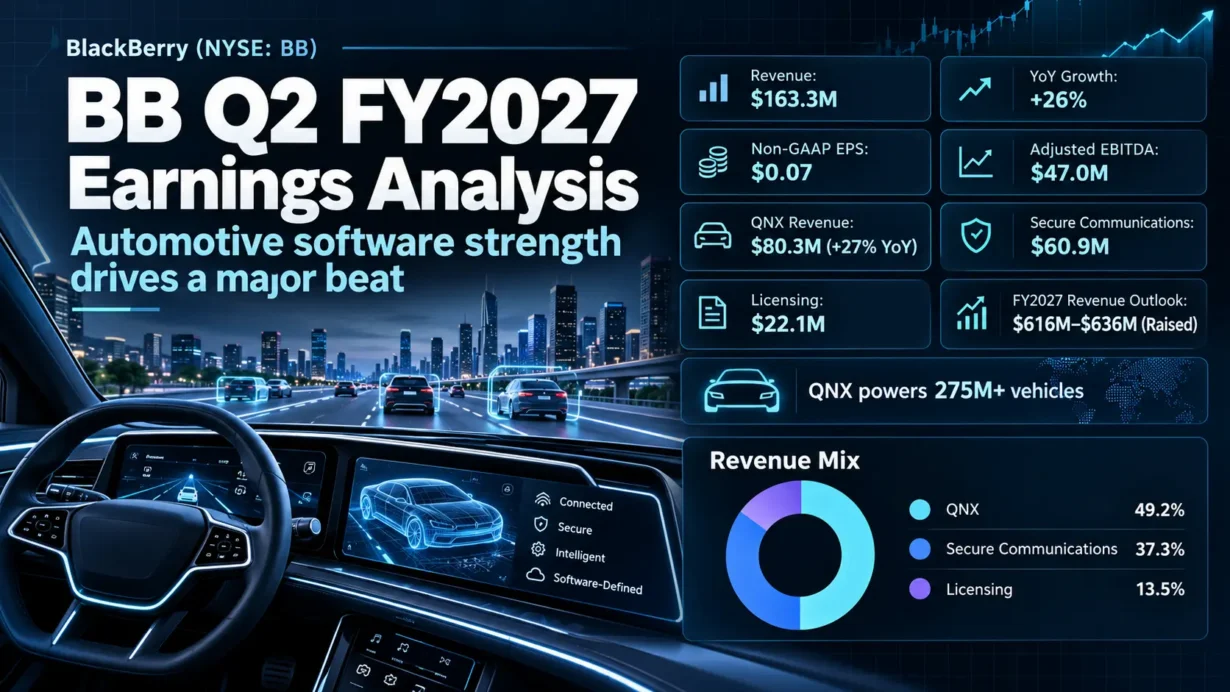
- BlackBerry reported $163.3 million of fiscal Q2 2027 revenue, up 26% year over year, and $0.07 in adjusted basic EPS versus a separately reported $0.04 analyst estimate. GAAP basic EPS was $0.06.
- QNX revenue reached a record $80.3 million, up 27%, while higher-margin royalties helped lift QNX’s adjusted gross margin to 87%. Coretura’s first Alloy Kore award adds more than $100 million to estimated future royalty backlog, not current-quarter revenue.
- Licensing delivered $22.1 million, against management’s approximately $10 million prior-quarter target; this unusually large transaction accounted for much of the earnings surprise and should not be annualized.
- FY2027 revenue guidance rose to $616 million–$636 million, even as Secure Communications guidance fell to $260 million–$270 million on a more cautious assessment of government-deal timing.
- At the September 28, 2026 NYSE close of $8.80, the stock’s illustrative basic-share enterprise value was about 32.9 times the midpoint of management’s FY2027 adjusted EBITDA guidance. Convertible-note dilution deserves separate scrutiny.
Core Earnings Breakdown
Revenue and Profitability Analysis
Consolidated revenue increased from $129.6 million a year earlier to $163.3 million, a $33.7 million gain, or 26% as reported by the company. GAAP gross margin rose to 77.8%, while adjusted gross margin reached 78.2%, approximately three percentage points higher year over year. GAAP operating income climbed from $11.5 million to $33.6 million, corresponding to a 20.6% GAAP operating margin (calculated from company-reported figures: $33.6 million ÷ $163.3 million). Adjusted operating income reached $42.9 million, or a company-reported 26% adjusted operating margin, versus 17% a year earlier. Adjusted EBITDA was $47.0 million, up 81%, equivalent to a company-reported 29% margin. These are distinct GAAP and non-GAAP measures and should not be treated interchangeably. BlackBerry’s company-filed Q2 results and reconciliations provide the underlying definitions.
- QNX: Revenue was $80.3 million, versus $63.1 million a year earlier, up 27% and representing 49.2% of group revenue (calculated from company-reported figures: $80.3 million ÷ $163.3 million). Segment adjusted gross margin rose to 87% from 83%, and segment adjusted EBITDA increased 41% to $29.0 million, a 36% margin. Investment interpretation: royalty growth from previously awarded automotive programs has a different degree of repeatability from a development-services project, making the rising royalty contribution particularly relevant to the long-term margin model.
- Secure Communications: Revenue was $60.9 million, up approximately 2% from $59.9 million and representing 37.3% of consolidated revenue (calculated from company-reported figures: $60.9 million ÷ $163.3 million). Annual recurring revenue stood at $221 million; dollar-based net retention was 91%. Segment adjusted gross margin fell five percentage points to 61% because of a greater contribution from lower-margin SecuSUITE hardware, while segment adjusted EBITDA declined 18% to $8.0 million. Investment interpretation: certified, mission-critical products support the recurring customer base, but the combination of below-100% retention and government-contract timing limits the visibility implied by ARR alone.
- Licensing: Revenue of $22.1 million rose from $6.6 million a year earlier, representing 13.5% of group revenue (calculated from company-reported figures: $22.1 million ÷ $163.3 million). Segment adjusted gross margin was 93%, and adjusted EBITDA was $20.0 million. Investment interpretation: this is high-margin cash generation, but management attributed the unusually strong quarter principally to a new licensing arrangement and guided to approximately $6 million in each of Q3 and Q4; it is not a defensible recurring quarterly run rate.
Adjusted net income was $43.2 million and adjusted basic EPS was $0.07. GAAP net income was $33.9 million and GAAP basic EPS was $0.06, marking six consecutive quarters of positive GAAP net income. Operating cash flow reached $29.3 million, versus $3.4 million a year earlier, and cash and investments ended the period at $447.1 million. The company defines its Rule of 40 as reported year-over-year revenue growth plus adjusted EBITDA margin; approximately 26% + 29% places Q2 around a Rule-of-55 outcome, rather than a standalone GAAP profitability benchmark.
Expectations vs. Actual Results
Revenue: $163.3 million actual versus $145.6 million in the LSEG analyst consensus reported by Reuters, a $17.7 million beat, or approximately 12.2% above that estimate. Result: ✅ Beat. BlackBerry’s own earlier Q2 revenue guidance was $137 million–$148 million, so actual revenue exceeded even the top of management’s range by $15.3 million. Published consensus snapshots differ by provider and collection time; this article uses the explicitly attributed LSEG figure rather than blending incompatible surveys.
EPS: $0.07 adjusted basic EPS actual versus a $0.04 analyst expectation reported by Barron’s. Result: ✅ Beat by $0.03. The company’s own prior adjusted basic EPS target was $0.03–$0.04; the reported GAAP basic EPS of $0.06 is disclosed separately and is not compared with an adjusted-EPS consensus.
Operating margin: 20.6% GAAP and 26% adjusted actual. Result: ✅ Year-over-year expansion, but no verified, like-for-like analyst operating-margin consensus was publicly established in the sources reviewed, so a market-consensus margin beat or miss is not asserted. The directly comparable company target was adjusted EBITDA of $20 million–$30 million; the $47.0 million actual exceeded the high end by $17.0 million. This distinction prevents an adjusted EBITDA surprise from being mislabeled as an operating-margin consensus surprise.
The surprise had two different sources. Management’s previous Q2 segment revenue targets were $70 million–$75 million for QNX, $57 million–$63 million for Secure Communications and approximately $10 million for Licensing. Using their midpoints, QNX exceeded its target by $7.8 million, Secure Communications by $0.9 million and Licensing by $12.1 million. QNX plus Licensing therefore supplied approximately 95.7% of the $20.8 million upside to management’s consolidated revenue midpoint (calculated from company-reported figures: [$7.8 million + $12.1 million] ÷ [$163.3 million − $142.5 million]). This is a comparison with management guidance, not a decomposition of the independent LSEG consensus. The filing specifically attributes QNX’s upside chiefly to stronger-than-expected royalties, and Licensing’s upside to a newly signed arrangement.
Next-quarter guidance: For Q3 FY2027, management expects $143 million–$154 million in consolidated revenue, $82 million–$88 million in QNX revenue, $55 million–$60 million in Secure Communications revenue, approximately $6 million in Licensing revenue, $28 million–$37 million in adjusted EBITDA, $0.04–$0.05 in adjusted basic EPS and $20 million–$30 million in operating cash flow. The midpoint of the revenue outlook is $148.5 million, slightly below the $149.6 million LSEG Q3 estimate reported by Reuters at the time. These figures are company guidance, not realized sales or independent forecasts.
Full-year guidance: FY2027 consolidated revenue increased to $616 million–$636 million from $594 million–$621 million; adjusted EBITDA increased to $141 million–$158 million from $119 million–$139 million; adjusted basic EPS rose to $0.19–$0.22 from $0.16–$0.20; and operating cash flow increased to approximately $115 million from approximately $100 million. Beneath that upgrade, QNX revenue guidance rose to $315 million–$325 million from $295 million–$312 million, and Licensing increased to approximately $41 million from approximately $29 million. By contrast, Secure Communications revenue guidance fell to $260 million–$270 million from $270 million–$280 million. This divergence is central to understanding the quality of the company-wide upgrade. BlackBerry’s Form 10-Q documents the previous and updated guidance ranges.
What mattered to the market was not a single EPS figure. QNX royalty conversion and Alloy Kore’s commercial validation improved the longer-duration narrative; the $12.1 million licensing surprise helped explain the current-quarter beat; and the near-consensus Q3 group outlook, alongside lower Secure Communications expectations, constrained how much of Q2 could reasonably be extrapolated. The stock’s response was not a simple, continuous post-earnings decline: BB closed at $8.73 on September 24, up 4.2% from $8.38 the previous day, fell 6.0% to $8.21 on September 25 and rebounded 7.2% to $8.80 on September 28. Reuters also described an intraday pullback following the in-line Q3 outlook. These observed prices demonstrate changing market interpretation; they do not by themselves establish the motivation of every trade. No announced acquisition dilution explains the September 25 move, although existing convertible-note exposure is a real separate valuation issue.
Earnings Call Highlights
The following bold statements are accurate paraphrases of management’s September 24 earnings-call discussion, not purported verbatim quotations. The explanations following them are investment interpretations rather than management claims. The company’s Investor Relations financial-reports index lists the Q2 FY2027 transcript; management’s remarks were also cross-checked against a published full-call transcript.
- CEO John Giamatteo: Core automotive growth is coming from broader penetration of software-defined architectures and more QNX content in each vehicle, not simply higher worldwide vehicle output.
💡 Reading Between the Lines: Unit-production forecasts are an incomplete driver for a QNX model. Investors need evidence that higher software content in new designs is converting into recognized production royalties, not just a larger addressable-market narrative. - CEO John Giamatteo: Coretura selected Alloy Kore for its next-generation commercial-vehicle platform; management said the first award carries an approximately threefold higher selling price per instance than that customer’s existing QNX OS deployment.
💡 Reading Between the Lines: Pre-integrated, safety-certified middleware could increase BlackBerry’s software revenue per platform while reducing the engineering burden for automakers. The award adds more than $100 million of estimated future royalties, but management explicitly said the bulk would arrive after a production lead time and would not materially change this fiscal year’s revenue profile. - CEO John Giamatteo: New QNX commercial arrangements increasingly include contractual minimum-volume commitments instead of relying exclusively on nonbinding production forecasts.
💡 Reading Between the Lines: A firmer contractual floor may improve revenue and cash-flow visibility and could accelerate some recognition. Management did not disclose the quarter’s quantified contribution from this evolving contract structure, so improved visibility should not be mistaken for a known recurring-revenue amount. - CFO Tim Foote: The company lowered Secure Communications’ second-half outlook because of caution around government-deal timing and Canada–U.S. trade tensions, while reporting no material realized effect from those issues at the time of the call.
💡 Reading Between the Lines: The downgrade represents management’s risk adjustment, not proof of government customer losses. However, with dollar-based net retention at 91%, the recurring base requires new sales and expansion to sustain growth; the distinction between pipeline creation and signed contracts matters. - CFO Tim Foote: Capital-allocation priorities remain investment in QNX, selective share repurchases and strategically suitable acquisitions, particularly those that could accelerate general embedded markets.
💡 Reading Between the Lines: Management’s roughly $247 million net-cash position gives it choices, not a guarantee of buybacks or acquisitions. At an elevated trading multiple, investors should examine the price paid for any deal and the offsetting impact of outstanding convertible securities before assigning value to optionality.
Deep Business Insights
Hidden Metrics That Matter
First, royalty revenue accounted for most of QNX’s incremental year-over-year revenue. The company’s Form 10-Q breaks QNX’s $17.2 million year-over-year increase into $10.4 million more royalty revenue, $3.9 million more development-license revenue and $2.6 million more professional-services revenue, with rounding accounting for the small residual. Royalties therefore contributed approximately 60.5% of QNX’s incremental revenue (calculated from company-reported figures: $10.4 million ÷ $17.2 million). This matters because QNX’s 87% adjusted gross margin rose alongside increased royalty mix. Existing design-win backlog entering vehicle production is a more testable profitability driver than an unconverted pipeline. The company last disclosed approximately $950 million in QNX royalty backlog before this quarter; adding the new Coretura award to that old snapshot would not yield a verified current backlog, because royalties have also been realized and other awards may have changed the balance.
Second, the convertible notes are economically relevant even though basic share count is roughly stable. BlackBerry’s September 2026 Form 10-Q reports 587,032,279 shares outstanding as of September 21 and $200 million principal of 3% convertible notes carrying a $3.88 conversion price, potentially convertible into approximately 51.5 million shares in full. That potential issuance equals about 8.8% of the existing base (calculated from company-reported figures: 51.5 million ÷ 587.032 million). The company can settle some conversions in cash, stock or a combination under the note terms, so 8.8% is an illustrative full-share-settlement scenario, not a forecast of actual dilution. The filing also reports 18.9 million restricted share units and 1.9 million deferred share units outstanding; neither is silently added to the basic valuation below. Future repurchases should be considered alongside these claims on the share count.
Why customers choose QNX: the product targets failures that ordinary consumer software can tolerate poorly—missed real-time deadlines, uncertain system behavior and complex safety certification. Automakers and robotics developers can buy a deterministic operating system and a pre-integrated safety-oriented platform rather than building and validating every foundational component themselves. Coretura’s move into multiple commercial-vehicle software domains and management’s roughly threefold increase in selling price per instance are evidence of willingness to pay for broader integration, although one award does not establish comparable pricing across the entire pipeline. Management said general embedded markets, including robotics and medical technology, represent approximately 20% of QNX revenue; applying that approximate share to Q2’s $80.3 million yields roughly $16.1 million (calculated from company-reported figures: 20% × $80.3 million). This is an illustrative estimate based on management’s rounded mix statement, not a separately disclosed segment result.
One additional quality check is Secure Communications’ $221 million ARR versus 91% dollar-based net retention. The former is an annualized contract-value measure, not booked quarterly revenue; the latter means the comparable prior-year customer cohort retained 91% of its ARR after expansion and contraction. ARR can remain substantial while an existing-customer cohort shrinks. This is why renewal quality and new government bookings deserve attention alongside QNX growth.
Industry Chain Reactions
- ✅ Potential beneficiary — NVIDIA (NASDAQ: NVDA): On the call, BlackBerry described engagements with more than 20 companies around NVIDIA-based platforms in robotics and physical AI. Wider adoption of safety-certified QNX alongside NVIDIA computing could improve the production-readiness and attractiveness of that ecosystem. This is a directional ecosystem implication, not evidence of an attributable or material NVIDIA revenue uplift from BlackBerry’s quarter.
- ❌ Potential competitive pressure — Aptiv (NYSE: APTV): Aptiv owns Wind River, whose real-time operating systems compete for some safety-critical embedded and automotive workloads. BlackBerry’s broader Alloy Kore positioning and Coretura award raise the competitive standard around pre-integrated software platforms. However, no disclosed evidence shows Coretura displaced Wind River from an existing contract, and Aptiv’s September 10, 2026 ADAS smart-camera announcement demonstrates its own Wind River-based commercial execution. Treat this as overlapping competitive exposure, not a demonstrated financial loss to Aptiv.
Valuation Framework and Key Risks
Valuation snapshot as of the September 28, 2026 NYSE close: BB traded at $8.80. Multiplying that market price by the company’s 587.032 million reported outstanding shares gives approximately $5.17 billion of basic-share equity value (calculated from company-reported figures and the observed market price: $8.80 × 587.032 million). Subtracting approximately $247.1 million of net cash, using $447.1 million of cash and investments less $200 million convertible-note principal, yields an illustrative basic-share enterprise value of approximately $4.92 billion. This convention treats the convertible notes as debt and excludes their conversion shares.
Using the midpoint of management’s FY2027 guidance, rather than inventing an independent forecast, that illustrative enterprise value represents approximately 7.9 times FY2027 guided revenue ($4.92 billion ÷ $626 million) and 32.9 times guided adjusted EBITDA ($4.92 billion ÷ $149.5 million). For context, an alternative scenario assuming all 51.5 million convertible shares were issued and the $200 million notes ceased to exist would produce approximately 638.5 million shares and $5.17 billion of enterprise value ($8.80 × 638.5 million − $447.1 million), or about 34.6 times the same guided EBITDA midpoint. The second illustration excludes additional equity-award dilution and avoids counting the converted debt twice; actual settlement is at the company’s contractual discretion. Neither multiple is a price target or a verified peer-comparison premium.
These multiples make the mix and duration of earnings important. Key monitoring points are whether QNX royalties continue to convert from awarded programs, whether Alloy Kore’s higher price per instance proves repeatable beyond Coretura, whether management’s Q3 licensing normalization occurs as signaled, and whether Secure Communications retention and government-deal timing improve. Other risks include software-platform competition, long automotive development-to-production cycles, exposure to customer programs and concentrated quarterly customers—two customers each accounted for at least 10% of Q2 revenue according to the Form 10-Q—plus possible acquisition spending, equity-award issuance and convertible-note settlement. The market price can change materially after the stated valuation date, and company guidance remains forward-looking rather than reported performance.
Key FAQs
Did BlackBerry beat revenue and EPS expectations in Q2 fiscal 2027?
Yes on the specifically attributed external comparisons: BlackBerry reported $163.3 million in revenue against the $145.6 million LSEG estimate published by Reuters, and $0.07 adjusted basic EPS against a $0.04 analyst figure reported by Barron’s. GAAP basic EPS was $0.06. The quarter’s surprise reflected both stronger QNX royalties and a new, unusually large licensing agreement; it should not be read as an equal-sized increase in recurring sales.
What is BlackBerry’s Q3 and full-year FY2027 earnings guidance after the Q2 report?
Management guided Q3 revenue to $143 million–$154 million, adjusted EBITDA to $28 million–$37 million and adjusted basic EPS to $0.04–$0.05. It raised full-year FY2027 revenue guidance to $616 million–$636 million, adjusted EBITDA to $141 million–$158 million and adjusted basic EPS to $0.19–$0.22. Management also lowered the full-year Secure Communications revenue outlook to $260 million–$270 million. These are forward-looking company estimates, not actual future financial results.
Why does BlackBerry’s Coretura Alloy Kore deal matter for QNX royalties and BB stock valuation?
The first Alloy Kore design win adds more than $100 million of estimated future royalties to QNX’s backlog and, according to management, carries approximately three times the per-instance selling price of that customer’s existing QNX OS deployment. It supports a possible higher-content-per-vehicle model, but most associated production royalties will follow a lead time and the deal is not expected to materially change FY2027 revenue. Investors assessing BB’s multiple need to distinguish the demonstrated commercial award from the still-unreported timing and amount of eventual recognized royalties.
Sources: BlackBerry Investor Relations (official fiscal Q2 FY2027 results and transcript index); company-filed September 24, 2026 earnings release; fiscal Q2 FY2027 Form 10-Q; September 24 earnings-call transcript (third-party transcription; company filings take precedence for spelling and financial figures); Reuters for the dated LSEG revenue consensus; Barron’s for the separately published EPS estimate; and historical BB market prices. Source pages were accessible during research on September 29, 2026; subsequent updates may change market quotations or linked content.
Disclaimer: This article/chart is for educational and informational purposes only and does not constitute investment advice of any kind. Past performance is not indicative of future results. Investors should independently evaluate their own risks.