

Key Takeaways
- Fink expects unusually intense competition for capital from AI infrastructure and federal borrowing to support structurally elevated long-term interest rates; this was a directional view, not a specific Treasury-yield target.
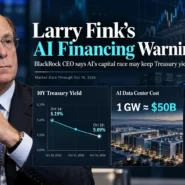
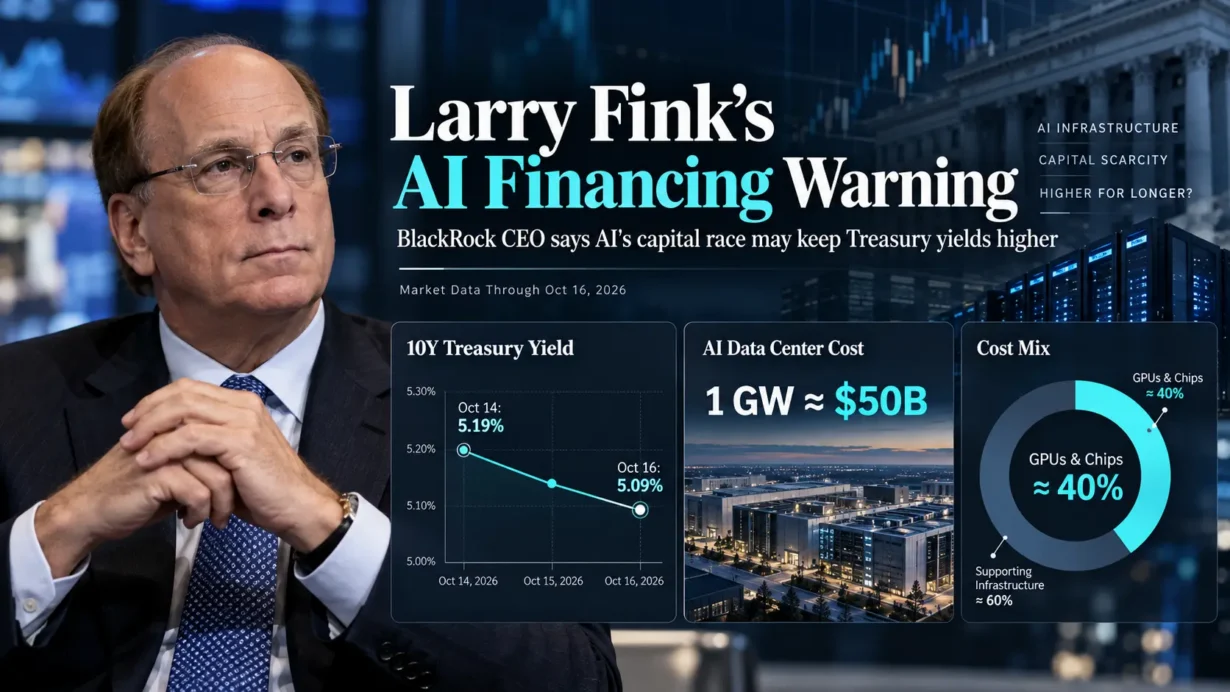
- He estimated that a U.S. one-gigawatt AI data center could represent roughly $50 billion of enterprise cost, with GPUs and chips accounting for approximately 40%. That is his illustrative estimate, not a universal construction benchmark.
- BlackRock wants to help turn financing tied to compute capacity into standardized, potentially tradable securities, drawing an analogy to the early mortgage-backed securities market. A mature liquid market does not yet exist.
- BlackRock (NYSE: BLK) could gain fee-earning assets from arranging and managing such capital, while financing-sensitive operators such as CoreWeave (NASDAQ: CRWV) illustrate the danger of a higher credit-risk premium.
- The investor response is to stress-test rates and debt servicing, distinguish contracted AI revenue from collectible cash flow, and avoid confusing a secular growth opportunity with a risk-free security.
1. The Core Thesis: Five Market-Moving Signals From Larry Fink
On October 14, 2026, Laurence D. Fink spoke during BlackRock’s third-quarter earnings conference call and answered questions from institutional analysts. This is a publicly accessible investor Q&A, not a private interview. The remarks matter because BlackRock reported approximately $15.5 trillion in assets under management and $205 billion of third-quarter net inflows, giving its chief executive an unusually broad perspective on where institutional capital is being deployed. His forecasts should still be treated as management opinions, not established market outcomes.
1. Capital Scarcity Is Becoming an Economic Force, Not Just a Fed Story
Fink described seeing “genuine shortages of capital” as governments, companies and AI developers seek funding simultaneously. The commercial implication is that the availability of investable savings is not the same as the availability of cheap financing: every borrower must compete on risk-adjusted returns, collateral quality and repayment certainty. When capital demand grows faster than investors’ willingness to absorb risk, borrowing spreads can widen even when central-bank policy is unchanged. This shifts the equity debate from gross AI spending to the actual return on that spending.
2. AI Spending and U.S. Deficits Could Keep Long-Term Rates Higher
Fink projected “structurally higher interest rates for longer,” particularly farther out on the Treasury curve, because public deficits and private-sector investment are competing for capital. This does not mean he forecast an uninterrupted bond selloff or a particular 10-year yield. In fact, U.S. Treasury data show the 10-year par yield fell from 5.19% on October 14 to 5.09% on October 16, even as his structural thesis remained relevant. Treasury yields also reflect inflation expectations, growth, safe-haven flows and the term premium; a short-term rally in bonds is not proof that long-term funding pressures have disappeared.
3. The $50 Billion-per-Gigawatt AI Infrastructure Equation Changes Underwriting
For a U.S. one-gigawatt data-center project, Fink cited an illustrative enterprise cost of about $50 billion, roughly 40% of it attributable to GPUs and chips and the rest to power, grids, buildings and related infrastructure. Applied to his own estimate, that implies approximately $20 billion in compute hardware and $30 billion in supporting infrastructure. The insight is that AI expansion is simultaneously a semiconductor demand story, a power-capacity story and a multiyear financing story. The figure should not be extrapolated mechanically to every campus: utilization, chip generation, geography, energy costs and project design can materially alter the economics.
4. GPU Financing Could Become a New Institutional Asset Class
Fink compared emerging compute financing with the evolution of mortgage-backed securities in the 1980s. His proposed direction is to pool or structure cash flows supported by GPUs, data-center assets, leases and customer commitments into instruments that more investors can evaluate and eventually trade. This could attract insurers, pension funds and other long-duration capital while giving smaller AI developers an alternative to relying entirely on hyperscaler balance sheets. Yet the analogy is an ambition, not evidence of equivalent safety: GPUs depreciate quickly, technology generations turn over, and concentrated tenant contracts can make cash flows more fragile than headline bookings suggest.
5. Data, Ratings and Credit Discipline Are the Real Gatekeepers
Fink acknowledged that rating agencies, historical performance data and consistent risk analytics need time to develop before compute-backed finance can scale into a widely traded market. That qualification is crucial. Investors would need standardized measures of asset value, chip obsolescence, contract enforceability, utilization, counterparty concentration and recoveries after default. BlackRock’s Aladdin, Preqin, HPS and Global Infrastructure Partners capabilities could play a role in building that market, but superior analytics do not eliminate losses from weak underwriting. The more important innovation may be the ability to price AI infrastructure risk correctly rather than merely package more of it.
2. Industry and Sector Impact: Two Stocks at Opposite Ends of the Financing Cycle
Potential Beneficiary: BlackRock (BLK), a Capital-Markets Infrastructure Provider
BlackRock is positioned to participate through infrastructure investment, private-credit origination, asset management and the analytics needed to make complex exposure investable. Management reported 11% annualized organic base-fee growth in the third quarter and said its private-credit fundraising totaled approximately $25 billion over its first full year with HPS. The bullish transmission mechanism is not simply higher AI spending; it is successful deployment into fee-paying assets, durable management fees and broader institutional distribution. Investors should track net inflows, fee-paying private-markets assets, realized credit performance and operating margins. Risks include slower fundraising, lower asset values, investment losses within managed funds, regulatory friction and new competitors. BlackRock’s business may benefit from financing activity without its shares necessarily outperforming in a falling equity market.
Potential Pressure Point: CoreWeave (CRWV), a Test of Leveraged AI Economics
CoreWeave illustrates the other side of Fink’s thesis. In an October 16 report, Reuters, citing LSEG data, put the company’s debt at roughly $50 billion and reported that yields on some CoreWeave bonds had reached approximately 15%–16%, while default-protection costs climbed to around 1,200 basis points. Those prices are signals of credit-market stress, not the interest rate on every CoreWeave loan. Long-term customer commitments can support financing, but a concentrated customer base, high capital intensity and refinancing requirements can turn an attractive revenue backlog into an inadequate equity cushion. The relevant question is whether contracted cash inflows, after power, hardware replacement and operating expenses, can service debt and fund the next technology cycle. CoreWeave is used here as an independently documented case study; Fink did not make a CRWV stock recommendation in the call.
The distinction matters across the supply chain: chip vendors can book sales while lenders assess collateral values and operators absorb financing costs. Sustained AI adoption can therefore coexist with falling valuations for overleveraged infrastructure owners. Conversely, lower yields, better utilization or stronger customer guarantees could improve their financing outlook. Sector winners will be determined by balance-sheet resilience and returns on invested capital, not just megawatts announced.
3. Investor Playbook: Three Practical Defenses
1. Stress-Test 5.5% and 6% Treasury-Yield Scenarios, Not a Single Rate Forecast
Begin with the verified October 16 U.S. 10-year par yield of 5.09%, then evaluate hypothetical 5.5% and 6% scenarios; neither level is a prediction attributed to Fink. Recalculate discounted cash-flow values, interest coverage and refinancing costs for rate-sensitive equity holdings. For a bond portfolio with a modified duration of seven years, a 50-basis-point upward yield shock implies an approximate 3.5% price decline before coupon income and convexity effects. Growth stocks do not obey that same simple formula, but businesses reliant on distant cash flows or perpetual external funding deserve particularly conservative valuation assumptions.
2. Demand Evidence That AI Backlogs Can Become Debt-Service Cash Flow
For data-center operators and AI-linked private-credit vehicles, review the next 24 months of maturities, available liquidity, interest expense, binding customer minimums, counterparty concentration and hardware refresh commitments. Compare debt-service requirements against contracted, realizable operating cash flow rather than headline remaining performance obligations. A practical warning signal is the combination of widening credit spreads, rising refinancing needs and weaker customer economics; that mix can overwhelm otherwise strong demand. Treat high quoted bond yields as compensation for risk, not as free income.
3. Separate Financing Toll Collectors From Balance-Sheet Risk Takers
Assess businesses such as BLK on the conversion of originated opportunities into sustainable fee-bearing assets; assess leveraged AI infrastructure companies such as CRWV on credit quality and cash conversion. Stage position entries rather than relying on a single macro call, and set portfolio exposure limits around how much drawdown or liquidity stress could be tolerated. The countercase to Fink’s structural view is also worth monitoring: a sustained easing in capital demand, materially stronger AI productivity, improved government financing conditions or a durable decline in risk premiums would weaken the higher-for-longer thesis. Neither macro conviction nor enthusiasm for AI should replace position sizing.
4. Frequently Asked Questions (FAQ)
Did Larry Fink predict the U.S. 10-year Treasury yield would reach 6% in October 2026?
No. His October 14 remarks expressed a structural expectation for higher long-term rates because of competition for capital; he did not provide a specific 6% target. The U.S. Treasury’s published 10-year par yield was 5.09% on October 16. Investors can use 6% as a hypothetical risk scenario without misrepresenting it as his forecast.
How could Larry Fink’s AI compute-financing plan affect BlackRock stock (BLK)?
If compute-backed investments become credible, scalable products, BlackRock could attract additional fee-paying institutional assets through its infrastructure, credit and technology platforms. That outcome depends on ratings, market acceptance, attractive underwriting returns and execution. No liquid, mature GPU-securitization market has been demonstrated by this announcement, and BLK equity remains exposed to broader financial-market conditions.
Why could CoreWeave stock (CRWV) face pressure even if demand for AI data centers keeps rising?
Capacity demand does not guarantee free cash flow to shareholders. High debt, expensive refinancing, hardware obsolescence and dependence on a few major counterparties can absorb the economics of growth. Reuters’ October 16 report on distressed pricing in some CoreWeave bonds illustrates why investors should watch credit spreads and cash conversion alongside contracts and revenue growth.
Sources: BlackRock’s official October 14, 2026 earnings-call webcast archive, the public earnings-call transcript, BlackRock’s third-quarter release, official U.S. Treasury yield data, and Reuters’ October 16 AI-credit reporting.
Disclaimer: This article is for informational purposes only and does not constitute investment advice.