
Key Takeaways
- Bill Ackman described Anthropic as “perhaps the greatest business story I’ve ever seen,” yet stopped well short of treating extraordinary growth as sufficient reason to own the company.
- His central investing test remains long-horizon predictability: he wants businesses whose competitive position, economics and capital requirements can still be sensibly underwritten years from now.
- A major risk to frontier AI companies is not demand but durability. Ackman explicitly questioned whether leading model developers can defend their market positions against increasingly capable open-source and open-weight alternatives.
- The current IPO market is unusually concentrated around a small number of high-profile deals, raising the risk that headline demand is mistaken for broad-based risk appetite.
- For public-equity investors, Ackman’s message favors durable AI beneficiaries and established toll-road business models over capital-hungry stories whose future economics depend on multiple uncertain assumptions converging at once.
1. Reconstructing Bill Ackman’s Core Views
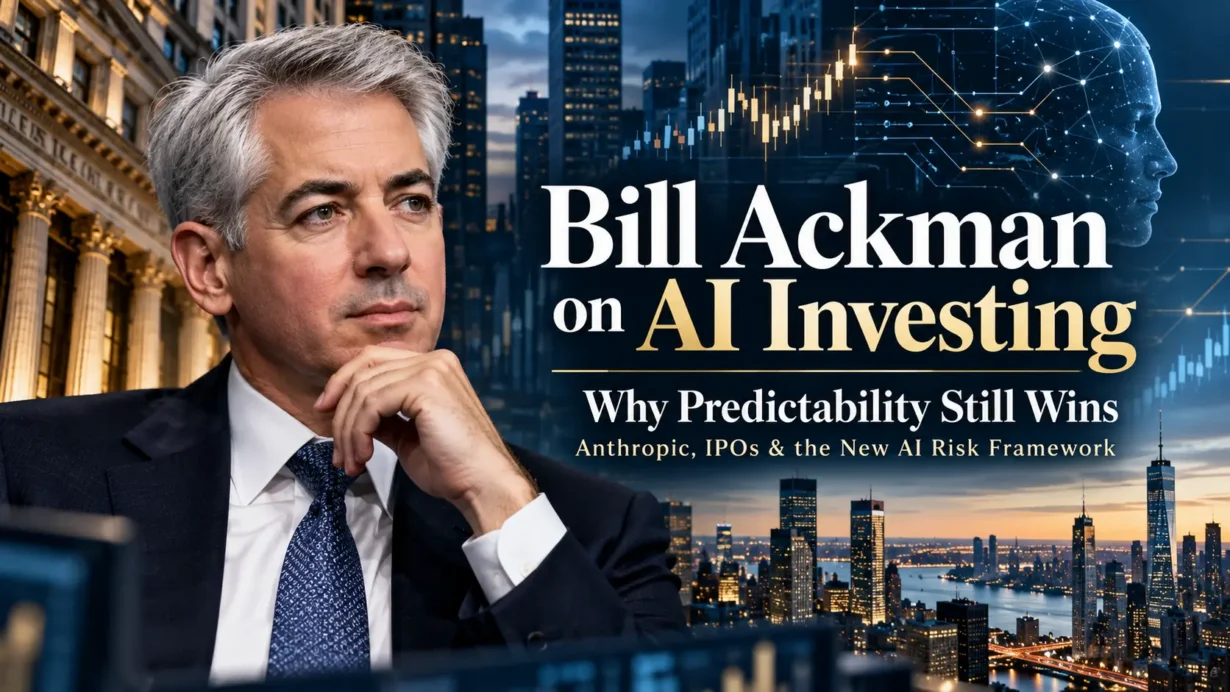
Bill Ackman’s September 30, 2026 Bloomberg Deals interview is unusually useful because it separates two ideas that investors often collapse into one: a company can be operationally extraordinary and still be difficult to underwrite as an equity investment. That distinction matters more in the current AI cycle than in almost any other part of the market. Revenue growth, product quality and strategic importance can all be real while the eventual distribution of shareholder returns remains uncertain.
“Perhaps the greatest business story I’ve ever seen” — but that does not automatically make Anthropic investable
Ackman’s praise for Anthropic was striking. He highlighted the company’s rapid revenue ramp and product quality, and noted that Pershing Square uses Claude internally. Yet his conclusion was not to chase the story. The deeper message is that business momentum and investment underwriting are different disciplines. For a long-duration investor, the relevant question is not merely whether demand is exploding today, but whether the company can preserve pricing power, unit economics and strategic relevance after the industry structure matures.
Frontier AI may face a moat problem even if demand keeps exploding
Ackman questioned whether frontier-model companies can maintain their market position as open-source and open-weight models become more capable. That is a critical point for valuation. The AI market can grow dramatically while competitive rents migrate away from model creators toward distribution platforms, enterprise software ecosystems, semiconductor suppliers, data-center infrastructure, proprietary data owners or applications with embedded customer workflows. Investors should therefore distinguish category growth from value capture. A trillion-dollar end market does not guarantee that every layer of the stack earns attractive returns on invested capital.
Predictability remains the hurdle rate: durable compounders beat spectacular uncertainty
Ackman said Pershing Square prefers businesses it can predict over a very long period and cited Microsoft, S&P Global, Visa and Mastercard as examples of the kind of companies that fit that framework. The commercial logic is straightforward: recurring demand, entrenched distribution, strong network effects, high switching costs and relatively visible reinvestment needs reduce the number of assumptions an investor must get right. In contrast, a hypergrowth AI company may require investors to forecast model leadership, capital intensity, inference costs, customer retention, pricing, regulation and technological substitution simultaneously. The more variables that must align, the wider the range of intrinsic-value outcomes.
Capital intensity is becoming as important as revenue growth
Ackman drew a line between durable growth companies and businesses that consume enormous amounts of capital while investors wait for future economics to “cross.” This is one of the most important analytical filters in the AI boom. When a company’s value proposition depends on persistent external financing, rapidly expanding compute budgets or distant free-cash-flow inflection points, the equity becomes increasingly sensitive to the cost of capital and to any slowdown in expected monetization. In that setup, great technology can coexist with mediocre shareholder returns if too much capital is required to defend the franchise.
The IPO market is signaling concentration, not necessarily broad confidence
Bloomberg framed part of the discussion around a market narrowly focused on a handful of major IPOs. That matters because a successful blockbuster listing can create the appearance of healthy market breadth even when investors remain highly selective elsewhere. For portfolio managers, the practical takeaway is to avoid using oversubscription or first-day price action as a substitute for fundamental underwriting. In concentrated markets, scarcity value can temporarily overpower valuation discipline.
2. Industry Chain and Sector Impact
Microsoft is the cleanest public-market beneficiary of Ackman’s framework. It participates directly in AI demand through cloud infrastructure and enterprise software, but its investment case does not depend on a single frontier model winning the race. Azure, Microsoft 365, security, developer tools and a deeply embedded enterprise distribution network create multiple monetization channels. That diversification is exactly what makes Microsoft easier to underwrite than a pure-play model developer: even if AI model economics compress, Microsoft can still capture value through distribution, workloads, productivity software and platform integration.
The second area favored by Ackman’s logic is financial and information infrastructure, particularly businesses such as Visa, Mastercard and S&P Global. These companies are not dependent on predicting which AI lab wins. Their value comes from network density, regulatory embeddedness, proprietary data, mission-critical workflows and recurring transaction or subscription economics. In a market increasingly obsessed with AI optionality, these “boring” compounders can become strategically more attractive because they offer growth without requiring investors to underwrite an unstable technology stack.
The pressure point is the capital-intensive frontier AI layer and any newly public company whose valuation assumes both sustained hypergrowth and durable market leadership. The risk is not that AI demand disappears; Ackman’s comments imply almost the opposite. The risk is that competition, open models and relentless infrastructure spending transfer a larger share of the economics to customers, cloud platforms, chip suppliers or downstream applications. Investors should be especially cautious when a valuation requires expanding margins at the same time capital expenditure and competitive intensity are also rising.
3. Investor Playbook
First, separate technological importance from equity attractiveness. A company can change the world and still produce a poor stock return if the entry valuation already discounts near-perfect execution. Before buying any AI-linked company, investors should ask a simple underwriting question: what must be true five to ten years from now for today’s valuation to work? If the answer depends on leadership in several uncertain variables at once, the required margin of safety should be materially higher.
Second, build AI exposure around value-capture durability rather than narrative purity. The strongest long-term setup may be a barbell: own established platforms with recurring cash flow and AI monetization pathways, while keeping speculative exposure to frontier-model or IPO stories deliberately small. The objective is to participate in upside without allowing a single technological forecast to dominate portfolio risk.
Third, use capital intensity as an operating defense line. Track free-cash-flow conversion, capex as a percentage of revenue, gross-margin progression, financing needs, customer concentration and the cost of inference. If revenue growth remains exceptional but each incremental dollar of growth requires disproportionately more capital, the business may be scaling in size faster than it is scaling in economic value. That is precisely the type of disconnect Ackman’s framework is designed to catch.
4. Frequently Asked Questions FAQ
What did Bill Ackman say about Anthropic and AI investing in 2026? In his September 30 Bloomberg interview, Ackman praised Anthropic’s extraordinary growth and product quality but did not treat those strengths as an automatic investment case. His emphasis was on whether a business can be predicted over a long horizon and whether its competitive advantage can survive technological change.
Why does Bill Ackman prefer Microsoft, Visa, Mastercard and S&P Global to many high-growth AI companies? These businesses have more visible economics, entrenched customer relationships, strong network effects or switching costs, and less dependence on a single technological outcome. That makes long-term cash flows easier to underwrite and reduces the number of assumptions required for the investment thesis to succeed.
How should investors interpret Bill Ackman’s comments before buying AI IPO stocks? Treat demand, valuation and durability as three separate questions. Strong demand proves that a market exists; it does not prove that a particular company will capture attractive returns. Investors should examine competitive moats, open-source substitution risk, capital requirements and the path to sustainable free cash flow before relying on headline growth or IPO scarcity.
免責聲明:本文僅供資訊分享,不構成投資建議。