
Key Takeaways
- RTX earned $88.6 billion in 2025 revenue: $64.2 billion from products and $24.4 billion from services. The service component is strategically significant because it monetizes equipment already deployed and, in Pratt & Whitney’s case, can extend across multiyear engine maintenance agreements. [1]
- The most defensible elements of the RTX business model are certified, deeply integrated intellectual property and high switching costs after an aircraft or weapon system enters service. Neither size alone nor an order backlog constitutes an economic moat.
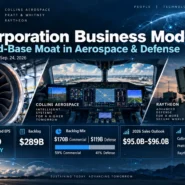
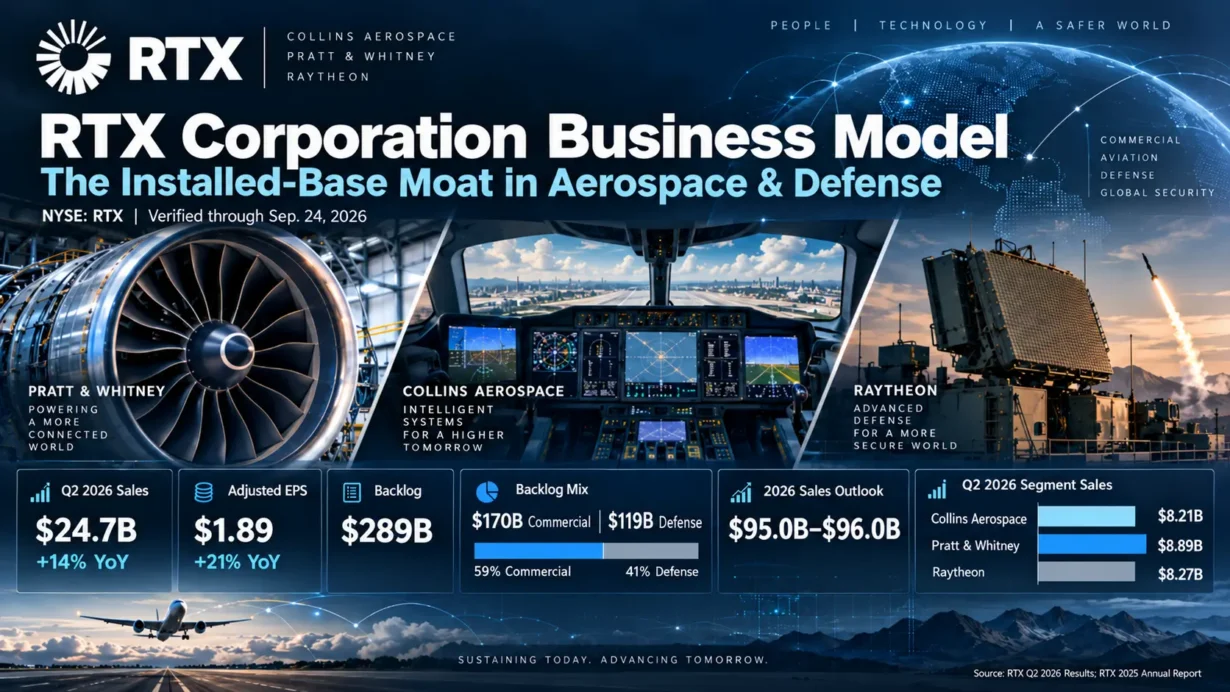
- At June 30, 2026, RTX reported approximately $289 billion of remaining performance obligations. Only about 25% was expected to become revenue within 12 months; approximately 45% related to Pratt & Whitney’s long-term commercial engine maintenance contracts, potentially running up to 20 years. [2]
- The 2026–2027 operating tests are GTF overhaul throughput and fleet availability, Raytheon production execution on recent munitions awards, and Collins Aerospace’s conversion of installed equipment into higher-value support contracts. [3] [6] [10]
- The central counterweight to the moat thesis is execution risk: Pratt & Whitney’s powder-metal inspections, fixed-price defense contract exposure, supply-chain bottlenecks, and demanding airline and government customers can absorb the economics of an otherwise durable franchise. [1] [2]
1. Business Model Breakdown
RTX is an aerospace and defense systems company operating through Collins Aerospace, Pratt & Whitney, and Raytheon. Its business should be understood as three related but economically distinct franchises, not a single defense contractor. Collins sells aircraft systems and support; Pratt & Whitney sells propulsion and engine lifecycle services; Raytheon develops and produces weapons, sensors, and integrated defense systems under government and allied-nation programs. Their common commercial logic is to enter platforms whose certification, integration, and replacement cycles create enduring customer relationships. [1]
Where the revenue comes from
RTX’s 2025 consolidated revenue was $88.603 billion, with products accounting for $64.171 billion, or approximately 72%, and services $24.432 billion, or approximately 28%. The three reported segment sales figures were $30.196 billion for Collins Aerospace, $32.916 billion for Pratt & Whitney, and $28.043 billion for Raytheon; $2.552 billion of eliminations and other adjustments reconcile these segment figures to consolidated sales. Segment sales include intercompany transactions and must not be added together as if all represented sales to outside customers. [1]
Collins Aerospace sells avionics, electrical power and environmental-control systems, flight controls, landing equipment, nacelles, cabin products, connectivity, and related aerospace and defense technologies. Its initial revenue comes largely from original-equipment installations and program deliveries; its longer-tail revenue comes from spare parts, repair, asset management, and contracted component availability. In 2025, Collins recorded $27.585 billion in external sales, including $6.118 billion in services. That distinction matters: a Collins product position is most economically valuable when it leads to subsequent high-reliability aftermarket work, not simply when an airframer increases production. [1]
Pratt & Whitney is the clearest illustration of the lifecycle model. An engine sale places an exceptionally complex asset into service, after which operators need approved parts, inspections, overhaul capacity, upgrades, technical support, and—in many cases—contracted maintenance. Pratt generated $32.916 billion of external revenue in 2025, including $14.449 billion of services. Its commercial engine economics therefore depend on the number of operating engines, utilization, shop-visit cadence, maintenance pricing, parts availability, and the actual cost of satisfying long-term service obligations. More shop visits may lift reported service revenue while hurting profitability if they arise from premature removals or uncompensated warranty work. [1] [2]
Raytheon has a different revenue-recognition and cash-flow profile. It wins development and production work for missiles, radars, air-defense systems, and related capabilities, then earns additional revenue from replenishment, integration, modernization, and sustainment. In 2025, Raytheon generated $27.892 billion of external revenue, comprising $24.063 billion in products and $3.829 billion in services. Its external revenue included $16.647 billion under fixed-price contracts and $11.245 billion under cost-type contracts. Fixed-price work offers operating leverage when factories execute efficiently, but it can turn unfavorable when labor, components, qualification, or engineering costs outrun the original estimate. [1]
The platform strategy: win the specification, then serve the installed base
RTX’s use of the word platform is primarily industrial rather than software-oriented. The entry point is a critical subsystem on an aircraft, engine family, fighter, or missile-defense architecture. Winning that slot requires years of engineering, customer qualification, and integration; the subsequent opportunity is to provide approved replacement parts, performance improvements, software and hardware upgrades, predictive maintenance, and operational support. At the corporate level, Collins systems and Pratt engines can serve overlapping commercial fleets, while Raytheon and Pratt participate in long-lived defense architectures. These adjacencies support engineering collaboration and selective cross-selling, but the divisions still operate under different procurement rules and customer economics. [1]
Recent examples show how the model is becoming more data-enabled without becoming a software-as-a-service business. Collins’ FlightSense and Dispatch offerings use fixed-rate service structures to provide component availability and maintenance predictability. On September 22, 2026, Collins announced two 12-year agreements covering Royal Brunei Airlines’ current and future Boeing 787 fleet. Pratt acquired AI-assisted inspection specialist Aiir Innovations in 2026, while RTX describes combining engine inspections, aircraft data, and maintenance planning to reduce downtime. These capabilities may improve customer retention and service productivity; RTX has not established a separately disclosed, high-margin SaaS revenue stream that should be valued independently of its industrial service contracts. [8] [9] [10]
The economic denominator: contract margins and cash conversion
The right financial question is not whether RTX can grow its backlog. It is how much incremental operating profit and cash can be earned as those obligations are performed. On a company-defined adjusted basis, 2025 segment operating margins were 16.2% for Collins, 8.3% for Pratt & Whitney, and 11.5% for Raytheon. RTX reported $7.94 billion of adjusted free cash flow in 2025; this is a non-GAAP metric, not a substitute for assessing working-capital requirements, capital expenditure, customer advances, or future service liabilities. Differing segment margins underscore why revenue mix and contract execution matter as much as headline growth. [4]
2. Deep Dive into Economic Moats
Under a Buffett-style framework, a genuine economic moat must protect excess returns against competitive erosion—not merely demonstrate an impressive product catalog. RTX’s most credible defenses are switching costs and specialized intangible assets. Network effects are limited; cost advantages exist in some programs but should be treated as conditional rather than universal.
Core moat I: switching costs embedded in safety-critical platforms
Once an engine, flight-control component, or defense subsystem has been designed into a platform and entered service, switching suppliers can require redesign, recertification, additional training, revised maintenance procedures, new inventories, and operational downtime. Airlines often prefer compatible parts and dependable support over a theoretical lower bid that introduces fleet complexity. Defense customers face additional interoperability, testing, logistical, and mission-readiness constraints. Pratt’s position on existing GTF-equipped fleets and its exclusive F135 propulsion role on the F-35 are concrete examples of embedded positions. [1]
The competitor’s challenge is therefore not just to engineer a replacement product. It is to fund a lengthy development and approval process, persuade aircraft manufacturers or procurement agencies to accept integration risk, and build enough global service capacity to protect customers after delivery. The defense is strongest on equipment already in service and on long-duration sustainment agreements; it is materially weaker at the next aircraft-design or competitive procurement decision, where rivals can contend for a new platform slot. Switching costs also constrain customers, so RTX must preserve trust through safety and reliability rather than assume indefinite pricing power.
Core moat II: intangible assets with costly qualification requirements
Engine architecture, materials science, proprietary repair procedures, flight-critical software, radar and missile engineering, and program-specific qualification data are intangible assets that can be difficult to duplicate. Their economic value emerges only when they are combined with regulatory approval, manufacturing repeatability, and sustained performance in the field. Pratt’s GTF Advantage received FAA and European aviation safety certification in 2025 for the A320neo family. The relevant advantage is not possession of a certification document in isolation, but the accumulated engineering, testing, tooling, and airline adoption required to secure and retain a certified position. [1]
Raytheon’s installed defense architectures create a similar, though procurement-dependent, advantage: an existing radar, interceptor, or command-and-control system can generate continuing integration, replenishment, and upgrade needs. The barriers are supported by classified or controlled technical requirements, testing history, and fielded interoperability. They are not absolute. Government customers control specifications and budgets, may support alternative suppliers, and can negotiate aggressively on pricing and intellectual-property access. Competition at the program-selection stage remains consequential.
Why network effects and scale are secondary
RTX can learn from a growing installed base. Flight data and maintenance histories can improve predictive diagnostics, planning, and turnaround times, particularly as Collins and Pratt deploy AI-assisted maintenance tools. That is a data and operational-learning advantage, not a classic network effect in which each additional user inherently makes the product more valuable to every other user. Data-access agreements, fragmented fleets, proprietary customer information, and safety validation limit automatic compounding. [9]
Manufacturing scale, supplier purchasing, global spare-parts inventories, and extensive maintenance networks may lower unit costs and shorten customer downtime. Yet scale also brings fixed costs, working-capital demands, and exposure to bottleneck suppliers. The 2023 powder-metal issue demonstrates that a vast installed base can magnify liabilities when a component problem propagates across fleets. Consequently, size is an enabling capability, not independent proof of a persistent cost advantage. [1] [2]
The durability test is whether switching costs and qualified technology consistently translate into attractive incremental returns after development expenditure, warranty costs, long-term service obligations, and capital invested to expand production. RTX’s reported margins and cash generation support an economically meaningful franchise, but they do not by themselves establish a companywide, through-cycle return on invested capital above its cost of capital. That conclusion requires sustained evidence across the engine recovery and defense capacity ramp.
3. Business Inflection Points & Future Catalysts
The defining inflection: the 2020 merger created a lifecycle-oriented aerospace and defense portfolio
RTX’s strategic break occurred on April 3, 2020. United Technologies separated Carrier and Otis and completed its all-stock merger with Raytheon Company, forming Raytheon Technologies, which later adopted the RTX name. The transaction combined the aerospace systems and engine franchises of Collins and Pratt with the former Raytheon’s defense technologies. Strategically, it concentrated the company around two end markets characterized by difficult qualification, long asset lives, and significant sustainment needs—rather than unrelated industrial activities. [5]
The 2023 restructuring from four businesses into Collins Aerospace, Pratt & Whitney, and Raytheon sharpened accountability and simplified the customer-facing portfolio. But the economic case for the combination is not a claim that a larger conglomerate must command a higher multiple. It is that diversified engineering capabilities and adjacent installed bases can support capital allocation and a wider set of lifecycle opportunities. The simultaneous risk is capital competition between businesses with fundamentally different cash-flow timing, regulatory obligations, and execution challenges. [5] [1]
Catalyst 1: GTF fleet recovery and the next engine upgrade cycle
The transmission mechanism is direct: greater maintenance, repair, and overhaul (MRO) throughput can reduce the number of aircraft waiting for engines, improve airline confidence, and allow Pratt to perform contracted service work with better labor and parts utilization. As reliability improves, fewer unplanned removals can reduce compensation and service-cost pressure; GTF Advantage deliveries could then reinforce the installed base. Pratt reported approximately 26% year-over-year growth in PW1100G-JM shop-visit output in 2025 and announced more than $100 million of U.S. MRO expansion investment in April 2026. In July, it disclosed more than 800 GTF orders and commitments year to date, with an engine order backlog exceeding 8,000; management expected GTF Advantage to enter service later in 2026. Orders and commitments should not be treated as completed deliveries. [1] [6] [7]
Observable indicators for 2026–2027 include quarterly shop-visit output, average turnaround time, affected aircraft-on-ground levels, parts availability, engine time on wing, and Pratt’s aftermarket contribution to operating margin and cash conversion. The failure case is material: RTX’s June 2026 filing still expected elevated affected A320neo aircraft-on-ground levels through 2026 and estimated approximately $0.7 billion of 2026 cash impact from the powder-metal matter. Additional durability findings, constrained overhaul capacity, supplier delays, or unexpected compensation can convert higher maintenance activity into lower-than-expected profit. [2]
Catalyst 2: defense orders convert into factory output
Raytheon’s near-term opportunity is to turn defense replenishment and multiyear procurement into predictable manufacturing volume. In February 2026, RTX announced government framework agreements intended to expand production of Tomahawk, AMRAAM, and Standard Missile variants. On August 17, the U.S. Navy separately confirmed a seven-year, $22.9 billion Tomahawk contract. This award occurred after the June 30 backlog measurement and should not be presumed to have been included in the previously disclosed $289 billion. A multiyear contract value is also not the same as revenue or free cash flow recognized immediately. [11] [12]
The economic mechanism is higher throughput across established production lines: spreading overhead across more units and improving supplier scheduling may strengthen margins while increasing delivery capacity. The metrics to track are funded orders and delivery releases, production rates, on-time shipment performance, program-level estimate-at-completion adjustments, Raytheon segment margin, inventory turns, and operating cash conversion. The principal risks are labor and propulsion or electronics bottlenecks, qualification setbacks, changes in appropriations or purchase timing, export approvals, and fixed-price cost overruns. Higher authorized spending alone does not establish a profitable ramp. [1] [2] [11]
Catalyst 3: Collins converts a larger installed base into contracted services
Commercial aircraft production and flight activity expand the population of Collins-equipped systems requiring future support. The higher-quality revenue opportunity is attachment of multiyear repair, component-pooling, and availability agreements, where operational data and logistics can improve uptime and customer retention. The September 2026 Royal Brunei agreements provide a recent, specific example of this model. For 2026–2027, monitor commercial aftermarket growth relative to original equipment, new contract attachment, recurring services revenue, repair turnaround, and adjusted segment margin—not just airframer delivery announcements. [1] [10]
Its main risks are airframer production volatility, airline financial health, import tariffs, constrained repair capacity, and fixed-rate agreements priced too tightly to cover inflation or reliability shortfalls. Digital maintenance tools can improve the service proposition, but measured cost savings and customer renewals are more informative than claims about artificial intelligence alone. [9]
Catalyst 4: F135 modernization provides program-specific optionality
Pratt remains the F135 supplier for all three F-35 variants. In September 2026, the company announced completion of a risk-reduction design review for the Engine Core Upgrade intended to support Block 4 and later capabilities. The potential transmission mechanism is additional engineering, integration, production, and eventual sustainment work within an established propulsion architecture. Relevant milestones are funded program decisions, design qualification, flight-test and integration progress, and agreed production schedules. Qualification delays, changes to the aircraft upgrade timetable, evolving program requirements, or contracting constraints could defer the benefit. It is a measurable longer-duration option, not a justified assumption of a near-term earnings step-up. [1] [13]
What the latest financial baseline does—and does not—confirm
RTX reported $24.708 billion of second-quarter 2026 revenue, up approximately 14% year over year, and $2.811 billion in GAAP operating profit. The company raised its July 2026 full-year guidance to $95.0–$96.0 billion in adjusted sales, $7.10–$7.25 in adjusted earnings per share, and $8.50–$8.75 billion in adjusted free cash flow. Guidance reflects management expectations and non-GAAP definitions; it is not a realized result or a valuation conclusion. The June quarter ended before the August Tomahawk award and September service announcements, so those later developments should be evaluated separately rather than retroactively inserted into June results. [2] [3]
4. Key FAQs
How does RTX make money from Pratt & Whitney engines after the original aircraft engine sale?
Through approved replacement parts, engine overhauls, technical support, upgrades, and multiyear maintenance arrangements. These services monetize the installed fleet as engines accumulate flight hours. In 2025, Pratt reported $14.449 billion of service revenue, but that should not be mistaken for guaranteed high-margin recurring income: premature removals, customer compensation, and the cost assumptions embedded in long-term agreements determine the profit ultimately retained. [1] [2]
Does RTX’s $289 billion backlog mean it will earn $289 billion in the next year?
No. The $289 billion figure was RTX’s total remaining performance obligations as of June 30, 2026, not one-year guidance. RTX expected roughly 25% to be recognized as revenue in the subsequent 12 months. About 45% related to Pratt’s long-term commercial engine maintenance arrangements, typically realized over periods of up to 20 years. Actual timing and profitability depend on deliveries, flight activity, contract performance, costs, and potential changes in estimates. The August 2026 Tomahawk award postdated this June balance. [2] [11]
What could prevent RTX from expanding profit margins in 2026 and 2027 despite growing defense and aerospace demand?
Demand does not eliminate execution risk. Pratt could face additional inspection, replacement, and airline-compensation costs; Raytheon could incur supplier delays or unfavorable cost estimates on fixed-price programs; Collins could face OEM schedule disruption and contract-pricing pressure. RTX also disclosed government contract disputes, litigation, and an SEC investigation relating to the company’s 2023 powder-metal disclosures; the existence of an investigation does not establish wrongdoing or predict its outcome. Segment margins, incremental free cash flow, GTF fleet availability, and defense production yield provide more useful evidence than backlog growth in isolation. [1] [2]
5. Conclusion
The corporate DNA of RTX is the monetization of technically qualified, mission-critical installed assets. Collins integrates systems across aircraft and earns downstream support revenue; Pratt installs and services propulsion systems across decades of flight; Raytheon embeds hardware and engineering into defense architectures that require replenishment, upgrades, and sustainment. The 2020 merger brought these businesses into a concentrated aerospace-and-defense portfolio, while the 2023 realignment established a simpler three-segment operating structure. [1] [5]
Its strongest economic defenses are the cost of replacing an approved platform component and the intellectual property, testing history, and service infrastructure needed to earn that approval in the first place. Those advantages support revenue visibility and can defend customer relationships; they do not eliminate competition on new programs, guarantee price increases, or immunize shareholders from operational liabilities.
For the next one to two years, the key research question is whether RTX can turn that installed-base position and its enlarged order book into higher-quality earnings and cash. Evidence would include fewer disrupted GTF aircraft, faster profitable maintenance throughput, reliable munitions production, stronger Collins service attachment, and cash conversion that holds up after capital expenditure and customer obligations. If those measures disappoint, backlog and engineering depth alone will be insufficient evidence of durable excess returns.
Primary Sources and Verification
All factual sources below are original corporate disclosures, SEC filings, or U.S. government statements. Company forecasts, program targets, and product performance claims are identified in the article as management expectations rather than independently established future results. Figures are presented as of their stated reporting dates.
- RTX Corporation, 2025 Form 10-K (SEC; filed February 6, 2026) — business descriptions, 2025 revenue mix, segment detail, program background, and risk factors.
- RTX Corporation, Q2 2026 Form 10-Q (SEC; filed July 23, 2026) — quarter results, remaining performance obligations, segment financials, powder-metal update, and legal disclosures.
- RTX, Second-Quarter 2026 Earnings Release, Exhibit 99 to Form 8-K (July 23, 2026) — reported earnings, backlog classification, and updated 2026 non-GAAP guidance.
- RTX, 2025 Results and Initial 2026 Outlook (January 27, 2026) — segment adjusted margins and full-year cash generation.
- Raytheon Technologies, Completion of United Technologies and Raytheon Merger (April 3, 2020); RTX, 2023 Annual Report — merger and subsequent segment realignment.
- RTX, GTF Engine Orders and Commitments Update (July 22, 2026) — GTF backlog and anticipated GTF Advantage entry into service.
- RTX, Pratt & Whitney U.S. MRO Expansion (April 21, 2026) — planned engine maintenance capacity investment.
- RTX, Pratt & Whitney Acquisition of Aiir Innovations (July 15, 2026) — AI-assisted borescope inspection investment.
- RTX, AI and Data in Aircraft Maintenance (September 18, 2026) — Collins and Pratt maintenance analytics deployment; operational performance figures are company-reported.
- RTX, Collins–Royal Brunei FlightSense and Dispatch Agreements (September 22, 2026) — two 12-year aircraft component service agreements.
- U.S. Navy, Tomahawk Contract Award to Raytheon (August 17, 2026) — official confirmation of the seven-year, $22.9 billion award.
- RTX, Raytheon Munitions Production Framework Agreements (February 4, 2026) — announced production-expansion frameworks.
- RTX, F135 Engine Core Upgrade Design Milestone (September 15, 2026) — development progress and intended Block 4 capabilities.
Disclaimer: This article is intended solely for business logic discussion and corporate research purposes, and does not constitute investment advice of any kind.