


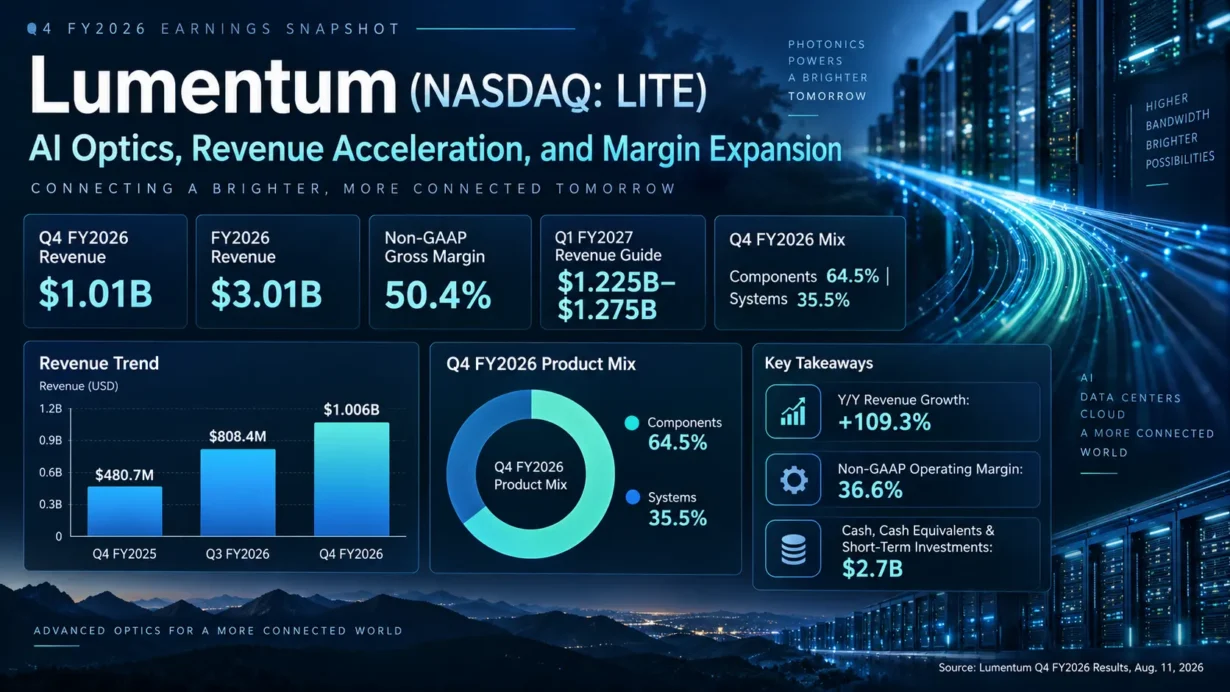
Key Takeaways
- Lumentum’s economic engine is no longer best understood as a legacy telecom-optics business. In fiscal 2026, revenue reached $3.014 billion, with $2.006 billion from Components and $1.008 billion from Systems, as AI data-center demand pulled the company deeper into high-speed lasers, cloud transceivers and optical circuit switching.
- The strongest moat is not brand awareness or a network effect. It is the combination of specialized photonics intellectual property, hard-to-replicate semiconductor and MEMS manufacturing know-how, high-volume yield learning, and customer qualification requirements that raise the cost and time required to displace an incumbent supplier.
- The 2023 Cloud Light acquisition was the pivotal strategic move because it pushed Lumentum downstream from supplying critical optical components into selling complete high-speed cloud modules. That created a component-to-system platform, but it also introduced a deliberate form of coopetition because some module competitors remain customers for Lumentum components.
- The next major growth vectors are the 1.6T cloud-transceiver ramp, Optical Circuit Switches, and co-packaged-optics-related ultra-high-power lasers and external laser source modules. Each can expand revenue content per AI cluster, but each is highly dependent on customer architecture choices, qualification, yield and manufacturing execution.
- Customer concentration is the clearest counterweight to the moat. Two unnamed end customers represented 41.6% of fiscal 2026 revenue combined, giving large hyperscale and OEM buyers substantial negotiating power and making product-level technological leadership less equivalent to company-wide pricing power.
1. Business Model Breakdown
What Lumentum actually sells
Lumentum Holdings Inc. is a photonics manufacturer whose products sit in the physical layer of data movement. Its portfolio spans semiconductor laser chips, laser subassemblies, wavelength-management products, line subsystems, optical modules, optical circuit switches, industrial lasers and 3D-sensing light sources. The common denominator is control of light: generating it, modulating it, routing it, amplifying it and packaging it into systems that move data or process materials.
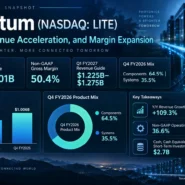
The company’s fiscal 2026 reporting structure makes the monetization model unusually clear. Lumentum now disaggregates revenue into Components and Systems. Components are building blocks sold into customers’ products and networks, including semiconductor laser chips, laser subassemblies, line subsystems and wavelength-management systems. Systems are complete deployable products, including optical modules, optical circuit switches and industrial lasers. In fiscal 2026, Components generated $2.006 billion, or roughly two-thirds of company revenue, while Systems generated $1.008 billion, or roughly one-third. In the fourth quarter, Systems had already risen to 35.5% of revenue. These figures are reported in the company’s FY2026 Form 10-K and FY2026 results release.
This is a hardware and manufacturing business rather than a recurring-software model. Revenue is generated primarily when products ship, and pricing is exposed to normal optical-industry average-selling-price pressure. The company’s own fiscal 2026 filing is instructive: cloud transceiver revenue rose by more than 173% on higher shipment volume, but that growth was partially offset by lower average selling prices. That matters because rapid unit growth does not automatically create pricing power. Lumentum must continually move to higher speeds, higher optical power, better efficiency and higher levels of integration just to remain economically differentiated.
The platform strategy: own more of the optical stack
Lumentum’s platform strategy is best understood as vertical control of scarce photonic building blocks rather than a conventional software platform. At the component layer, it designs and manufactures indium-phosphide-based lasers and other advanced optical devices. At the module layer, it uses those components in high-speed transceivers and data-interconnect products. At the switching layer, it applies decades of wavelength-selective-switch and MEMS expertise to optical circuit switches. At the emerging co-packaged-optics layer, it is positioning continuous-wave and ultra-high-power lasers, and external laser source modules, as the light engines that feed silicon-photonic systems.
This architecture creates several ways to monetize the same underlying photonics capabilities. Lumentum can sell a laser to a transceiver manufacturer, sell a complete transceiver to a cloud operator, sell coherent components into data-center interconnect, and sell an optical switch into the same broader AI infrastructure buildout. The company describes its target network domains as scale-out, scale-up and scale-across: optics connecting servers and switches across the data center, optics increasingly penetrating the accelerator fabric inside AI clusters, and optics linking geographically separated data centers. That broad positioning is described in the Lumentum OFC 2026 Investor Briefing and the company’s FY2026 Form 10-K.
Why the profit model can scale faster than revenue
The underlying economics resemble a high-fixed-cost compound-semiconductor and precision-assembly business. Wafer fabs, packaging lines, test infrastructure and engineering teams must be funded before full utilization is achieved. Once demand loads qualified capacity, higher volume can improve absorption of fixed manufacturing costs and lift yields through process learning. This operating leverage was visible in fiscal 2026: revenue increased 83.2% year over year to $3.014 billion, while GAAP gross margin rose to 41.7% from 28.0%. By the fourth quarter, GAAP gross margin reached 47.4% and GAAP operating margin reached 27.8%.
That margin expansion should not be interpreted as permanently structural. Product mix matters, average selling prices can fall, new products can initially carry weak yields, and underutilized capacity can quickly reverse the economics. The same manufacturing intensity that can create operating leverage in an upcycle can create deleverage when demand pauses. Lumentum explicitly identifies yield, capacity utilization, pricing, supply constraints and customer qualification as material variables in its filings.
A second economic lever is vertical integration. When Lumentum places internally produced laser content into its own modules or systems, it has the opportunity to capture a larger portion of the bill of materials, coordinate design across components and packaging, and reduce dependency on outside suppliers. Management has specifically tied the cloud-module roadmap to greater internal laser content. The strategic objective is therefore not merely to sell more boxes; it is to increase proprietary optical content per deployed AI network while improving manufacturing economics as volumes scale.
2. Deep Dive into Economic Moats
Core moat #1: Intangible assets embedded in process technology, not just patents
Lumentum’s most defensible intangible asset is a layered body of photonics know-how that spans device physics, compound-semiconductor process technology, optical packaging, MEMS switching, reliability engineering and production yield. As of June 27, 2026, the company reported approximately 1,000 U.S. patents, 900 foreign patents and roughly 670 pending patent applications. The patent portfolio is relevant, but the more important economic asset is tacit manufacturing knowledge: recipes, process controls, packaging techniques, testing data and accumulated yield learning that do not transfer simply because a competitor can read a patent.
The distinction matters in photonics. A rival does not catch up by designing a nominally equivalent laser on paper. It must reproduce performance, reliability and manufacturability at volume, then prove that capability inside customer-approved production lines. Lumentum’s strategic acquisitions reinforced this stack over time. Oclaro added indium-phosphide laser, photonic-integrated-circuit and coherent capabilities; NeoPhotonics added high-speed optical technology; Cloud Light added leading-edge cloud transceiver design, assembly, test and packaging. The resulting company has assembled a broad chain from optical semiconductor to finished system rather than relying on a single product franchise.
The latest competitive evidence is particularly relevant in high-speed EMLs, continuous-wave and ultra-high-power lasers, and optical switching. In its OFC 2026 materials, management described a four-fab InP footprint and a long history of increasing EML data rates, while also showing how its wavelength-selective-switch MEMS heritage is being reused inside optical circuit switches. These are company claims and should be treated as such, but they illustrate why Lumentum’s moat is better described as a reusable photonics process platform than as a single-generation product lead.
What would it cost a competitor to catch up? The required investment is not limited to R&D spending. It includes recruiting specialized compound-semiconductor talent, building or securing qualified wafer capacity, developing packaging and test processes, absorbing years of yield learning, establishing reliability histories, and funding capacity before customer demand is fully certain. That combination raises both the capital cost and the time cost of entry.
Core moat #2: Switching costs created by qualification, reliability and design-in friction
Lumentum’s second major moat is customer switching friction. The company’s 10-K states that some customers purchase only evaluation units before a manufacturing line is qualified for volume production, and that new or relocated production lines may need to be re-qualified. In mission-critical optical networking, switching suppliers can therefore require engineering validation, process qualification, reliability testing and supply-chain re-approval rather than a simple purchase-order change.
This creates an incumbent advantage when Lumentum has already been designed into a high-volume platform. A hyperscaler or network-equipment manufacturer may still dual-source for resiliency and pricing leverage, but replacing a proven supplier can impose qualification time, engineering resources and execution risk. The same dynamic is visible in optical circuit switching, where field reliability and high-volume manufacturing readiness are central to customer adoption.
Importantly, this switching-cost moat is bilateral. It protects Lumentum after qualification, but it also slows Lumentum when the company opens a new fab, moves production or introduces a new contract manufacturer. The Greensboro InP facility therefore cannot become economically productive merely by installing equipment; processes and customer qualifications must also ramp. A moat that protects incumbency can simultaneously lengthen the payback period on new capacity.
Why network effects are not the moat
Lumentum does not possess a classic network effect. The value of one customer’s laser, transceiver or optical switch does not automatically increase because another customer adopts the same Lumentum product. Industry standards can enlarge the addressable market, but standardization can also make supplier substitution easier over time. For that reason, describing Lumentum’s market growth or hyperscaler adoption as a network effect would be conceptually incorrect.
Cost advantage: real at the product level, but not yet an unquestionable enterprise-wide moat
Lumentum explicitly targets cost leadership and vertical integration, and there are credible pathways to lower unit cost: internal laser supply, wafer-fab scale, higher yields, common photonics platforms and greater utilization of fixed manufacturing assets. Those advantages can be meaningful in bottleneck products where qualified capacity is scarce. However, the historical volatility of optical markets and the company’s own sensitivity to underutilization and yield indicate that cost advantage should be viewed as conditional rather than permanent.
The most defensible conclusion is that Lumentum has a stronger moat in high-performance photonic components and qualified manufacturing processes than in standardized finished modules. The latter can grow rapidly, but module markets are exposed to aggressive pricing and powerful customers. Long-term excess economic returns are therefore plausible where Lumentum controls a scarce optical bottleneck and keeps the yield and reliability lead, but they should not be assumed across the whole portfolio. Customer concentration and annual price erosion can transfer a meaningful portion of the economic surplus back to hyperscale buyers.
3. Business Inflection Points & Future Catalysts
The strategic inflection point: Cloud Light changed Lumentum from a component supplier into a fuller cloud-optics platform
Lumentum’s corporate history is a sequence of capability accumulation. The company was incorporated in 2015 and spun out of JDS Uniphase that August. It acquired Oclaro in 2018, NeoPhotonics and IPG Photonics’ telecom transmission product lines in 2022, and Cloud Light in 2023. In fiscal 2026 it reorganized from two reportable segments into a single integrated enterprise, a structure consistent with the increasingly shared technology and manufacturing base across its portfolio.
The 2023 Cloud Light acquisition stands out as the most important strategic turning point. Earlier acquisitions strengthened Lumentum’s component technology and coherent-optics position, but Cloud Light directly expanded the company into high-speed cloud transceivers at meaningful scale. When the deal was announced, Lumentum said nearly all of Cloud Light’s trailing revenue came from 400G-or-higher transceivers and that more than half of its latest-quarter transceiver revenue came from 800G modules. The acquisition therefore moved Lumentum downstream at exactly the point when AI clusters were beginning to force a step-change in optical bandwidth.
The strategic effect is larger than the acquired revenue. Cloud Light gave Lumentum a downstream vehicle for internal component pull-through. That means the company can monetize its laser technology twice: externally as a component supplier and internally as content inside its own modules. The tradeoff is channel conflict. Lumentum acknowledges that some competitors are also customers. Managing that coopetition is central to the platform strategy: the company must capture more system value without alienating customers that still depend on its components.
Official background on this transition is available in Lumentum’s Cloud Light acquisition announcement, Oclaro completion announcement, and NeoPhotonics completion announcement.
Catalyst 1: 1.6T transceivers can turn component leadership into higher system content
The transmission mechanism is straightforward. AI clusters require more optical bandwidth per switch and per accelerator generation. As 1.6T modules replace 800G modules, Lumentum can benefit from higher-speed EML demand at the component level while also selling complete 1.6T transceivers at the Systems level. If internal continuous-wave or EML content rises inside Lumentum modules, the company may also retain more value internally and improve supply-chain control.
The most useful indicators are 1.6T volume shipments, cloud-module revenue growth, Systems revenue growth, internal laser attach rates, gross margin and evidence that yields improve as production scales. The company’s August 2026 results stated that 1.6T adoption was advancing and that the cloud-module business was beginning to layer into growth. Lumentum’s first-quarter fiscal 2027 guidance of $1.225 billion to $1.275 billion in revenue and 39.5% to 40.5% non-GAAP operating margin provides a near-term benchmark for whether the broader AI ramp is translating into operating leverage.
The main failure modes are aggressive price erosion, weaker-than-expected 1.6T adoption, lower manufacturing yields, supply bottlenecks and customer concentration. Fiscal 2026 already demonstrated the pricing risk: cloud-transceiver revenue expanded sharply while average selling prices declined. A strong demand curve can therefore coexist with weak unit economics if competition captures the productivity gains through lower prices.
Catalyst 2: Optical Circuit Switches can move Lumentum into a higher-value control point in AI networks
Optical Circuit Switches are strategically different from transceivers. Instead of merely transmitting data over a link, an OCS directly reconfigures optical paths. If hyperscale architectures use OCS to manage massive east-west AI traffic, Lumentum gains exposure to a higher-level system function while reusing its MEMS and wavelength-management expertise.
The early commercial evidence is material but still incomplete. Lumentum reported more than $90 million of OCS revenue in fiscal 2026. In March 2026, management also disclosed a multi-year, multi-billion-dollar OCS agreement, more than $400 million of backlog expected to be fulfilled in the second half of calendar 2026, and a management objective of exceeding a $1 billion annualized revenue run rate in 2027. The backlog and agreement are concrete commercial signals; the future run-rate figure remains a forward-looking management target and should not be treated as realized revenue.
The observable indicators are quarterly OCS revenue, Systems mix, backlog conversion, manufacturing yield and the number of customers adopting the architecture. The key risks are customer concentration, schedule changes, alternative network architectures, product qualification and the difficulty of scaling a complex new system without quality issues. Because hyperscalers can redesign network topology, even technically strong optical hardware remains exposed to architecture risk.
Catalyst 3: Co-packaged optics can expand Lumentum from inter-rack optics into the compute fabric itself
The largest strategic upside comes from optics moving closer to the accelerator. Traditional pluggable transceivers dominate many scale-out links, but higher bandwidth and tighter power budgets are pushing optical I/O toward co-packaged optics and related architectures. Lumentum’s role is to supply high-power light sources, ultra-high-power laser chips and external laser source modules that feed silicon-photonic engines.
This catalyst gained commercial validation in 2026. NVIDIA and Lumentum announced a multi-year strategic partnership that includes a nonexclusive multibillion-dollar purchase commitment, future capacity-access rights for advanced laser components and a $2 billion NVIDIA investment in Lumentum. By August, Lumentum also said it had received an initial order for external laser source modules while demand for ultra-high-power CPO lasers was increasing. These developments reduce the uncertainty around customer interest, but they do not eliminate adoption, pricing or execution risk. The official terms are described in the Lumentum-NVIDIA strategic partnership announcement and the corresponding NVIDIA investor-relations release.
The transmission mechanism is potentially powerful: if optics moves from rack-to-rack links into scale-up links around accelerators, the number of optical lanes and required laser power per AI cluster can rise substantially. Lumentum can then monetize both devices and external laser assemblies. The company has also acquired a 240,000-square-foot Greensboro, North Carolina facility to expand 6-inch InP manufacturing. Lumentum expects that fab to ramp production in mid-2028, making it more relevant to the outer edge of the next two-year catalyst window than to immediate fiscal 2027 earnings.
The most useful indicators are ultra-high-power laser shipments, external-laser-source orders, customer qualification milestones, evidence of CPO deployments in production rather than demonstrations, and progress retrofitting and qualifying the Greensboro fab. The major risks are slower CPO adoption, architecture shifts toward alternative optical approaches, delayed qualification, yield problems and capital underutilization. The $2 billion strategic investment improves funding flexibility, but it also deepens customer and ecosystem concentration and introduces future equity dilution considerations through convertible preferred stock.
The risk dashboard: what can break the thesis even if AI demand remains strong
The first risk is bargaining power. In fiscal 2026, Lumentum’s two largest end customers accounted for 26.6% and 15.0% of revenue, respectively. Large hyperscale customers can demand lower prices, capacity commitments, favorable warranties and other commercial terms. A product can be technologically differentiated yet still generate only moderate economic rent if the buyer controls the negotiation.
The second risk is manufacturing execution. Lumentum’s manufacturing processes are complex, and the company acknowledges that poor yields, facility moves and qualification delays can materially affect margins and deliveries. Capacity expansion is therefore not a simple capital-expenditure equation. The value of a fab is determined by qualified output at acceptable yield, not by installed square footage.
The third risk is technology substitution. Lumentum’s current advantage in EMLs, InP lasers and MEMS-based optical switching can be challenged by new materials, silicon-photonics architectures, alternative switching technologies or customer-designed solutions. The company itself warns that customers may vertically integrate. A durable moat therefore requires repeated leadership across generations rather than a one-time technology win.
The fourth risk is portfolio complexity. Moving from components to modules to systems can capture more value, but it also increases execution burden and can create conflicts with component customers. The strategy works best if Lumentum remains the indispensable photonics supplier even when customers choose not to buy the complete system.
4. Key FAQs
How does Lumentum make money from AI data centers?
Lumentum makes money from AI data centers at multiple layers of the optical stack. It sells high-speed laser chips and assemblies used in transceivers, complete high-speed optical modules, coherent components for data-center interconnect, optical circuit switches, and emerging high-power light sources for co-packaged optics. The strategic advantage is that the same AI infrastructure buildout can create demand for both Components and Systems. That expands Lumentum’s revenue content per network, although the economics differ by product and are subject to price erosion, yield and customer negotiation.
What is Lumentum’s biggest competitive advantage in optical networking?
The most defensible advantage is the combination of specialized photonics technology and qualified high-volume manufacturing. Lumentum’s value does not come from patents alone; it comes from being able to turn advanced InP lasers, optical components and MEMS-based switching technology into reliable products at scale. Customer qualification adds switching friction once a production line is approved. This advantage is strongest in performance-critical bottleneck components and less absolute in standardized modules where customers can multi-source and negotiate aggressively.
Is Lumentum mainly a telecom company or an AI infrastructure company now?
It is increasingly an AI and cloud photonics supplier, but it is not purely an AI company. Lumentum still sells into long-haul, metro, submarine, industrial-laser and sensing markets. What changed is the center of gravity. Fiscal 2026 growth was driven heavily by laser chips, cloud transceivers and early OCS shipments tied to AI and cloud infrastructure. The most useful way to classify the company today is as a diversified photonics manufacturer whose highest-growth capital allocation is increasingly directed toward AI data-center connectivity.
5. Conclusion
Lumentum’s corporate DNA is the conversion of deep photonics know-how into qualified, high-volume optical hardware. The company began as a 2015 JDSU spin-off, accumulated InP, coherent-optics and packaging capabilities through acquisitions, and then used Cloud Light to move farther downstream into complete cloud modules. Fiscal 2026 marked the point at which that architecture became economically visible: Components and Systems both expanded rapidly, OCS became a meaningful new revenue stream, and the company achieved a substantial margin recovery as AI demand loaded manufacturing capacity.
The moat is real, but it is narrower and more technical than a simple market-leadership narrative. Lumentum’s best defenses are device and process know-how, fab and packaging capability, reliability history, yield learning and customer qualification. Those advantages can create strong economics around scarce optical bottlenecks. They do not create a classic network effect, and they do not neutralize hyperscaler purchasing power. The fact that two customers represented more than 40% of fiscal 2026 revenue is a reminder that supplier differentiation and supplier bargaining power are not the same thing.
The next phase of the Lumentum business model depends on whether the company can convert its component advantage into a broader system franchise without sacrificing pricing discipline or channel relevance. The 1.6T ramp, OCS commercialization and CPO-related laser demand are the critical tests. If Lumentum can preserve yield, qualify new capacity and remain architecturally relevant as optics moves deeper into AI clusters, its vertical photonics platform can support a larger share of data-center spending. If pricing, customer concentration, technology substitution or manufacturing execution deteriorate, the same capital intensity can magnify downside as quickly as it magnified the fiscal 2026 recovery.
Primary Sources
- U.S. SEC — Lumentum Holdings Inc. FY2026 Form 10-K
- Lumentum Investor Relations — Fourth Quarter and Full Fiscal Year 2026 Results
- Lumentum Investor Relations — OFC 2026 Investor Briefing
- Lumentum Investor Relations — NVIDIA Strategic Partnership With Lumentum
- NVIDIA Investor Relations — Strategic Partnership With Lumentum
- Lumentum Investor Relations — Greensboro U.S. InP Manufacturing Facility
- Lumentum Investor Relations — Cloud Light Acquisition Announcement
- Lumentum Investor Relations — NeoPhotonics Acquisition Completion
- Lumentum Investor Relations — Oclaro Acquisition Completion
Disclaimer: This article is intended solely for business logic discussion and corporate research purposes, and does not constitute investment advice of any kind.