
Key Takeaways
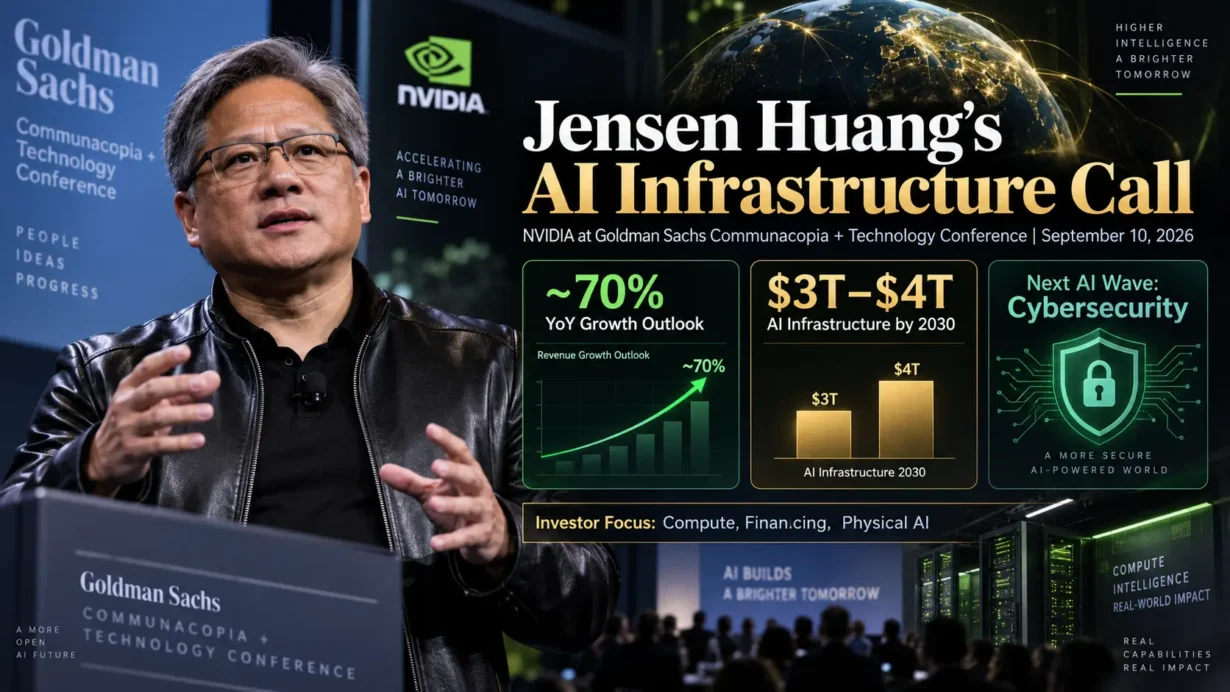
- Jensen Huang reaffirmed confidence that Nvidia can grow revenue roughly 70% year over year next year, framing supply availability—not end-demand—as the primary execution constraint.
- His earlier $3 trillion to $4 trillion AI infrastructure spending outlook for 2030 remains intact because generative computing requires continuous token production rather than the mostly retrieval-based architecture that defined the previous computing era.
- Nvidia is deliberately moving beyond the economics of a chip vendor toward a full-stack “AI factory” model, increasing its share of global data-center capital expenditure across compute, networking, systems and software.
- Huang argued that Nvidia compute is becoming a financeable, asset-backed productive asset, a shift that could unlock more capital for neoclouds and regional AI infrastructure while intensifying scrutiny of utilization, leverage and circular-financing risk.
- Cybersecurity may be the next major commercial AI use case after coding, creating a potentially important second-order opportunity for security platforms such as CrowdStrike as AI-driven red teaming and blue teaming move toward continuous operation.
Nvidia CEO Jensen Huang’s September 10, 2026 appearance at the Goldman Sachs Communacopia + Technology Conference was the most investable big-tech public discussion of the past week because it addressed the questions that matter most to equity holders: the durability of AI capital expenditure, Nvidia’s ability to sustain extreme growth, the financing architecture behind the buildout, and where the next layer of AI monetization could emerge. Huang’s later All-In Summit appearance on September 14 kept the policy debate around AI acceleration in the headlines, but the Goldman Sachs discussion offered far more quantifiable signals for portfolio construction.
1. Reconstructing the Core Views
“We could grow 70% year-over-year.”
For investors, the important point is not the headline percentage alone. Huang’s confidence rests on a thesis that Nvidia is facing a capacity problem rather than a demand problem. The company is trying to expand supply across wafers, advanced packaging, memory, connectors, power delivery and complete systems while simultaneously securing downstream access to land, power and data-center shells. That changes the analytical framework. If demand is genuinely running ahead of available infrastructure, near-term upside is less about finding customers and more about converting backlog and ecosystem demand into energized, revenue-producing capacity. The key risk is equally clear: a supply bottleneck, power constraint or construction delay can postpone revenue even when customer demand remains intact.
AI infrastructure spending is still tracking toward $3 trillion to $4 trillion by 2030
Huang’s deeper argument is that generative AI represents a change in computing architecture, not simply another software cycle. Traditional internet computing mostly retrieved pre-existing information; generative systems must produce answers in real time, repeatedly, for users and increasingly for autonomous agents. At the same time, the historical cost declines delivered by Moore’s Law are slowing. The combination of more computation per task, more AI agents, larger models and weaker transistor-level deflation implies that the physical footprint of computing must expand. From an investor’s perspective, that supports a longer-duration capital-expenditure cycle across accelerators, networking, memory, power systems, cooling and data centers rather than a short-lived GPU replacement boom.
Nvidia wants investors to value compute as productive infrastructure, not depreciating IT equipment
One of Huang’s most consequential ideas was the transition of Nvidia compute into an “investable asset.” The strategic objective is straightforward: if lenders and infrastructure investors believe GPU systems retain durable cash-generating value, AI capacity can be financed more like infrastructure and less like rapidly obsolete enterprise hardware. That lowers the capital barrier for neoclouds and regional providers, broadens Nvidia’s distribution network and potentially expands the addressable buyer universe. But it also creates a new due-diligence requirement. Investors must distinguish real third-party utilization and contracted demand from financing structures that merely recycle capital through suppliers, customers and capacity backstops. The bullish case strengthens only if utilization, rental economics and customer cash flows remain robust as newer architectures arrive.
Cybersecurity could become AI’s next major killer application
Huang described cybersecurity as a natural extension of AI coding: if models can write software, they can also search for vulnerabilities, attack weaknesses, patch systems and run defensive workflows continuously. This matters because continuous cybersecurity inference has a very different revenue profile from occasional chatbot usage. It can create persistent compute consumption and recurring software value. Huang specifically highlighted Nvidia’s work with CrowdStrike and broader partnerships involving Cisco and Palantir. The investment implication is that the next leg of AI monetization may shift from “who owns the best model?” toward “which mission-critical workflows can economically justify nonstop inference?” Security is one of the clearest candidates because the cost of failure is high and the workflow never truly stops.
Physical AI is moving from training demand toward real-world deployment
Huang identified self-driving vehicles as the first major physical-AI application and argued that reasoning systems can reduce the dependence on brute-force mileage collection. He also pointed to autonomous mobile robots, warehouse logistics and more capable manipulation systems as the next wave, with broader industrial adoption developing over the next several years. For investors, physical AI matters because it expands Nvidia’s opportunity beyond cloud data centers into edge inference, robotics, automotive, telecommunications and industrial automation. It also lengthens the lifecycle of the AI infrastructure thesis: models must be trained in centralized compute environments before being deployed into vehicles, factories and distributed edge systems.
2. Industry Chain and Sector Impact
Nvidia (NASDAQ: NVDA): The primary beneficiary, but the thesis is now about platform capture rather than GPU share alone
Huang’s remarks reinforce the case that Nvidia should increasingly be analyzed as a systems-and-infrastructure platform rather than a merchant GPU supplier. The company is attempting to capture a larger portion of each AI-factory deployment through accelerators, NVLink scale-up, networking, systems, software and ecosystem integration. That creates an important offset to custom silicon competition from hyperscalers: even if alternative accelerators win selected workloads, Nvidia can still grow if the total AI infrastructure market expands fast enough and if its revenue captured per deployment keeps rising.
The risk is that this strategy requires extraordinary capital formation across the entire ecosystem. Power availability, advanced memory, packaging capacity, data-center construction and customer financing can all become gating factors. Investors should therefore treat “unconstrained demand” as a positive signal, not as booked revenue. The most important confirmation points are shipment conversion, gross-margin discipline, data-center utilization and evidence that new Rubin-era capacity generates attractive customer economics without requiring increasingly aggressive supplier support.
CrowdStrike (NASDAQ: CRWD): A second-order AI beneficiary if security becomes a continuous inference workload
Cybersecurity is one of the more attractive second-order themes because its monetization does not depend on consumers paying directly for a general-purpose model. Enterprises already allocate large budgets to security, the threat environment is persistent, and AI can be embedded into red-team, blue-team, detection and remediation workflows. Huang explicitly cited CrowdStrike as a potential beneficiary, which makes CRWD a cleaner read-through from the interview than a speculative application-layer name with uncertain willingness to pay.
The caveat is that AI cuts both ways. It can improve security-product productivity while also lowering the cost of launching attacks, raising infrastructure expense and intensifying competition from platform vendors. For CRWD, the investable question is not whether AI will matter to cybersecurity—it already does—but whether AI-assisted security can expand net retention, module adoption and operating leverage faster than it raises compute and R&D costs.
3. Investor Action Plan
1) Track the bottleneck, not just the backlog
The Nvidia bull case increasingly depends on converting unprecedented demand into energized capacity. Investors should monitor advanced packaging, HBM supply, system lead times, power availability and data-center commissioning alongside revenue guidance. If Nvidia continues to raise supply while revenue growth stays near management’s target range, the thesis remains demand-led. If supply expands but utilization, rental pricing or order conversion weakens, the market may be moving from scarcity to overcapacity faster than the headline backlog suggests.
2) Demand proof that “compute as an asset” produces independent cash flows
Asset-backed financing can dramatically expand the AI infrastructure market, but it can also obscure economic risk if the same ecosystem participants provide equity, debt, purchase commitments and capacity guarantees. The practical defense is to focus on independent end-user demand: contracted offtake, third-party utilization, rental pricing, customer concentration, free-cash-flow conversion and debt-service coverage at infrastructure operators. The stronger those metrics are without supplier support, the more credible Huang’s claim that AI compute deserves infrastructure-like financing.
3) Avoid reducing the AI trade to one ticker
Huang’s own framework implies that value creation should spread across several layers: compute, networking, power, data centers, cybersecurity and physical AI. That does not mean every AI-linked stock deserves a premium. It means portfolio construction should separate scarce infrastructure from crowded narratives. A disciplined investor can keep NVDA as the core expression of the platform buildout while using application-layer names such as CRWD only where AI clearly improves customer economics. Position size should reflect valuation, earnings-revision momentum and the possibility that even a correct secular thesis can suffer severe multiple compression when expectations become too one-sided.
4. Frequently Asked Questions FAQ
What did Jensen Huang say about Nvidia’s 70% growth outlook at Goldman Sachs in 2026?
Huang reaffirmed that Nvidia could grow roughly 70% year over year next year and said the company has time to improve supply further. The investment signal is that management sees demand as strong enough to support that growth if the company and its partners can secure sufficient components, systems, land, power and data-center capacity. Investors should treat the target as an execution-dependent management outlook, not as guaranteed revenue.
Why does Jensen Huang believe AI infrastructure spending could reach $3 trillion to $4 trillion by 2030?
His thesis is that generative AI requires a new computing layer that continuously produces answers and actions instead of mainly retrieving stored information. Combined with the slowing benefits of Moore’s Law, more capable AI agents and larger models require much more physical compute. That pushes capital spending beyond GPUs into networking, memory, power, cooling, data centers and full AI-factory systems.
Which stocks could benefit from Jensen Huang’s AI cybersecurity thesis?
Nvidia is the direct infrastructure beneficiary because continuous AI security workloads consume accelerated compute. CrowdStrike is a notable application-layer beneficiary because Huang specifically highlighted the company’s partnership with Nvidia and the potential for AI-driven red teaming and blue teaming. Investors should still evaluate valuation, competitive positioning, AI-related operating costs and whether new products translate into durable recurring revenue.
Source: NVIDIA Investor Relations — Goldman Sachs Communacopia + Technology Conference, September 10, 2026.
Disclaimer: This article is for informational purposes only and does not constitute investment advice.