



Key Takeaways
- D-Wave’s highest-quality economic engine is not one-time hardware sales but the conversion of professional-services engagements into recurring Quantum Computing as a Service revenue through the Leap cloud platform.
- The company’s most defensible competitive asset is its accumulated annealing system know-how, full-stack superconducting control infrastructure, application tooling, and production operating experience; those advantages are more substantive than raw qubit counts or brand recognition.
- Switching costs exist when customer optimization workflows become embedded in D-Wave-specific problem formulations, hybrid solvers, SLAs, and production processes, but those switching costs are still moderate rather than structurally dominant.
- The January 2026 Quantum Circuits acquisition is the central strategic inflection point because it attempts to reuse D-Wave’s control, cryogenic, cloud, and commercialization infrastructure across both annealing and gate-model systems.
- The largest risks are revenue lumpiness from system sales, heavy R&D spending, customer concentration, the technical execution burden of the gate-model roadmap, and the possibility that classical optimization or competing quantum architectures improve faster than D-Wave’s economic advantage.
1. Business Model Breakdown
The D-Wave Quantum business model has three primary revenue pillars: QCaaS subscriptions through Leap, professional services, and quantum-computer system sales. The strategic logic is a land-and-expand model rather than a simple equipment model. Professional services help an enterprise identify a computationally difficult use case, translate that use case into a formulation suitable for D-Wave’s annealing or hybrid solvers, build a proof of concept, and move the workload toward production. Once the application is operational, D-Wave can monetize recurring usage through Leap. On-premises system sales serve a different customer class, especially research institutions, high-performance computing centers, national-security users, and organizations that want dedicated control over the hardware.
QCaaS: The Recurring Revenue Core
Leap is the most strategically important part of the model because it converts scarce quantum hardware into shared cloud capacity. D-Wave reports that Leap provides real-time access, greater than 99.9% uptime across key components, multi-region availability, and enterprise-grade security controls, including SOC 2 Type 2 compliance. The platform includes access to Advantage and Advantage2 quantum processing units as well as quantum-classical hybrid solvers. D-Wave’s open-source Ocean SDK sits above this infrastructure and reduces the friction required to formulate and submit problems.
QCaaS revenue is generally recognized ratably over contract terms that typically range from one month to two years. That accounting profile matters because it is economically cleaner than the company’s system revenue: recurring contracts can improve visibility, smooth quarterly volatility, and increase the lifetime value of a customer once a production application has been established. D-Wave explicitly describes professional services as a strategic enabler of long-term QCaaS growth, which reveals the real funnel: services are not merely consulting revenue; they are a customer-acquisition and workload-conversion mechanism for the cloud platform.
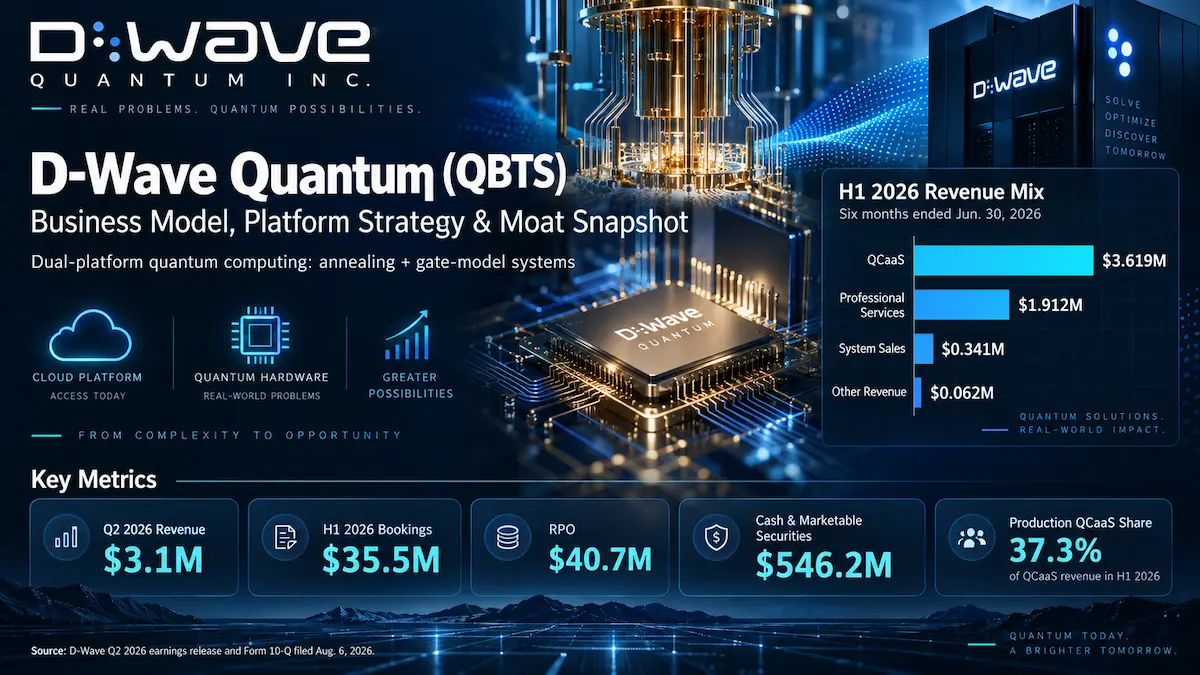
The first half of 2026 illustrates that shift. D-Wave reported approximately $3.6 million of QCaaS revenue, $1.9 million of professional-services revenue, and only about $0.3 million of system-sales revenue during the six months ended June 30, 2026. Total revenue was $5.9 million, down sharply from $18.1 million in the prior-year period because the first half of 2025 included $13.7 million of revenue from the company’s first annealing-system sale. The comparison is a useful warning: D-Wave’s reported growth rate can be dominated by the timing of individual system installations, so investors and operators should focus on QCaaS growth, remaining performance obligations, bookings quality, and production usage rather than headline revenue alone.
Professional Services: The Conversion Layer
Quantum computing still requires substantial problem selection, mathematical formulation, workflow integration, and experimentation. D-Wave’s professional-services organization is therefore part of the product architecture rather than an afterthought. Through its Launch program and related technical engagement, the company works with customers from application discovery through proof of concept, pilot, and production deployment.
The economic logic is similar to enterprise software businesses that use implementation services to accelerate adoption, but with one important difference: in quantum computing, the services layer may be more structurally necessary because customers often lack internal expertise. That creates a potential flywheel. More implementations produce more reusable industry knowledge; reusable knowledge reduces time-to-value for the next customer; faster deployment can increase QCaaS conversion; and recurring workloads increase the value of the cloud platform. The risk is that services remain labor-intensive and fail to translate into sufficiently large recurring contracts. D-Wave therefore needs to prove that services revenue is a bridge to scalable platform revenue rather than a permanent substitute for it.
System Sales: High-Ticket but Lumpy
D-Wave also sells complete superconducting annealing systems and associated installation, commissioning, upgrade, support, and maintenance services. The February 2025 sale to Forschungszentrum Jülich demonstrated that a major high-performance computing institution was willing to own a D-Wave system. In January 2026, Florida Atlantic University agreed to purchase an Advantage2 system for $20 million, with deployment expected by the end of 2026. Separately, a 2025 agreement in Italy represented a €10 million commitment for 50% of an Advantage2 system’s capacity over approximately five years, with an option to purchase the system.
System sales can be economically attractive, but they create reporting volatility because revenue is recognized over the installation period based on progress. They also concentrate revenue around a small number of large customers. D-Wave’s long-term model is therefore stronger if system sales serve as strategic anchors that expand geographic capacity, sovereign access, or research ecosystems while QCaaS becomes the more predictable economic base.
The Platform Strategy: Hardware, Cloud, Software, Services, and Distribution
D-Wave’s platform strategy is vertically integrated. At the hardware layer, Advantage2 provides a 4,400-plus-qubit annealing system with more than 40,000 couplers and 20-way qubit connectivity. Relative to the prior Advantage generation, D-Wave reports higher energy scales, longer coherence, lower noise, and greater connectivity. At the cloud layer, Leap exposes that hardware in real time. At the software layer, Ocean and hybrid solvers abstract problem formulation and can handle enterprise-scale optimization models, including nonlinear problems with up to two million variables and constraints. At the services layer, D-Wave helps customers identify and operationalize workloads. At the distribution layer, the company sells directly, works with systems integrators and resellers, and makes Leap and services available through AWS Marketplace.
This stack is strategically important because the customer does not need to own a dilution refrigerator, hire a quantum-hardware team, or build every orchestration layer internally. The more of the stack D-Wave can standardize, the more the business resembles a specialized computing platform rather than a laboratory-equipment supplier.
2. Deep Dive into Economic Moats
Under a Buffett-style moat framework, D-Wave should not receive credit merely for being early, growing bookings rapidly, having a recognizable brand, or operating a system with thousands of qubits. Those facts may be strategically useful, but a moat requires an advantage that competitors cannot cheaply or quickly replicate and that can protect future economics. On that stricter standard, D-Wave’s strongest potential moats are intangible technical assets and embedded switching costs. Network effects are weak, while cost advantages remain promising but not yet proven at scale.
Moat #1: Intangible Assets and Accumulated System Know-How
D-Wave’s most credible moat is the accumulated engineering knowledge required to design, fabricate, control, calibrate, operate, and continuously improve large superconducting annealing systems. The company has spent more than 25 years building in this architecture, and its current stack spans QPU design, cryogenic infrastructure, local control electronics, system calibration, hybrid algorithms, cloud orchestration, developer tools, and production support. Company materials filed with the SEC in 2026 reported more than 290 U.S. granted patents and more than 800 granted and pending patents worldwide, including exclusively licensed patents.
The patent count alone is not the moat. The stronger barrier is the combination of protected intellectual property and tacit engineering know-how accumulated through multiple commercial hardware generations. A competitor attempting to replicate D-Wave’s position would need to reproduce not just a chip design but also fabrication recipes, cryogenic reliability, control electronics, calibration systems, real-time cloud operations, solver software, application expertise, and customer support processes. That replication cost is measured in engineering cycles and operational learning, not simply capital expenditure.
The Quantum Circuits acquisition potentially deepens this intangible-asset moat by adding dual-rail gate-model qubits with built-in error detection. D-Wave is attempting to combine that technology with control and packaging capabilities developed for annealing systems. If the same engineering infrastructure can support both architectures, D-Wave could amortize decades of superconducting-system experience across a broader product set. That would be a more durable advantage than a temporary lead in qubit count.
The limitation is equally important: technical leadership in quantum computing can erode quickly. Competitors include well-capitalized technology companies and specialized quantum firms pursuing different modalities. Patents can be designed around, and architecture-level breakthroughs can reset the competitive landscape. D-Wave’s intangible moat is therefore real but dynamic; it must be renewed through continued execution.
Moat #2: Switching Costs in Production Quantum Workflows
D-Wave’s second-most-defensible advantage is emerging switching cost. When a customer moves from experimentation to a production optimization workflow, it can accumulate D-Wave-specific intellectual capital around problem decomposition, constraint modeling, embedding, solver tuning, hybrid orchestration, error handling, application monitoring, and integration into operational systems. Once that workflow is tied to Leap SLAs and production schedules, changing providers may require re-formulation, revalidation, security review, procurement work, and operational testing.
The August 2026 NTT DOCOMO deployment is useful evidence of what production integration can look like. DOCOMO reported a second D-Wave-powered production application that reduced the daily peak volume of location-registration signals by 65.3% while also reducing paging signals by 7.0%. In July 2026, AT&T announced an expanded agreement with D-Wave and said early work had reduced a network-optimization process from roughly one hour to less than 15 seconds. These examples do not prove a wide moat by themselves, but they show the type of workflow where switching costs can emerge: once a quantum optimization component becomes part of a mission-critical network process, the customer is evaluating operational reliability and business outcomes, not just benchmark performance.
Still, the switching-cost moat should not be overstated. Many quantum workloads remain experimental. Customers may be able to reformulate problems for classical solvers or competing quantum systems, and large enterprises generally prefer architectural flexibility. The switching cost becomes meaningful only when D-Wave repeatedly proves superior economics in production and the application becomes deeply embedded. The most important leading indicator is therefore not total cloud users; it is the proportion of QCaaS revenue derived from production applications. In the first half of 2026, D-Wave reported that production applications accounted for 37.3% of QCaaS revenue, up from 9.8% in the prior-year period. That is an encouraging direction, but still an early-stage base.
Why Network Effects and Cost Advantages Are Not Yet Core Moats
D-Wave does not currently possess a classic network effect. One additional Leap customer does not automatically make the service more valuable to every other customer in the way a payments network, social platform, or marketplace does. Open-source Ocean contributions and a growing developer ecosystem can improve tooling, but that is better classified as ecosystem reinforcement than a hard network effect.
Cost advantage is also not yet demonstrated strongly enough to qualify as a durable moat. Management has presented attractive theoretical unit economics for mature QCaaS capacity, but the company is still loss-making and investing heavily. For the first half of 2026, operating expenses reached $111.5 million and operating loss was $108.0 million on $5.9 million of revenue. That cost structure reflects an aggressive R&D and go-to-market buildout, including the Quantum Circuits acquisition. D-Wave may eventually achieve attractive hardware utilization economics if each system supports a large recurring cloud revenue base, but that outcome should be treated as a business-model objective rather than an established cost advantage.
The institutional conclusion is therefore nuanced: D-Wave has a credible technical moat and an emerging production-workflow moat, but it does not yet have the self-reinforcing economic characteristics of a mature software monopoly. The durability of its advantage will depend on whether production applications scale faster than competing architectures and classical alternatives improve.
3. Business Inflection Points & Future Catalysts
The Strategic Inflection Point: Acquiring Quantum Circuits in January 2026
The most important strategic turning point in D-Wave’s modern history was the January 20, 2026 acquisition of Quantum Circuits. The transaction added superconducting gate-model technology based on dual-rail qubits with built-in error-detection capabilities. D-Wave paid $250 million in cash and issued 10.43 million shares; the accounting fair value of consideration was approximately $538.5 million at closing.
The acquisition changes the company’s strategic identity. Before the deal, D-Wave’s differentiation depended primarily on annealing: a specialized architecture aimed at optimization and related workloads. After the deal, management can pursue two distinct computational markets while attempting to reuse common infrastructure. The company believes its annealing-derived cryogenic systems, on-chip control technology, multi-chip packaging, cloud platform, and commercial operating experience can accelerate the gate-model roadmap. If that reuse is real, the acquisition is not simply diversification. It is a platform-extension strategy in which existing engineering assets are redeployed across a second architecture.
The risk is equally large. Gate-model competition is intense, the technical roadmap is ambitious, and the acquired business adds substantial R&D expense. Quantum Circuits contributed only $0.25 million of revenue from the January 20 acquisition date through June 30, 2026 while recording a net loss of roughly $16.0 million in that period. The strategic thesis therefore depends on future technical and commercial milestones, not near-term acquired earnings.
Catalyst 1: Converting Bookings and RPO into Recognized Revenue
D-Wave entered the second half of 2026 with a significantly larger contracted revenue base than its current income statement suggests. First-half bookings were $35.5 million, up from $2.9 million a year earlier, and remaining performance obligations were $40.7 million, up 668% year over year. The first-half bookings figure included the $20 million FAU system purchase. The company also has a $10 million, two-year enterprise QCaaS agreement with a Fortune 100 company and the multi-year Italian capacity agreement.
The transmission mechanism is straightforward. As FAU installation milestones are completed, system revenue should be recognized over time. As the Fortune 100 contract runs, QCaaS and related services revenue should be recognized ratably. If those customers move multiple applications into production, the mix can shift toward higher-quality recurring revenue rather than one-time project activity.
Observable indicators include quarterly RPO, deferred revenue, QCaaS revenue growth, the share of QCaaS tied to production applications, average booking size, and the timing of system-installation milestones. The major execution risks are delayed installations, dependence on a small number of large contracts, slower-than-expected application deployment, and a weak second wave of bookings after the unusually large first quarter of 2026.
Catalyst 2: Production Adoption Turns Technical Proof into Enterprise Retention
The most important commercial catalyst is not another research benchmark; it is the replication of production deployments across enterprises. D-Wave’s strongest strategic claim is that annealing can solve optimization problems today, while many gate-model systems remain primarily research platforms. The July 2026 AT&T expansion and August 2026 second DOCOMO production deployment strengthen that narrative because both are tied to network operations rather than laboratory experimentation.
The transmission mechanism runs through customer economics. If D-Wave reduces optimization time, network congestion, scheduling cost, or resource waste, the quantum workload can become part of a recurring business process. That can increase QCaaS consumption, expand contract size, support renewals, and deepen switching costs. It also gives D-Wave reusable reference architectures for adjacent telecom, logistics, manufacturing, and infrastructure customers.
Observable indicators include new named production deployments, growth in production-derived QCaaS revenue, expansion contracts from existing customers, commercial customer mix, and the number of large enterprises progressing from pilot to production. The main risk is substitution: a customer may decide that a classical optimizer, improved heuristic, GPU-based method, or another quantum architecture offers sufficient performance at lower cost or complexity. D-Wave must therefore demonstrate business-level advantage, not merely technical novelty.
Catalyst 3: Gate-Model Commercialization and the CHIPS-Funded Scaling Program
D-Wave’s gate-model roadmap is the most asymmetric catalyst because success would materially expand the company’s addressable market, while failure would leave the company carrying a much larger R&D base. The roadmap targets a 17-physical-qubit dual-rail system in 2026, a 49-physical-qubit system in 2027, and a 181-physical-qubit system in 2028, with progressively stronger error reduction. D-Wave also announced an error-aware gate-model simulator intended for Leap, with access scheduled to begin in September 2026. As of the official sources reviewed through September 10, 2026, that simulator launch remains an execution checkpoint rather than a separately confirmed completed milestone.
The strategic objective is to build a developer funnel before large gate-model hardware is mature. A simulator, software toolkit, and paid development bundles can attract researchers and enterprises early, allowing customers to develop algorithms around D-Wave’s dual-rail error-detection model. If hardware then arrives on schedule, those developers are already inside the D-Wave environment. This is the same platform logic that makes software ecosystems valuable in conventional computing: application work begins before hardware reaches full scale.
The U.S. government’s September 2026 CHIPS and Science Act agreement provides up to $100 million to support advanced microelectronics R&D for both annealing and gate-model systems. The initial funding tranche of approximately $53.6 million was made available shortly after the award date, with additional tranches tied to milestones involving tooling, prototype fabrication, process integration, calibration, and benchmarking. This funding can reduce the amount of internally funded capital required for the scaling program and may also strengthen D-Wave’s position in U.S. national quantum infrastructure.
However, the CHIPS agreement is not free capital. Funding is milestone-dependent, subject to government terms and appropriations, and the company issued 7,095,721 shares to the U.S. Department of Commerce at an issuance price of $14.093 per share. D-Wave itself disclosed dilution risk and the possibility that government ownership could complicate certain future strategic transactions. The relevant operating indicators are gate-model delivery milestones, measured error-reduction performance, simulator availability, paid gate-model customer engagements, CHIPS milestone achievement, and the pace of R&D spending.
Catalyst 4: Advantage2 Capacity Expansion Without Losing Capital Discipline
D-Wave’s annealing roadmap still matters even as gate-model development receives more attention. Advantage2 became generally available in May 2025, and the company is expanding system placements across North America and Europe. D-Wave has also disclosed a scalable I/O prototype concept intended to support future annealing systems with much larger qubit counts without a proportional increase in control wiring.
The business transmission mechanism is utilization. More strategically placed systems can increase geographic access, sovereign-computing options, secure deployments, and available Leap capacity. If demand grows faster than the cost of deploying and supporting additional systems, QCaaS can gain operating leverage. The observable indicators are system utilization, QCaaS revenue per deployed production system, uptime, system-build cost, gross margin by revenue mix, and new capacity commitments.
The risk is overbuilding. Quantum demand is still nascent, and capacity added before recurring workloads materialize can depress returns on capital. A second risk is technology obsolescence: if customers shift toward gate-model systems or classical alternatives faster than anticipated, dedicated annealing capacity could become less economically productive. Capital discipline therefore matters as much as technical scaling.
4. Key FAQs
What is the D-Wave Quantum business model and how does QBTS make money?
D-Wave makes money through three principal channels: recurring QCaaS access to its Leap quantum cloud platform, professional services that help customers build and deploy quantum applications, and sales of on-premises quantum-computing systems. The most strategically valuable path is professional services converting customers into recurring QCaaS usage because that model produces better revenue visibility than episodic system installations. System sales can still be important because they generate large contract values and can establish strategic regional or sovereign-computing hubs.
What is D-Wave Quantum’s strongest competitive advantage versus other quantum-computing companies?
D-Wave’s strongest advantage is its full-stack experience operating commercial superconducting annealing systems at production scale, combined with its cloud, hybrid-solver, developer-tool, and application-services layers. The company has accumulated this know-how over multiple hardware generations rather than relying on a single research prototype. Its 2026 acquisition of Quantum Circuits adds a second potential advantage: dual-rail gate-model technology with built-in error detection that D-Wave is attempting to combine with its existing control and cryogenic infrastructure. Neither advantage guarantees long-term leadership, but both are more economically meaningful than raw qubit counts alone.
Can D-Wave Quantum become a high-margin recurring-revenue business?
It is possible, but not yet proven. The business architecture supports higher-quality recurring economics because Leap can monetize shared hardware capacity across many customers, and QCaaS contracts are generally recognized ratably over time. Production-derived QCaaS revenue also increased materially as a share of total QCaaS revenue in the first half of 2026. However, D-Wave remains deeply loss-making, is investing heavily in R&D and sales capacity, and still has material exposure to lumpy system contracts. The key proof points will be sustained QCaaS growth, higher production utilization, stable or improving gross margin, and operating-expense growth that eventually becomes slower than recurring revenue growth.
5. Conclusion
D-Wave’s corporate gene is commercialization-first quantum computing. Its history is unusual because the company spent decades building a specialized annealing architecture, then wrapped that hardware in a cloud platform, hybrid solvers, developer tools, professional services, and enterprise operating processes. That gives D-Wave a different economic starting point from quantum companies whose primary asset is a research roadmap. The strongest part of the thesis is not that D-Wave has the largest qubit count; it is that D-Wave has a functioning stack that can move selected optimization workloads from discovery into production.
The January 2026 Quantum Circuits acquisition raises the strategic ceiling but also the execution burden. If D-Wave can successfully reuse its superconducting control, cryogenic, packaging, cloud, and commercialization infrastructure in gate-model systems, the company could evolve from an annealing specialist into a broader quantum platform. If the gate-model roadmap slips materially, however, the acquisition could become a costly expansion of an already heavy R&D structure.
The moat today is therefore best described as credible but unfinished. D-Wave has meaningful intangible technical assets and early switching costs around production workflows, while network effects remain weak and cost advantage remains unproven. Over the next one to two years, the quality of the business will be determined less by headline quantum announcements and more by a small set of operating evidence: conversion of RPO into revenue, expansion of production QCaaS, repeat enterprise deployments, disciplined Advantage2 utilization, and measurable progress on the dual-rail gate-model roadmap.
Primary Sources and External Links
- D-Wave Quantum 2025 Form 10-K
- D-Wave Quantum Q2 2026 Form 10-Q
- D-Wave Q2 2026 Earnings Release
- Advantage2 General Availability Announcement
- Quantum Circuits Acquisition Closing Announcement
- D-Wave Gate-Model Roadmap Announcement
- D-Wave Error-Aware Gate-Model Simulator Announcement
- AT&T Expanded D-Wave Quantum Agreement
- NTT DOCOMO Second Production Quantum Application
- D-Wave CHIPS and Science Act Agreement Form 8-K
- D-Wave CHIPS Securities Issuance Agreement Amendment
- D-Wave Q1 2026 Investor Presentation
Disclaimer: This article is intended solely for business logic discussion and corporate research purposes, and does not constitute investment advice of any kind.