

Key Takeaways
- UEC is in the middle of an earnings-model transition. Historically, reported uranium revenue has included opportunistic sales from a purchased physical uranium portfolio; the strategic objective is to make internally produced U3O8 from Wyoming and South Texas the recurring operating engine.
- The company’s most credible moat is not uranium itself. It is the combination of licensed central processing infrastructure, permitted or advanced satellite ISR projects, mineral rights and operating know-how that can shorten development timelines and spread processing assets across multiple production areas.
- UEC’s hub-and-spoke model can create a structural cost advantage if satellite production scales into existing hubs. That advantage is not yet fully proven at steady-state volume: fiscal Q3 2026 unit costs increased as production volumes were low and regulatory timing delayed new header houses.
- The proposed U.S. refining and conversion business is strategically important but should be treated as an option, not a current moat or current earnings stream. As of the latest filing, site selection and engineering were still underway and the formal NRC license application had not yet been submitted.
- The principal risks are commodity-price exposure, execution during production ramp-up, permitting delays, capital intensity and equity dilution. UEC also remains an SEC-defined Exploration Stage issuer and has not established proven or probable reserves for the projects it operates.
1. Business Model Breakdown
The economic engine: converting licensed uranium infrastructure into saleable U3O8
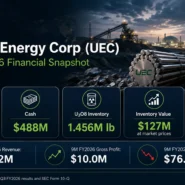
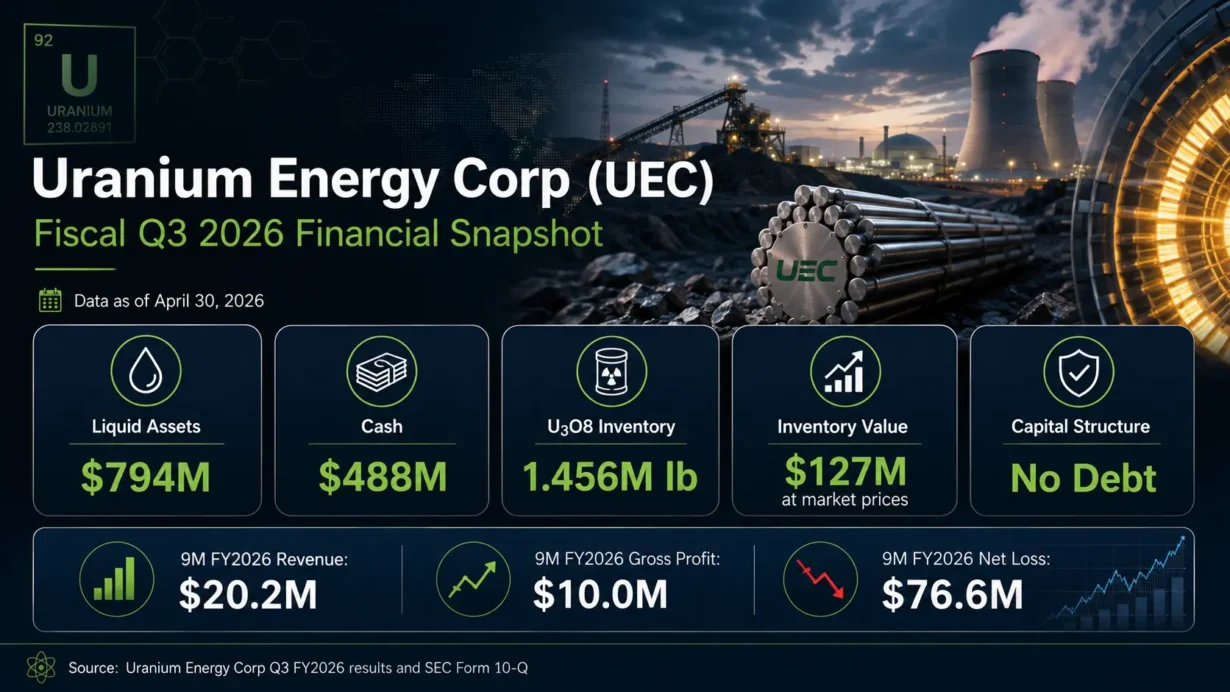
The simplest way to understand the Uranium Energy Corp business model is to separate today’s accounting revenue from the business UEC is trying to become. UEC is a uranium mining and development company whose long-term operating thesis is to recover uranium through in-situ recovery, or ISR, at multiple satellite wellfields and process that material through centralized plants. Yet its recent income statement still reflects a transitional model: for the nine months ended April 30, 2026, UEC reported $20.2 million of sales, all identified in the SEC filing as sales of purchased uranium inventory, with $10.0 million of gross profit. The fiscal third quarter itself had no uranium sales. In other words, producing uranium and recognizing uranium revenue are not yet the same event for UEC; newly recovered material can remain in process or inventory until management chooses to sell it.
This distinction matters because it changes how investors should evaluate the company. UEC’s physical uranium inventory has historically functioned as both a liquidity reserve and a tactical trading asset. In fiscal 2025, the company reported $66.8 million of revenue and $24.5 million of gross profit from selling 810,000 pounds from its physical portfolio at an average price of $82.52 per pound. By April 30, 2026, it held 1.456 million pounds of purchased U3O8 inventory, while its Wyoming operations had generated approximately 276,516 pounds of precipitated uranium and dried-and-drummed concentrate since restart. This gives management pricing optionality, but inventory monetization is not the same quality of earnings as a repeatable mining margin generated from internally produced pounds.
How the hub-and-spoke platform is designed to make money
UEC’s U.S. production architecture is built around central processing plants that serve multiple satellite ISR projects. In Wyoming’s Powder River Basin, Christensen Ranch and planned satellites such as Ludeman send uranium-loaded resin to the Irigaray Central Processing Plant, where uranium is stripped, precipitated, dried and packaged. In South Texas, Burke Hollow is the active production satellite intended to feed the Hobson processing hub as uranium recovery ramps. The Sweetwater complex is being advanced as a third Wyoming hub-and-spoke platform, with potential to support both ISR and conventional uranium feed after further permitting, engineering and refurbishment.
The commercial logic is straightforward. A central plant is an expensive, licensed, specialized asset. If a company can feed that same plant from multiple nearby wellfields over time, each new satellite can potentially require less incremental processing capital than a standalone mine-and-mill development. That can improve capital efficiency, reduce duplicated infrastructure and increase operating leverage as volumes rise. The model resembles a shared production platform: geological assets are the spokes, while the licensed processing plant is the reusable infrastructure layer.
As of fiscal Q3 2026, management presented approximately 12.1 million pounds per year of combined licensed production capacity across Irigaray, Hobson and Sweetwater. Licensed capacity should not be confused with current production, however. Actual output remains in ramp-up mode. During fiscal Q3 2026, UEC produced 32,195 pounds of uranium concentrate at a reported total cost of $54.61 per pound and cash cost of $46.69 per pound. Cumulatively since the Wyoming restart, the company reported a total cost of $39.30 per pound and cash cost of $32.40 per pound across 276,516 pounds. These are non-GAAP operating metrics, and management itself states that its definitions may not be comparable with those of other mining companies.
Three layers of value creation
The first layer is domestic ISR production. This is the core operational business and the part that can eventually produce recurring gross profit from mined pounds rather than trading gains on purchased inventory. The second layer is portfolio optionality: UEC owns or controls a broad pipeline of U.S. and Canadian uranium assets, including the Sweetwater complex and the high-grade Roughrider project in Saskatchewan. These assets can create future production capacity, but they require additional technical work, permits and capital before becoming cash-generating operations.
The third layer is downstream strategic integration. In September 2025, UEC launched United States Uranium Refining & Conversion Corp., a wholly owned subsidiary intended to evaluate a domestic refining and uranium conversion facility. Conversion transforms uranium oxide into UF6, the feedstock used by enrichment facilities. This could move UEC one step downstream in the nuclear fuel cycle and potentially improve strategic relevance to utilities and the U.S. government. But the economics are not yet established. The latest SEC filing states that the project remains contingent on engineering and economic studies, government commitments, utility contracts, regulatory approvals and favorable market conditions.
UEC therefore operates less like a mature single-mine producer and more like a capital-allocation platform built around uranium infrastructure. Its value proposition depends on four linked capabilities: acquiring assets when industry capital is scarce, preserving licenses and processing infrastructure, funding projects through weak portions of the uranium cycle, and then ramping production when uranium market conditions justify deployment. The potential payoff is significant operating leverage; the tradeoff is that the company must carry substantial development expenditure before its asset base produces consistent operating cash flow.
The financing model is part of the business model
UEC’s balance-sheet strength is real, but its source matters. At April 30, 2026, the company reported $488.1 million of cash and no debt, contributing to $794 million of liquid assets as defined by management. That financial flexibility can help fund wellfields, plant upgrades, Sweetwater development, Roughrider studies and the conversion initiative without relying on project debt at every stage.
However, UEC has also relied heavily on equity markets. During the nine months ended April 30, 2026, it issued shares through at-the-market programs, a public offering and a Canadian flow-through financing, and reported $508.2 million of net proceeds from equity financings and option exercises. The SEC filing states that reliance on equity is expected to continue for the foreseeable future. For shareholders, this creates a critical analytical tension: a stronger balance sheet lowers project-financing risk, but repeated share issuance can dilute the per-share benefit of future production growth. Capital access is a competitive advantage only if management converts the incremental equity into assets and cash flow at returns above the cost of that capital.
2. Deep Dive into Economic Moats
Moat #1: Intangible assets embedded in licenses, permits and operating infrastructure
Within Buffett’s framework, UEC’s strongest defensible advantage sits closest to intangible assets, but not in the conventional sense of brand or patents. Uranium production is regulation-heavy. A licensed central processing plant, permitted satellite project, groundwater authorization, wellfield approval, historical drilling database and experienced operating team represent accumulated regulatory and technical capital. Competitors cannot reproduce those assets simply by raising money and buying drilling rigs.
The economic value of this regulatory capital is time. A new entrant may identify a uranium deposit, but it still needs resource definition, environmental work, engineering, permits, community engagement, processing capacity and operating systems before it can reliably deliver U3O8. UEC already owns the Irigaray and Hobson processing hubs and acquired the licensed Sweetwater plant from Rio Tinto in 2024. It also controls a pipeline of satellite projects designed to feed those hubs. That shortens the distance between a favorable uranium price signal and incremental production compared with a greenfield developer that must build the entire system from scratch.
Replacement cost alone does not make a moat. The durability comes from the combination of replacement cost and regulatory lead time. A competitor can theoretically build another plant, but doing so requires capital, licenses, qualified personnel and years of project execution, while UEC can focus capital on new wellfields and satellite facilities around infrastructure it already controls. This is especially relevant in a commodity industry where the window between high prices and new supply can determine which producers capture excess margins.
Moat #2: Potential cost advantage from ISR and shared processing hubs
The second credible moat is a potential structural cost advantage. ISR mining can avoid many of the surface-mining, crushing and conventional milling steps associated with traditional hard-rock uranium operations. UEC then layers a hub-and-spoke design on top: satellite ion-exchange operations recover uranium onto resin, and centralized plants perform the downstream processing. If multiple satellites feed a hub over a long period, fixed infrastructure is utilized more intensively and capital spending can be distributed across more pounds.
The word potential is important. UEC has not yet demonstrated a long, stable production history at current assets sufficient to prove a permanent position at the bottom of the industry cost curve. Fiscal Q3 2026 is a useful reminder: total cost per pound rose to $54.61 from the cumulative restart average of $39.30 because production was lower, regulatory approvals for new header houses arrived later in the quarter and state taxes increased. This is precisely how a fixed-infrastructure model behaves during ramp-up: low throughput can temporarily overwhelm the structural cost advantage.
For the moat to become durable, UEC must show that cost performance improves as header houses, wellfields and additional satellites feed existing hubs. The relevant test is not a single quarter’s reported cost. It is whether multi-year unit costs remain competitive through uranium-price cycles after accounting for sustaining wellfield development, royalties, taxes, restoration obligations and corporate overhead.
Why switching costs and network effects are weak
UEC has little in the way of classic customer switching costs. Uranium concentrate is a commodity input. Utilities care about security of supply, origin, contract reliability, specifications and price, but they are not technically locked into UEC in the way an enterprise customer can become locked into software, data architecture or proprietary workflows. Long-term supply contracts may create commercial commitment, but they do not fundamentally change the fungible nature of U3O8.
Network effects are even less relevant. More uranium customers do not make UEC’s product inherently more valuable to each additional customer. The company can gain purchasing, marketing or government-relations advantages from scale, but scale economics are not network effects. This distinction matters because commodity companies often appear more defensible during a tight market than they truly are.
What is not yet a moat: vertical conversion, inventory and sheer resource size
The proposed conversion business could become strategically valuable, but it is premature to count it as a moat. The U.S. Nuclear Regulatory Commission currently identifies an existing commercial uranium conversion facility at Metropolis, Illinois. UEC’s planned facility has received an NRC docket number, but the company has stated that a formal license application is expected only after engineering and design work is complete and a site is selected. Until permits, financing, construction and contracts are secured, conversion is an embedded strategic option rather than a proven competitive barrier.
Similarly, UEC’s physical uranium inventory creates pricing flexibility but not a durable moat. It can support liquidity, allow opportunistic sales and provide immediate exposure to uranium prices, yet competitors can also purchase uranium when capital and material are available. Finally, large resources are valuable only when they can be economically permitted, financed and produced. UEC itself cautions that the approximately 175 million pounds associated with Sweetwater are historical estimates rather than current S-K 1300 mineral resources, and the SEC filing states that UEC has not established proven or probable reserves at the uranium projects it operates.
The institutional conclusion is therefore narrower than the promotional narrative: UEC’s moat is strongest where geology intersects with already-licensed infrastructure and repeatable project development. If the company turns that position into sustainably low delivered costs and disciplined capital returns, the moat can support above-average economics. If costs rise, permitting stalls or equity issuance outpaces per-share cash-flow growth, the advantage becomes an asset collection rather than an economic moat.
3. Business Inflection Points & Future Catalysts
The strategic inflection point: the 2021 Uranium One Americas acquisition
UEC was incorporated in Nevada in 2003 and began building its South Texas ISR platform through acquisitions and permitting during the following decade. Production at Palangana began in November 2010, uranium-loaded resin started processing at Hobson shortly afterward, and UEC completed its first uranium sale in 2011. Those milestones proved that the company could operate an ISR chain from wellfield to packaged product.
The more consequential corporate transformation came in December 2021, when UEC completed the acquisition of Uranium One Americas. The deal added Wyoming’s Irigaray processing facility, Christensen Ranch and a portfolio of additional permitted and development-stage ISR projects. Strategically, that changed UEC from a South Texas-focused producer/developer into a multi-basin infrastructure owner with two U.S. hub-and-spoke platforms. The acquisition also created a template that subsequent transactions expanded rather than replaced.
In 2022, UEC acquired UEX Corporation and then the Roughrider project from Rio Tinto, building a high-grade Canadian conventional-development leg. In 2024, it acquired Rio Tinto’s Sweetwater plant and Wyoming uranium assets for approximately $175.4 million in cash, establishing a third U.S. hub. In August 2024, the company restarted ISR production at Christensen Ranch. In September 2025, it launched its planned conversion subsidiary. In April 2026, Burke Hollow began production in South Texas. The common thread is consistent: UEC has been assembling scarce infrastructure and project inventory before fully monetizing it, creating a platform whose economics depend on sequential activation rather than a single flagship mine.
Catalyst 1: Production scale-up at Christensen Ranch and Burke Hollow
The most important 12-to-24-month catalyst is not a higher uranium price by itself; it is the conversion of installed capacity into sustained production volume. At Christensen Ranch, three new header houses in Wellfield 11 began operating toward the end of fiscal Q3 2026, with additional units under construction or awaiting approval. Burke Hollow commenced uranium recovery in April 2026 and was expected by management to contribute production in the fiscal fourth quarter.
The transmission mechanism is operational leverage. More productive wellfields should increase resin loading and feed into Irigaray and Hobson, allowing plant labor and fixed infrastructure to be absorbed across more pounds. If unit costs decline while UEC begins selling a larger proportion of internally produced uranium, gross profit should become more representative of mining economics and less dependent on gains from purchased inventory. That transition would also give investors a cleaner basis for evaluating sustainable margins.
Observable indicators include quarterly pounds precipitated and dried-and-drummed, uranium head grades, number of active header houses, operating days, cash cost per pound, total cost per pound, mined inventory balances, and the proportion of revenue generated from internally produced uranium rather than purchased material. Key execution risks are slower-than-expected regulatory approvals, wellfield performance below geological expectations, water-management constraints, plant downtime, rising state taxes and royalties, and uranium prices that fall before volume ramps.
Catalyst 2: Sweetwater evolves from acquired infrastructure into a third production hub
Sweetwater is strategically important because it tests whether UEC can repeat its acquisition-and-reactivation playbook. The company acquired the licensed plant and associated Wyoming assets from Rio Tinto in December 2024. During 2026, it completed delineation drilling in initial planned ISR wellfields, started evaluating refurbishment needs for conventional and ISR operations, and advanced a federal permitting process for ISR development.
The transmission mechanism is twofold. First, a permitted Sweetwater ISR circuit would add another production center that can monetize nearby resources through shared infrastructure. Second, better technical definition can convert a headline asset into an investable project with measurable recoveries, capital requirements and timing. Because the approximately 175 million pounds associated with the acquisition are historical estimates rather than current S-K 1300 resources, updated compliant technical work is more valuable than the raw headline number.
Observable indicators include Bureau of Land Management and NEPA milestones, conversion of historical estimates into current technical resources where applicable, wellfield delineation results, ion-exchange equipment installation, refurbishment scope, initial capital guidance and a formal production schedule. The principal risks are permitting delays, lower recoverable resources than historical data implies, refurbishment costs above expectations, groundwater or restoration constraints and the possibility that uranium economics do not justify the planned pace of development.
Catalyst 3: Roughrider pre-feasibility turns geological optionality into project economics
Roughrider is structurally different from the U.S. ISR portfolio. It is a high-grade conventional uranium development in Saskatchewan’s Athabasca Basin and can become a major long-duration production pillar if technical and permitting work supports development. By fiscal Q3 2026, UEC reported that more than 80% of a 35,000-meter conversion core drilling program had been completed and that Tetra Tech Canada was leading pre-feasibility work.
The transmission mechanism is valuation de-risking rather than near-term revenue. A credible pre-feasibility study can tighten assumptions around resource classification, mine design, recoveries, capital intensity, operating costs and project sequencing. That can narrow the discount investors apply to a development-stage asset and can also improve UEC’s negotiating position for future partnerships, offtake or project financing.
Observable indicators include completion of the PFS, changes in indicated versus inferred resources, estimated initial capital, operating-cost assumptions, development schedule, environmental baseline work, Indigenous engagement milestones and power-infrastructure planning. Risks include resource conversion shortfalls, capex inflation, technical complexity, permitting timelines, community and Indigenous consultation, and a uranium price environment that fails to support construction economics.
Catalyst 4: De-risking the U.S. conversion option
UEC’s conversion subsidiary has the highest strategic upside and the lowest current earnings visibility. Federal policy has moved in a direction favorable to domestic nuclear fuel infrastructure: the 2024 law banning Russian uranium imports was paired with federal funding intended to expand domestic enrichment and conversion capacity; the May 2025 nuclear executive orders directed development of a plan to expand domestic uranium conversion and enrichment; and the Department of Energy’s April 2026 “Nuclear Dominance — 3 by 33” initiative explicitly targets a secure domestic fuel cycle including conversion.
For UEC, the near-term catalyst is not conversion revenue. It is a sequence of de-risking milestones that can change the probability-weighted value of the project: selecting a site, completing engineering sufficient for a formal NRC application, submitting that license application, securing government participation or strategic commitments, obtaining utility contracts and defining project capital requirements. Each step would move the project from policy-aligned concept toward financeable industrial infrastructure.
The observable indicators are therefore binary and documentary rather than production-based. Investors should watch for a selected site, NRC application submission and acceptance, public licensing milestones, front-end engineering deliverables, government awards or agreements, commercial offtake, and a funding structure. The risks are substantial: licensing can take years, capital requirements may be large, existing U.S. conversion capacity already operates in Illinois, customer contracts may not support acceptable returns, and political support can shift. Until those uncertainties are resolved, conversion should be valued as strategic optionality rather than a base-case profit center.
The macro catalyst is an amplifier, not the moat itself
U.S. nuclear policy is increasingly supportive of domestic fuel-cycle capacity, but policy support should not be confused with company-specific competitive advantage. The Russian uranium import ban, federal efforts to expand enrichment and conversion, and the 2026 DOE fuel-cycle initiative can raise the strategic value of U.S.-origin uranium supply. UEC benefits because it already owns licensed and operating infrastructure. Still, the commercial outcome will ultimately depend on contracted demand, realized uranium prices, operating reliability and returns on incremental capital.
4. Key FAQs
How does Uranium Energy Corp make money from uranium production?
UEC can generate revenue by selling U3O8 produced from its ISR mines, but the recent financial statements show that its reported sales have also come from uranium purchased earlier and held in physical inventory. For the nine months ended April 30, 2026, all $20.2 million of reported sales were classified as sales of purchased uranium inventory. The core business transition is therefore toward producing enough uranium at Christensen Ranch, Burke Hollow and future satellites that internally produced pounds become a repeatable source of sales and gross profit. Until that transition is visible in the income statement, inventory trading and mining operations should be analyzed separately.
What is Uranium Energy Corp’s ISR hub-and-spoke business model?
UEC develops multiple satellite ISR mining areas around centralized processing plants. The satellites circulate recovery solution through uranium-bearing sandstone, capture uranium on ion-exchange resin, and transport the loaded resin to a hub such as Irigaray in Wyoming or Hobson in Texas. The hub performs stripping, precipitation, drying and packaging. Economically, the model is designed to reuse licensed processing infrastructure across multiple deposits, reducing duplicated capital and potentially lowering the incremental cost and development time of bringing additional satellites into production.
Does Uranium Energy Corp have a sustainable competitive moat versus other U.S. uranium miners?
UEC has a credible but still developing moat. Its strongest advantages are licensed processing hubs, a large pipeline of permitted or advanced ISR projects, accumulated geological and operating data, and the ability to finance development without current debt. Those assets can be costly and time-consuming to replicate. However, uranium itself is a commodity, customer switching costs are low, network effects are absent, and UEC’s current production ramp is still small relative to licensed capacity. A sustainable moat will require evidence that the platform produces lower delivered costs, faster satellite activation and superior returns on capital over a full uranium cycle.
5. Conclusion
Uranium Energy Corp’s corporate DNA is best described as an infrastructure aggregator becoming an operating producer. Its history shows a repeated strategy: acquire licensed or strategically located uranium assets, preserve and expand the regulatory infrastructure, and activate production when market and policy conditions support development. The 2021 Uranium One Americas acquisition was the defining inflection point because it established the Wyoming hub-and-spoke platform that now anchors the company’s production restart. Sweetwater, Roughrider and the conversion initiative extend the same playbook into additional geographies and stages of the fuel cycle.
The most defensible part of the UEC business model is not resource size, inventory holdings or a bullish uranium price view. It is the installed and licensed infrastructure that can be shared across multiple ISR satellites, combined with a project pipeline that may shorten the time required to add future pounds. If Christensen Ranch, Burke Hollow and later Ludeman scale successfully, that platform can translate regulatory lead time into a real cost and capital-efficiency advantage. If they do not, the same asset breadth can become a source of ongoing development expenditure without adequate cash returns.
The next phase of the story is therefore measurable. UEC needs to convert licensed capacity into sustained production, internally produced inventory into sales, and strategic projects into increasingly financeable assets without allowing dilution to outrun per-share economics. Roughrider and U.S. conversion can add meaningful long-duration optionality, but the near-term evidence of corporate quality will come from throughput, unit costs, permitting execution, contract economics and capital discipline rather than from resource headlines alone.
Official Sources
- U.S. SEC — Uranium Energy Corp Form 10-Q for the quarter ended April 30, 2026
- U.S. SEC — Uranium Energy Corp Form 10-K for fiscal year ended July 31, 2025
- Uranium Energy Corp — Fiscal Q3 2026 results, June 9, 2026
- Uranium Energy Corp — Palangana ISR production commencement, November 17, 2010
- Uranium Energy Corp — Fiscal Q1 2012 results and first uranium sale, December 13, 2011
- Uranium Energy Corp — Completion of Uranium One Americas acquisition, December 20, 2021
- Uranium Energy Corp — Completion of Roughrider acquisition, October 17, 2022
- Uranium Energy Corp — Wyoming ISR production restart, August 13, 2024
- Uranium Energy Corp — Completion of Rio Tinto Sweetwater acquisition, December 6, 2024
- Uranium Energy Corp — Burke Hollow production commencement, April 8, 2026
- Uranium Energy Corp — Launch of United States Uranium Refining & Conversion Corp., September 2, 2025
- U.S. Department of Energy — “Nuclear Dominance — 3 by 33” fuel-cycle initiative, April 23, 2026
- U.S. Department of Energy — Prohibiting Russian Uranium Imports Act implementation, May 14, 2024
- The White House — Executive Order 14302, Reinvigorating the Nuclear Industrial Base, May 23, 2025
- U.S. Nuclear Regulatory Commission — Locations of commercial fuel-cycle facilities
Disclaimer: This article is intended solely for business logic discussion and corporate research purposes, and does not constitute investment advice of any kind.