

Key Takeaways
- Cameco’s economic engine is no longer just uranium production. It combines scarce high-grade mining assets, long-duration utility contracts, conversion and fuel services, a 49% equity interest in Westinghouse, and a 49% interest in Global Laser Enrichment to capture value across more of the nuclear fuel and reactor lifecycle.
- The strongest moat is cost and asset scarcity rather than brand alone. Cigar Lake and McArthur River are exceptionally high-grade, licensed, operating uranium assets in Canada, and replicating their combination of geology, permits, infrastructure, operating know-how and customer qualification would require years of development and substantial capital.
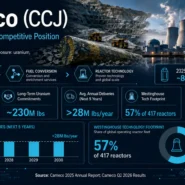
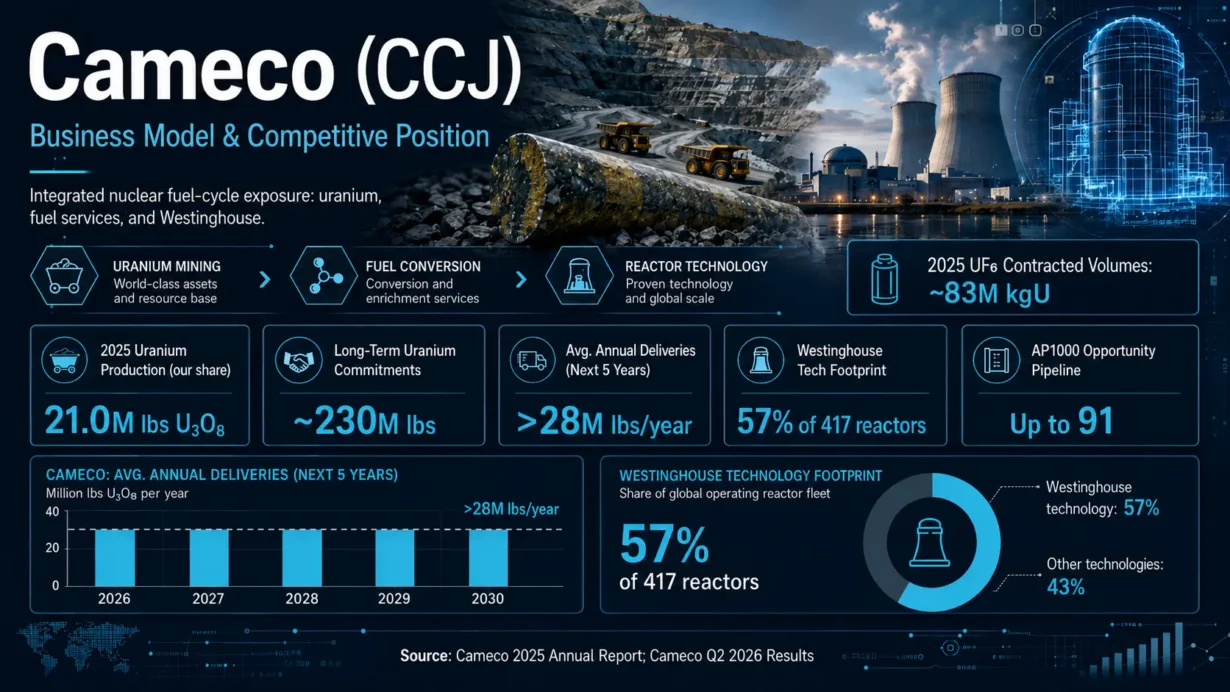
- Westinghouse adds a second moat layer: regulatory-qualified intellectual property, an installed reactor base and recurring aftermarket demand. Cameco reported in Q2 2026 that Westinghouse technology is used by 57% of the 417-reactor global operating fleet, creating meaningful switching friction for fuel, parts, engineering and outage services.
- The key earnings transmission mechanism is contract repricing, not a one-for-one move with uranium spot prices. Cameco has more than 28 million pounds of average annual uranium deliveries contracted over the next five years, while retaining market-related pricing exposure that can lift realized prices as legacy contracts roll and new volumes are layered in.
- The major risks are equally structural: mine and mill disruptions, execution and financing risk on new reactor projects, commodity-price reversals, dependence on third-party infrastructure such as the McClean Lake mill, geopolitical exposure through JV Inkai, and the possibility that Westinghouse’s proposed IPO or U.S.-backed reactor pipeline develops more slowly than expected.
1. Business Model Breakdown
From a Crown-asset merger to an integrated nuclear platform
Cameco Corporation was created in 1988 through the merger of Saskatchewan Mining Development Corporation and Eldorado Nuclear Limited. It listed publicly in Canada in 1991 and began trading on the New York Stock Exchange in 1996. That origin matters because Cameco inherited more than mines: it combined upstream uranium expertise with refining and conversion capabilities, creating the foundation for a broader nuclear-fuel franchise.
The company’s strategic identity has changed materially since then. The old model was primarily a uranium producer and fuel-services supplier. The current Cameco business model is better understood as a portfolio of nuclear control points: uranium mining and milling, uranium refining and conversion, CANDU fuel manufacturing, a 49% interest in reactor OEM and services leader Westinghouse, and a 49% interest in Global Laser Enrichment, with an option to increase the GLE stake to as much as 75%. The strategic ambition is not conventional conglomerate diversification. It is to own scarce assets at multiple stages where nuclear utilities face long qualification cycles, strict regulation and security-of-supply constraints.
Uranium: long-term contracted sales with selective market exposure
Uranium remains the core cash-generation engine. Cameco produces uranium from tier-one assets led by Cigar Lake and McArthur River/Key Lake in Saskatchewan and participates in JV Inkai in Kazakhstan. As of December 31, 2025, Cameco reported 433 million pounds of attributable proven and probable uranium reserves, while its tier-one operations had licensed capacity exceeding 30 million pounds per year on an attributable basis.
The monetization model is more sophisticated than “mine pounds and sell at spot.” Nuclear utilities typically contract fuel years in advance because fuel security is operationally critical but represents a relatively small portion of the total cost of nuclear generation. Cameco therefore uses a portfolio of long-term contracts containing base-escalated and market-related pricing mechanisms. This structure can smooth downside volatility while preserving partial upside as market-linked formulas reset.
At the end of 2025, Cameco had roughly 230 million pounds of long-term uranium delivery commitments. In Q2 2026, management said contracts covered average annual deliveries of more than 28 million pounds over the following five years, with commitments above that average in 2026 through 2028 and below it in 2029 and 2030. The economic logic is deliberate scarcity management: do not commit every future pound when security-of-supply concerns are strengthening the long-term market. Instead, layer in contracts when pricing, escalators and market-related terms compensate the company for the value of scarce, reliable supply.
Cameco also manages inventory and third-party purchases as part of its supply portfolio. In 2025 it delivered 33.0 million pounds while producing 21.0 million attributable pounds and purchasing 9.6 million pounds, including JV Inkai purchases. That difference should not automatically be read as a weakness. The company is effectively operating a risk-managed merchant book around physical production, contract commitments and inventory. However, this flexibility becomes a margin risk if operational shortfalls force purchases in a sharply rising uranium market.
Fuel Services: conversion capacity as a scarcity asset
Cameco’s Fuel Services segment refines uranium, produces UO2 and UF6 conversion products, manufactures CANDU fuel, and supplies reactor components. This is strategically important because conversion has become a constrained Western fuel-cycle step. The company produced 14.0 million kgU of combined fuel-services products in 2025, including a record 11.2 million kgU of UF6 at Port Hope, and had about 83 million kgU of long-term UF6 conversion volume under contract at year-end.
The margin logic resembles the uranium business: legacy contracts gradually roll into contracts signed in a stronger pricing environment. As a result, current earnings can lag changes in quoted conversion prices, but the backlog creates future revenue visibility. The business also deepens customer relationships because utilities procuring uranium must ultimately move material through conversion, enrichment and fuel fabrication before it can enter a reactor.
Westinghouse: equity-accounted access to the reactor installed base
The 2023 acquisition of a 49% interest in Westinghouse, alongside Brookfield’s 51% ownership, is the defining expansion of Cameco’s profit architecture. Westinghouse is not consolidated line by line into Cameco’s reported revenue because the investment is equity-accounted. Investors therefore need to distinguish between Cameco’s consolidated revenue and the economic contribution from its share of Westinghouse earnings, adjusted EBITDA and cash distributions.
Westinghouse monetizes nuclear power through several layers: nuclear fuel design and fabrication, engineered components, instrumentation and controls, outage and maintenance services, plant engineering, new-reactor technology and project support, and nuclear sustainability services. The installed base creates a long-duration aftermarket. A reactor can operate for decades, and once a technology platform, fuel design and safety case are embedded in a licensed plant, replacing suppliers can involve engineering requalification, regulatory review, outage planning and execution risk.
That is why the Westinghouse stake changes Cameco’s earnings quality. Uranium remains cyclical, but reactor services and fuel demand are linked to operating-fleet activity and multi-decade asset lives. In Q2 2026, Cameco reported its share of Westinghouse adjusted EBITDA at $163 million, and $284 million for the first half. Those results were below the unusually strong prior-year comparison because 2025 included a large Dukovany-related contribution, illustrating that Westinghouse earnings are more recurring than a mine-development business but can still be lumpy around major projects.
The platform strategy: control points, not vertical integration for its own sake
Cameco’s platform strategy should not be confused with a software-style network platform. Economically, it is a nuclear lifecycle platform. Uranium production provides feedstock exposure; conversion captures another constrained step; Westinghouse adds light-water-reactor fuel, engineering and installed-base services; and GLE could eventually add enrichment if SILEX technology is successfully commercialized. Westinghouse new-build wins can create future fuel and service demand, while broader reactor growth increases the addressable market for Cameco’s upstream products.
The strategic benefit is therefore information, customer access, contracting reach and lifecycle monetization rather than a guaranteed internal transfer of volumes. The businesses remain subject to customer procurement rules, joint-venture economics, regulation and competitive bidding. The platform works when Cameco can use its position across the cycle to understand where scarcity is forming and commit capital only when long-term contracts justify investment.
2. Deep Dive into Economic Moats
Cost Advantages: the strongest moat
Cameco’s clearest Buffett-style moat is a resource and infrastructure cost advantage rooted in geology, existing licenses and sunk capital. Cigar Lake’s 2025 proven and probable reserves averaged 16.33% U3O8, while McArthur River’s averaged 6.48%. Those grades are extraordinary relative to most uranium deposits globally. High grade does not automatically equal low total cost because these deposits are technically difficult to mine, but it gives Cameco far more contained uranium per tonne of ore and supports favorable economics once the specialized mining and milling systems are in place.
The barrier to replication is not simply finding uranium. A competitor must discover an economic deposit, delineate reserves, complete technical studies, secure environmental and operating approvals, finance a mine and mill, establish remote logistics, recruit nuclear-qualified personnel, build community and Indigenous relationships, and then operate reliably under strict radiation and safety standards. That process can consume a decade or more, and there is no guarantee that a new deposit will match the grade, scale or jurisdictional quality of Cameco’s Saskatchewan assets.
Cameco’s July 2026 increase in Cigar Lake ownership to 57.418% reinforces this moat by allocating more capital to an already licensed and producing tier-one asset rather than relying solely on greenfield development. The trade-off is concentration: Cigar Lake ore is milled at Orano’s McClean Lake facility, so Cameco still carries third-party processing dependency.
Intangible Assets and Switching Costs: powerful downstream, weaker upstream
Intangible assets are the second major moat, especially through Westinghouse. Nuclear intellectual property, reactor designs, operating procedures, regulatory approvals, safety analyses, fuel-design codes, component qualifications and decades of plant-specific engineering history are not easily reproduced. Westinghouse’s installed base compounds that advantage because utilities optimize around proven systems where reliability matters more than marginal procurement savings.
Switching costs are therefore asymmetric across Cameco’s portfolio. For uranium concentrate itself, switching costs are relatively low because U3O8 is a globally traded commodity and utilities can source from multiple approved suppliers. Long-term relationships and security of supply matter, but Cameco should not be credited with software-like customer captivity in raw uranium.
By contrast, switching becomes materially more difficult deeper in the reactor stack. Nuclear fuel assemblies, safety-related components, instrumentation and controls, outage services and reactor engineering require qualification, licensing and plant-specific knowledge. A utility can change suppliers, but the decision may trigger technical validation, regulator interaction and execution risk. This creates a rational preference for incumbent vendors when performance is acceptable.
Network Effects: not a core moat
Cameco does not possess a classic network effect. Adding one uranium customer does not directly increase the product’s utility for another customer. Westinghouse’s large installed base can create scale benefits in engineering knowledge, spare-parts availability, training and supplier economics, but those are better classified as switching costs, intangible assets and economies of scale than a true network effect.
This distinction matters because overstating network effects can lead to overestimating durability. Cameco’s defensibility comes from hard-to-replicate physical assets, licenses, know-how and installed-base lock-in, not from a self-reinforcing user network.
Moat durability: sufficient for excess returns, but only with capital discipline
The moat is capable of supporting long-run excess returns because competitors cannot quickly recreate high-grade Canadian uranium assets or a century-old reactor technology franchise. However, the moat does not immunize Cameco from cyclicality. Uranium producers can destroy value by overbuilding capacity at peak prices, while reactor vendors can destroy value through fixed-price construction risk, cost overruns or poorly structured contracts.
Cameco’s strategic discipline is therefore part of the moat’s monetization, even if it is not itself a moat. The company has repeatedly emphasized aligning production, contracting and capital deployment rather than maximizing near-term volume. The quality of future returns depends on whether management continues to sell scarcity rather than subsidize customers with prematurely committed supply.
3. Business Inflection Points & Future Catalysts
The strategic inflection point: the 2023 Westinghouse acquisition
The most important strategic turning point in Cameco’s modern history was the November 2023 closing of the Westinghouse acquisition. Before the deal, Cameco was primarily an upstream and midstream nuclear-fuel company. After the deal, it gained economic exposure to reactor technology, light-water-reactor fuel fabrication, operating-plant services and new-build activity.
This changed the company’s enterprise gene from “scarce uranium supplier” to “scarce nuclear infrastructure owner.” The distinction is economically significant. A uranium cycle can reprice over several years; an installed reactor can create fuel, parts and service requirements for decades. The Westinghouse stake therefore expands the duration of Cameco’s monetization opportunity, although the 49% equity-accounted structure means Cameco does not have unilateral operating control.
Catalyst 1: uranium contract repricing and disciplined volume layering
Transmission mechanism: higher long-term uranium prices and stronger utility contracting can flow into Cameco through market-related pricing formulas and newly signed contracts. Because delivery commitments are front-loaded above the five-year average in 2026 through 2028, rising realized prices can improve uranium revenue and segment EBITDA even if physical production growth is modest.
Observable indicators: average realized uranium price, long-term contracting volumes, remaining contracted pounds, market-related price sensitivity, annual deliveries, inventory cost and the spread between production cost, purchased material and realized selling price.
Execution risks: a reversal in uranium prices would reduce repricing upside; operational disruptions could force higher-cost market purchases; and management could destroy option value by over-contracting future production too early. In Q2 2026, Cameco explicitly accepted lower planned sales deliveries as part of its contracting discipline, which supports long-term optionality but can make quarterly results look weaker.
Catalyst 2: AP1000 fleet deployment and U.S.-backed nuclear financing
Transmission mechanism: every successful AP1000 new-build opportunity can create multiple layers of economic value for Westinghouse: engineering and project revenue during construction, component and technology revenue, initial fuel, recurring reload fuel, and decades of parts and operating-plant services. It can also enlarge the long-term uranium and conversion demand pool available to Cameco.
The public policy channel became more concrete in June 2026 when the U.S. Department of Energy announced a conditional $17.5 billion financing commitment for American Nuclear Supply Chain Loans designed to accelerate long-lead procurement for 10 large-scale reactors. Cameco’s Q2 2026 disclosure cited a pipeline of up to 91 AP1000 opportunities. In August, Westinghouse and Amentum announced agreements to expand delivery capacity for fleet-scale APX deployment, an important execution signal because reactor demand is only valuable if engineering and supply-chain capacity can scale.
Observable indicators: conversion of the AP1000 opportunity pipeline into signed projects, DOE loan closings, utility/site announcements, Westinghouse New Plants backlog, new orders, customer advances, supply-chain expansion and evidence that serial deployment is reducing schedule and cost risk.
Execution risks: nuclear projects have long permitting and financing timelines; conditional government support is not the same as completed financing; supply-chain bottlenecks can delay schedules; and fixed-price or poorly risk-shared construction commitments can convert demand growth into margin destruction. The bull case depends on repeatable deployment economics, not merely more project announcements.
Catalyst 3: a potential Westinghouse IPO as a valuation and capital-allocation event
On July 31, 2026, Cameco announced that Westinghouse had confidentially submitted a draft Form S-1 registration statement for a proposed initial public offering. No share count or price range had been determined at that time.
Transmission mechanism: a public listing could create an observable market value for an asset that is currently embedded inside Cameco through equity accounting. It could also give Westinghouse independent access to equity capital for growth and create a clearer public-market benchmark for Cameco’s 49% interest. However, an IPO is not automatically value-accretive to Cameco; the outcome depends on offering structure, valuation, proceeds, dilution and post-IPO governance.
Observable indicators: a public S-1 filing, disclosed segment economics, offering size, primary versus secondary shares, post-offering ownership, use of proceeds and any lock-up or governance arrangements affecting Cameco.
Execution risks: the IPO can be delayed or withdrawn due to market conditions. A lower-than-expected valuation could weaken the perceived sum-of-the-parts case, while dilution could reduce Cameco’s economic interest if it does not participate proportionately. Until terms are public, the IPO should be treated as a potential price-discovery catalyst rather than a guaranteed monetization event.
Catalyst 4: extracting more value from existing tier-one assets
Transmission mechanism: Cameco’s July 2026 increase in Cigar Lake ownership to 57.418% raises its attributable exposure to one of the world’s highest-grade operating uranium mines without requiring the execution risk of a new greenfield project. If production meets guidance and uranium pricing remains supportive, a larger ownership share should increase attributable production and cash-generation capacity.
Observable indicators: Cigar Lake production against the 2026 guidance range of 17.5 to 18.0 million pounds on a 100% basis, unit cost performance, mill availability at McClean Lake, packaged production at McArthur River/Key Lake, and consolidated uranium production against Cameco’s 2026 guidance of 19.5 to 21.5 million attributable pounds.
Execution risks: the temporary 2026 Cigar Lake shutdown highlighted the dependency on Orano’s McClean Lake mill. Northern Saskatchewan operations also face remote-road, flooding, workforce, equipment and maintenance risks. A larger ownership stake magnifies both upside and operational concentration.
Optional catalyst: GLE could close the missing enrichment link
Global Laser Enrichment is strategically important because enrichment is the major fuel-cycle step Cameco does not currently operate at commercial scale. Cameco owns 49% and is the commercial lead, with an option to increase ownership to 75%. GLE’s SILEX technology could eventually address depleted uranium tails, conventional LEU and potentially HALEU markets.
The transmission mechanism is straightforward but highly conditional: successful technology maturation plus government and customer support could move Cameco closer to a full-cycle Western nuclear fuel offering. That would improve strategic relevance in a market focused on reducing dependence on Russian fuel-cycle services. The observable indicators are technology-readiness milestones, DOE funding, commercial contracts and a defined financing path for deployment. The major risk is technical and economic: enrichment commercialization is capital intensive, regulated and not yet proven at the scale required for a durable earnings contribution.
Westinghouse’s advanced-reactor pipeline also remains optionality rather than a core near-term earnings assumption. In August 2026, the eVinci microreactor achieved zero-power criticality and was selected for the next phase of the U.S. Army’s Janus program. These milestones validate technical progress and customer interest, but investors should wait for funded deployments, commercial contracts and margin disclosure before assigning material recurring earnings.
4. Key FAQs
How does Cameco make money from uranium prices if most sales are under long-term contracts?
Cameco does not receive the spot uranium price on every pound. Its long-term contracts use a mix of base-escalated and market-related pricing, so realized prices move with a lag and depend on contract-specific formulas. The business model is designed to trade some immediate spot exposure for revenue visibility while preserving upside through market-linked terms and new contracting. The most useful indicators are Cameco’s realized uranium price, contract sensitivity disclosures and the volume of uncommitted future production, not the daily spot quote by itself.
Is Cameco vertically integrated after buying 49% of Westinghouse?
Cameco is strategically integrated across much of the nuclear fuel and reactor lifecycle, but it is not fully vertically integrated in the accounting or control sense. It directly operates uranium and fuel-services assets, owns 49% of Westinghouse through an equity-accounted investment, and owns 49% of GLE, whose enrichment technology is still being commercialized. The advantage is broader exposure to nuclear demand and customer relationships; the limitation is that Cameco does not unilaterally control Westinghouse and does not yet operate a commercial enrichment business.
What is Cameco’s strongest competitive advantage versus other uranium producers?
The strongest advantage is the combination of exceptionally high-grade, already permitted Canadian uranium assets and downstream nuclear infrastructure. A competitor can raise capital to develop a uranium project, but it cannot quickly recreate Cigar Lake or McArthur River geology, operating licenses, specialized mining expertise, conversion capacity and a Westinghouse-scale installed-base services franchise. That combination lowers replication risk for customers and gives Cameco more ways to monetize a nuclear upcycle than a mining-only producer.
5. Conclusion
Cameco’s enterprise gene is scarcity monetization under long-duration contracts. The company owns difficult-to-replicate uranium assets, deliberately withholds some future supply from premature contracting, and uses market-related pricing to preserve upside as utilities compete for secure fuel. That is fundamentally different from a volume-maximizing miner whose economics depend on continually expanding production.
The Westinghouse acquisition added a second gene: installed-base monetization. Reactor intellectual property, fuel qualification, plant-specific engineering and decades of operating relationships create switching friction and recurring service opportunities that extend far beyond the uranium cycle. This makes Cameco more diversified across the nuclear value chain, but it also introduces project-execution, equity-accounting and governance complexity that investors must analyze separately from the mining business.
The durable case for Cameco is therefore not that uranium prices must rise forever. It is that the company controls scarce, regulated nuclear infrastructure at multiple points where customers prioritize reliability and security of supply. Long-term excess returns will depend on maintaining contracting discipline, executing safely at tier-one mines, scaling Westinghouse without taking uncompensated construction risk, and converting policy support into signed, financeable reactor and fuel-cycle projects. Those are the variables that determine whether the platform becomes more valuable over time.
Official Sources and Verification Links
- Cameco 2025 Annual Report
- Cameco 2026 Second Quarter Results
- Cameco Business Overview
- Cameco Strategy
- Cameco Corporate History
- Cameco Proven and Probable Uranium Reserves
- Cameco Cigar Lake Ownership Increase, July 2026
- Cameco and Brookfield Completion of Westinghouse Acquisition
- Cameco Announcement of Westinghouse Confidential IPO Submission
- U.S. Department of Energy: American Nuclear Supply Chain Loans
- Westinghouse Operating Plants Business
- Westinghouse and Amentum APX Fleet Deployment Partnership
- Westinghouse eVinci Zero-Power Criticality Milestone
- Westinghouse eVinci Selection for U.S. Army Janus Project
- Cameco Global Laser Enrichment Overview
- Cameco Long-Term Uranium Supply Agreement with India
Disclaimer: This article is intended solely for business logic discussion and corporate research purposes, and does not constitute investment advice of any kind.