




Key Takeaways
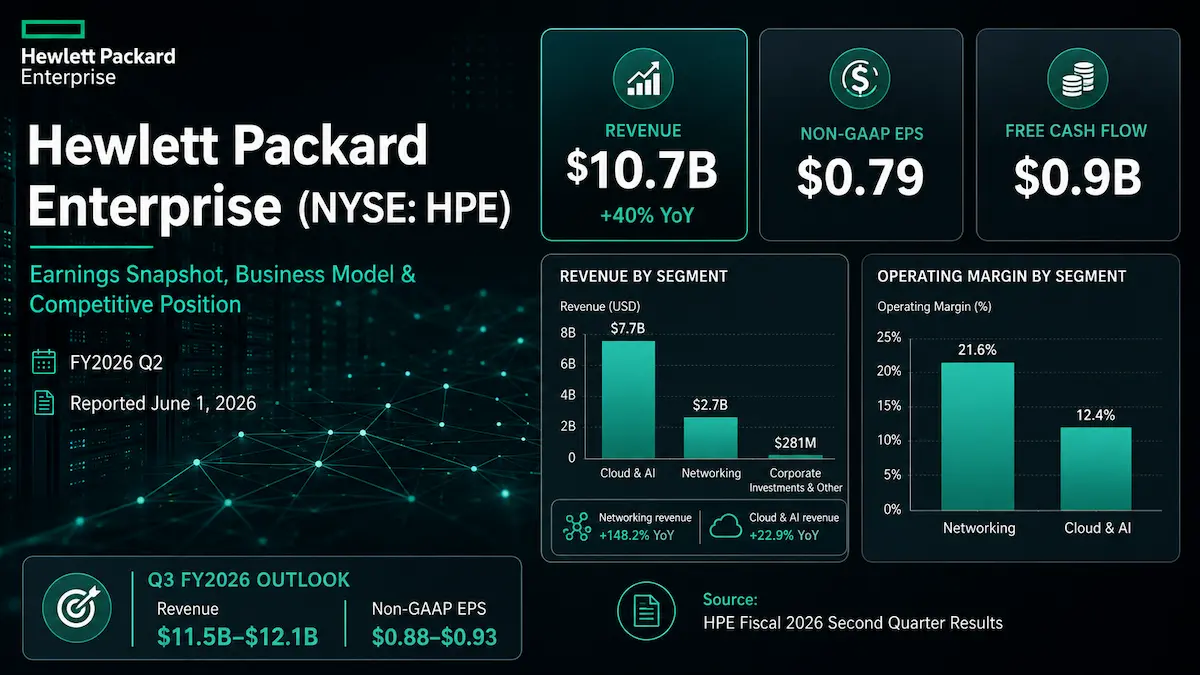
- HPE still monetizes primarily through enterprise infrastructure, but its economic center of gravity is shifting toward networking, software, services, and consumption-based offerings. In fiscal Q2 2026, Cloud & AI generated $7.7 billion of revenue, while Networking generated $2.7 billion; the important distinction is profitability, with Networking posting a 21.6% segment operating margin versus 12.4% for Cloud & AI.
- The Juniper Networks acquisition is the most important strategic reset in HPE’s post-2015 history. It expanded HPE from campus networking into routing, data-center switching, security, and AI-native operations, while giving management a higher-margin profit pool to attach to HPE’s compute, storage, private cloud, and AI infrastructure footprint.
- HPE’s strongest moat is not brand or scale alone. Its more defensible advantages are switching costs created by deeply embedded enterprise infrastructure and operational workflows, plus proprietary networking and infrastructure-management software that becomes more valuable when deployed across a broader HPE estate.
- GreenLake is best understood as HPE’s commercial and operational control layer rather than a public-cloud clone. It combines consumption economics, hybrid-cloud management, observability, orchestration, and increasingly agentic operations across infrastructure that may remain on premises, at the edge, in colocation facilities, or across multiple clouds.
- The main risks are executional: Juniper integration, product-roadmap overlap, debt reduction, commodity cost volatility, intense competition, and the possibility that AI infrastructure demand grows faster than HPE’s ability to convert revenue into attractive free cash flow. The U.S. antitrust settlement also requires divestiture of Instant On and licensing of specified Mist AIOps source code, modestly reducing exclusivity in WLAN software.
1. Business Model Breakdown
HPE Is Still Hardware-Heavy, but the Profit Pool Is Moving Up the Stack
The cleanest way to understand the Hewlett Packard Enterprise business model is to separate revenue volume from profit quality. HPE sells large amounts of physical infrastructure—servers, storage systems, switches, routers, wireless access points, and AI systems—but the company is trying to monetize a progressively larger software, services, financing, and operational layer around that installed base.
Under HPE’s fiscal 2026 reporting structure, the company is organized principally into Networking and Cloud & AI, with a smaller Corporate Investments and Other segment. In fiscal Q2 2026, HPE reported $10.678 billion of total revenue. Cloud & AI contributed $7.707 billion, or roughly 72% of the total, while Networking contributed $2.690 billion, or roughly 25%. Within Cloud & AI, Server alone generated $5.454 billion, meaning that servers still represented slightly more than half of company revenue in the quarter. That makes one point unavoidable: HPE has not become a software company. Its strategic objective is instead to improve the economics of a very large infrastructure franchise by attaching higher-value networking, software, subscriptions, support, lifecycle services, financing, and consumption contracts.
The margin structure explains why Juniper matters so much. Networking produced a 21.6% segment operating margin in fiscal Q2 2026, compared with 12.4% for Cloud & AI. The reported 148.2% year-over-year increase in Networking revenue was heavily influenced by Juniper consolidation; HPE’s own normalized comparison described Networking revenue growth as double-digit. That distinction is essential for investors because acquisition accounting can make top-line growth look structurally stronger than the underlying demand trend.
Four Monetization Engines
The first engine is infrastructure product revenue. HPE sells ProLiant servers, AI systems, Alletra storage, networking hardware, high-performance computing systems, and related products. This business creates scale, customer access, and an installed base, but it is exposed to component costs, supply cycles, configuration mix, and competitive pricing. Hardware therefore provides distribution and account control more reliably than it provides a permanent margin moat.
The second engine is networking software and subscriptions. Following the Juniper acquisition, HPE can sell across campus and branch, data-center networking, routing, security, and cloud-managed operations. The strategic value is that network management and assurance are recurring operational functions. Once a customer standardizes policies, telemetry, identity, automation, and troubleshooting workflows on platforms such as HPE Aruba Networking Central or HPE Juniper Networking Mist, the relationship becomes more persistent than a one-time switch or access-point sale.
The third engine is GreenLake and the broader hybrid-cloud software stack. GreenLake monetizes infrastructure through cloud-like consumption and subscription models while also serving as an operating layer for management, observability, orchestration, lifecycle services, and increasingly AI-assisted operations. HPE’s fiscal 2025 annualized revenue run-rate, or ARR, reached $3.151 billion, up 63% year over year. By fiscal Q2 2026, HPE said the GreenLake platform was managing more than 6.7 million systems across approximately 50,000 customers. These metrics do not convert HPE into a pure SaaS business, but they show that recurring software and services are becoming a larger economic overlay on the installed hardware estate.
The fourth engine is HPE Financial Services. Financing is strategically important because enterprise infrastructure is capital intensive. Leasing, consumption financing, asset lifecycle management, and certified pre-owned infrastructure can reduce customer budget friction while preserving HPE’s ability to sell larger systems. Financial Services therefore functions less like an isolated finance subsidiary and more like a conversion tool that can improve attach rates, customer retention, and refresh-cycle economics.
The Platform Strategy: Turn Infrastructure Silos into an Operating System for Hybrid IT
HPE’s platform strategy is increasingly coherent. Compute, storage, networking, private cloud, observability, and orchestration generate operational telemetry and control points. GreenLake is the umbrella through which HPE can unify those control points, while HPE Morpheus Software adds virtualization and orchestration, OpsRamp adds multi-vendor observability, GreenLake Intelligence adds agentic AIOps, and the combined Aruba and Juniper portfolio contributes network assurance and automation.
This matters commercially because HPE does not need to win every individual infrastructure category to increase wallet share. If the company can become the control plane across a heterogeneous enterprise estate, it can monetize management and operations even when part of the underlying environment is supplied by third parties. The 2026 integration of Juniper Apstra with HPE Morpheus, Mist support for HPE Networking CX switches, Marvis capabilities inside Aruba Central, and deeper cross-domain observability are all examples of this strategy moving from marketing architecture into product integration.
2. Deep Dive into Economic Moats
Moat #1: Switching Costs Embedded in Mission-Critical Operations
HPE’s most credible moat is switching cost. Enterprise infrastructure is not sticky merely because replacing hardware is expensive. The deeper cost comes from operational dependence: network policies, identity controls, security rules, automation scripts, observability integrations, capacity planning, support processes, certifications, staff training, procurement standards, and migration risk. A hospital, bank, government agency, telecommunications provider, or large industrial customer does not evaluate a network or private-cloud migration as if it were replacing a consumer device. Downtime, misconfiguration, data movement, regulatory validation, and retraining can all cost more than the equipment itself.
The Juniper combination can strengthen those switching costs if HPE executes well. HPE is deliberately cross-pollinating Aruba Central and Mist rather than forcing an immediate platform migration. Common hardware, shared AIOps capabilities, and support for HPE Networking CX switches within Mist can protect existing customer investments while gradually increasing the amount of HPE software involved in day-to-day operations. That is a more durable retention mechanism than simply bundling products at a discount.
However, the moat is not absolute. Enterprise networking is built around standards, customers frequently maintain multi-vendor environments, and large buyers have sophisticated procurement teams. Cisco, cloud providers, server vendors, specialist networking companies, and software-defined infrastructure platforms can all attack parts of HPE’s account. HPE therefore has meaningful switching costs, but not the near-irreversible lock-in associated with some proprietary transaction networks or vertically integrated software ecosystems.
Moat #2: Operational IP, Telemetry, and Cross-Domain AIOps
The second defensible barrier is a form of intangible asset advantage: networking and infrastructure-management intellectual property reinforced by accumulated operational telemetry. Juniper Mist brings mature AI-native network operations, while Aruba contributes its own enterprise networking software, identity, and management capabilities. HPE is now extending those technologies across compute, storage, networking, and hybrid cloud through GreenLake Intelligence and OpsRamp.
The strategic value is not simply that HPE “has AI.” The defensible element is the combination of domain-specific models, operational data, remediation workflows, hardware knowledge, and enterprise deployment history. A new entrant can build a dashboard quickly; recreating years of network-event data, support cases, failure signatures, remediation logic, and enterprise integrations is materially harder. HPE’s June 2026 networking announcements show the company moving toward predictive maintenance, agentic root-cause analysis, self-driving remediation, and shared AIOps across the Aruba and Juniper estates.
This advantage should not be mislabeled as a classic network effect. Customers do not necessarily receive more direct value merely because another customer joins HPE. The effect is closer to a learning-scale advantage: more deployed systems can generate more operational patterns that may improve models and automation. That can be economically valuable, but competitors with large installed bases can pursue the same mechanism.
Why Network Effects and Cost Advantages Are Secondary
HPE has scale benefits in procurement, distribution, support, channel reach, and R&D, and management expects at least $600 million of annualized Juniper-related cost synergies by fiscal 2028. Those efficiencies matter for margins, but they do not constitute a permanent cost moat because other large infrastructure vendors also buy components at scale and operate global channels. In servers especially, memory, storage, accelerator, and processor economics can overwhelm vendor-specific sourcing advantages during tight supply cycles.
Likewise, GreenLake has platform characteristics, but it does not yet exhibit the self-reinforcing two-sided network economics seen in marketplaces, payment networks, or dominant developer ecosystems. HPE’s durable case therefore rests primarily on switching costs plus operational software and IP—not on the mere fact that the company is large or growing.
Can These Moats Support Long-Term Excess Returns?
Potentially, but only if mix shift continues. The evidence to watch is not total revenue growth by itself. The better test is whether HPE can expand the proportion of profit generated by Networking, recurring software, services, and hybrid-cloud operations while preserving free cash flow. Management’s fiscal 2028 framework calls for Networking operating margins of 25% to 28%, compared with 21.6% in fiscal Q2 2026. If HPE reaches that range while growing normalized Networking revenue and GreenLake adoption, the moat thesis becomes more credible. If revenue grows mainly through lower-margin AI systems and servers, the company may remain strategically relevant without earning structurally superior economics.
3. Business Inflection Points & Future Catalysts
From the 2015 Separation to a Reassembled Infrastructure Platform
HPE became an independent company in November 2015 when Hewlett-Packard separated its enterprise technology businesses from HP Inc. The first phase of HPE’s independent life was simplification. In 2017, HPE separated its Enterprise Services business and merged it with CSC to create DXC Technology, then separated its Software business and combined it with Micro Focus. Those transactions narrowed HPE toward infrastructure, hybrid IT, the intelligent edge, and flexible consumption.
The second phase was platform reconstruction. HPE used acquisitions and internal development to rebuild differentiated layers around infrastructure: Aruba in networking, Nimble and 3PAR in storage, Cray in high-performance computing, OpsRamp in observability, Morpheus in orchestration and virtualization, and GreenLake as the consumption and management umbrella. In 2019, management explicitly committed to offering the portfolio increasingly as a service, making recurring consumption economics a central strategic objective.
The Defining Inflection: Juniper Changes the Profit Architecture
The July 2, 2025 completion of the Juniper Networks acquisition is the most consequential strategic inflection because it changes what HPE wants its core profit engine to be. HPE paid approximately $13.4 billion in cash consideration for Juniper. The transaction doubled the size of HPE’s networking business and expanded the portfolio into data-center switching, routing, firewalls, service-provider networking, and AI-native operations. HPE has said the combined Networking business is expected to contribute more than half of total company operating income.
This is more than diversification. Networking sits at the junction of HPE’s AI, private-cloud, and hybrid-cloud strategy. AI systems require high-performance fabrics; enterprise AI requires secure connectivity and data movement; private cloud requires orchestration and policy control; and distributed infrastructure requires observability. By owning a broader network stack, HPE can attach more of the architecture surrounding compute and storage instead of competing mainly for the hardware chassis.
Catalyst 1: Juniper Integration Converts Revenue Scale into Margin Scale
The transmission mechanism is straightforward. HPE can cross-sell Juniper routing, switching, security, and Mist into its global enterprise installed base, while Juniper customers gain access to HPE compute, storage, private cloud, AI infrastructure, financing, and services. On the cost side, management has identified supply-chain integration, corporate-function rationalization, sales and services optimization, product-roadmap convergence, and R&D prioritization as synergy sources. HPE now expects at least $600 million of annualized Juniper-related synergies by fiscal 2028, above the $450 million originally targeted when the transaction was announced.
The observable indicators are normalized Networking revenue and order growth, the Networking operating margin, cross-platform product integration, realized cost synergies, and net leverage. Fiscal Q2 2026 showed encouraging but incomplete evidence: Networking revenue grew double digits on a normalized basis, orders grew significantly faster than revenue, campus and branch orders reached a record, enterprise data-center switching orders rose nearly 20%, and routing orders rose nearly 30% on HPE’s normalized comparisons.
The risk is that integration creates complexity faster than it creates differentiation. Aruba Central and Mist overlap in some management functions; product rationalization can unsettle customers and channel partners; sales compensation changes can disrupt pipelines; and competitors can use migration uncertainty to attack the installed base. The U.S. Department of Justice settlement also requires HPE to divest the Instant On business and license specified Mist AIOps source code on a perpetual, non-exclusive basis to approved competitors. HPE retains broader Mist intellectual property, but the remedy reduces exclusivity around one important WLAN AIOps component.
Catalyst 2: Enterprise AI Improves Mix, Not Just Revenue
AI is only a meaningful catalyst if HPE captures attractive economics around it. The company can sell large AI systems, but GPU-rich infrastructure can consume working capital and may carry less attractive margins when customers are hyperscalers, model builders, or highly concentrated buyers. HPE’s more valuable opportunity is enterprise and sovereign AI, where customers may buy a broader architecture: compute, networking, storage, private cloud, security, data protection, lifecycle services, and financing.
Fiscal Q2 2026 provided concrete indicators. HPE reported a record AI Systems backlog of $5.9 billion, including $1.8 billion of new AI Systems orders, and raised its cumulative Networks for AI order target to at least $2 billion by the end of fiscal 2026. Private Cloud AI orders also increased again in the quarter. The transmission mechanism is therefore not simply backlog conversion into server revenue; it is backlog conversion with higher attachment of networking, storage, software, and services.
The key metrics are AI backlog conversion, Networks for AI orders, Private Cloud AI customer growth, storage attachment, Networking growth, Cloud & AI operating margin, inventory, and free cash flow. The execution risk is substantial. AI infrastructure is exposed to accelerator availability, memory and NAND costs, customer concentration, rapid product cycles, and capital intensity. HPE has explicitly stated that it is willing to prioritize profitable AI growth over maximum market-share growth. Investors should therefore treat slower headline AI revenue growth as acceptable if mix, margin, and free cash flow improve.
Catalyst 3: GreenLake and Morpheus Become a Control Plane for Hybrid IT
HPE’s third catalyst is software-led: turn GreenLake from a consumption wrapper into a cross-domain operating platform. The 2026 product roadmap is moving in that direction. HPE Morpheus Software now spans virtual machines, containers, orchestration, networking, and hybrid-cloud control; GreenLake Intelligence is adding agentic operations; OpsRamp provides cross-vendor observability; and Juniper Apstra integration adds intent-based network automation.
The commercial transmission mechanism is attractive. Virtualization and infrastructure management are recurring operational workloads, and every additional management domain increases the number of workflows that can be consolidated onto HPE software. That can increase subscription revenue, support revenue, services attachment, and hardware pull-through while lowering customer friction around multi-vendor estates.
The observable indicators are GreenLake customer count, systems under management, ARR, Morpheus subscription growth, private-cloud new logos, and software attach across networking and storage. The major risk is competitive substitution. Enterprises can remain on incumbent virtualization stacks, adopt other private-cloud platforms, or shift more workloads to hyperscalers. GreenLake therefore has to win on economics, operational simplicity, sovereignty, and integration—not merely on the promise of a unified dashboard.
4. Key FAQs
How does Hewlett Packard Enterprise make money after the Juniper Networks acquisition?
HPE makes most of its revenue from enterprise infrastructure, but the post-Juniper model is designed to earn a larger share of profit from networking and recurring operational software. In fiscal Q2 2026, Cloud & AI remained the larger revenue segment at $7.7 billion, but Networking generated a materially higher 21.6% operating margin. The business logic is to use HPE’s large compute, storage, AI, and channel footprint to sell more networking, software, services, and lifecycle management—and to use Juniper’s installed base to cross-sell the rest of HPE.
Is HPE GreenLake a public cloud competitor or an infrastructure subscription platform?
GreenLake is primarily a hybrid-cloud consumption and operations platform, not a hyperscale public cloud built on the same model as AWS, Microsoft Azure, or Google Cloud. It allows customers to consume infrastructure and software with cloud-like economics while keeping workloads in private data centers, edge locations, colocation facilities, sovereign environments, or mixed-cloud architectures. Its strategic value comes from unifying consumption, observability, orchestration, lifecycle management, and increasingly agentic operations across those environments.
Does HPE have a durable economic moat after acquiring Juniper Networks?
HPE has a credible but not impregnable moat. Its strongest defense is switching cost: enterprise networks, private clouds, storage, and compute environments become embedded in operational processes, policies, automation, security, and staff expertise. Juniper adds differentiated networking software and AI-native operations that can deepen those switching costs. However, standards-based infrastructure, multi-vendor procurement, and powerful competitors prevent HPE from having monopoly-like lock-in. The moat will be proven by sustained normalized Networking growth, higher recurring software penetration, and margin expansion—not by acquisition-driven revenue growth alone.
5. Conclusion
HPE’s corporate DNA is best described as infrastructure pragmatism evolving into platform economics. The company spent its first years as an independent public company removing businesses that diluted strategic focus, then rebuilt around the infrastructure layers that remain essential in hybrid IT: compute, storage, networking, private cloud, high-performance computing, operations software, financing, and services. GreenLake became the commercial framework tying those layers together, and Juniper changed the center of gravity by making networking a larger and more profitable architectural anchor.
The most important competitive advantage is not that HPE can sell every piece of the data center. It is that the company increasingly has enough control points—from the network and the server to storage, observability, orchestration, and consumption financing—to reduce operational complexity for customers without requiring an all-or-nothing public-cloud migration. That creates switching costs and cross-sell potential. The more HPE can unify Aruba, Mist, Morpheus, OpsRamp, and GreenLake Intelligence without forcing disruptive customer migrations, the more defensible that advantage becomes.
The investment-relevant question is therefore one of economic conversion. HPE has already shown that Networking carries a stronger operating margin profile than Cloud & AI, and management is targeting further Networking margin expansion through Juniper synergies and scale. AI backlog, Networks for AI, GreenLake adoption, and private-cloud modernization can all accelerate revenue, but they only strengthen the corporate model if they also improve recurring revenue quality, operating leverage, and free cash flow. HPE’s next phase will be judged less by how much infrastructure it ships and more by how much high-value software, networking, and lifecycle economics it can capture around that infrastructure.
Official Sources
- HPE — Fiscal 2026 Second Quarter Results
- HPE Investor Relations — Q2 Fiscal 2026 Earnings Presentation
- HPE — Completion of the Juniper Networks Acquisition
- HPE — 2025 Securities Analyst Meeting Strategic and Financial Framework
- HPE — 2026 Self-Driving Networking Portfolio Expansion
- HPE — GreenLake and HPE Morpheus Agentic IT Operations
- U.S. SEC — HPE Fiscal 2025 Form 10-K
- U.S. Department of Justice — Juniper Acquisition Settlement Requirements
- HPE — Corporate History and Milestones
- HPE Investor Relations — 2017 Enterprise Services Spin-Off and DXC Merger
Disclaimer: This article is intended solely for business logic discussion and corporate research purposes, and does not constitute investment advice of any kind.