



Key Takeaways
- Applied Optoelectronics, Inc. (NASDAQ: AAOI) is fundamentally a high-performance optical hardware manufacturer, not a SaaS or advertising platform. Its economics are driven by product volume, product mix, manufacturing yield, fixed-cost absorption and the ability to move customers from qualification into recurring purchase orders.
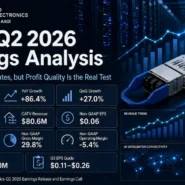
- The revenue engine is now increasingly data-center-led. In the second quarter of 2026, data center products generated $107.7 million, or 56.1% of revenue, while CATV generated $80.6 million, or 42.0%. Both businesses grew year over year, but the data center segment expanded much faster.
- AAOI’s most defensible economic advantage is best classified as a potential cost and execution advantage built on vertical integration: in-house U.S. laser fabrication, internally produced light engines, automated transceiver manufacturing and proprietary process know-how. Customer qualification adds a second, narrower layer of switching friction.
- The 2025 re-engagement with a major hyperscale customer, followed by volume shipments and 2026 orders for 800G and 1.6T transceivers, is the clearest commercial inflection in the company’s recent history. However, announced shipment schedules and capacity targets remain forward-looking until delivered.
- The central counterweight to the growth story is concentration and capital intensity. AAOI reported that its top ten customers represented 99% of revenue in the first half of 2026, while the production ramp has required substantial working capital, capital expenditure and equity financing. Revenue growth therefore does not automatically translate into durable per-share economics.
Evidence Discipline
Confirmed facts in this analysis are drawn from Applied Optoelectronics’ SEC filings, official investor-relations releases and contractual filings. Management targets and claims are explicitly identified as such. Analytical inferences represent conclusions drawn from those public facts rather than company guidance. Unverified market expectations are not used as factual premises; where relevant, they are labeled “Not verified.”
That distinction matters particularly for AAOI. The company is moving through an unusually aggressive capacity and product-cycle expansion, so the difference between an order, a customer forecast, a qualification milestone, installed manufacturing capacity and recognized revenue is economically material. The most useful way to understand the Applied Optoelectronics business model is therefore not as a simple “AI optics growth” narrative, but as a manufacturing platform whose value depends on whether technical capability can be converted into qualified volume at attractive yields and acceptable capital intensity.
1. Business Model Breakdown
What does Applied Optoelectronics actually sell?
AAOI generates revenue primarily by selling physical optical and networking products to data center operators, cable multiple-system operators, equipment manufacturers and other network customers. Its product stack spans laser chips, optical components, light-engine subassemblies, transceivers and complete HFC/CATV equipment. The company’s 2025 Form 10-K describes the business as vertically integrated from foundational laser technology through increasingly complete networking products.
This is important for valuation logic because AAOI does not have the economic structure of a software subscription platform. Public filings do not disclose a material recurring SaaS, advertising or transaction-fee revenue stream. AOI does offer software within its Quantum Bandwidth broadband portfolio, including QuantumLink remote-management software, but the company does not separately disclose a material software subscription revenue line. Investors should therefore avoid importing software-like recurring-revenue assumptions into the core model without evidence.
Revenue mix: a two-engine business with data center now in front
In 2025, CATV was AAOI’s largest end market at 53.8% of revenue, followed by internet data center at 42.9%, telecom at 3.0%, and FTTH and other at 0.3%. By the second quarter of 2026, the mix had shifted: data center revenue reached $107.7 million, or 56.1% of quarterly revenue, up 140.4% year over year, while CATV revenue reached $80.6 million, or 42.0%, up 43.8% year over year. The mix shift is a confirmed fact; the durability of that mix is not.
The data center business sells high-speed optical transceivers used to connect switches, servers and other network devices over fiber. The majority of these transceivers use AAOI’s own lasers and light-engine subassemblies. Economically, the company is attempting to capture more of the value chain than a pure module assembler by internalizing critical photonic components and the manufacturing processes around them.
The CATV business has a different route to market. Historically, AAOI supplied optical and HFC products through equipment vendors. In 2023, the company began selling many CATV products directly to cable operators under the Quantum Bandwidth brand and established Digicomm International as the exclusive go-to-market distributor for the Quantum12 amplifier platform. That strategy pushes AAOI closer to the network operator and potentially increases the amount of system content it can address, but it also creates substantial distributor concentration.
Telecom and FTTH remain strategically relevant because they reuse portions of the same laser and optical manufacturing base, but they are currently small contributors to consolidated revenue. The practical economic center of gravity is therefore data center optics plus broadband access.
The real platform strategy: reusable photonics manufacturing, not a digital network
AAOI’s “platform” is best understood as a physical technology and manufacturing platform. At the base are laser design and fabrication capabilities, including Molecular Beam Epitaxy and Metal Organic Chemical Vapor Deposition. Above that sit internally produced optical components and light engines, followed by module assembly, transceiver integration, automated production, test systems and end-market-specific equipment.
The strategic logic is reuse. A company that owns more of the photonics stack can potentially shorten design cycles, tune components and modules together, reduce external supplier dependency, and reuse process knowledge across product generations such as 400G, 800G and 1.6T. In broadband access, the same broader engineering organization can combine optics, mixed-signal electronics, mechanical design and HFC system knowledge into complete amplifier and network products. This is closer to a semiconductor-manufacturing platform than to a software platform.
How the company converts design capability into revenue
AAOI’s sales process is qualification-intensive. Customers evaluate a product for performance, interoperability, reliability and cost before it becomes part of a deployed design. The company states in its 2026 Form 10-Q that it generally does not have long-term purchase commitments exceeding one year and that most customers buy on a purchase-order basis. However, once a solution is designed into a customer product, management believes it is likely to remain in that design through the product life cycle because replacement can require time and engineering expense.
This creates a hybrid economic pattern: revenue is not contractually recurring in the SaaS sense, but successful qualification can generate repeated purchase orders over the life of a customer program. A design win should therefore be viewed as an option on future volume, not as recognized backlog. AAOI itself cautions that design-win counts do not necessarily translate into short-term revenue.
Where gross profit really comes from
The underlying profit equation is manufacturing-driven. Revenue growth can improve fixed-cost absorption, while vertical integration can reduce supplier markups and give AAOI more control over yields and component cost. Higher-speed optics can also carry different pricing and margin profiles than mature products. Yet the same model carries substantial fixed cost, inventory risk and ramp inefficiency.
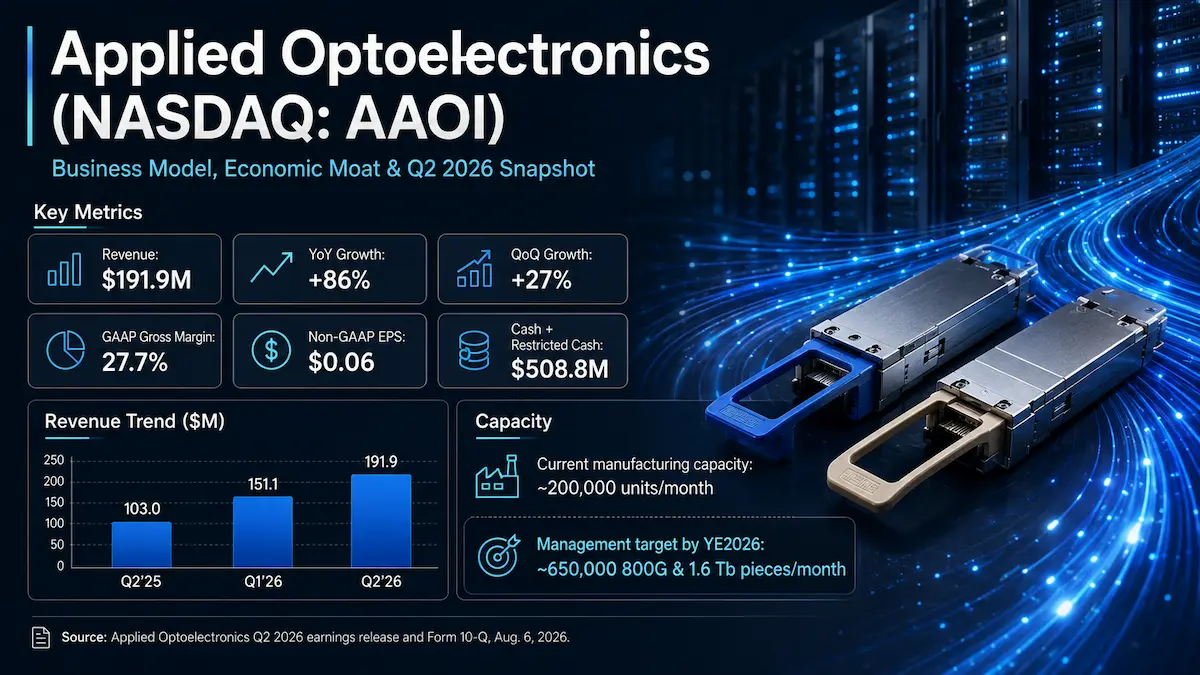
The second quarter of 2026 illustrates the tension. Revenue rose 86.4% year over year to $191.9 million, but GAAP gross margin declined to 27.7% from 30.3%. The 10-Q attributed the margin decline to higher direct material, labor and other manufacturing costs associated with increased production volumes, with certain data center product costs also weighing on gross profit. This is a critical confirmed fact: the current volume ramp has not yet proven that higher revenue automatically produces higher percentage margins.
Management expects future gross margin improvement from product mix, cost optimization and production efficiency. That is a management expectation, not a confirmed outcome. The key analytical question is whether automation, learning curves and utilization eventually reduce unit cost faster than industry pricing compresses average selling prices.
Capital structure is part of the business model, not a footnote
AAOI is currently funding a very large manufacturing buildout. During the first half of 2026, the company used $73.8 million of cash in operating activities and $633.7 million in investing activities. Capital expenditures were substantial, inventory rose by approximately $94.1 million as production ramped, and the company raised approximately $1.03 billion of net proceeds through at-the-market equity issuance during March through June 2026.
That financing strengthened liquidity, with cash, cash equivalents and restricted cash at $508.8 million as of June 30, 2026, but it also increased share count. For a capital-intensive manufacturer, competitive success must ultimately be judged on return on invested capital and per-share cash generation, not merely on factory capacity or headline revenue growth.
2. Deep Dive into Economic Moats
Moat #1: Cost Advantages from vertical integration and manufacturing know-how
Under a Buffett-style moat framework, AAOI’s strongest candidate is cost advantage, but it should be described carefully. The company manufactures the majority of the laser chips and optical components used in its products and fabricates all of its laser chips in Sugar Land, Texas. It also integrates those components into light engines and transceivers and has invested heavily in automated manufacturing and test systems.
Management states that its use of both MBE and MOCVD laser-fabrication processes, and its knowledge of combining those processes with other fabrication techniques, is unusual in the industry. Management also argues that automation allows capacity to scale rapidly and supports geographic flexibility. Those are management claims. The confirmed facts are the vertically integrated production architecture, the U.S. laser-fabrication footprint, the large automation investments, and the company’s expansion of high-speed transceiver capacity in Texas and Taiwan.
The potential moat comes from cumulative process complexity. A competitor trying to replicate AAOI’s full stack would need more than a transceiver design. It would need laser epitaxy and fabrication expertise, packaging know-how, automated assembly, test infrastructure, yield learning, supplier relationships, production capacity, quality systems and customer qualification. Capital can buy equipment, but it cannot instantly buy stable yields or years of tacit manufacturing knowledge.
However, this advantage is not yet sufficient to declare a wide economic moat. Optical transceivers are competitive, customers are sophisticated and price-sensitive, and AAOI itself lists large and capable competitors across its markets. The 2026 margin profile also shows that rapid scaling can temporarily increase cost rather than reduce it. A durable cost moat would require evidence that AAOI can sustain attractive gross margins and returns through multiple product cycles while continuing to win volume without excessive capital consumption.
Moat #2: Switching costs created by customer qualification — meaningful, but not lock-in
AAOI’s second defensible barrier is switching friction at the qualified-design level. Once a hyperscale customer or equipment vendor has qualified a transceiver, laser or subsystem, replacing it can require engineering work, validation, interoperability testing, reliability testing and deployment risk. The company explicitly states that redesigning a customer product or substituting an alternative solution can require time and expense.
This can create favorable economics after qualification: the supplier may receive repeat purchase orders throughout the program life cycle, and the customer has an incentive not to change a functioning component casually. The same logic can apply in HFC networks, where compatibility with installed architectures and operational support can matter.
But the switching-cost moat is bounded. Hyperscalers are powerful buyers and frequently maintain multiple qualified sources to manage supply risk and pricing. AAOI generally lacks long-term purchase commitments, and customer forecasts can change quickly. The correct conclusion is therefore “qualification friction,” not customer captivity. This moat can protect an awarded program; it does not guarantee the next generation of that program.
Intangible Assets: useful, but not the primary moat by themselves
AAOI has intellectual property, process know-how, engineering talent and a long operating history in laser and optical manufacturing. These are economically valuable intangible assets. Yet the more durable advantage appears to reside in tacit manufacturing knowledge and integration rather than in a brand premium or a single patent portfolio that can independently sustain excess returns.
For institutional analysis, this distinction matters. A patent can expire, be designed around or fail to protect manufacturing economics. By contrast, a dense web of process recipes, test methodology, accumulated yield data, cross-disciplinary engineering and qualified customer relationships may be harder to copy. The evidence supports viewing AAOI’s intangible assets as inputs into its manufacturing moat rather than as a standalone franchise moat.
Network Effects: effectively absent
AAOI does not exhibit a classic network effect. A new customer buying an 800G transceiver does not inherently make the product more valuable to another customer. Larger production scale can create learning curves and purchasing leverage, but those are cost advantages, not network effects. The distinction prevents a common analytical error: growth in installed units is not equivalent to a self-reinforcing network.
Does the moat support long-term excess returns?
The evidence supports a narrow-to-moderate moat hypothesis, not a proven wide moat. The most defensible combination is vertical integration plus process automation, reinforced by customer qualification. If that stack consistently produces faster time-to-market, reliable supply and lower unit cost, it could generate excess returns during high-speed optical transitions. If competitors match cost, customers diversify supply, or AAOI must repeatedly fund each node transition with disproportionate capital, the economic moat will be thinner than the technology narrative suggests.
The decisive test is therefore not whether AAOI can build 800G and 1.6T products. It is whether it can manufacture them at high yield, at scale, with sustained margins and repeat customer awards while producing attractive incremental cash returns on the capital invested.
3. Business Inflection Points & Future Catalysts
The strategic inflection: the 2025 hyperscaler re-engagement
AAOI was founded in Houston in 1997, expanded manufacturing into China and Taiwan during the 2000s, and completed its Nasdaq IPO in 2013. The 2013 IPO supplied capital for manufacturing expansion at a time when the company was moving beyond its established CATV base into faster-growing data center optics. A decade later, the company made another important strategic move by launching Quantum Bandwidth products directly to cable operators in 2023.
The most consequential recent commercial inflection, however, occurred in 2025 when AAOI re-engaged a major hyperscale data center customer and resumed significant volume shipments after several years. This is an analytical inference based on the subsequent revenue mix and order flow; AAOI has not formally labeled 2025 as its single most important historical turning point.
The sequence is notable. In March 2025, AAOI and Amazon entered into a transaction agreement tied to commercial arrangements and a warrant for up to 7,945,399 AAOI shares. In June 2025, AOI separately announced its first significant-volume shipment in several years to a recently re-engaged major hyperscale customer. In March 2026, the company announced an initial 1.6T volume order of more than $200 million from a long-term major hyperscale customer and, two weeks later, an 800G volume order of more than $53 million from the same unnamed customer referenced in that 800G release.
Two cautions are essential. First, the official releases do not identify that 2026 hyperscale customer as Amazon, so the two should not be conflated without additional disclosure. Second, Amazon’s warrant mechanics do not constitute a $4 billion purchase order. The vesting structure uses cumulative purchases as a condition for additional warrant vesting; it is not evidence of a binding $4 billion product commitment.
Why call this an inflection? Because the numbers changed from “technology optionality” to material commercial scale. Data center revenue reached 56.1% of second-quarter 2026 sales and increased 140.4% year over year. The company is now spending heavily to expand 800G and 1.6T capacity in the United States and Taiwan. The business is therefore shifting from merely having high-speed optical technology to betting its balance sheet and operating model on volume execution.
Catalyst 1: 800G and 1.6T volume conversion
Confirmed fact: AAOI’s 800G volumes more than doubled sequentially in the second quarter of 2026, according to management’s earnings release, while data center revenue reached $107.7 million. The company also has publicly announced volume orders exceeding $200 million for 1.6T and $53 million for 800G from a major hyperscale customer.
Management target: As of August 6, 2026, management said manufacturing capacity was approaching 200,000 units per month and continued to expect capability of roughly 650,000 combined 800G and 1.6T units per month by year-end 2026. Management also forecast that demand would outpace production capacity through mid-2027. These are forward-looking statements, not confirmed future demand or shipments.
Transmission mechanism: successful qualification and shipment of the announced orders would expand data center revenue. If volume also improves yield, throughput and fixed-cost absorption, gross profit can grow faster than factory overhead. A richer mix of newer 800G and 1.6T products could further support economics, although actual margin by speed class is not publicly disclosed and should not be assumed.
Observable indicators: quarterly data center revenue, 800G and 1.6T shipment milestones, disclosed monthly production capacity, customer qualification updates, GAAP gross margin, inventory growth, accounts receivable, operating cash flow and incremental capital expenditure. A high-quality ramp should eventually show not only more units but also improving conversion of revenue into gross profit and cash.
Execution risks: qualification delays, lower manufacturing yield, higher material or labor cost, customer deployment changes, pricing pressure, order reductions, alternative optical architectures and overbuilding capacity ahead of realized demand. The 2025 Form 10-K explicitly warns that slower AI adoption or different demand patterns could produce overcapacity, negative operating leverage and stranded capital.
Catalyst 2: U.S. capacity expansion as a supply-chain differentiator
Confirmed fact: AAOI is expanding its U.S. manufacturing footprint. In April 2026 it announced a $20.85 million Texas Semiconductor Innovation Fund grant supporting an additional 210,000-square-foot Sugar Land facility. In July 2026, it announced construction on two adjacent Pearland properties adding nearly 400,000 square feet of manufacturing capacity to support 800G and 1.6T transceiver production.
Management claim: AAOI argues that domestic production is a competitive advantage because some customers prefer key components and high-speed optical capacity sourced from the United States. Management also positions automation as a way to make production more location-flexible and cost-effective. These are plausible strategic advantages, but public filings do not independently prove a permanent pricing premium for U.S.-made transceivers.
Transmission mechanism: if hyperscalers value geographic diversification and secure optical supply, AAOI’s U.S. laser fab and expanding domestic transceiver footprint may improve its probability of qualification and share allocation. More capacity also removes a physical bottleneck if customer demand materializes.
Observable indicators: capacity commissioned versus planned, factory utilization, yield, gross margin, capital expenditure per incremental unit of capacity, on-time deliveries and customer concentration. The most important metric is not square footage; it is whether the new assets generate acceptable incremental gross profit and cash returns.
Execution risks: construction delays, labor and equipment bottlenecks, underutilization, technology shifts, higher domestic operating costs and shareholder dilution if additional external capital is required. AAOI’s first-half 2026 equity issuance demonstrates that financing risk is already part of the operating equation rather than a theoretical concern.
Catalyst 3: Quantum Bandwidth and DOCSIS 4.0 monetization
Confirmed fact: AAOI began selling many CATV products directly to MSO customers under the Quantum Bandwidth brand in 2023. Digicomm became the exclusive go-to-market distributor for the Quantum12 platform. In May 2026, AAOI announced that it was working with Mediacom on DOCSIS 4.0-related network upgrades and was the primary vendor for the upgrade across specified legacy amplifier footprints. The same release stated that Digicomm had shipped several hundred thousand AOI 1.8 GHz amplifiers to multiple North American operators over the preceding 12 months.
Transmission mechanism: direct branded access to MSOs can increase AAOI’s addressable system content beyond being an upstream component supplier. Compatibility with installed HFC architectures, distribution availability and remote-management capabilities can make the offering more useful to operators that want to upgrade coax networks without replacing the entire physical plant.
Observable indicators: CATV revenue growth, new MSO wins, product certifications, unit deployments, share of revenue attributable to Digicomm, accounts-receivable concentration and gross margin. Revenue growth accompanied by lower distributor concentration would be qualitatively stronger than growth that simply increases exposure to one channel partner.
Execution risks: operator capital-spending delays, slower DOCSIS 4.0 deployment, pricing competition, distributor concentration and credit exposure. Digicomm represented 53.1% of total AAOI revenue in 2025 and remained a major concentration in 2026. That concentration magnifies both the upside of rapid deployment and the downside of any channel disruption.
Unverified market expectations
Not verified: this article does not rely on third-party total-addressable-market estimates, unnamed analyst order forecasts, social-media claims about customer identity, or assumptions that every announced capacity target will be fully utilized. Those may influence market sentiment, but they are not treated here as established facts.
4. Key FAQs
How does Applied Optoelectronics make money from AI data centers?
Applied Optoelectronics makes money from AI data centers primarily by selling high-speed optical transceivers and related photonic components used to connect servers, switches and other network devices. It does not monetize AI workloads through cloud-compute rentals or software subscriptions. The economic opportunity comes from the rising number and speed of optical links required as AI clusters scale, while AAOI attempts to capture more value through internally manufactured lasers, light engines and automated module production. The key variable is not AI demand in the abstract; it is how much qualified transceiver volume AAOI can ship at sustainable gross margins.
Does Amazon’s AAOI warrant mean Amazon committed to buy $4 billion of Applied Optoelectronics products?
No. The public SEC documents describe a warrant for up to 7,945,399 AAOI shares issued in connection with commercial arrangements with Amazon. A portion vested initially, while additional warrant vesting is tied to cumulative purchase thresholds over time. The existence of a $4 billion cumulative-purchase threshold in the vesting mechanics should not be represented as a confirmed $4 billion product order or guaranteed revenue commitment.
What is Applied Optoelectronics’ competitive advantage in 800G and 1.6T optical transceivers?
The most credible advantage is manufacturing integration rather than brand or network effects. AAOI combines in-house laser fabrication in Texas, internally produced optical subassemblies, transceiver integration, automated production and customer qualification. That can reduce supplier dependency and potentially improve time-to-market, yield learning and supply assurance. The advantage becomes an economic moat only if those capabilities translate into lower unit cost, reliable high-volume delivery and repeat customer awards without requiring returns-dilutive capital spending. The ongoing 2026 ramp is therefore a live test of the moat, not proof that it is already permanent.
5. Conclusion
Applied Optoelectronics’ corporate DNA is best described as vertically integrated photonics manufacturing. The company began with laser and optical engineering, built fabrication and assembly capabilities across Texas and Asia, extended those capabilities into complete data center and broadband products, and is now trying to industrialize high-speed optics through automation. Its strategic platform is not a digital ecosystem; it is a reusable stack of laser technology, optical integration, manufacturing process control, automated test and customer qualification.
The most attractive feature of that DNA is that technical depth can potentially become an economic cost and execution advantage when the industry moves rapidly from one speed generation to the next. The 2025–2026 hyperscaler re-engagement, 800G ramp and first 1.6T volume order show that AAOI has converted part of that capability into meaningful commercial traction. At the same time, the decline in GAAP gross margin during the 2026 volume ramp, continued GAAP losses, extremely high customer concentration and heavy capital requirements show why technological relevance should not be equated with a proven wide moat.
Over the next one to two years, the central question is whether AAOI can turn capacity into high-quality earnings rather than simply high revenue. Evidence of a strengthening business would include sustained 800G/1.6T shipments, improving yields and gross margins, stronger operating cash conversion and a broader customer mix. Evidence against the thesis would include repeated qualification delays, persistent margin compression, rising working-capital intensity, underutilized new factories or dependence on further dilution to fund growth. The enterprise has genuine strategic assets; the durability of their economic returns remains an execution question.
Primary and Official Sources
- U.S. Securities and Exchange Commission — Applied Optoelectronics 2025 Form 10-K
- Applied Optoelectronics Investor Relations — Q2 2026 Form 10-Q
- Applied Optoelectronics Investor Relations — Second Quarter 2026 Results
- U.S. Securities and Exchange Commission — March 2025 Amazon Transaction Agreement
- Applied Optoelectronics Investor Relations — June 2025 Hyperscale Customer Volume Shipment
- Applied Optoelectronics Investor Relations — March 2026 First 1.6T Volume Order
- Applied Optoelectronics Investor Relations — March 2026 800G Volume Order
- Applied Optoelectronics Investor Relations — 2023 Digicomm and Quantum12 Distribution Agreement
- Applied Optoelectronics Investor Relations — 2026 Mediacom DOCSIS 4.0 Upgrade Announcement
- Applied Optoelectronics Investor Relations — 2026 Texas Semiconductor Innovation Fund Grant
- Applied Optoelectronics Investor Relations — July 2026 Pearland Manufacturing Expansion
- Applied Optoelectronics — Official Company History
- Applied Optoelectronics Investor Relations — 2013 IPO-Era Results and Manufacturing Expansion
Disclaimer: This article is intended solely for business logic discussion and corporate research purposes, and does not constitute investment advice of any kind.