



Key Takeaways
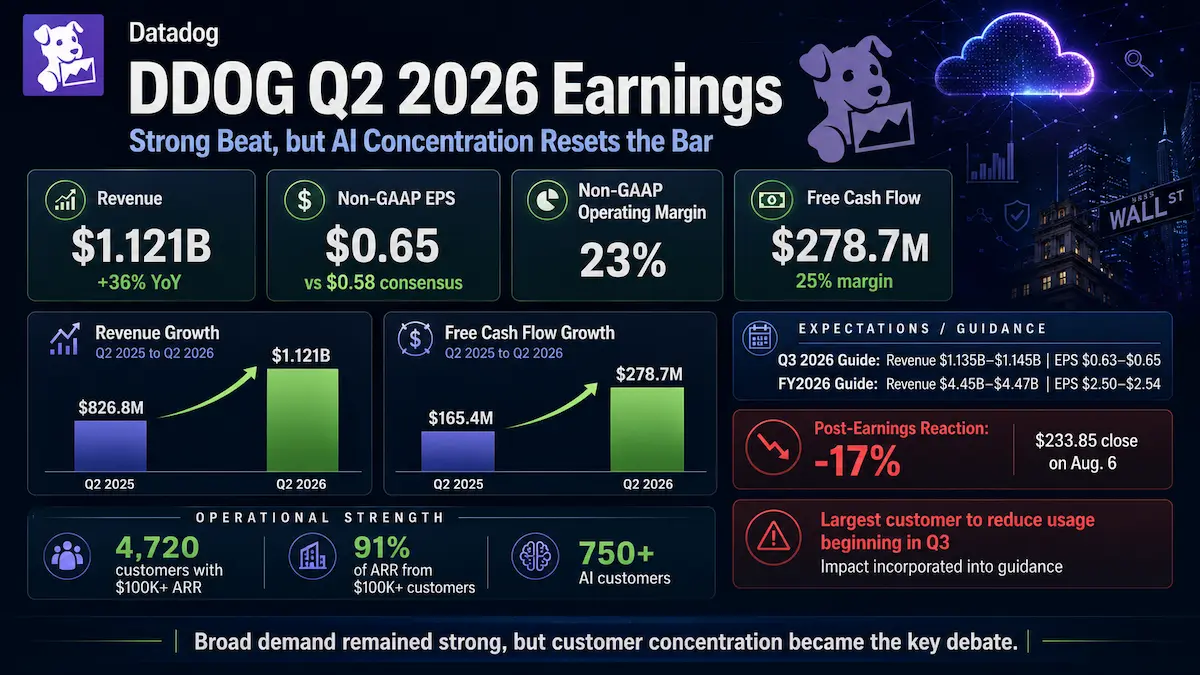
- Datadog delivered $1.121 billion of Q2 2026 revenue, up 36% year over year, versus roughly $1.08 billion expected by analysts, while non-GAAP diluted EPS of $0.65 exceeded the $0.58 consensus.
- Underlying demand was broader than the headline AI narrative suggests: management said revenue growth excluding AI customers accelerated into the high-20% range year over year, up from the mid-20% range in Q1 and 18% a year earlier.
- Profitability improved on an adjusted basis, with 23% non-GAAP operating margin, but GAAP operating margin remained approximately 0%. Stock-based compensation was $220.3 million, or about 19.6% of revenue, so the GAAP/non-GAAP gap remains economically important.
- The major negative was not Q2 execution. Management disclosed that its largest customer renewed a nine-figure contract but is reducing usage beginning in Q3. Datadog says the impact is incorporated into guidance, creating a sharper debate around customer concentration and second-half growth.
- After the report, DDOG fell about 17% to $233.85 on August 6. Even after that reset, the stock trades at roughly 92.8 times the midpoint of management’s 2026 non-GAAP EPS guidance, leaving little tolerance for slower growth or weaker conversion of AI demand into durable revenue.
1. Core Earnings Breakdown
Revenue and Profitability Analysis
Datadog reported Q2 2026 revenue of $1.121 billion, up 36% year over year from $826.8 million. The quarter also represented approximately 11.4% sequential growth from Q1 revenue of $1.006 billion, calculated from company-reported figures. Management described the sequential increase as the strongest since Q2 2022 and said the roughly $115 million of sequential revenue added was a company record.
The most important quality-of-growth point was the performance outside the largest AI accounts. Management said revenue from non-AI customers accelerated to the high-20% range year over year, compared with the mid-20% range in Q1 and 18% a year earlier. That is not a formal constant-currency or organic-growth metric, so it should not be presented as one. It is, however, a useful operational read-through: the acceleration was not confined to a handful of frontier-model customers.
Datadog does not report separate product revenue segments. Its 2025 Form 10-K states that the company has a single operating and reportable segment covering its observability and security platform. As a result, any attempt to assign revenue shares to Infrastructure Monitoring, APM, Log Management, Security, AI Observability or other individual products would be unsupported. Investors should instead use the product-adoption and ARR milestones Datadog actually discloses.
- Large-customer engine: Datadog ended Q2 with about 4,720 customers generating at least $100,000 of ARR, up roughly 23% from about 3,850 a year earlier. These customers represented 91% of ARR. The investment implication is that enterprise expansion remains the primary economic engine even as the total customer count grows more slowly.
- Platform depth: 58% of customers used four or more products, 37% used six or more, 22% used eight or more, and 13% used ten or more. Each metric improved materially year over year. The relevant takeaway is not simply cross-sell volume: deeper deployment raises switching costs and allows Datadog to monetize new categories without needing a new logo for every dollar of growth.
- Digital experience expansion: Real User Monitoring exceeded $200 million of ARR and grew more than 50% year over year. This matters because it demonstrates that Datadog can build meaningful businesses adjacent to its original infrastructure and application-observability foundation.
- AI customer monetization: Datadog said it had more than 750 AI customers, including 31 spending more than $1 million annually and eight spending more than $10 million. The opportunity is substantial, but the quarter also showed why usage concentration must be modeled separately from customer-count growth.
On profitability, GAAP gross profit was $881.3 million, equal to roughly 78.6% of revenue calculated from company-reported figures, while non-GAAP gross profit was $892.3 million and management reported a 79.6% non-GAAP gross margin. That adjusted gross margin was below 80.2% in Q1 and 80.9% a year earlier, indicating that rapid growth is not currently producing gross-margin expansion.
GAAP operating income was only $5.5 million, equivalent to roughly 0.5% of revenue before rounding, while non-GAAP operating income was $257.0 million and non-GAAP operating margin was 23%. The difference is material. Stock-based compensation alone was $220.3 million in Q2, and employer payroll taxes on employee stock transactions added another $27.6 million to the GAAP-to-non-GAAP reconciliation. Investors should therefore distinguish between genuine operating leverage and adjustments that shift compensation costs outside the headline non-GAAP result.
There was nevertheless progress in earnings quality. Stock-based compensation represented approximately 19.6% of Q2 revenue, calculated as $220.3 million divided by $1.121 billion. A year earlier, the comparable ratio was approximately 21.8%, calculated as $180.5 million divided by $826.8 million. The ratio improved by about 2.2 percentage points even as absolute stock compensation increased.
Free cash flow was $278.7 million, representing a 25% margin, compared with $165.4 million and a 20% margin a year earlier. That is approximately 68.6% year-over-year free-cash-flow growth, calculated from company-reported figures. Cash conversion therefore remains a stronger part of the Datadog investment case than GAAP operating profit.
Expectations vs. Actual Results
- Revenue: $1.121B vs. approximately $1.08B consensus — ✅ Beat. The beat was about $41 million, or 3.8%, versus the consensus figure reported by FactSet. Revenue also exceeded Datadog’s prior Q2 guidance high end of $1.08 billion.
- Non-GAAP diluted EPS: $0.65 vs. $0.58 consensus — ✅ Beat. The upside was approximately 12% relative to consensus.
- Non-GAAP operating income: $257.0M vs. prior company guidance of $225M-$235M — ✅ Beat. Actual operating income was about 9.4% above the prior guidance high end.
- Non-GAAP operating margin: 23% actual vs. approximately 21.4% implied by prior guidance midpoints — ✅ Above company-guidance implication. A reliable public Wall Street operating-margin consensus was not available in the reviewed primary and major-market sources, so presenting one would be inappropriate. The 21.4% comparison is calculated from the prior $230 million operating-income midpoint divided by the $1.075 billion revenue midpoint, not an analyst consensus.
The Q2 beat came from more than a single AI customer. Datadog said broad-based non-AI growth accelerated, enterprise new-logo annualized bookings more than doubled year over year, and new customers contributed roughly 30% of year-over-year revenue growth, up from about 25% in Q1. Billings reached $1.18 billion, up 38%, while remaining performance obligations were $3.47 billion, up 43%, and current RPO grew about 40%. Those indicators support the view that demand and bookings momentum remained healthy entering the second half.
Management’s Q3 2026 guidance calls for revenue of $1.135 billion to $1.145 billion, representing 28% to 29% year-over-year growth, non-GAAP operating income of $260 million to $270 million, and non-GAAP diluted EPS of $0.63 to $0.65 on approximately 378 million diluted shares. FactSet consensus cited by major financial media before the report was approximately $1.11 billion of revenue and $0.61 of EPS, so the formal Q3 guide was above consensus.
For full-year 2026, Datadog raised revenue guidance to $4.45 billion to $4.47 billion from $4.30 billion to $4.34 billion. The midpoint increased about 3.2%. Non-GAAP operating-income guidance rose to $1.01 billion to $1.03 billion, and non-GAAP diluted EPS guidance increased to $2.50 to $2.54 from $2.36 to $2.44. The new full-year revenue midpoint of $4.46 billion was also above the approximately $4.35 billion FactSet consensus cited by Barron’s and MarketWatch.
Why, then, did the stock fall? The problem was the trajectory embedded behind the formal beat-and-raise. The midpoint of Q3 revenue guidance is $1.140 billion, only about 1.7% above Q2 revenue, calculated from company-reported figures. More importantly, management disclosed that its largest customer is reducing usage beginning in Q3. Although Datadog said it had incorporated that reduction into guidance, the disclosure challenged the market’s prior assumption that AI-related consumption would keep accelerating smoothly through the second half.
DDOG fell about 17% to $233.85 on August 6, its worst one-day percentage decline in more than six years according to Dow Jones Market Data as reported by Barron’s. The stock had risen 108% year to date through the prior close. That context matters: the market was not pricing Datadog for an ordinary beat. It was pricing for continued upward revisions and increasingly powerful AI-driven acceleration. A good quarter can still disappoint when the embedded expectation is exceptional.
The selloff therefore should not be reduced to “sell the news.” Four factors were more relevant: a smaller revenue beat than the prior quarter, modest sequential growth implied by Q3 guidance, the first explicit warning that a very large AI customer will reduce usage, and a valuation that still requires sustained high growth even after the post-earnings decline.
Earnings Call Highlights
- Management said revenue growth excluding AI customers accelerated into the high-20% range, extending a five-quarter improvement in the broader business. 💡 Reading Between the Lines: This is the strongest counterargument to the idea that Datadog has become only an AI-customer concentration story. If non-AI growth stays near the high-20s while the largest AI customer’s usage normalizes, the core platform can absorb part of the concentration shock without a full thesis break.
- The largest customer renewed a nine-figure contract and uses 17 Datadog products, but management expects a usage reduction beginning in Q3 and says that reduction is reflected in guidance. 💡 Reading Between the Lines: Contract renewal lowers outright churn risk, but it does not remove consumption volatility from a usage-based model. Investors should model the relationship and the revenue trajectory separately rather than treating a large renewal as proof that spend can only rise.
- Datadog said new customers contributed about 30% of year-over-year revenue growth, while enterprise new-logo annualized bookings more than doubled. 💡 Reading Between the Lines: Growth is becoming less dependent on expansion from the installed base. That matters because a healthier mix of new-logo contribution can improve durability when a large existing customer optimizes usage.
- Management highlighted a multi-year deal worth more than $30 million of total contract value in which a large online-media customer standardized on Datadog and displaced four commercial or internal tools. 💡 Reading Between the Lines: The strategic objective is platform consolidation, not merely winning another monitoring workload. Larger consolidation deals expand wallet share and strengthen switching costs, while increasing competitive pressure on point solutions and rival observability platforms.
- Datadog said MCP tool calls quadrupled again sequentially and were more than 22 times Q4 2025 levels as agentic AI traffic expanded rapidly. 💡 Reading Between the Lines: The monetization opportunity may shift from observing traditional cloud infrastructure toward observing and controlling autonomous software activity. The key valuation question is whether rapidly rising agent activity converts into durable, diversified revenue rather than concentrated consumption from a few frontier AI customers.
2. Deep Business Insights
Hidden Metrics That Matter
One underappreciated metric is the economic concentration of Datadog’s large-customer cohort. The company had about 4,720 customers with at least $100,000 of ARR out of roughly 33,400 total customers. That means only about 14.1% of customers account for a cohort that generates 91% of ARR, calculated as 4,720 divided by 33,400 using company-reported figures. This does not mean a small number of individual customers account for 91% of revenue; it means the platform is economically weighted toward larger enterprises. That structure is attractive when enterprise cross-sell is strong, but it also explains why changes in consumption by a very large account can move forward expectations.
A second hidden metric is the widening product footprint. Ten-or-more-product adoption increased to 13% from 7% a year ago, a six-percentage-point increase, while six-or-more-product adoption rose to 37% from 29%. The trend supports a platform-consolidation thesis: customers increasingly use Datadog across infrastructure, applications, logs, user experience, security, developer workflows and AI-related workloads instead of deploying the product as a narrow monitoring tool.
That platform breadth helps explain why customers select Datadog. A unified environment can reduce the operational friction of correlating telemetry across infrastructure, applications, end-user behavior, security events and AI workloads. The customer examples in the call reinforce the point: management described a South American bank adopting 11 products, a Fortune 100 health insurer expanding to 19 products, and a large online-media customer consolidating multiple tools onto Datadog. These are not proof that every customer will consolidate, but they demonstrate the commercial logic behind Datadog’s product-expansion strategy.
The third metric is the gap between adjusted profitability and equity-based compensation. Q2 stock-based compensation of $220.3 million was about 19.6% of revenue, calculated from company-reported figures. The ratio improved from approximately 21.8% a year earlier, which is positive, but it remains large enough that non-GAAP EPS cannot be treated as equivalent to fully burdened economic earnings. For long-duration valuation work, investors should track both free cash flow per diluted share and dilution, not just adjusted EPS growth.
Industry Chain Reactions
- ✅ Potential beneficiary — Amazon (NASDAQ: AMZN): Datadog’s management described enterprise AI adoption as driving more cloud adoption, more workloads and broader modernization. That is a positive read-through for hyperscale cloud infrastructure if the trend persists. The conclusion is an industry inference, not a disclosure that Datadog’s Q2 growth came specifically from AWS.
- ❌ Potential pressure — Dynatrace (NYSE: DT): Datadog’s increasing multi-product penetration and its disclosed platform-consolidation wins raise competitive pressure on other observability vendors. Datadog did not identify which competitors were displaced in the large online-media deal, so it would be incorrect to claim Dynatrace was one of them; the read-through is about category-level competition.
Valuation Framework and Key Risks
At the latest regular-session close available when this analysis was prepared, DDOG traded at $233.85 after the August 6 earnings selloff. Against the midpoint of management’s 2026 non-GAAP EPS guidance of $2.52, that equals approximately 92.8 times guided non-GAAP earnings, calculated as $233.85 divided by $2.52. The reciprocal adjusted earnings yield is only about 1.1%.
That multiple is not automatically excessive for a company growing revenue around 30% with strong free cash flow, but it is demanding. More importantly, the denominator is non-GAAP EPS, which excludes substantial stock-based compensation. The valuation therefore assumes both continued revenue compounding and eventual conversion of adjusted profitability into stronger GAAP economics on a per-share basis.
The bull case requires several things to happen at once. Broad non-AI growth must remain strong; AI-related observability must become more diversified across customers; multi-product adoption must continue raising wallet share; and free-cash-flow growth must offset ongoing dilution. If those conditions hold, the Q2 customer-specific usage reduction can be treated as a concentration event inside an otherwise healthy growth engine.
The bear case is that the largest-customer issue reveals a structural characteristic of AI workloads: very large customers may optimize, internalize tooling or change infrastructure rapidly after periods of explosive consumption. If so, Datadog could continue winning AI logos while still experiencing unusually volatile usage growth. That would make a premium valuation harder to sustain because investors would need to apply a larger discount to near-term consumption trends.
- Largest-customer concentration risk: Management disclosed a material usage reduction but did not disclose the customer’s identity or revenue contribution. Some market commentary has speculated about the customer’s identity, but Datadog did not name it. Treating any specific company as confirmed would be unsupported.
- Second-half growth risk: Q3 guidance implies only about 1.7% sequential revenue growth at the midpoint, even though year-over-year growth remains high at 28%-29%.
- Gross-margin risk: Non-GAAP gross margin declined to 79.6% from 80.9% a year ago. AI and data-intensive workloads can be strategically valuable while still carrying infrastructure-cost implications.
- GAAP versus adjusted earnings risk: Q2 GAAP operating income was $5.5 million versus $257.0 million non-GAAP. SBC is trending down as a percentage of revenue, but the absolute adjustment remains large.
- Execution risk from portfolio expansion: Datadog is launching aggressively across AI, security, developer experience, analytics and observability. Breadth can increase wallet share, but it also increases product-development and go-to-market complexity.
- Valuation risk: A roughly 93x multiple on the midpoint of adjusted 2026 EPS means the market can punish even above-consensus results when the forward growth slope falls short of elevated expectations.
The most useful framework after Q2 is therefore not “beat or miss.” It is whether Datadog can preserve high-20s or better broad-based growth while reducing the percentage of incremental growth that depends on a few extremely large AI consumers. If that diversification occurs, the post-earnings reset may eventually look like a valuation normalization around a still-exceptional software asset. If concentration persists and sequential growth remains muted, the stock can remain vulnerable despite strong headline year-over-year numbers.
3. Key FAQs
Why did DDOG stock fall after beating Q2 2026 earnings?
DDOG fell because the market was focused on forward growth rather than the Q2 beat. Datadog exceeded consensus revenue and EPS expectations and raised full-year guidance, but management disclosed that its largest customer will reduce usage beginning in Q3. The Q3 revenue midpoint also implies only about 1.7% sequential growth. With the stock up 108% year to date before the report, expectations were materially above the published consensus bar.
What is Datadog’s Q3 and full-year 2026 guidance after Q2 earnings?
For Q3 2026, Datadog expects revenue of $1.135 billion to $1.145 billion, non-GAAP operating income of $260 million to $270 million, and non-GAAP diluted EPS of $0.63 to $0.65. For full-year 2026, it expects revenue of $4.45 billion to $4.47 billion, non-GAAP operating income of $1.01 billion to $1.03 billion, and non-GAAP diluted EPS of $2.50 to $2.54.
Is Datadog’s largest AI customer a material risk after Q2 2026?
It is a material forecasting risk because management explicitly incorporated lower usage from the largest customer into Q3 and full-year guidance. However, the customer renewed a nine-figure agreement, Datadog said the rest of the business continued to accelerate, and the company did not disclose the customer’s identity or exact revenue contribution. The correct analytical approach is to stress-test concentration and usage volatility without presenting unconfirmed customer identities as fact.
Source: Datadog Investor Relations — Quarterly Results, including the official Q2 2026 financial statement package and Q2 2026 Earnings Call Transcript. Market-consensus figures and the August 6 closing-price reaction were cross-checked against FactSet figures reported by major U.S. financial media.
Disclaimer: This article/chart is for educational and informational purposes only and does not constitute investment advice of any kind. Past performance is not indicative of future results. Investors should independently evaluate their own risks.