



Key Takeaways
- Microsoft’s core earnings engine is a portfolio of recurring subscriptions and consumption-based cloud services, reinforced by enterprise agreements that bundle productivity, security, identity, data, and infrastructure.
- The company’s most defensible moat is switching cost, not brand alone. Replacing Microsoft often requires simultaneous migration of applications, permissions, data, workflows, compliance controls, and employee habits.
- Azure, Microsoft 365, GitHub, Microsoft Graph, and the security stack form an enterprise AI distribution system that can monetize AI at the infrastructure, developer, and application layers.
- AI growth is economically real but not costless. Microsoft Cloud gross margin fell to 65% in fiscal Q4 2026 as infrastructure investment and product usage rose, making utilization and pricing discipline critical.
- The main risks are overbuilding AI capacity, weak customer returns on Copilot deployments, model commoditization, regulatory constraints, cybersecurity failures, and concentration in large cloud commitments.
1. Business Model Breakdown
What Microsoft Actually Sells
Microsoft monetizes three interlocking economic layers. The first is infrastructure: Azure compute, storage, databases, networking, cybersecurity, AI training and inference, and related cloud services. The second is enterprise applications: Microsoft 365, Teams, Dynamics 365, Power Platform, LinkedIn, and security and compliance products. The third is distribution and endpoints: Windows, devices, search, gaming, and the developer ecosystem anchored by GitHub and Visual Studio.
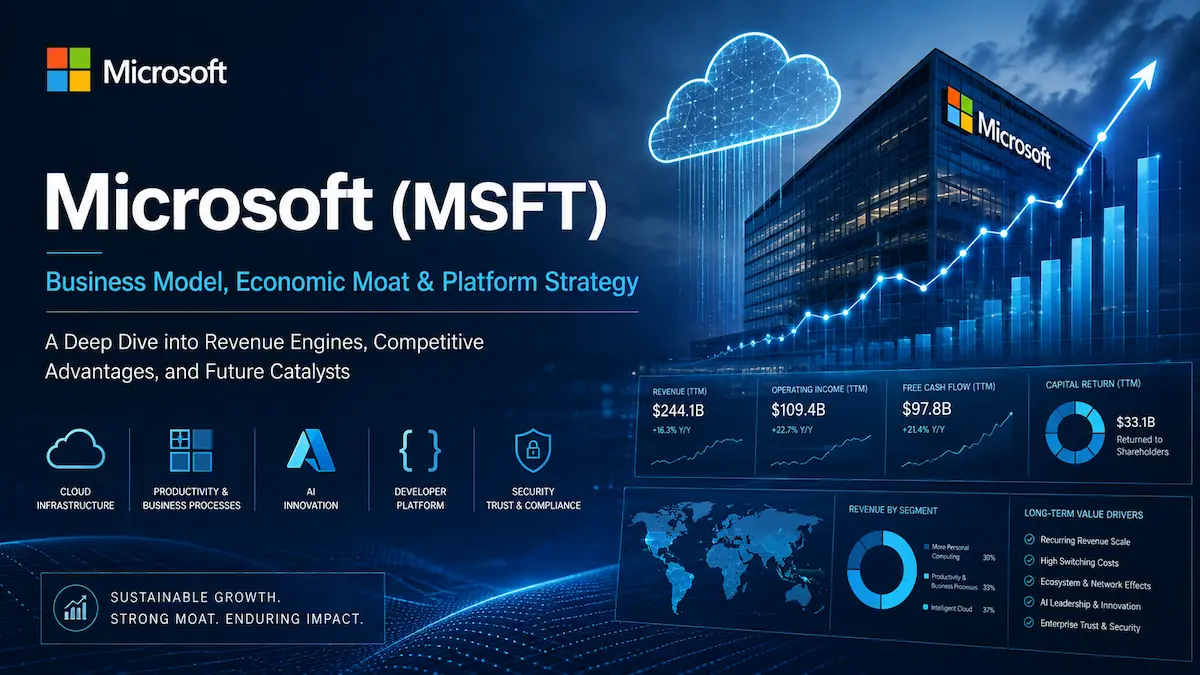
Confirmed fact: Microsoft reported fiscal 2026 revenue of $331.8 billion and operating income of $155.2 billion. In the June 2026 quarter, Productivity and Business Processes generated $37.8 billion of revenue, Intelligent Cloud generated $39.3 billion, and More Personal Computing generated $12.9 billion. Azure and other cloud services revenue grew 43% year over year in the quarter, while Windows OEM and Devices declined 7% and Xbox content and services declined 10%. These figures show that the corporate earnings center has decisively shifted toward cloud and recurring enterprise software rather than PC unit growth. Source: Microsoft FY2026 Q4 earnings release.
Productivity and Business Processes
This segment includes Microsoft 365 Commercial and Consumer, LinkedIn, and Dynamics. Its revenue model is primarily subscription-based, with per-user pricing, tiered bundles, premium security and compliance features, and increasingly AI add-ons. Microsoft 365 Commercial is economically important because it combines a large installed base with a steady path to higher average revenue per user through E5, Copilot, security, analytics, voice, and compliance.
Confirmed fact: Microsoft said it had more than 450 million paid Microsoft 365 Commercial seats in fiscal Q2 2026. By fiscal Q4 2026, Microsoft 365 Copilot had exceeded 30 million paid seats, while total commercial seat growth remained 6%. The implication is that near-term monetization depends less on adding net-new information workers and more on attaching premium capabilities to an existing base. Sources: Microsoft FY2026 Q2 earnings call and Microsoft FY2026 Q4 earnings call.
LinkedIn adds a different monetization model: talent solutions, marketing solutions, premium subscriptions, and sales tools. Dynamics 365 and Power Platform monetize customer relationship management, enterprise resource planning, workflow automation, analytics, and low-code development. These businesses increase Microsoft’s exposure to operational workflows, not merely document creation. The deeper Microsoft sits inside revenue operations, finance, human resources, and customer service, the more difficult it becomes for a buyer to evaluate products independently.
Intelligent Cloud
Azure monetizes through consumption. Customers pay for compute, storage, databases, networking, security, developer tools, data services, and AI workloads. This model can scale rapidly when demand grows, but it is more capital-intensive than traditional software licensing because Microsoft must fund data centers, power, networking equipment, CPUs, GPUs, and long-lived facilities before all capacity is fully utilized.
Confirmed fact: Microsoft said annual Azure revenue surpassed $100 billion for the first time in fiscal 2026. Microsoft Cloud revenue reached $214.4 billion for the year, and commercial remaining performance obligation reached $678 billion at fiscal year-end. Roughly 30% of that obligation was expected to be recognized within the following 12 months. Source: Microsoft FY2026 Q4 investor metrics and the Microsoft FY2026 Q4 earnings call.
The economic logic is a two-sided conversion engine. Enterprise software relationships create Azure demand, while Azure adoption creates opportunities to sell databases, security, GitHub, analytics, AI services, and Microsoft 365 extensions. Microsoft does not need to win every workload to profit. It needs to remain a preferred control layer for enough mission-critical workloads that customers keep expanding total commitments.
More Personal Computing
This segment includes Windows OEM and Commercial licensing, Surface and other devices, Xbox hardware and content, Game Pass and related services, and search advertising. Its economics are more cyclical and less uniformly attractive than Microsoft’s cloud and productivity businesses. Windows still provides valuable distribution and enterprise endpoint control, but OEM revenue depends partly on PC shipments. Gaming has subscription and content advantages, yet it is hit-driven and requires substantial development and acquisition spending. Search produces advertising revenue but competes in a market where scale and default distribution matter heavily.
Analytical inference: More Personal Computing is strategically more important than its current growth rate suggests. Windows, Edge, Xbox, and search create consumer reach, endpoint presence, identity relationships, and product surfaces through which Microsoft can distribute Copilot. However, this segment should not be treated as the primary source of the company’s moat or valuation support; its role is increasingly distributional and complementary.
The Underlying Profit Formula
Microsoft’s profit formula can be summarized as follows: acquire users and enterprises through entrenched productivity and infrastructure products; convert them to recurring contracts; cross-sell adjacent workloads; deepen data and identity integration; then monetize incremental usage through cloud consumption and premium software tiers.
The model is powerful because customer acquisition costs are shared across products. A company already using Microsoft 365, Entra, Teams, Windows, and Defender can add Azure, Power Platform, GitHub, Fabric, or Copilot through an existing procurement, identity, compliance, and support relationship. This can shorten sales cycles and reduce integration friction compared with a stand-alone vendor.
However, the portfolio also creates a margin trade-off. Traditional software subscriptions have low incremental delivery costs. AI infrastructure does not. In fiscal Q4 2026, Microsoft Cloud gross margin was 65%, down from 68% a year earlier, with management attributing the decline to Azure mix, AI infrastructure investment, and growing product usage, partly offset by efficiency gains. Confirmed fact: capital expenditures were $41 billion in the quarter, and roughly two-thirds went to shorter-lived assets, primarily CPUs and GPUs. Source: Microsoft FY2026 Q4 earnings call.
2. Deep Dive into Economic Moats
Moat Assessment by Buffett’s Four Categories
Moat Category | Assessment | Why It Matters |
|---|---|---|
Intangible Assets | Strong | Enterprise trust, software intellectual property, compliance certifications, technical standards, developer tools, and long-standing procurement relationships improve win rates and reduce perceived implementation risk. |
Switching Costs | Very strong | Customers must migrate data, identities, permissions, workflows, applications, security controls, contracts, and employee behavior. The cost is organizational, not merely technical. |
Network Effects | Moderate | GitHub, Windows, Microsoft 365, Teams, and the partner ecosystem benefit from developer and user participation, but customers can multi-home and many standards remain interoperable. |
Cost Advantages | Moderate | Scale supports chip procurement, data-center utilization, global distribution, and shared R&D, but AI infrastructure is capital-intensive and competitors also operate at hyperscale. |
Core Moat 1: Enterprise Switching Costs
Microsoft’s strongest economic moat is the cumulative switching cost created by interconnected enterprise systems. A typical large customer may use Microsoft 365 for documents and collaboration, Entra for identity, Defender and Sentinel for security, Windows for endpoints, Azure for infrastructure, SQL Server for data, Dynamics for workflows, Power Platform for automation, and GitHub for software development. Each product can be replaced individually. The difficulty lies in replacing several without disrupting the operating model.
The cost of switching includes data migration, application refactoring, permission redesign, retraining, vendor requalification, cybersecurity testing, regulatory review, contract renegotiation, and productivity loss during transition. Competitors therefore do not merely need a better product. They must offer enough economic value to justify a multi-year transformation program with execution risk.
Microsoft Graph strengthens this moat by acting as a gateway to data and intelligence across Microsoft 365, Windows, and enterprise mobility and security services. As applications and Copilot agents use that context, the value of integration can rise while the cost of recreating the same permissions and data relationships elsewhere also rises. Confirmed fact: Microsoft describes Graph as a single endpoint for accessing people-centric data and insights across its cloud services. Source: Microsoft Graph overview.
Analytical inference: AI can make these switching costs stronger if customers build internal agents, prompts, governance rules, connectors, and workflow automations around Microsoft data and identity. The moat would come from embedded business process context, not from the underlying language model alone. Foundation models may become more interchangeable, but the permissioned enterprise data layer is harder to replicate.
Core Moat 2: Intangible Assets and Enterprise Trust
Microsoft’s second major moat is a bundle of intangible assets: brand credibility with chief information officers, technical know-how, compatibility standards, intellectual property, cybersecurity capabilities, compliance certifications, and a global partner and support network. Brand recognition by itself is not a moat. It becomes economically relevant when it lowers perceived deployment risk for systems that cannot fail.
A challenger can build a high-quality application faster than it can build decades of enterprise references, regulated-industry approvals, channel relationships, data-residency options, migration tooling, and support infrastructure. This matters most in government, financial services, healthcare, and global enterprises, where procurement is partly an exercise in risk transfer.
Azure’s hybrid and multicloud tooling also reflects this intangible asset. Azure Arc extends Azure management and services across data centers, edge environments, and other clouds. That does not eliminate competition, but it allows Microsoft to monetize governance and management even when workloads do not run entirely inside Azure. Source: Microsoft Azure Arc overview.
Why Network Effects and Scale Are Supporting, Not Primary, Moats
Microsoft benefits from network effects in GitHub, Teams, Windows, and its partner ecosystem. More developers produce more repositories, integrations, extensions, and skills; a larger user base attracts more software vendors; and a broader partner ecosystem reduces deployment friction. Yet these effects are not fully exclusive. Developers use multiple clouds, coding tools, operating systems, and collaboration products. Open standards and open-source software limit lock-in.
Similarly, Microsoft’s scale creates procurement and utilization advantages, but it should not be confused with an unassailable cost moat. Amazon, Google, and other well-capitalized competitors can also fund hyperscale infrastructure. The more important advantage is Microsoft’s ability to spread AI infrastructure and research costs across Azure, Microsoft 365, GitHub, Bing, security, gaming, and internal product development. A stand-alone AI vendor must recover similar costs through a narrower revenue base.
Can the Moat Support Long-Term Excess Returns?
Reasonable inference: Microsoft’s switching costs and enterprise trust are sufficient to support durable pricing power and high retention, provided the company maintains product quality and avoids forcing customers into economically unattractive bundles. The moat is strongest where Microsoft controls identity, productivity data, security policy, and workflow integration simultaneously.
The moat is less secure at the infrastructure and model layers, where customers can multi-cloud and models can commoditize. Long-term excess returns therefore depend on Microsoft converting AI from a capital-intensive feature race into a high-value workflow layer. If AI remains mostly undifferentiated compute, returns may migrate toward chip suppliers, model developers, or specialized applications instead.
3. Business Inflection Points & Future Catalysts
The Defining Strategic Inflection: From Windows-Centric Licensing to Cloud and Cross-Platform Services
The most consequential strategic turn occurred after Satya Nadella became chief executive officer in February 2014. Microsoft moved away from protecting Windows as the center of every user experience and toward selling productivity and cloud services across operating systems and devices. Office expanded to iPad, Azure embraced Linux and open-source technologies, and management framed Microsoft’s identity around productivity and platform rather than a single operating system.
Confirmed history: Microsoft launched Office 365 in 2011, appointed Nadella as CEO in 2014, released Office for iPad that year, expanded Azure support for Linux and open-source technologies, acquired LinkedIn in 2016, and continued building a broader cloud and developer platform. Sources: Microsoft company history, Microsoft’s Nadella appointment announcement, and Microsoft’s 2014 cloud strategy briefing.
Analytical inference: The decisive change was not simply “moving to the cloud.” It was abandoning the idea that Windows exclusivity should determine Microsoft’s distribution. That trade allowed Microsoft to maximize the reach of Office, Azure, developer tools, identity, and later Copilot. The company exchanged some operating-system control for a much larger addressable market and a more resilient recurring-revenue model.
Catalyst 1: Azure Capacity Expansion Converts Backlog into Consumption Revenue
Transmission mechanism: Microsoft is investing heavily in data-center capacity, CPUs, GPUs, networking, and power. If new capacity comes online against genuine customer demand, constrained workloads can move into production, Azure consumption rises, and existing commercial commitments convert into recognized revenue. Higher utilization can then partially offset the gross-margin pressure created by depreciation and energy costs.
Observable indicators: Azure and other cloud services growth; Microsoft Cloud revenue; commercial remaining performance obligation excluding unusually large frontier-model contracts; the proportion of RPO recognized within 12 months; management commentary on capacity constraints; Microsoft Cloud gross margin; and cash capital expenditures.
Confirmed fact: Azure and other cloud services grew 43% in fiscal Q4 2026, while commercial RPO reached $678 billion. Management also said customer demand continued to exceed available capacity in fiscal Q3 and that calendar 2026 capital expenditure expectations were roughly $190 billion. Sources: Microsoft FY2026 Q3 earnings call and Microsoft FY2026 Q4 earnings call.
Execution risks: Demand may be less durable than contracted commitments imply; customers may optimize workloads; power and component constraints may delay deployment; new capacity may arrive after pricing falls; and short-lived AI hardware may depreciate economically faster than expected. A revenue acceleration accompanied by persistent gross-margin deterioration would indicate that growth is becoming more capital-intensive rather than more valuable.
Catalyst 2: Microsoft 365 Copilot Raises Revenue per User
Transmission mechanism: Microsoft can attach Copilot, E5, E7, security, and compliance products to a base of more than 450 million paid commercial seats. Because identity, permissions, documents, calendars, meetings, email, and collaboration data already sit inside Microsoft 365, Copilot can be sold through an existing contract and deployed through an existing administrative control plane. Revenue growth can therefore exceed seat growth if average revenue per user rises.
Observable indicators: Microsoft 365 Commercial cloud revenue growth; paid Copilot seats; sequential net seat additions; enterprise deployments above 50,000 seats; average revenue per user commentary; renewal behavior; usage intensity; and the gap between pilot deployments and broad production rollouts.
Management statement: Microsoft said Copilot paid seats exceeded 30 million in fiscal Q4 2026, with net paid seat additions more than doubling sequentially. Management also attributed Microsoft 365 average revenue per user growth to premium offerings including Copilot, E5, and early E7 traction. Source: Microsoft FY2026 Q4 earnings call.
Execution risks: Customers may not achieve sufficient productivity gains to justify broad renewal; usage may remain concentrated among a small group of employees; competing AI tools may provide adequate functionality at lower cost; data-governance concerns may slow deployment; and inference costs may limit margin expansion. Seat count alone is insufficient evidence of durable value. Retention, active usage, and measurable workflow outcomes matter more.
Catalyst 3: Agentic Workflows Expand Monetization Across GitHub, Azure, and Power Platform
Transmission mechanism: Microsoft is extending Copilot from a chat interface into coding agents, workflow automation, data analysis, security operations, and business-process agents. This could create multiple monetization points: subscription fees, usage-based pricing, Azure inference consumption, data-platform demand, and higher-value enterprise agreements.
Microsoft’s platform advantage is that developers can build on GitHub and Azure while business users configure workflows in Microsoft 365, Dynamics, and Power Platform. Identity, governance, security, and data access can be managed through a common enterprise relationship. GitHub has also expanded enterprise reporting for Copilot usage, code review, coding agents, command-line activity, teams, and repositories, which can help customers govern adoption and connect usage to business outcomes. Source: GitHub’s July 2026 Copilot usage metrics update.
Observable indicators: GitHub Copilot usage growth; adoption of agentic features beyond code completion; Azure AI consumption; Power Platform and Dynamics growth; customer expansion from pilots to production; usage-based pricing disclosures; and attach rates for security and governance products.
Execution risks: Foundation models may become interchangeable; open-source agents may reduce pricing power; specialized software vendors may own the highest-value workflows; developers may resist closed governance layers; and autonomous agents may create security, compliance, and liability problems. This catalyst succeeds only if Microsoft captures workflow value rather than merely reselling expensive compute.
Potential Margin Catalyst: Utilization and Software Mix
Reasonable inference: If AI infrastructure utilization improves, model inference becomes more efficient, and Copilot revenue scales faster than delivery costs, Microsoft Cloud gross margin could stabilize or recover. Management said fiscal Q1 2027 Microsoft Cloud gross margin should be relatively stable sequentially, but this is guidance, not a confirmed outcome.
Observable indicators: Microsoft Cloud gross margin, depreciation growth, capital expenditures relative to cloud revenue, cash flow after capital spending, and disclosed efficiency gains. The principal risk is that competitive pricing and rapidly changing hardware keep unit economics under pressure even as revenue grows.
Unverified Market Expectations
Some market participants expect AI agents to become a new operating layer for enterprise work, with Microsoft positioned as a primary beneficiary. That outcome is not yet proven. It assumes customers will allow agents to access sensitive corporate data, that productivity gains will exceed subscription and infrastructure costs, and that Microsoft will retain sufficient pricing power as models and tools proliferate.
Another unverified expectation is that current AI capital spending will produce returns comparable to Microsoft’s historical software economics. The evidence is incomplete. Revenue growth and backlog are strong, but cloud gross margin has declined and free cash flow is absorbing substantial infrastructure investment. The burden of proof is therefore shifting from demand validation to return-on-capital validation.
4. Key FAQs
How does Microsoft make money from Azure and Microsoft 365?
Azure primarily generates consumption-based revenue from compute, storage, databases, networking, security, developer services, and AI workloads. Microsoft 365 primarily generates recurring per-user subscription revenue, with higher-priced tiers for security, compliance, analytics, voice, and Copilot. The strategic advantage is cross-selling: Microsoft can use the same enterprise agreement, identity system, support relationship, and data environment to sell both infrastructure and applications, lowering sales friction and increasing customer lifetime value.
What is Microsoft’s strongest economic moat in enterprise software?
Microsoft’s strongest moat is enterprise switching cost. Large customers often depend on Microsoft for identity, productivity, endpoint management, security, databases, cloud infrastructure, developer tools, and workflows. A competitor must compensate the customer not only for software migration but also for operational disruption, retraining, compliance review, data and permission redesign, and execution risk. Brand and scale help, but they are secondary to this embedded operating complexity.
Can Microsoft Copilot materially expand Microsoft 365 revenue?
Yes, but the result depends on attach rate, renewal, and usage rather than launch publicity. Microsoft has a commercial base exceeding 450 million paid seats and reported more than 30 million paid Copilot seats by June 2026. Even modest penetration can raise average revenue per user. The business case weakens if customers limit deployments after pilot programs, fail to measure productivity gains, or shift to lower-cost AI tools. The most useful indicators are paid-seat growth, active usage, enterprise-wide deployments, renewal rates, and Microsoft 365 revenue growth relative to total seat growth.
5. Conclusion
Microsoft’s corporate gene is not simply software excellence. It is the repeated conversion of a dominant distribution surface into a broader platform. DOS and Windows distributed applications; Office distributed productivity standards; Microsoft 365 distributed identity, collaboration, and security; Azure distributed infrastructure and data services; GitHub distributed developer tools; and Copilot is now being positioned as a common AI layer across them.
The company’s most durable advantage is the enterprise control plane created by identity, data, permissions, productivity, security, and workflow integration. This architecture makes Microsoft difficult to displace even when competitors offer superior point products. The defense is organizational switching cost combined with enterprise trust, not an assumption that Microsoft will always have the best model, chip, search engine, or application.
The next phase is economically more demanding than the cloud transition that preceded it. Microsoft must prove that AI revenue can scale faster than the capital, depreciation, energy, and inference costs required to deliver it. Azure backlog, Copilot seat growth, and developer adoption establish demand. They do not yet guarantee software-like returns. The central research question for the next one to two years is whether Microsoft can convert its distribution advantage into high-retention, high-usage AI workflows while stabilizing cloud margins and maintaining customer trust.
Official Sources
- Microsoft FY2026 Form 10-K filed with the U.S. Securities and Exchange Commission
- Microsoft FY2026 Q4 earnings release
- Microsoft FY2026 Q4 earnings call
- Microsoft FY2026 Q4 investor metrics
- Microsoft FY2026 Q3 earnings call
- Microsoft FY2026 Q2 earnings call
- Microsoft official company history
- Microsoft 2014 cloud strategy briefing
- Microsoft Graph official overview
- Microsoft Azure Arc official overview
- GitHub Copilot enterprise usage metrics update
Disclaimer: This article is intended solely for business logic discussion and corporate research purposes, and does not constitute investment advice of any kind.