

Key Takeaways
- SK hynix is still fundamentally a semiconductor product company, not a software-style recurring-revenue business. Its economic engine is the sale of DRAM and NAND products, but the mix has shifted decisively toward premium AI memory, especially HBM, where technical qualification, advanced packaging and supply reliability can support structurally better economics than commodity memory.
- The company’s most defensible moat is the combination of intangible process know-how and customer switching friction. Years of HBM stacking, thermal-management, yield-learning and packaging expertise are increasingly embedded in customers’ accelerator roadmaps, making qualification and supplier replacement costly in engineering time even when customers continue to multi-source.
- SK hynix’s platform strategy is industrial rather than software-based: it is trying to own more of the AI memory hierarchy through HBM, server DRAM, SOCAMM2, enterprise SSDs, NAND and emerging products such as HBF, while moving from component vendor to co-designer and co-architect with leading compute platforms.
- The next 12–24 months depend on execution, not simply AI demand. HBM4 volume ramp, HBM4E qualification, broader attachment of SOCAMM2 and enterprise SSDs, and capacity expansion at M15X and Yongin can lift revenue and mix only if yields, customer ramps and capital discipline remain strong.
- The principal risks are memory cyclicality, customer concentration, technological catch-up by Samsung Electronics and Micron, the possibility that long-term supply arrangements do not guarantee fixed volumes or pricing, and the danger that aggressive capacity expansion converts today’s scarcity economics into tomorrow’s oversupply.
1. Business Model Breakdown
The SK hynix business model is best understood as a high-capital, technology-intensive semiconductor manufacturing model whose profit pool is increasingly concentrated in premium memory rather than commodity bits. The company designs, manufactures and sells advanced DRAM and NAND flash products, with smaller exposure to foundry and other semiconductor activities. There is no meaningful SaaS subscription layer, advertising engine or marketplace take rate. Revenue is generated primarily when physical semiconductor products are sold to device makers, server vendors, cloud platforms and AI-compute customers.
The revenue mix shows how far the center of gravity has moved toward DRAM. In its July 2026 U.S. prospectus, SK hynix reported 2025 revenue of KRW97.147 trillion, of which KRW74.904 trillion, or 77.1%, came from DRAM; NAND contributed KRW20.690 trillion, or roughly 21.3%, with the remainder from other products. In the first quarter of 2026, DRAM remained 77.3% of revenue. This matters because the DRAM category now includes HBM, whose economics are different from those of undifferentiated commodity memory.
HBM monetization is driven by three reinforcing mechanisms. First, AI accelerators require exceptionally high bandwidth and power efficiency, making HBM a performance-critical input rather than a generic component. Second, HBM combines advanced DRAM process technology with complex three-dimensional stacking and packaging, increasing the engineering content and manufacturing difficulty per unit. Third, customers increasingly align memory specifications with their own accelerator roadmaps, so qualification begins earlier and supply commitments can extend over multiple product generations. These features support premium average selling prices and a richer product mix, although SK hynix does not publicly disclose a standalone HBM gross margin.
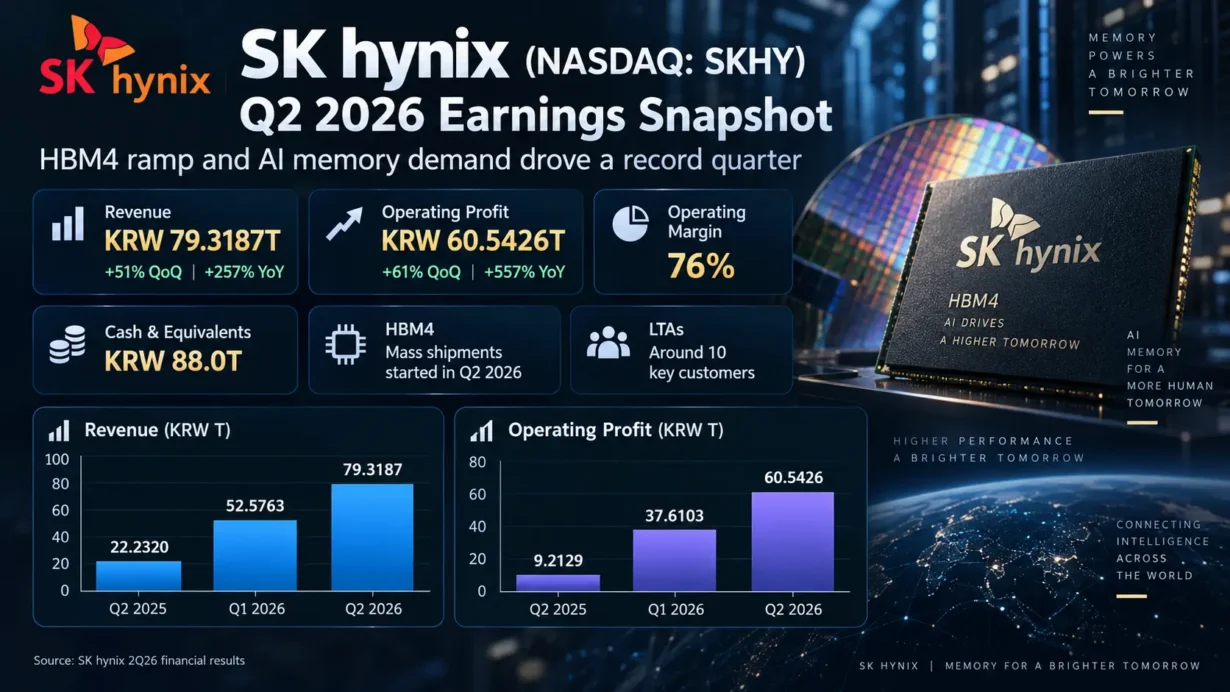
The latest operating evidence illustrates the leverage of that mix shift. SK hynix’s preliminary second-quarter 2026 K-IFRS release reported KRW79.319 trillion of revenue and a 76% operating margin, with management attributing the record performance to high-value products and strong AI memory demand. The same release said HBM4 mass shipments had started in the second quarter and that the company had entered long-term agreements with around 10 key customers. Those agreements improve planning visibility, but investors should not confuse them with software-like contracted recurring revenue: the company’s SEC prospectus states that specific quantities and pricing under supply arrangements are typically determined by mutual agreement around the time of purchase based on market conditions and demand.
NAND is the second major earnings engine and is strategically more important than its revenue share alone suggests. The acquisition of Intel’s NAND and storage business, completed through payments in 2021 and 2025 and operated under the Solidigm brand, gave SK hynix a larger enterprise SSD footprint and differentiated QLC expertise. The strategic logic is to capture more AI data-center storage spending as model training and inference generate large datasets, checkpoints and retrieval workloads. In 2026, SK hynix also accelerated its transition toward 321-layer NAND, while positioning Solidigm’s high-capacity enterprise SSDs as part of a broader AI infrastructure portfolio.
This leads to the company’s platform strategy. SK hynix describes itself as evolving into a “Full Stack AI Memory Creator,” and the phrase is commercially meaningful if interpreted correctly. The goal is not to build a software ecosystem with classic network effects. It is to become a memory architecture partner across multiple layers of the AI system: HBM beside accelerators, high-capacity server DRAM and SOCAMM2 around CPUs, enterprise SSDs and NAND for storage, and emerging high-bandwidth flash products for data-intensive workloads. The more of that hierarchy SK hynix can co-design with compute vendors, the more revenue per AI system it can address and the earlier it can enter customers’ product roadmaps.
The business therefore has two simultaneous economic identities. At the base, it remains a cyclical memory manufacturer exposed to industry supply, pricing and capital intensity. At the premium layer, it is becoming a co-engineered AI infrastructure supplier whose products are qualified against tightly specified performance, thermal, power and reliability requirements. The investment case depends on how much of the second identity can structurally dilute the cyclicality of the first.
2. Deep Dive into Economic Moats
Intangible Assets: Process Know-How, Packaging Expertise and Customer-Specific Engineering
The strongest moat is not the SK hynix brand by itself. It is accumulated manufacturing know-how that is difficult to transfer from a laboratory result into high-volume, high-yield production. SK hynix began full-scale HBM development in 2009, years before AI accelerators created today’s demand. That early commitment built expertise in through-silicon vias, wafer-level stacking, thermal control and packaging processes such as MR-MUF. The company has since moved through HBM3, HBM3E and HBM4 and, in June 2026, shipped 12-layer HBM4E samples to major customers with a stated maximum speed of 16 Gbps per pin and improved power efficiency.
The moat is strongest where technology and manufacturing execution meet. A rival can reproduce a specification on paper, but commercial competitiveness also requires acceptable yield, thermal behavior, reliability, packaging throughput and timely qualification at customer scale. Those capabilities accumulate through production learning. In memory semiconductors, a few percentage points of yield or a faster ramp can materially change cost per good die and customer confidence. That is why SK hynix’s competitive advantage should be framed as a process-learning curve, not merely a patent portfolio.
The durability test is whether this knowledge remains relevant as architectures change. So far, the evidence is favorable because each new HBM generation increases packaging and system-integration complexity rather than simplifying it. SK hynix is also deepening collaboration with TSMC around advanced packaging and future HBM generations. At TSMC’s September 2026 Open Innovation Platform Conference, SK hynix highlighted joint development activity around future HBM and CoWoS integration and received TSMC’s Partner of the Year recognition for a second consecutive year. That does not guarantee permanent leadership, but it shows that the company is embedded in a broader manufacturing ecosystem rather than competing only at the memory-die level.
Switching Costs: Qualification Friction and Roadmap Co-Design
The second moat is customer switching cost, but it should be described precisely. AI customers are not locked into SK hynix by contractual impossibility. Large buyers have strong incentives to qualify multiple suppliers to reduce supply risk and improve negotiating leverage. The switching cost instead comes from engineering friction: HBM suppliers must meet strict quality, performance and reliability standards, and the memory configuration must align with the customer’s accelerator package, power envelope, thermal design and production timetable.
SK hynix’s SEC prospectus explicitly notes that HBM customers seek suppliers whose development can be aligned with their own product programs and that rigorous testing and approval processes are required. In June 2026, SK hynix and NVIDIA announced a multi-year technology partnership covering next-generation memory co-development and supply alignment across AI infrastructure, personal AI and physical AI. The strategic value is not just volume. It gives SK hynix earlier visibility into future compute architectures and creates repeated qualification touchpoints that can compound into roadmap familiarity.
For a competitor to displace an incumbent supplier, it must therefore do more than offer a lower price. It must match performance, deliver consistent yield, clear qualification, demonstrate supply reliability and integrate on schedule with an accelerator launch whose delay can cost the customer far more than the memory component itself. That is real switching friction. However, it is not absolute lock-in, and it can erode if Samsung or Micron closes the performance and yield gap while offering attractive capacity or pricing.
Network effects are not a core moat here. One additional SK hynix customer does not automatically make the memory product more valuable to every other customer in the way that users strengthen a marketplace or social network. Cost advantage is more relevant but still secondary. Scale, advanced nodes, high yields and dense NAND structures can lower unit cost, yet Samsung and Micron also possess global scale and substantial capital resources. SK hynix’s cost position can reinforce the moat when its process execution is superior, but scale alone is not a defensible advantage in a memory industry where competitors continuously reinvest.
The most defensible conclusion is therefore narrow: SK hynix’s moat rests on accumulated HBM manufacturing know-how plus qualification-driven customer switching friction. Those advantages can support above-industry returns while the company remains ahead in high-value memory, but they do not eliminate semiconductor cyclicality or guarantee permanent market share.
3. Business Inflection Points & Future Catalysts
The Defining Inflection Point: Betting on HBM Before the Market Was Ready
The most important strategic turning point was not the 2026 Nasdaq ADS listing and arguably not even the 2012 entry into SK Group. It was the decision to begin full-scale HBM development in 2009, when the commercial market was still immature. SK hynix’s own historical account acknowledges that early HBM did not immediately receive broad market adoption because high-performance computing demand had not yet matured. That period of under-monetized R&D is precisely what later created an option on the AI boom.
The commercial significance is profound. Traditional memory competition rewards cost per bit, node migration and cycle timing. HBM added another axis: packaging, thermal management, vertical interconnects, system-level optimization and early customer collaboration. When AI accelerators made memory bandwidth a system bottleneck, SK hynix already possessed years of process learning. The result was not simply faster growth; it changed the company’s position in the value chain from a largely interchangeable memory supplier toward a co-engineered infrastructure partner.
Catalyst 1: HBM4 Ramp and HBM4E Qualification
Transmission mechanism: HBM4 and HBM4E can raise revenue through higher AI-memory bit demand, premium product mix and potentially better utilization of advanced DRAM and packaging capacity. SK hynix began mass shipments of HBM4 in the second quarter of 2026, while HBM4E samples were delivered to major customers in June. If qualification converts into volume production on next-generation accelerator platforms, the company can sustain the mix shift toward high-value DRAM even as older HBM generations mature.
Observable indicators: investors should watch customer qualification milestones, HBM4 volume commentary, HBM4E mass-production timing, yield and supply-capacity language, and evidence that SK hynix can support multiple accelerator customers rather than one dominant platform. Product speed claims matter less than repeatable high-volume yield and on-time delivery.
Execution risks: Samsung and Micron can narrow the technology gap; customers can delay accelerator ramps; advanced packaging bottlenecks can constrain output; and excessive industry capacity could compress HBM pricing faster than expected. A technically superior product does not create economic value if the company cannot manufacture it at the required yield or if customers redesign around alternative memory configurations.
Catalyst 2: Expanding from HBM Supplier to Full-Stack AI Memory Partner
Transmission mechanism: SK hynix can increase semiconductor content per AI system by attaching complementary products to the same customer roadmap. SOCAMM2 extends the company into high-capacity, power-efficient AI server memory; server DDR5 addresses general compute; enterprise SSDs and Solidigm QLC products capture storage; and future HBF concepts target bandwidth-intensive data movement. In April 2026, SK hynix began mass production of a 192GB SOCAMM2 module designed for NVIDIA’s Vera Rubin platform. The June NVIDIA partnership further broadens the relationship across AI supercomputers, CPUs, PCs and robotics.
The strategic payoff is not cross-selling in the conventional sales sense. It is architectural adjacency. Once SK hynix engineering teams are already engaged with a customer on HBM, they can enter earlier discussions about the rest of the memory hierarchy. That may improve design-win probability, customer lifetime value and demand visibility without requiring a software subscription model.
Observable indicators: watch SOCAMM2 shipment growth, enterprise SSD momentum in AI data centers, references to HBF or next-generation storage qualification, the number and scope of long-term customer agreements, and whether DRAM/NAND revenue growth becomes less dependent on broad commodity pricing.
Execution risks: the full-stack thesis can fail if customers prefer best-of-breed sourcing from different vendors, if Solidigm’s enterprise storage economics lag expectations, or if the portfolio becomes strategically broad without producing meaningful attachment. Customer concentration also remains material: SK hynix disclosed that its largest customer represented 23.9% of 2025 revenue and that its two largest customers represented 14.8% and 12.4% of first-quarter 2026 revenue. Deeper strategic relationships can increase switching costs while simultaneously increasing bargaining power and concentration risk.
Catalyst 3: Converting Scarcity into Shipments Through M15X and Yongin
Transmission mechanism: in a supply-constrained AI memory market, demand only becomes revenue if wafer capacity, TSV capability, packaging and test capacity are available at the right time. SK hynix has accelerated the ramp of the M15X DRAM facility and has said the first Yongin cleanroom is expected to open in early 2027. Additional advanced-packaging capacity in Cheongju is intended to support HBM production. These investments can expand the company’s ability to monetize HBM and advanced DRAM demand while lowering the risk that customers diversify solely because SK hynix cannot supply enough volume.
Observable indicators: capital-expenditure guidance, M15X equipment installation and output ramps, Yongin cleanroom milestones, packaging-capacity additions, inventory trends, net debt and management commentary on supply-demand balance should be monitored together. Capacity growth is bullish only when it is matched to durable customer demand.
Execution risks: semiconductor fabs have long lead times and high fixed costs. If AI infrastructure spending slows, customer inventory rises or competitors add capacity simultaneously, today’s shortage can become tomorrow’s oversupply. The company’s own SEC filings identify cyclicality, capital expenditure returns and product-mix shifts as material determinants of profitability. The correct analytical framework is therefore “capacity discipline plus technology leadership,” not “more capacity is always better.”
4. Key FAQs
How does SK hynix make money from HBM and AI memory?
SK hynix makes money primarily by selling physical memory products, not by charging recurring software fees. HBM improves the economics of that model because it is a high-value DRAM product that combines advanced memory dies with complex stacking and packaging and is qualified for specific AI accelerator platforms. The company can benefit from higher product mix, greater memory content per accelerator and closer supply planning with major customers. The economic advantage still depends on yield, pricing and utilization; HBM is not automatically high-margin if manufacturing execution weakens or industry supply catches up.
What is SK hynix’s competitive advantage in HBM versus Samsung and Micron?
The clearest advantage is accumulated production know-how plus customer qualification depth. SK hynix entered HBM development early, built expertise in TSV and MR-MUF packaging, and has repeatedly moved into new HBM generations while aligning product development with leading AI platforms. Its July 2026 SEC prospectus, citing IDC, reported a 56.4% HBM revenue share in the first quarter of 2026. That leadership is meaningful but not permanent: Samsung and Micron have comparable strategic incentives, deep capital resources and the ability to close technology gaps. SK hynix must keep winning on yield, thermal performance, power efficiency, qualification timing and supply reliability.
Is the SK hynix business model still cyclical despite AI and HBM growth?
Yes. AI memory can improve mix and make some demand more roadmap-driven, but it does not repeal memory economics. SK hynix remains exposed to semiconductor supply cycles, average selling prices, capital intensity, foreign exchange, customer ordering patterns and competitive capacity additions. The better question is whether HBM, server DRAM and enterprise SSDs can reduce the amplitude of the cycle by increasing the share of differentiated products. So far, the strategy appears to be working, but the durability of that improvement must be tested through a future industry downturn.
5. Conclusion
SK hynix’s corporate DNA is best described as long-cycle engineering conviction converted into manufacturing leverage. The company spent years developing HBM before the end market was large enough to reward the effort. When AI computing shifted the bottleneck from raw compute toward memory bandwidth, that accumulated know-how became economically valuable. The company’s advantage today is therefore not simply that it sells a product in a fast-growing market; it is that HBM requires a combination of process technology, packaging, thermal control, yield management, qualification and customer-roadmap integration that SK hynix has been refining for more than a decade.
The next phase is a platform expansion across the AI memory hierarchy. HBM remains the flagship profit engine, but SOCAMM2, server DRAM, enterprise SSDs, advanced NAND and future high-bandwidth storage can increase SK hynix’s content per AI system and deepen customer integration. The strategic direction is credible because it follows the architecture of AI infrastructure rather than an arbitrary diversification plan. The key question is whether those adjacencies become meaningful revenue pools without diluting capital returns.
The moat is real but conditional. Intangible manufacturing know-how and qualification-driven switching costs are stronger defenses than brand, scale or market share alone. Yet customer concentration, aggressive rival investment and the inherent cyclicality of memory remain powerful counterweights. Long-term excess returns will depend on SK hynix preserving its yield and roadmap lead while resisting the industry’s historical tendency to overbuild capacity at the top of the cycle.
Official Sources and Regulatory Filings
- U.S. Securities and Exchange Commission — SK hynix 2026 Final Prospectus (Form 424B4)
- Nasdaq Trader — SK hynix Nasdaq Listing and SKHY Symbol Notice
- SK hynix — Company Overview and “Full Stack AI Memory Creator” Strategy
- SK hynix Newsroom — Second-Quarter 2026 Financial Results
- SK hynix Newsroom — Multi-Year Technology Partnership with NVIDIA
- SK hynix Newsroom — HBM4E Sample Shipments
- SK hynix Newsroom — 192GB SOCAMM2 Mass Production
- SK hynix Newsroom — 2026 TSMC Open Innovation Platform Conference
- SK hynix Newsroom — M15X DRAM and HBM Capacity Expansion
- SK hynix Newsroom — History of HBM Development
Disclaimer: This article is intended solely for business logic discussion and corporate research purposes, and does not constitute investment advice of any kind.