



Key Takeaways
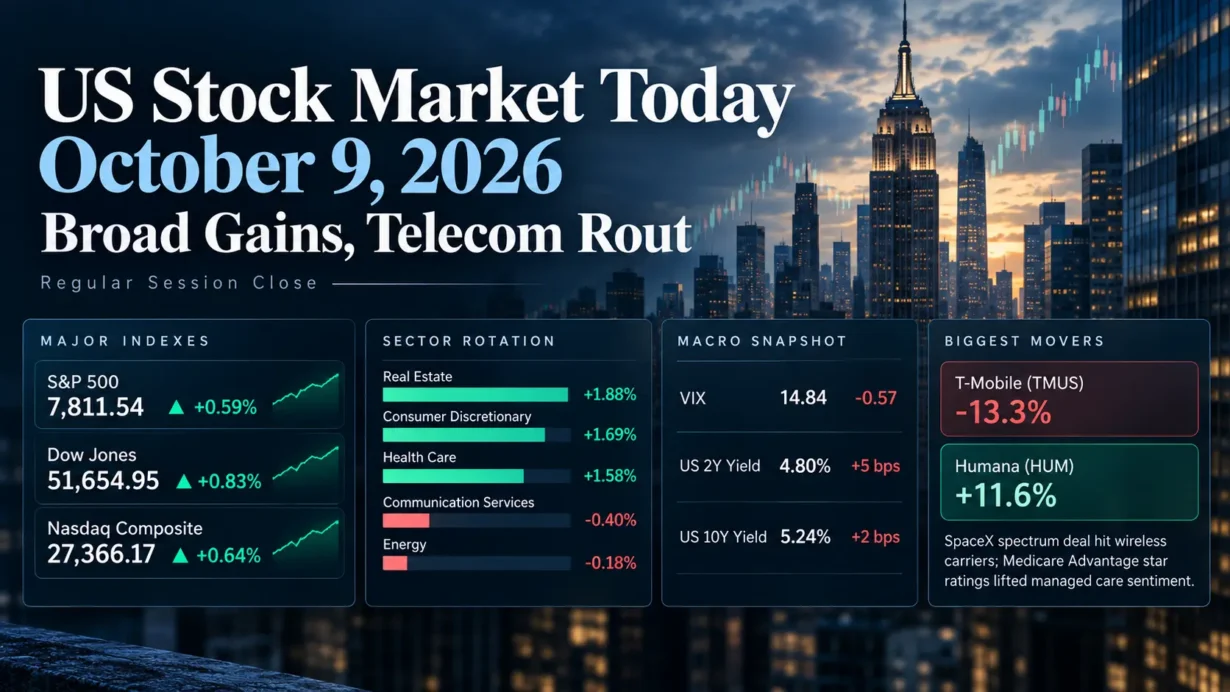
- The S&P 500 gained 0.59% to 7,811.54, the Dow rose 0.83% to 51,654.95, and the Nasdaq Composite advanced 0.64% to 27,366.17 in Friday’s regular session.
- Real estate (+1.88%) led the S&P 500’s sectors, followed by consumer discretionary (+1.69%) and health care (+1.58%); communication services (-0.40%) lagged as wireless carriers sold off.
- SpaceX’s proposed 800 MHz spectrum acquisition exposed competitive risks for T-Mobile, while improved Medicare Advantage Star Ratings lifted Humana. Both moves reflected changes in expected business economics, not fresh quarterly earnings.
- October’s preliminary consumer sentiment fell to 46.3, one-year inflation expectations reached 4.7%, and Treasury yields rose even as the Cboe VIX eased to 14.84. September CPI is due October 14.
1. Market Capital Flows and Sector Rotation
Friday’s advance masked unusually sharp industry dispersion. According to S&P Dow Jones Indices’ October 9 closing sector data, real estate gained 1.88%, consumer discretionary 1.69%, health care 1.58%, financials 0.91%, and utilities 0.81%. Energy lost 0.18%, while communication services was the weakest sector at -0.40%. Nine of the 11 sectors finished higher. Notably, real estate’s strength was consistent with a surge in tower REITs: Crown Castle rose 15.6% and American Tower gained 9.3% as investors reconsidered the infrastructure implications of satellite-to-phone competition. The tower-stock explanation is an inference about sector leadership, not a verified attribution of sector-level capital flows. Source: Associated Press closing recap.
The Russell 2000 rose approximately 0.5% to 2,806.98, trailing the S&P 500’s 0.59% gain; over the week, the Russell fell 0.9% versus a 1.2% gain for the S&P 500. Cyclical consumer discretionary and financial stocks advanced, but defensive health care and utilities also participated. Information technology rose a modest 0.36%, below the broad market, while consumer staples edged up 0.11%. That mix argues against labeling Friday a uniform growth-over-value or cyclical-over-defensive trade; style leadership varied materially by industry. Source: AP index closes and weekly returns.
Market breadth corroborated participation beyond a handful of megacaps: advancing issues outnumbered decliners by 1.65 to 1 on the NYSE and 1.38 to 1 on Nasdaq. Yet U.S. exchange volume totaled 14.37 billion shares, below the preceding 20-session average of 17.76 billion. Positive breadth alongside comparatively light turnover supports a broad rebound, but not an unequivocal high-conviction buying wave. Source: Reuters closing market data.
Institutional Flow Insight: One plausible allocation framework is selective exposure to visible cash flows and company-specific catalysts rather than an indiscriminate increase in equity risk. Tower REITs benefited from perceived network-infrastructure optionality despite higher bond yields; managed-care stocks reacted to measurable reimbursement-related information. At the start of a new quarter, portfolio rebalancing, valuation discipline and risk-budget adjustments could amplify such dispersion, but trading data do not establish that institutional managers actually executed those reallocations. Rising discount rates and policy uncertainty remain constraints.
2. Decoding the Biggest Market Movers
T-Mobile US (TMUS)
T-Mobile shares fell 13.3% at the regular-session close, while AT&T declined 9.8% and Verizon 8.7%. The immediate catalyst was Grain Management’s October 8 definitive agreement to sell its nationwide 800 MHz spectrum portfolio to SpaceX, subject to FCC approval and other closing conditions. The strategic twist matters: T-Mobile disclosed on August 11 that it had transferred the same portfolio to Grain for $2.9 billion in cash and Grain’s 600 MHz spectrum licenses. An asset T-Mobile had monetized could now help enable a prospective competitor’s satellite-and-terrestrial mobile network. Regulatory clearance, deployment costs and service performance still separate that possibility from actual subscriber losses.
This was a competition-driven valuation reset, not a newly reported earnings shortfall. T-Mobile’s latest published quarterly release, for Q2 2026, showed $19.0 billion of service revenue, $2.99 in GAAP diluted EPS and $9.5 billion in non-GAAP Core Adjusted EBITDA. Its official earnings release and Investor Relations earnings-call transcript listing frame the incumbent’s current cash-generation base. The share-price reaction suggests investors were revisiting long-run pricing power and terminal valuations across the wireless industry, rather than marking down an already disclosed quarter.
Humana (HUM)
Humana gained 11.6% after its October 9 company announcement reported that 95% of its Medicare Advantage members were in plans rated at least four stars for 2027, including 42% in 4.5-star plans. The crucial timing distinction is that the Centers for Medicare & Medicaid Services explicitly states these 2027 ratings affect 2028 quality-bonus payments. Higher ratings therefore improve the potential reimbursement and retention outlook; they do not represent earnings already recognized in October 2026.
The company’s latest Q2 2026 results reported $40.867 billion in GAAP consolidated revenue, $5.73 in GAAP diluted EPS and a 91.2% GAAP Insurance segment benefit ratio. Those are historical figures, not estimates or updated October guidance. Humana’s official results and earnings-call transcript underscore why membership mix, quality-bonus dollars per member and medical-cost execution matter more than the star-count headline alone. The rally strengthened managed-care sentiment, but the eventual earnings benefit depends on enrollment, rebates and care costs rather than on ratings in isolation.
3. Macro Indicators and Market Outlook
The Cboe VIX finished at 14.84, down 0.57 points, or 3.70%, from the previous session. That decline aligned with higher stock indexes and suggests less near-term index volatility was priced into S&P 500 options. It does not, by itself, prove that investors abandoned downside hedges or that event risk disappeared.
On the U.S. Treasury’s official daily par-yield curve, the two-year yield was 4.80%, up 5 basis points from October 8, and the 10-year yield was 5.24%, up 2 basis points. The 2s/10s spread narrowed from 47 to 44 basis points. These are Treasury’s daily indicative curve readings, not executable 4 p.m. bond quotes. The front-end-led increase is consistent with reassessment of the Fed’s near-term inflation and policy trade-off; movements in growth expectations, bond supply and term premium cannot be isolated from one session’s yields. Meanwhile, the University of Michigan’s October preliminary survey showed sentiment at 46.3, down from September’s 48.1, and one-year inflation expectations rising from 4.6% to 4.7%—a reminder that equity resilience is not synonymous with improving household purchasing power.
Upcoming Economic Data & Catalysts:
- September 2026 Consumer Price Index (Release date: October 14, 2026, 8:30 a.m. ET): Headline and core inflation will test whether price pressures justify the bond market’s more restrictive policy pricing and may reset rate-sensitive equity valuations.
- September 2026 Producer Price Index (Release date: October 15, 2026, 8:30 a.m. ET): Input-cost and services inflation will matter for margin resilience, pricing power and the interpretation of the preceding CPI release.
Both release dates and times are confirmed on the Bureau of Labor Statistics’ official October 2026 calendar.
Market Insights: Friday’s advance was broader than a megacap-only rally, based on sector participation and exchange breadth, but below-average volume tempers its signal. The material risks are a further jump in Treasury yields after CPI, renewed energy-driven inflation pressure, disappointing earnings revisions, regulatory surprises and a reversal in breadth or VIX. The contrast between telecom losses and tower-REIT gains demonstrates that even a rising index can contain consequential business-model repricing.
Trading & Investment Strategy: Preserve diversified position sizing and retain liquidity for event-driven volatility. Consider phased entries in businesses with demonstrable cash-flow durability rather than chasing a one-session gap; assess the effect of higher discount rates on long-duration valuations. Define thesis-invalidation and stop-loss or review levels before adding exposure, while allowing for overnight gaps that can defeat mechanical stops. Treat regulatory-dependent satellite competition and prospective Medicare bonuses as scenarios to monitor, not realized earnings or guaranteed trades.
4. Key FAQs About the US Stock Market Today
Why did the US stock market move on October 9, 2026?
Stocks rose on broad, if relatively light-volume, participation ahead of inflation releases and earnings season. The market absorbed a weak Michigan sentiment reading and higher Treasury yields, while SpaceX’s announced spectrum deal and Humana’s improved Medicare ratings produced large, opposing industry-level valuation moves.
Which sectors performed best and worst in the US stock market on October 9, 2026?
Real estate led at +1.88%, followed by consumer discretionary at +1.69% and health care at +1.58%. Communication services was weakest at -0.40%, followed by energy at -0.18%. Tower-REIT gains and insurer-specific news help explain the leaders, whereas wireless competition concerns pressured communication services. Source: S&P Dow Jones Indices.
What should investors watch after the US stock market close on October 9, 2026?
Watch the officially scheduled October 14 CPI and October 15 PPI releases, the direction of two-year and ten-year Treasury yields, and whether positive breadth persists on stronger volume. Monitor FCC developments around the SpaceX–Grain transaction and whether Medicare insurers can translate rating improvements into sustainable reimbursement economics.
Disclaimer: This article is intended solely for the exchange of investment ideas and does not constitute investment advice of any kind.