
Key Takeaways
- The F-35 is the central franchise: it accounted for 27% of Lockheed Martin’s $75.0 billion in FY2025 revenue and links aircraft production to a growing installed base of sustainment and modernization work.
- Switching costs and accumulated systems-integration expertise are the two most defensible moat candidates. Multinational training, certification, tooling, software integration, and logistics make replacement costly, although government data rights and performance failures can erode that advantage.
- Missile defense is becoming a second industrial-scale growth engine. The July 2026 PAC-3 MSE multiyear award carries a stated ceiling of $58.62 billion, but its undefinitized structure and production ramp mean that award value is not equivalent to near-term revenue or profit.
- As of June 28, 2026, reported backlog stood at $230.4 billion. It offers substantial revenue visibility, not guaranteed cash conversion: execution estimates, appropriations, timing, and contract profitability still matter.
- The central offset to platform durability is accountability for cost and readiness. A June 2026 U.S. GAO report found that fleetwide F-35 mission-capable rates had declined from 67% in FY2021 to 44% in FY2025.
1. Business Model Breakdown
How Lockheed Martin actually makes money
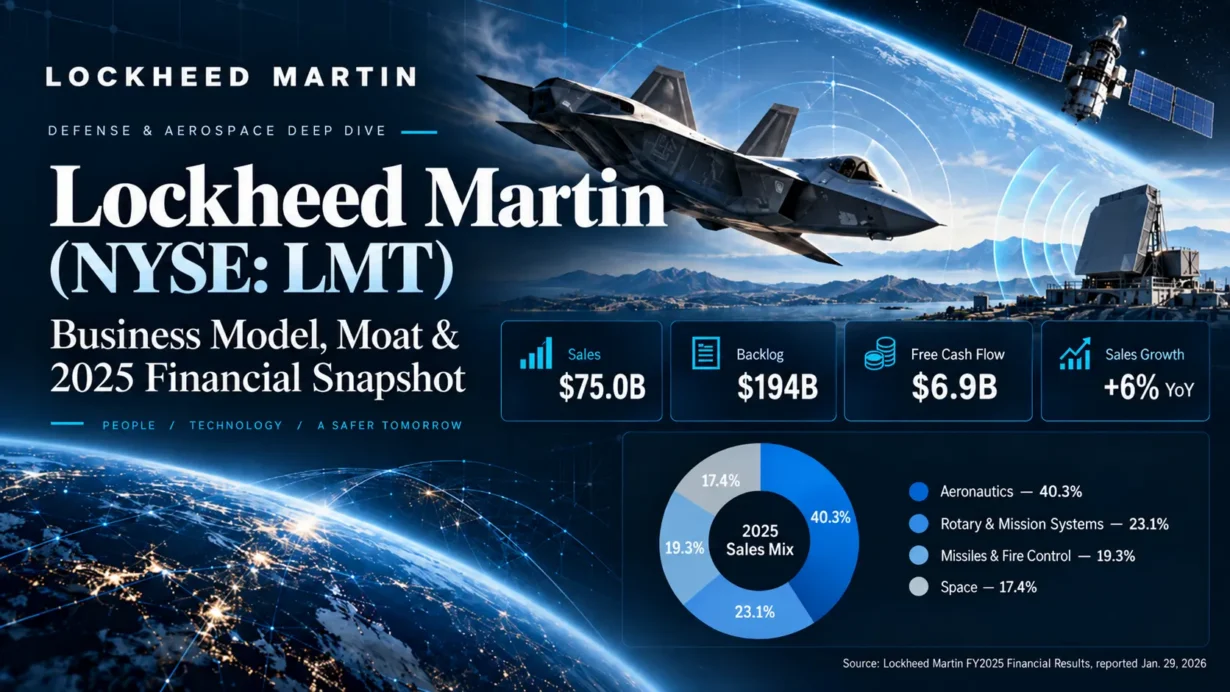
Lockheed Martin’s revenue is overwhelmingly contract-based rather than transactional. The economic sequence starts when a government funds development or chooses a platform, continues through engineering and production, and extends into maintenance, training, software integration, upgrades, and replacement inventory. Revenue is generally recognized as contract work is performed, often using cost-to-cost progress accounting; aircraft delivery counts and quarterly reported sales therefore do not move one-for-one. Its FY2025 Form 10-K discloses $62.65 billion of product sales, or 83.5% of the $75.05 billion total, and $12.39 billion of service sales, or 16.5%. This is a program-economics model, not a high-margin software subscription business.
Its four segments give that model complementary cash-generation pathways. Aeronautics generated $30.26 billion in FY2025 sales, anchored by the F-35 and complemented by the F-16, C-130, F-22, and classified programs. Missiles and Fire Control generated $14.45 billion through interceptors and precision weapons such as PAC-3, THAAD, JASSM, LRASM, and PrSM. Rotary and Mission Systems contributed $17.31 billion through Sikorsky helicopters, Aegis and other naval combat systems, radar, mission computing, and training. Space contributed $13.03 billion through strategic, missile-warning, government-space, and related programs. These are reported revenue streams, not four independent profit engines insulated from shared suppliers or federal budget decisions. Source: FY2025 Form 10-K.
The platform strategy: win the system, then serve its life cycle
Platform leadership creates multiple opportunities to earn additional program revenue. An F-35 sale is followed by years of parts provisioning, engineering change orders, mission-system updates, training infrastructure, logistics, and fleet sustainment. The commercial distinction is critical: Lockheed Martin does not automatically capture the entire aftermarket, own every component’s intellectual property, or receive an uncapped recurring fee per aircraft. Governments negotiate sustainment scope and data rights, suppliers retain economically important roles, and program offices can change work allocation. The valuable asset is the combination of an installed fleet and the technical authority, integration experience, industrial tooling, and certifications needed to support it.
The same architecture applies across its portfolio. Aegis participation can extend from shipboard combat-system integration into modernization and lifetime support; missile-defense programs require production, software and sensor integration, and replenishment; rotary-wing fleets need upgrades and long-duration parts support. Lockheed’s corporate portfolio was assembled deliberately: the 1995 merger of Lockheed and Martin Marietta created breadth across air, electronics, and space; the 2015 Sikorsky acquisition added a mature rotary-wing installed base. The result is diversification by mission and contract life cycle, not diversification away from sovereign customers.
Contract structure determines how revenue becomes profit
In FY2025, approximately $45.2 billion of sales came from fixed-price contracts and $29.85 billion from cost-reimbursable contracts. Fixed-price work can reward lower manufacturing costs and higher throughput, but the contractor bears meaningful cost-overrun risk. Cost-reimbursable arrangements can reduce exposure to unpredictable development costs but generally involve negotiated fees, oversight, and limits on economic upside. The company also periodically revises estimated lifetime program costs and profit-booking rates; adverse changes may cause immediate cumulative charges even while nominal revenue or backlog remains strong. Source: FY2025 Form 10-K, revenue disaggregation and contract accounting.
Customer concentration is the other essential underwriting variable. The U.S. government represented 72% of FY2025 sales, including 63% from the defense department as identified in the company’s filing; international customers represented 28%, including foreign military sales routed through the U.S. government. Among international sales, 77% were foreign military sales and 23% direct commercial sales. Export approval, appropriations, allied procurement calendars, and local-content commitments matter more to cash generation than consumer-style pricing elasticity. Source: FY2025 Form 10-K.
The latest reported operating snapshot shows both momentum and the need for normalization. For the quarter ended June 28, 2026, revenue rose 11% year over year to $20.06 billion; Missiles and Fire Control grew 19% to $4.10 billion at a 14.5% segment operating margin. The company reported $2.92 billion in quarterly free cash flow and raised its FY2026 guidance to approximately $79.75–$81.75 billion of sales and $7.0–$7.2 billion of free cash flow. These are management estimates; free cash flow is a non-GAAP measure. The unusually large reported year-over-year profit improvement partly reflects $1.6 billion of program losses recorded in Q2 2025, while 2026 quarterly cash flow benefited substantially from receipt and tax-payment timing. Source: Q2 2026 results, July 23, 2026.
2. Deep Dive into Economic Moats
Core moat one: switching costs embedded in mission-critical fleets
Under the economic-moat framework, switching costs are the clearest source of durability. Replacing a fielded fighter or integrated missile-defense architecture requires far more than selecting a competing catalog item. Buyers must address pilot and maintainer retraining, secure mission software, spare-parts inventories, safety and weapons certifications, operational doctrine, classified interfaces, depot capacity, and the transition risk of running two fleets. On multinational programs, commonality across partner fleets creates an additional incentive to stay with compatible equipment and upgrades. These frictions can preserve the incumbent’s position even when a competing product has appealing specifications.
The F-35 provides an unusually visible example. Lockheed Martin reported 1,344 production-aircraft deliveries from program inception through June 28, 2026, with 317 aircraft in company backlog at that date. As the installed base ages, modernization and sustainment needs grow, creating repeat bidding and contracting opportunities. Yet this is not an automatic annuity: the government can seek greater maintenance autonomy or technical-data access, award some work to other providers, and impose performance-based terms. A large fleet creates demand for support; who captures its incremental economics is a separate question. Source: Q2 2026 Form 10-Q.
Core moat two: intangible assets as difficult-to-replicate execution knowledge
Lockheed Martin’s second moat is less about its trademark than about accumulated know-how: program-specific engineering, classified integration credentials, manufacturing processes, embedded supplier relationships, test infrastructure, and a long performance record in highly regulated procurement. A new entrant pursuing an equivalent role would have to finance years of research, qualify secure facilities and personnel, build an aerospace-grade supply chain, demonstrate reliability, compete through lengthy source-selection processes, and survive production ramp risk before comparable scale could translate into attractive economics.
Program selection is the critical gating event. The October 26, 2001 Joint Strike Fighter award made Lockheed Martin the lead contractor on a multinational platform that could be modernized and supported for decades. The advantage is the ability to integrate, certify, build, and maintain a complex system under demanding procurement constraints—not a claim that competitors cannot develop sophisticated military aircraft. Boeing, Northrop Grumman, RTX, General Dynamics, and newer technology suppliers compete across adjacent missions, subsystems, and future programs.
Why scale and network effects are not standalone proof of a moat
Production scale can spread fixed engineering, plant, and tooling costs, improve purchasing leverage, and make multiyear investments economically viable. It is a conditional cost advantage, however: specialized defense supply chains can remain capacity-constrained, and negotiated contract pricing often passes part of efficiency gains to government customers. The economically relevant test is sustained program-level margins and cash conversion after ramp costs, not raw backlog or the size of an announced contract.
Network effects are likewise secondary. A larger common F-35 fleet may support interoperability, common training, shared upgrade pathways, and supplier investment, but this is not an open, self-reinforcing two-sided marketplace. Security restrictions, export controls, sovereign modification demands, and customer-owned data reduce the scope for private platform monetization. The company is pursuing open-architecture and cross-domain integration, which may broaden its addressable program content, while simultaneously making some interfaces more contestable.
Can these moats support durable excess returns?
They can support long program tenure, lower customer-replacement risk, and recurring opportunities to earn engineering and sustainment fees. They do not establish a reliable right to unusually high returns on every program. Unlike many commercial platform companies, Lockheed Martin faces negotiated profit, audit scrutiny, procurement competition, operational scorecards, and unusually consequential execution failures. The June 2026 U.S. Government Accountability Office review found that F-35 mission-capable rates fell from 67% in FY2021 to 44% in FY2025 and questioned the effectiveness of some sustainment incentives. That is a direct reminder that entrenched incumbency can coexist with customer dissatisfaction and pressure to restructure contracts.
3. Business Inflection Points & Future Catalysts
The decisive inflection: winning the F-35 competition in 2001
The 1995 corporate merger assembled the capabilities; the October 2001 selection of Lockheed Martin’s team for the Joint Strike Fighter turned that breadth into a scalable platform position. The award placed the company at the center of a multi-variant U.S. and allied aircraft architecture. Its strategic significance was not simply a large initial production opportunity: every additional operator increased the relevance of common production tooling, training, sustainment systems, mission-software integration, and future upgrade road maps. In FY2025, the F-35 alone represented 27% of consolidated sales and 67% of Aeronautics revenue. Such concentration demonstrates the franchise’s importance and the risk of excessive dependence on a single program. 2001 award; FY2025 Form 10-K.
2026–2028 catalyst one: converting missile-defense commitments into productive capacity
The most concrete near-term industrial catalyst is the move from missile-defense demand signals to multiyear procurement and manufacturing throughput. In January 2026, Lockheed Martin announced a seven-year framework intended to raise annual PAC-3 MSE capacity from roughly 600 to 2,000 interceptors, alongside a THAAD framework targeting an increase from 96 to 400 per year. By June 28, 2026, backlog had reached $230.4 billion, up $36.8 billion in six months, primarily because of a THAAD undefinitized contractual action. On July 29, the government awarded a seven-year PAC-3 undefinitized modification of up to $53.86 billion, bringing the announced multiyear PAC-3 value to $58.62 billion, inclusive of an earlier $4.7 billion action. The July award occurred after the June backlog measurement and should not be added indiscriminately to that balance. PAC-3 framework; THAAD framework; July PAC-3 award; June 2026 backlog disclosure.
The earnings transmission mechanism is straightforward but not automatic: procurement certainty can justify tooling, facilities, workforce training, supplier commitments, and steadier production; successful throughput may then support greater recognized sales and lower per-unit costs. Investors can monitor definitization of the awards, funded orders, quarterly Missiles and Fire Control revenue and margin, annual interceptor deliveries, inventory growth, and cash absorbed by expansion. The explicit 2,000-unit PAC-3 objective is targeted for 2030, beyond this article’s two-year catalyst window. The major failure modes are supplier bottlenecks, energetic-material and component shortages, labor constraints, production-quality problems, inflation in fixed-price work, and demand or funding changes before projected capacity is utilized. The full headline contract ceiling must not be treated as immediate funded revenue.
2026–2028 catalyst two: translating the F-35 installed base into readiness and modernization economics
The aircraft franchise’s next earnings lever is not merely higher deliveries; it is better conversion of the installed base into reliable sustainment and deployable modernization. Improved Technology Refresh 3 software and hardware, Block 4 capability releases, and better spare-parts availability can support engineering volume, retrofit activity, and renegotiated support contracts. Management reported 19 F-35 deliveries in Q2 2026 and 1,344 cumulative production deliveries through June 28. In its July results, higher F-35 production volume contributed to Aeronautics growth. Source: Q2 2026 Form 10-Q.
The observable test is fleet mission-capable rates, on-time aircraft deliveries, software and hardware acceptance, modernization milestones, spare-parts availability, and sustainment contract economics—not aircraft announcements alone. The execution risk is substantial. The September 2025 GAO production review documented severe prior delivery delays and modernization cost growth; its recommendation updates reported that certain production-capacity and Block 4 planning work remained incomplete as of July 2026. The June 2026 GAO sustainment review identified constrained spare-parts capacity, rising life-cycle costs, and a new government readiness-improvement strategy requiring substantial additional resources. Faster fleet growth without better readiness could increase working capital, trigger contract pressure, or push customers toward different support arrangements.
2026–2028 catalyst three: expanding precision-strike content without mistaking contract ceilings for sales
Lockheed Martin’s September 21, 2026 announcement provides a measurable adjacent growth option: the U.S. Army awarded an indefinite-delivery, indefinite-quantity contract worth up to $1.2 billion for Precision Strike Missile Increment 2 following a second test involving a moving maritime target. Increment 2 potentially increases the relevance of Lockheed’s existing missile-production infrastructure and compatible launch ecosystem. The mechanism is additional funded task orders and repeatable manufacturing, rather than an assumption that the full contract ceiling will be exercised. Source: September 21, 2026 company release.
Monitor funded order value, the next test and qualification milestones, production acceptance, unit-cost development, and whether the program moves from initial procurement into sustained delivery. Execution risks include test or integration setbacks, engineering redesign, annual procurement decisions, and competition for skilled workers and components with larger PAC-3 and THAAD ramps. Strategically, success would broaden the revenue mix within Missiles and Fire Control; economically, it only creates value if delivery performance and realized margins keep pace with the order book.
4. Key FAQs
How does Lockheed Martin make money after selling an F-35 fighter jet?
Aircraft production is only one phase of the F-35 program. Lockheed Martin also competes for and performs government-funded development, sustainment, logistics, training, and modernization contracts. As fleets expand, support demand can persist for decades, but the company does not own all aftermarket activity or receive an automatic subscription from every operator. Actual revenue depends on contract scope, negotiated terms, performance, and government funding. The F-35’s combined development, production, and sustainment contracts generated 27% of company sales in FY2025. Source: FY2025 Form 10-K.
Does Lockheed Martin’s $230 billion backlog guarantee future revenue?
No. The $230.4 billion figure was the company’s reported remaining-performance-obligation estimate as of June 28, 2026, not cash in the bank. Lockheed expected to recognize roughly 30% of that balance as sales within 12 months and about 50% within 24 months, with the remainder later. Contract modifications, estimated consideration, changes in funding, performance, and termination rights can alter realization or profitability. July 2026 awards announced after quarter-end should be assessed separately to avoid double counting or confusing contract ceilings with funded activity. Source: Q2 2026 Form 10-Q.
Why can Lockheed Martin’s revenue rise while its defense-contract margins fall?
Revenue is often recognized as the company incurs costs on multiyear contracts, while profit depends on the expected cost to complete the entire program. A larger production ramp can increase sales even as overtime, supplier inflation, parts shortages, engineering redesign, or unfavorable contract mix lower margins. On certain fixed-price contracts, higher projected lifetime costs can force a cumulative loss recognition before the final product ships. Q2 2025 included approximately $1.6 billion of program losses, illustrating why reported year-over-year margin recovery in 2026 requires a prior-period adjustment before drawing conclusions about the underlying economics. Source: Q2 2026 results.
5. Conclusion
Lockheed Martin’s corporate DNA is that of a long-cycle defense platform integrator. The 1995 merger created breadth, the 2001 F-35 selection established a multinational aircraft franchise, and subsequent portfolio additions reinforced its ability to compete across air, missile defense, naval systems, rotary wing, and space. Its strongest advantages arise after program selection: integrating complex systems, qualifying production, and supporting installed platforms that governments cannot replace quickly or cheaply.
That durability is economically meaningful but bounded. U.S. government concentration, negotiated profit, export approval, classified-program uncertainty, and demanding operational requirements prevent installed-base scale from functioning like unrestricted software pricing power. The F-35’s readiness record is a concrete challenge to the assumption that incumbency alone protects future economics. Persistent excess returns, where achieved, must be demonstrated through disciplined bidding, operational delivery, and cash generation rather than inferred from program size.
Over 2026–2028, the central research question is whether record June 2026 backlog and subsequent missile awards become funded, on-time deliveries at acceptable margins while F-35 modernization and sustainment performance improve. Track missile output against capacity plans, Aeronautics execution against independent readiness metrics, program-level charge trends, and free cash flow after manufacturing investment. Lockheed Martin’s moat is fundamentally a capability-to-execute advantage; the financial outcome depends on whether it can make that capability more productive than the cost of maintaining it.
Primary Sources & Verification
Only company disclosures, SEC filings, and U.S. Government Accountability Office material are cited. Company statements about targets and production plans are identified as such; GAO reports supply independent program-performance evidence. Research cutoff: September 24, 2026.
- U.S. SEC — Lockheed Martin FY2025 Form 10-K (segment revenue, contract mix, F-35 concentration, government exposure, and risk factors).
- U.S. SEC — Lockheed Martin Q2 2026 Form 10-Q (backlog, F-35 deliveries, segment results, program-loss exposure).
- Lockheed Martin Investor Relations — Q2 2026 Financial Results, July 23, 2026 (quarterly performance and management outlook).
- Lockheed Martin — A Merger of Equals (March 1995 corporate combination).
- Lockheed Martin Investor Relations — Joint Strike Fighter Selection, October 26, 2001.
- Lockheed Martin Investor Relations — Completion of Sikorsky Acquisition, November 6, 2015.
- Lockheed Martin Investor Relations — PAC-3 MSE Production Framework, January 6, 2026.
- Lockheed Martin Investor Relations — THAAD Production Framework, January 29, 2026.
- Lockheed Martin Newsroom — PAC-3 Multiyear Award, July 29, 2026.
- Lockheed Martin Investor Relations — PrSM Increment 2 IDIQ Award, September 21, 2026.
- U.S. GAO — F-35 Joint Strike Fighter: Actions Needed to Address Late Deliveries and Improve Future Development, September 3, 2025 (including updates available as of July 2026).
- U.S. GAO — F-35 Sustainment: Actions Needed to Ensure Updated Strategy Improves Persistent Readiness Challenges, June 11, 2026.
Disclaimer: This article is intended solely for business logic discussion and corporate research purposes, and does not constitute investment advice of any kind.