

Key Takeaways
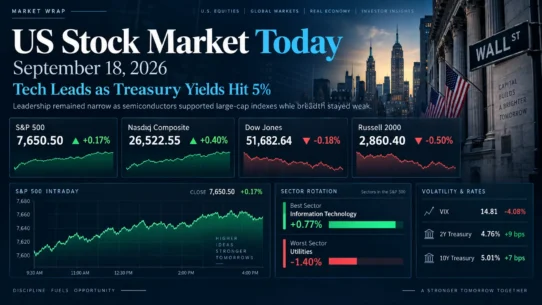
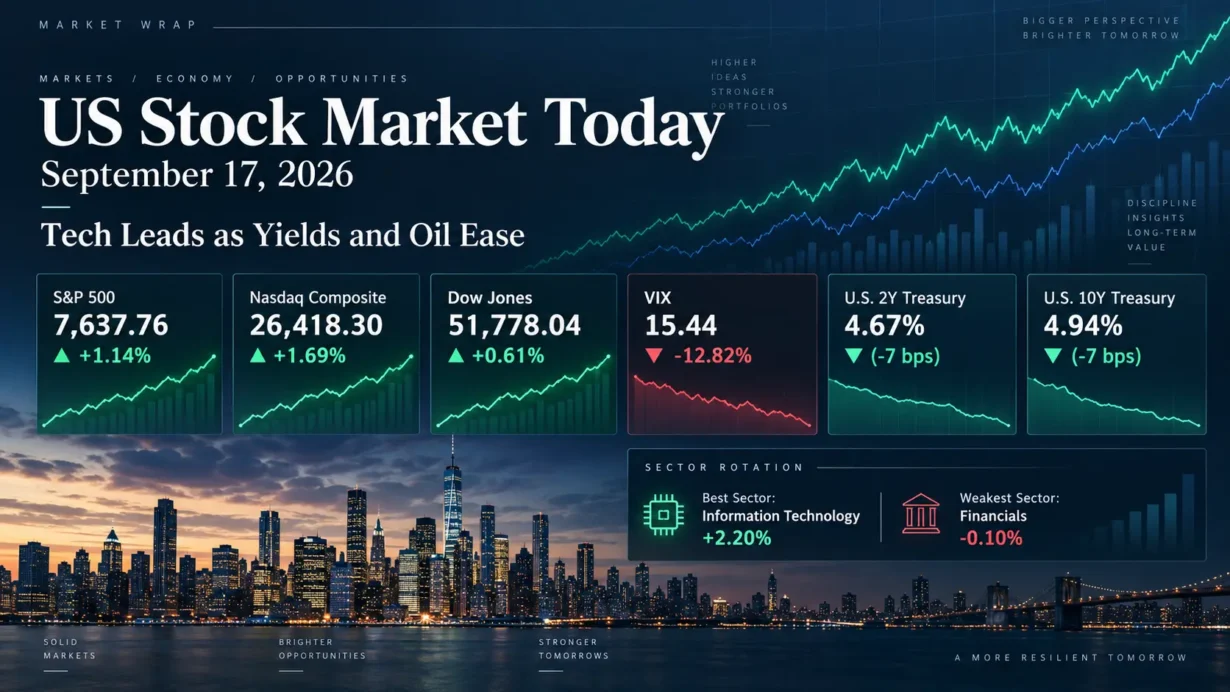
- The S&P 500 rose 1.14% to 7,637.76, the Nasdaq Composite gained 1.69% to 26,418.30, and the Dow Jones Industrial Average advanced 0.61% to 51,778.04 as U.S. equities rebounded from a three-session decline.
- Information Technology led the S&P 500 sectors with a 2.20% gain, while Financials was the weakest group at -0.10%; Consumer Staples also finished slightly lower. The equal-weight S&P 500 proxy gained only 0.49%, showing that large growth companies contributed disproportionately to the index-level rebound.
- The U.S. Treasury’s official closing curve showed the 2-year yield at 4.67% and the 10-year yield at 4.94%, both 7 basis points below September 16. Cboe’s VIX closed at 15.44, down 12.82%, consistent with a sharp post-event volatility unwind.
- Macro data were mixed but not recessionary: initial jobless claims fell to 196,000, while August housing starts declined 2.6% to a 1.275 million annualized rate even as single-family starts rose 7.6%.
- Company-specific dispersion remained extreme. Generac surged 18.34% after disclosing a long-term Amazon data-center backup-power agreement, while Fluence Energy fell 15.47% after materially cutting fiscal 2026 revenue and adjusted EBITDA guidance.
1. Market Capital Flows and Sector Rotation
Thursday’s rebound was broad enough to qualify as genuine risk-on participation, but the return contribution was still concentrated in large-cap growth. Information Technology was the strongest S&P 500 sector at +2.20%, while Financials was the weakest at -0.10%; Consumer Staples also finished slightly lower. The S&P 500 gained 1.14%, versus 0.49% for the Invesco S&P 500 Equal Weight ETF, a useful equal-weight proxy, and roughly 0.55% for the Russell 2000. That spread indicates large caps outperformed small caps. Growth also decisively beat value: the Vanguard Growth ETF rose 1.55% versus 0.52% for the Vanguard Value ETF. The cross-sector pattern was therefore less a simple cyclical-versus-defensive trade than a duration-sensitive rotation toward technology and growth as bond yields retreated; defensive staples lagged, while financials failed to participate despite the broader rally.
Market breadth nevertheless improved materially. On the NYSE, advancers outnumbered decliners by 2.38 to 1; on Nasdaq, the ratio was 2.21 to 1. Total U.S. exchange volume was about 17.57 billion shares, above the 20-session average of 15.37 billion. The combination of positive breadth with a much stronger cap-weighted S&P 500 than its equal-weight proxy suggests the rally was not narrowly confined to a handful of stocks, but its magnitude was still amplified by mega-cap and technology leadership.
Institutional Flow Insight: The tape was consistent with investors adding exposure to long-duration growth as lower Treasury yields reduced the discount-rate pressure on future cash flows. The decline in crude oil also eased a key near-term inflation and margin risk, which may have allowed some risk budgets to expand after the Federal Reserve’s September 16 rate increase. At the same time, the equal-weight lag argues against interpreting the session as an indiscriminate beta chase. Institutional portfolios may still be favoring earnings visibility, balance-sheet strength and secular capital-spending exposure over lower-quality cyclicals. This is an inference from price, breadth and rate behavior rather than confirmed fund-flow data.
2. Decoding the Biggest Market Movers
Generac Holdings (GNRC)
Generac closed at $207.23, up 18.34%. The catalyst was a September 16 regulatory filing disclosing a long-term supply agreement with Amazon for backup generators used in Amazon data centers. Generac said initial deliveries are expected to total $2.4 billion across 2027 and 2028. In connection with the agreement, Generac issued an Amazon subsidiary a warrant for up to 1,693,745 shares at an exercise price of $200.926 per share; 307,954 shares vested immediately, while the balance vests in tranches tied to aggregate gross payments for backup generators of up to $8 billion.
The agreement matters because it extends the AI-infrastructure capital-spending theme beyond semiconductors and networking into power resiliency. Generac’s latest reported quarter already showed that transition. In the second quarter of 2026, net sales were $1.1735 billion, up 10.6% year over year; gross margin was 44.5%; adjusted EBITDA was $290.7 million, or a 24.8% margin; and adjusted EPS was $2.91, up 76.5%. Management’s latest full-year 2026 outlook called for mid-to-high-teens net sales growth, low-30% growth in Commercial & Industrial sales, a 9.0%-10.0% net income margin and a 20.0%-21.0% adjusted EBITDA margin. Importantly, the company said the higher margin outlook included an approximately 1.5-percentage-point full-year benefit from a tariff refund, so investors should not treat the entire margin step-up as purely structural operating leverage.
For the broader industrial and data-center power complex, the read-through is that hyperscalers are willing to secure multi-year backup-power capacity as compute intensity rises. That can support valuation premiums for suppliers with credible large-megawatt production capacity and execution records. The counterweight is that a large headline contract does not eliminate manufacturing, delivery, customer-concentration or warrant-dilution risk, especially after an 18% one-day repricing.
Fluence Energy (FLNC)
Fluence Energy closed at $7.65, down 15.47%, after the company sharply revised fiscal 2026 guidance. On September 16, Fluence reduced expected fiscal-year revenue to approximately $2.4 billion from a prior midpoint of approximately $3.0 billion and widened its expected adjusted EBITDA loss to approximately $200 million from a prior midpoint loss of approximately $10 million. Management attributed the revision primarily to continuing U.S. supply-chain issues and delays in ramping its Houston contract manufacturing facility.
The cut compounds execution concerns already visible in Fluence’s fiscal third quarter. Revenue for the quarter ended June 30 was $649.8 million, GAAP gross margin was 5.1% versus 14.8% a year earlier, adjusted gross margin was 5.9% versus 15.4%, and adjusted EBITDA was a loss of $29.3 million. Net loss attributable to Fluence Energy was $32.8 million, with basic and diluted Class A loss per share of $0.24. At the same time, demand indicators remained strong: quarterly order intake exceeded $1.44 billion and backlog reached approximately $6.4 billion.
The market implication is important for energy-storage and AI-adjacent infrastructure names: backlog quality and end-market demand are not sufficient if manufacturing conversion, working capital and gross-margin execution deteriorate. Generac and Fluence moved in opposite directions on the same day despite both being exposed to power infrastructure, reinforcing that investors are differentiating between demand visibility and operational delivery rather than rewarding the theme indiscriminately.
3. Macro Indicators and Market Outlook
The Cboe VIX closed at 15.44, down 2.27 points or 12.82% from 17.71. That move was directionally consistent with the equity rally and suggests that some event premium embedded around the Federal Reserve decision was removed from S&P 500 options. The drop in volatility should not be read as the disappearance of macro risk: oil and Middle East developments remain capable of quickly restoring inflation and hedging demand, but Thursday’s close showed a meaningful reduction in near-term protection pricing.
The U.S. Treasury’s official September 17 closing curve put the 2-year yield at 4.67%, down 7 basis points from 4.74% on September 16, and the 10-year yield at 4.94%, also down 7 basis points from 5.01%. The 10s2s spread therefore remained positive at about 27 basis points. The parallel decline helped equity duration even though the Federal Reserve had just raised the federal funds target range by 25 basis points to 3.75%-4.00% on September 16. The correct interpretation is repricing at the margin, not proof of an imminent policy reversal: lower oil, post-FOMC positioning and demand for duration can all pull Treasury yields lower even while the central bank remains focused on above-target inflation.
Oil was the most relevant cross-asset confirmation. Brent crude settled near $104.82 a barrel, down about 1%, as some immediate supply anxiety eased. Lower oil reduced pressure on inflation-sensitive yields and supported rate-sensitive equities, although crude remained high enough that a renewed geopolitical spike would still represent a material risk to margins and inflation expectations.
Upcoming Economic Data & Catalysts:
- New Residential Sales (Release date: September 24, 2026): The Census Bureau and Department of Housing and Urban Development will publish August new-home sales. Investors will watch demand, inventory and pricing for evidence of how mortgage rates are transmitting into housing activity and homebuilder earnings.
- Advance Report on Durable Goods (Release date: September 25, 2026): The Census Bureau’s August report will provide a fresh read on manufacturing orders and business capital spending. The core capital-goods components can influence growth expectations, Treasury yields and earnings assumptions for industrial companies.
Market Insights:
The September 17 advance was broad in participation but top-heavy in return contribution. Positive NYSE and Nasdaq breadth, above-average volume and a lower VIX argue that the session was more than a single-stock squeeze. However, the 65-basis-point gap between the cap-weighted S&P 500 and its equal-weight proxy shows that large growth stocks remained the primary engine. The most important reversal risks are a renewed rise in the 10-year yield above the 5% area, another oil shock, deterioration in breadth, downward earnings revisions or a renewed rise in implied volatility as investors rebuild event hedges.
Trading & Investment Strategy:
A risk-managed approach favors selective exposure rather than chasing the index after a sharp one-day rebound. Investors can scale positions in tranches, favor sectors and companies with visible earnings and cash-flow conversion, and keep position sizes smaller in names that have gapped sharply on single announcements. Growth exposure benefits from lower yields but remains duration-sensitive, while value and smaller-cap positions still need evidence of broader earnings participation. Predefined exit levels, portfolio-level loss limits and disciplined rebalancing are preferable to adding leverage simply because volatility fell. In high-beta infrastructure names, separate backlog growth from execution quality and avoid treating thematic demand as a substitute for margin discipline.
4. Key FAQs About the US Stock Market Today
Why did the US stock market move on September 17, 2026?
U.S. stocks rose as Treasury yields and crude oil prices fell after the Federal Reserve’s September 16 rate increase, easing some of the discount-rate and inflation pressure that had weighed on equities. Technology led the rebound, while weekly jobless claims of 196,000 signaled that layoffs remained low. Company-specific catalysts, including Generac’s Amazon agreement, reinforced strength in selected infrastructure and growth themes.
Which sectors performed best and worst in the US stock market on September 17, 2026?
Information Technology was the best-performing S&P 500 sector at +2.20%. Financials was the weakest at -0.10%, while Consumer Staples also ended slightly lower. The rotation favored growth and rate-sensitive duration rather than defensive staples, although the broader tape was not a pure cyclical rally because financial stocks lagged.
What should investors watch after the US stock market close on September 17, 2026?
The next major confirmed macro releases are August New Residential Sales on September 24 and August Durable Goods on September 25. In markets, the key checks are whether the 10-year Treasury yield can remain below 5%, whether oil stays contained, whether equal-weight and small-cap participation improves, and whether VIX remains subdued without a deterioration in earnings expectations. For company fundamentals, execution against backlog and margins should remain more important than headline AI-infrastructure exposure alone.
Disclaimer: This article is intended solely for the exchange of investment ideas and does not constitute investment advice of any kind.