


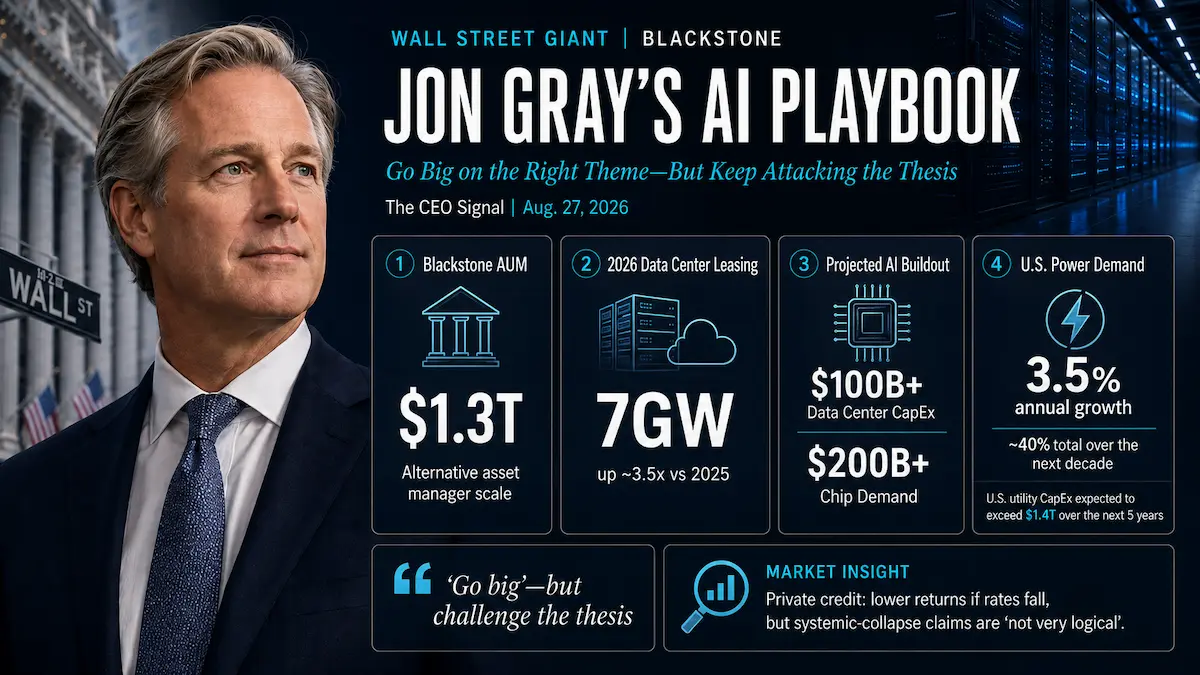

Key Takeaways
- Gray says Blackstone’s edge is to “go big” after identifying a durable investment theme, but size must be paired with continuous challenge of the thesis.
- AI is creating secular winners and losers across software, information services, media and professional services, making terminal-value assumptions far less reliable than in a normal cycle.
- Blackstone’s own data-center portfolio is pointing to extraordinary physical demand: the firm says its global platforms are on track for roughly 7GW of leasing in 2026, supporting more than $100 billion of data-center capital expenditure and more than $200 billion of associated chip demand over the next several years.
- Gray accepts that falling base rates and tighter spreads can reduce private-credit returns; he rejects the leap from lower returns to a broad systemic-collapse thesis.
- The investable implication is a quality-and-bottleneck strategy: favor businesses monetizing power, cooling, electrical distribution and contracted infrastructure demand, while demanding a higher margin of safety from AI-exposed software and credit vehicles whose economics depend on elevated rates or unusually wide spreads.
1. Core Views Reconstructed
“When we identify something, we go big.”
Gray’s most important portfolio-construction lesson is about asymmetry. Large institutions do not outperform by owning every plausible theme in equal size; they outperform when research, operating data and capital-market access converge on a small number of high-confidence opportunities. Blackstone’s AI infrastructure push is an example of this model. The business logic is straightforward: if compute demand is compounding faster than physical capacity can be delivered, scarce assets such as powered land, data-center shells, electrical equipment and cooling systems can capture economic rent before the value chain normalizes. The key for equity investors is to distinguish scale backed by contracted demand from scale backed only by narrative.
“You keep pressing against what you’re doing” so you do not simply fall in love with the thesis.
This is the risk-control half of Gray’s “go big” philosophy. High-conviction investing becomes dangerous when the investor stops updating probabilities. In AI, the bull case can remain structurally correct while individual securities still become bad investments because expectations outrun cash flows. Investors therefore need a falsification process: what would prove the thesis wrong? For AI infrastructure, the warning signs would include slowing leasing, hyperscaler capex reductions, project delays caused by financing or power constraints, weaker equipment backlogs, or a sharp deterioration in customer credit quality. The deeper message is that conviction should increase with evidence, not with price appreciation.
AI is making some business models much harder to value because secular change can “knock out” incumbents.
Gray highlighted professional services, information services, media and software as areas where the future value of existing economics has become harder to estimate. That is a direct challenge to traditional discounted-cash-flow comfort. When AI can compress labor intensity, alter pricing units, reduce switching costs or enable new competitors, the historical relationship between revenue growth, margins and terminal value becomes less dependable. The market may still reward category leaders, but investors should be cautious about assuming that every recurring-revenue model deserves its old multiple simply because the revenue is labeled “recurring.” The competitive moat itself has to survive AI-driven changes in cost structure and customer behavior.
“Pattern recognition” matters: find the “good neighborhoods” before the consensus fully prices them.
Gray’s language points to a repeatable institutional playbook. Blackstone is not merely trying to pick a single AI winner; it is identifying the physical and contractual ecosystems where many winners must spend money. That is why the second-order AI trade can be more durable than the most crowded application-layer trade. Regardless of which model provider or software platform wins share, compute still needs electricity, cooling, network connectivity, land, construction and financing. In portfolio terms, this creates a picks-and-shovels opportunity set whose revenue drivers can be tied to industry capacity additions rather than to one model’s market share.
Lower private-credit returns are plausible; a systemic collapse is a different claim.
Gray’s private-credit view is deliberately nuanced. If benchmark rates decline and credit spreads compress, floating-rate lenders should expect lower all-in yields, all else equal. That is not a controversial statement; it is arithmetic. But lower returns do not automatically imply a banking-style systemic event, particularly in vehicles with lower structural leverage and long-dated capital. The investable distinction is between return compression and credit impairment. Investors should watch non-accruals, realized losses, payment-in-kind income, NAV trends, redemption pressure and underwriting quality rather than treating every decline in portfolio yield as evidence of insolvency.
2. Industry Chain and Sector Impact
Potential beneficiary: Eaton (NYSE: ETN) — electrical infrastructure becomes the scarce link in the AI capex chain
This is an analytical inference from Gray’s infrastructure thesis, not a stock recommendation made by Gray. The reason Eaton fits the framework is that AI data centers cannot monetize GPUs without power-management equipment, switchgear, thermal systems and electrical distribution capacity. Blackstone says its global data-center platforms are on track for record leasing activity, with roughly 7GW expected in 2026 and more than $100 billion of data-center capex associated with its projects over the next several years. Eaton’s own second-quarter 2026 results showed 14% organic sales growth, 43% year-over-year Electrical-sector backlog growth, and management continued to identify data centers as a key growth driver.
The capital-flow logic matters. Early in an AI cycle, investor attention concentrates on chips and model providers. As the buildout moves from announcements to construction, spending broadens into electrical equipment and grid-adjacent infrastructure. That creates a potential earnings-duration advantage for suppliers with long backlogs, qualified products and scarce manufacturing capacity. The risk is valuation: if the market has already capitalized several years of unusually strong data-center growth, even excellent execution can produce mediocre stock returns. Investors should therefore track order growth, backlog conversion, margin expansion and hyperscaler capex rather than relying on the AI label alone.
Potential beneficiary: Vertiv (NYSE: VRT) — cooling and power density are becoming economic bottlenecks
Vertiv is another public-market expression of the physical AI buildout. Higher-density racks increase the technical burden on thermal management, power conversion and data-center reliability. Vertiv entered 2026 with unusually strong demand and raised full-year guidance earlier in the year as data-center momentum accelerated. Gray’s framework strengthens the strategic case for this type of business because it sits where AI demand meets physical capacity: model innovation can change quickly, but every incremental cluster still has to be powered and cooled.
The investor advantage is that bottleneck suppliers can capture pricing, volume and service revenue simultaneously when capacity is tight. The risk is equally important: infrastructure stocks can de-rate sharply if hyperscaler spending decelerates, if new manufacturing capacity erodes scarcity premiums, or if customers delay projects because power availability becomes the gating factor. In other words, the same bottleneck that supports near-term pricing can eventually become a capex-delay risk.
On the pressure side, Gray’s comments argue for selectivity in legacy software and private-credit exposures. AI can weaken the terminal economics of software businesses whose products are easy to replicate or whose pricing depends on human-seat counts, while declining base rates can compress income for floating-rate lenders. Neither outcome means the entire sector is broken. It means dispersion should rise, which historically favors security selection over passive exposure.
3. Practical Investor Strategy
1) Separate the AI demand thesis from the stock-price thesis.
Investors should build two models, not one. The first asks whether AI infrastructure demand remains structurally strong. The second asks whether the current share price already discounts that strength. A company can be positioned in the best secular theme in the market and still offer poor forward returns if the entry multiple assumes flawless execution. A disciplined approach is to map revenue growth, backlog, free-cash-flow conversion and required valuation multiple under base, bull and stress cases, then size the position based on expected return rather than narrative confidence.
2) Monitor three real-time confirmation signals: leasing, equipment backlog and financing conditions.
For the AI infrastructure trade, leasing is the demand signal, supplier backlog is the conversion signal, and financing is the feasibility signal. Strong leasing without grid access or financing can produce announcements but not revenue. Strong supplier backlog without customer credit quality can increase cancellation risk. Investors should therefore follow data-center leasing commentary, hyperscaler capex guidance, electrical-equipment orders, utility interconnection timelines, project-finance spreads and private-credit availability as one integrated dashboard.
3) Use Gray’s “attack the thesis” rule as a portfolio defense.
Before adding to a winning position, write down the three facts that would force a reduction. For ETN or VRT, examples might include a material deceleration in data-center orders, declining backlog quality, or evidence that customer capex plans are being pushed out. For private-credit exposure, the defense line should be rising non-accruals, falling NAV, weaker interest coverage or increasing reliance on payment-in-kind income. This prevents a common late-cycle error: allowing a strong secular story to override deteriorating security-level evidence.
The broader allocation takeaway is a barbell rather than a binary bet. Investors can maintain exposure to the AI infrastructure supercycle while holding liquidity or lower-beta assets that provide optionality if crowded growth trades correct. Gray’s comments support concentration only when the underlying evidence is strengthening; they do not support concentration simply because a theme has strong momentum.
4. Frequently Asked Questions
What did Jon Gray say about AI investing in his latest 2026 interview?
In the August 27, 2026 episode of The CEO Signal, Gray said Blackstone tends to “go big” when it identifies a compelling theme, but he emphasized that the firm keeps challenging its own assumptions so conviction does not become complacency. He also described investing as pattern recognition: identifying attractive “neighborhoods” where structural forces can support returns across multiple assets. For AI, the practical implication is that investors should look beyond model providers to the infrastructure, power and financing required for the buildout.
Which U.S. stocks could benefit from Jon Gray’s AI infrastructure thesis?
Gray did not recommend individual public stocks in the interview. As an independent industry-chain inference, Eaton (ETN) and Vertiv (VRT) are relevant names because they sell power-management, electrical and thermal infrastructure used in data centers. Their potential upside depends on continued AI capex, backlog conversion and pricing power; their principal risk is that valuation or customer spending expectations become too aggressive.
Does Jon Gray think private credit is facing a systemic crisis in 2026?
No. Gray acknowledged that private-credit returns can decline as base rates fall and spreads tighten, calling that criticism reasonable. But he argued that extrapolating return compression into a broad systemic-collapse thesis is not logical. Investors should therefore separate yield normalization from actual credit deterioration and monitor defaults, non-accruals, realized losses, leverage, NAV and redemption behavior.
For investors, the most important point from Gray’s latest interview is not “buy AI.” It is to combine structural conviction with institutional-grade skepticism. Blackstone’s scale allows it to deploy billions behind a theme, but Gray’s process still demands that every large bet survive repeated challenges. That is exactly the discipline public-equity investors need in a market where AI can create extraordinary earnings growth and extraordinary valuation risk at the same time.
Source: Listen to Jon Gray’s August 27, 2026 interview on Semafor’s The CEO Signal on Apple Podcasts, with supporting AI infrastructure data from Blackstone’s Pattern Recognition research.
Disclaimer: This article is for informational purposes only and does not constitute investment advice.