



Key Takeaways
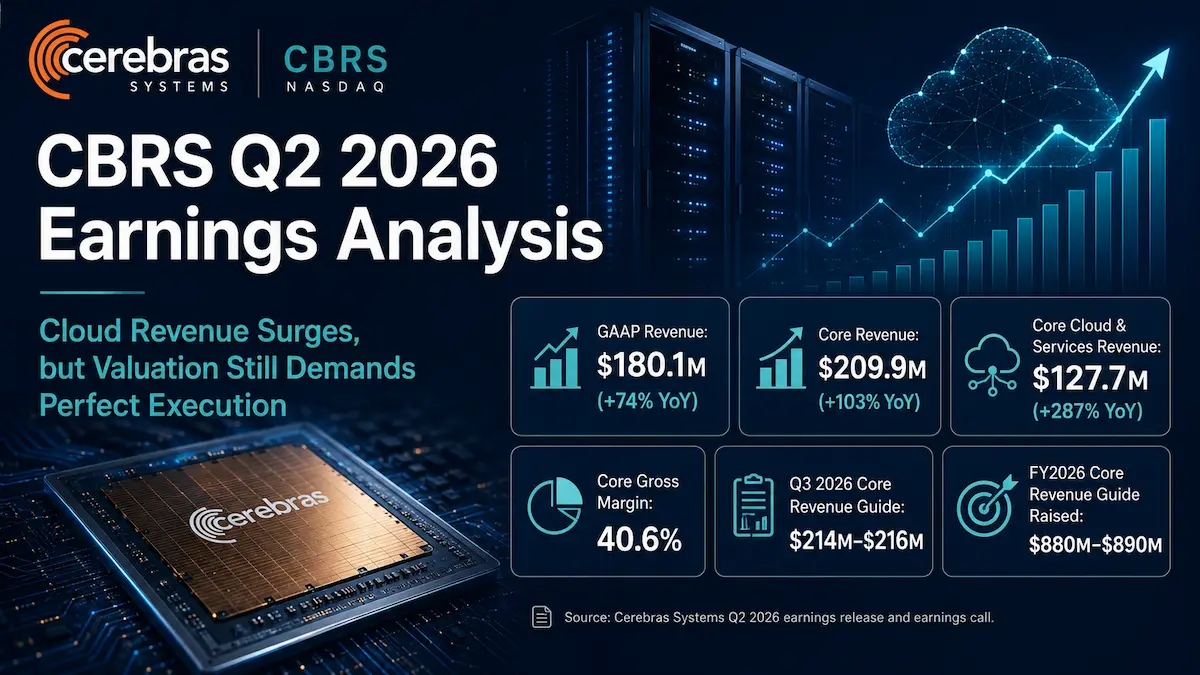
- Cerebras Systems reported Q2 2026 GAAP revenue of $180.1 million, up 74% year over year, while core non-GAAP revenue reached $209.9 million, up 103%. The distinction matters because the two revenue definitions produced opposite-looking conclusions versus different Wall Street consensus datasets.
- Core cloud and other services revenue rose 287% to $127.7 million and became roughly 61% of core revenue, confirming that Cerebras is rapidly shifting from a hardware-led model toward recurring inference infrastructure.
- Core gross margin of 40.6% and core operating margin of -16% both beat the company’s prior Q2 guidance by wide margins, but temporary system rent-backs are expected to push Q3 gross margin to a near-term trough before a Q4 recovery.
- Management raised FY2026 core revenue guidance to $880 million-$890 million and said 2027 core revenue should more than triple, supported by $25.4 billion of remaining performance obligations and more than 600 MW of data-center capacity live or under contract through the end of 2027.
- At the August 14, 2026 close of $218.98, CBRS carried an equity value of about $33.1 billion, or roughly 37.4x the midpoint of FY2026 core revenue guidance. The post-earnings selloff therefore looks more like an expectations and valuation reset than a rejection of the company’s underlying growth story.
1. Core Earnings Breakdown
Revenue and Profitability Analysis
Cerebras Systems delivered another quarter of exceptional top-line growth, but investors need to separate GAAP revenue from the company’s core non-GAAP framework to understand what actually happened. GAAP revenue was $180.1 million, up 74.3% from $103.3 million a year earlier. Core revenue was $209.9 million, up 103.1% year over year. Core revenue excludes $14.5 million of data-center pass-through revenue and adds back $44.3 million of non-cash customer-warrant amortization that is recorded as contra-revenue under GAAP.
That reconciliation is not a cosmetic detail. It is the central reason some earnings headlines described the quarter as a revenue beat while others described it as a miss. The underlying operating momentum was stronger than the GAAP headline, but the gap also reminds investors that customer warrants and contract structure have real economic and dilution implications even when management excludes them from core metrics.
- GAAP cloud and other services revenue: $126.0 million, up 281% year over year. Investment view: cloud is becoming the primary growth engine, which improves revenue visibility but increases Cerebras’ need to fund and operate infrastructure at scale.
- Core cloud and other services revenue: $127.7 million, up 287% year over year. Investment view: the nearly fourfold increase validates demand for fast inference and shows that large customers are moving from experimentation into meaningful production usage.
- GAAP hardware revenue: $54.1 million, down 23% from $70.3 million a year earlier. Investment view: the decline is not necessarily evidence of weaker product demand because management is increasingly deploying systems into Cerebras’ own cloud rather than recognizing revenue through outright hardware sales.
- Core hardware revenue: $82.1 million, up 17% year over year. Investment view: hardware remains strategically important, but its role is shifting toward seeding future cloud capacity and enabling a larger services revenue stream rather than maximizing near-term unit sales.
Profitability was mixed depending on the accounting lens. GAAP gross margin was only 14.2%, while core gross margin was 40.6%, up approximately 940 basis points from Q2 2025. Core cloud and other services gross margin reached 41.8%, up 1,600 basis points year over year, and core hardware gross margin was 38.8%, up 510 basis points. Core operating loss was $33.6 million, translating to a core operating margin of -16%, compared with -42% a year ago.
The GAAP net loss was $450.5 million, or $2.98 per share, heavily affected by $377.0 million of stock-based compensation and other non-GAAP adjustments. Core net loss was $6.9 million. Using Q2 basic weighted-average shares of 151.0 million, core net loss implies approximately -$0.05 per share; this is a calculated figure from company-reported figures rather than an EPS metric directly reported by Cerebras.
Expectations vs. Actual Results
The cleanest way to read the quarter is to compare like with like rather than mix GAAP and non-GAAP consensus figures.
- Core revenue: $209.9 million versus FactSet consensus of $190.6 million. ✅ Beat by about $19.3 million, or 10.1%.
- GAAP revenue: $180.1 million versus LSEG consensus of $194.23 million. ❌ Miss by about $14.1 million, or 7.3%.
- Adjusted/core EPS: approximately -$0.05 versus FactSet consensus of -$0.17. ✅ Better by roughly $0.12 per share. The company-reported core net loss supports the approximately -$0.05 figure, but Cerebras itself does not present a separate core EPS line item.
- Core gross margin: 40.6% versus prior company Q2 guidance of 36%-38%. ✅ Beat the high end by 260 basis points.
- Core operating margin: -16% versus prior company Q2 guidance of approximately -32% to -30%. ✅ Beat the guidance range by roughly 14-16 percentage points.
There is no consistently published, apples-to-apples analyst consensus for Q2 core operating margin in the authoritative public sources reviewed, so the company’s prior guidance is the cleaner benchmark for operating-margin execution.
For Q3 2026, Cerebras guided to core revenue of $214 million-$216 million, core gross margin of 38%-40%, and core operating margin of -25% to -23%. The $215 million revenue midpoint is above the roughly $210.2 million FactSet consensus cited immediately after the release. For FY2026, management raised core revenue guidance to $880 million-$890 million from $855 million-$865 million, raised core gross margin guidance to 41%-43% from 38%-41%, and improved core operating-margin guidance to -19% to -17% from -32% to -28%.
The true source of the beat was not simply “more AI demand.” Three factors mattered. First, cloud usage expanded sharply as OpenAI deployments and other customers ramped. Second, pricing improved as management argued that faster inference is commanding a premium. Third, operating leverage was much stronger than expected despite continued investment in capacity and engineering.
What mattered most to the market, however, was different from what looked best in the release. Investors were forced to reconcile a strong core revenue beat with a GAAP revenue miss, a Q3 gross-margin trough, still-heavy infrastructure spending, and a valuation that had already priced in extraordinary 2027 growth. Management also disclosed that temporary rent-backs of Cerebras systems reduced Q2 core gross margin by approximately 500 basis points. That is an execution choice designed to satisfy demand sooner, but it shows that demand cannot be monetized at optimal economics until owned data-center capacity catches up.
The stock reaction illustrates this tension. CBRS closed at approximately $262.06 on August 12 before the earnings release and fell sharply in extended trading. By the August 14 close, shares were $218.98, about 16.4% below the pre-earnings close. The gap between strong core metrics and weak stock performance therefore should not be dismissed as “sell the news.” The more defensible explanation is that the market was repricing the probability of flawless execution at a premium valuation, while also assigning greater weight to GAAP revenue, warrant-related dilution economics, the Q3 margin trough, and the time required to convert a massive backlog into profitable revenue.
Earnings Call Highlights
- Management said 2026 is a foundation-building year and expects core revenue to more than triple in 2027 as capacity, manufacturing and customer deployments scale.
💡 Reading Between the Lines: The investment case has shifted from proving demand to proving conversion. With valuation already discounting very high growth, the key variable is no longer whether customers want Cerebras capacity, but whether the company can turn contracted demand into live megawatts, billable tokens and expanding margins on schedule. - Cerebras has secured more than 600 MW of data-center capacity that is live or under contract for delivery by the end of 2027, while its opportunity pipeline is measured in gigawatts.
💡 Reading Between the Lines: Data-center availability is the binding constraint on near-term revenue. This makes power, construction timing and deployment execution more important to the model than traditional semiconductor unit supply alone, and it raises the sensitivity of 2027 estimates to infrastructure slippage. - CFO Bob Komin said system rent-backs reduced Q2 core gross margin by about 500 basis points and expects Q3 to be the low point before a significant Q4 improvement as lower-cost Cerebras-owned capacity comes online.
💡 Reading Between the Lines: The margin compression is being presented as temporary and demand-driven rather than structural. The thesis becomes materially stronger if Q4 confirms the promised inflection; a delayed recovery would challenge the assumption that scale can move gross margin toward management’s long-term 60%+ target. - Management described disaggregated inference with AMD and AWS as a way to keep Cerebras decode speed while materially increasing throughput, with GPU-based deployments targeted for Q4 2026 and Amazon Bedrock availability expected in Q1 2027.
💡 Reading Between the Lines: Cerebras is trying to become complementary to existing accelerator fleets rather than forcing customers into an all-or-nothing replacement cycle. If successful, that lowers adoption friction, enlarges the addressable installed base and could improve both tokens per system and gross-margin economics. - Management emphasized that Cerebras does not depend on HBM, CoWoS packaging or leading-edge 3 nm fabrication, and said it has secured the TSMC wafer supply required for planned growth.
💡 Reading Between the Lines: Supply-chain architecture is becoming part of the competitive moat. If HBM and advanced-packaging constraints remain tight, Cerebras may gain relative pricing flexibility and deployment reliability, although the company still faces execution risk in manufacturing, data centers and customer concentration.
2. Deep Business Insights
Hidden Metrics That Matter
One of the most important changes in the quarter is the speed of the revenue-mix transition. GAAP cloud and other services represented approximately 70.0% of total Q2 revenue, calculated as $126.0 million divided by $180.1 million. A year earlier, the same category represented approximately 32.0%, calculated as $33.0 million divided by $103.3 million. That is an increase of roughly 38 percentage points in one year, calculated from company-reported figures.
The core non-GAAP mix tells the same story. Core cloud and other services represented approximately 60.9% of Q2 core revenue, calculated as $127.7 million divided by $209.9 million. This matters because Cerebras is rapidly becoming an AI infrastructure service provider rather than simply a merchant hardware vendor. That can increase lifetime customer value and recurring revenue, but it also moves capital intensity, utilization risk and data-center execution onto Cerebras’ own balance sheet.
A second underappreciated metric is the scale of contracted demand relative to the current revenue base. Remaining performance obligations were $25.4 billion at June 30. Dividing $25.4 billion by the midpoint of FY2026 core revenue guidance of $885 million produces approximately 28.7x, calculated from company-reported figures. Investors should not interpret this ratio as 28.7 years of guaranteed revenue because RPO timing, contract milestones and customer concentration matter. The correct conclusion is narrower: Cerebras has unusually large forward contractual visibility relative to its present revenue scale, which justifies investing ahead of demand but magnifies execution risk if deployments slip.
The customer value proposition is also becoming clearer. Cerebras combines a wafer-scale processor, system architecture and cloud delivery model to reduce latency and increase token generation speed. The company reported support for OpenAI GPT-5.6 Sol at up to 750 tokens per second and is pairing Cerebras decode with other processors for disaggregated inference. Customers therefore do not have to choose Cerebras solely as a replacement for an existing accelerator fleet; they may use it to accelerate the most latency-sensitive portion of inference while preserving prior infrastructure investments.
That is a meaningful distinction. For coding, multi-agent workflows and inline security, latency can directly affect user productivity, task completion time or whether an application can operate in real time. Cerebras is effectively trying to monetize speed as a premium product attribute rather than compete only on raw compute capacity. If customers continue to pay for that speed, the company can support better pricing while its architecture avoids some HBM and advanced-packaging constraints affecting conventional accelerators.
Industry Chain Reactions
- ✅ Benefit — Advanced Micro Devices (NASDAQ: AMD): Cerebras’ disaggregated-inference strategy uses AMD Helios systems for prefill while Cerebras handles decode. If this architecture gains adoption, AMD can participate in heterogeneous AI inference deployments where the customer values both throughput and low-latency token generation rather than selecting a single accelerator vendor for the entire workload.
- ❌ Face Pressure — NVIDIA (NASDAQ: NVDA): Cerebras remains much smaller and NVIDIA retains enormous ecosystem, software and scale advantages, but Cerebras is directly attacking high-value inference workloads on speed, supply-chain structure and cost per token. If disaggregated inference lets customers pair Cerebras with existing GPU fleets while reducing dependence on the newest NVIDIA systems, it could pressure incremental inference share and pricing at the margin.
Valuation Framework and Key Risks
CBRS closed at $218.98 on August 14, 2026, with an equity market capitalization of approximately $33.1 billion. Against the midpoint of FY2026 core revenue guidance of $885 million, the stock trades at roughly 37.4x forward core revenue on an equity-value-to-sales basis. That is an exceptionally demanding multiple for a company that still has negative operating margins and substantial infrastructure investment ahead.
Management’s 2027 statement changes the picture, but it does not eliminate valuation risk. If “more than triple” is applied mechanically to the $885 million FY2026 midpoint, 2027 core revenue would exceed $2.655 billion. At today’s market capitalization, that implies less than approximately 12.5x 2027 core revenue, calculated from company-reported figures and management’s directional growth statement. This is not formal 2027 point guidance, and the calculation should be treated as a scenario framework rather than a forecast.
The valuation can work if Cerebras executes several things simultaneously: converts RPO into revenue on schedule, brings owned data centers online fast enough to remove rent-back costs, sustains premium pricing for low-latency inference, expands beyond OpenAI, delivers its AMD and AWS partnerships on time, and demonstrates that gross margin can move structurally toward the 60%+ long-term target. At a 37x FY2026 sales multiple, the market does not need growth to be merely good; it needs growth to remain exceptional while unit economics improve.
The primary risks are therefore execution and expectation risk rather than demand risk alone. Data-center construction is a bottleneck. Manufacturing is being scaled more than tenfold. Customer concentration remains material, with OpenAI expected to remain a meaningful share of 2027 revenue even as AWS and other customers expand. The company also carries substantial stock-based compensation and customer-warrant economics: Q2 included $377.0 million of stock-based compensation and $44.3 million of customer-warrant amortization added back in the core revenue reconciliation. Those items do not negate the core growth story, but investors should not treat them as economically irrelevant because they can affect dilution, GAAP revenue and the long-run per-share value of the business.
There is also a margin-timing risk. Q3 guidance calls for core gross margin of only 38%-40%, below Q2, before management expects a significant Q4 rebound. The next earnings report will therefore be less about whether Cerebras can post another triple-digit growth rate and more about whether the cost structure begins to validate management’s promised margin trajectory.
3. Key FAQs
Did Cerebras (CBRS) beat Q2 2026 earnings expectations?
Yes on the company’s core framework, but not on every GAAP comparison. Core revenue of $209.9 million beat the $190.6 million FactSet consensus, and an approximately -$0.05 adjusted/core loss per share was better than the roughly -$0.17 FactSet expectation. However, GAAP revenue of $180.1 million was below the $194.23 million LSEG consensus cited by Reuters. Investors should therefore avoid treating “beat” or “miss” as a single answer without specifying the accounting basis.
Why did CBRS stock fall after Q2 2026 earnings despite raising guidance?
The decline was more consistent with a valuation and expectations reset than a simple “sell the news” event. CBRS entered the report at a very high revenue multiple, while GAAP revenue missed one widely followed consensus measure, Q3 gross margin is expected to trough, and management still needs to convert massive RPO into live capacity and profitable revenue. Customer warrants, stock-based compensation and the heavy infrastructure build-out also make per-share economics more complex than the core growth rate alone suggests.
What is Cerebras guidance after the Q2 2026 earnings report?
For Q3 2026, Cerebras expects core revenue of $214 million-$216 million, core gross margin of 38%-40%, and core operating margin of -25% to -23%. For FY2026, it raised core revenue guidance to $880 million-$890 million, core gross margin to 41%-43%, and core operating margin to -19% to -17%. Management also said it expects core revenue to more than triple in 2027, although it did not provide a formal 2027 revenue range.
Primary sources: the official Cerebras Q2 2026 earnings release, the official Cerebras Q2 2026 earnings webcast page, and the SEC-filed earnings release. Cerebras’ IR site provides the official webcast replay rather than a text transcript; management remarks in this article were cross-checked against a published call transcript and the company’s official release.
Disclaimer: This article/chart is for educational and informational purposes only and does not constitute investment advice of any kind. Past performance is not indicative of future results. Investors should independently evaluate their own risks.