

Key Takeaways
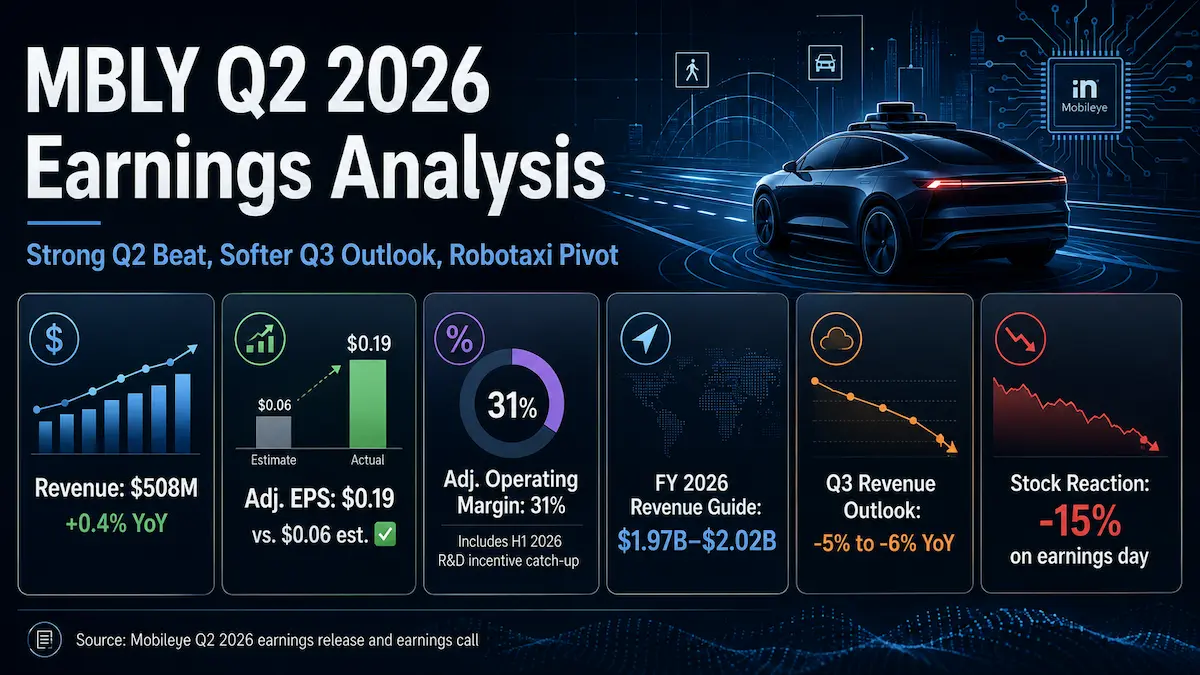
- Mobileye reported Q2 2026 revenue of $508 million, up approximately 0.4% year over year from $506 million and above the $481.24 million LSEG consensus cited by Reuters. Adjusted diluted EPS was $0.19 versus $0.06 expected.
- Headline adjusted operating margin reached 31%, but Q2 included $93 million of non-GAAP R&D incentive benefit covering both Q1 and Q2. Removing only the roughly half attributable to the Q1 catch-up implies a normalized Q2 adjusted operating margin of about 21.4%, calculated from company-reported figures.
- Mobileye raised full-year 2026 revenue guidance to $1.970-$2.020 billion and adjusted operating income guidance to $365-$425 million, but Q3 revenue is expected to decline approximately 5%-6% year over year, with EyeQ shipments of 9.3-9.5 million units.
- The stock fell about 15% on the earnings day despite the Q2 beat. The disconnect was driven primarily by softer Q3 guidance, CEO Amnon Shashua’s planned transition, and the market’s need to price a more capital-intensive vertically integrated robotaxi strategy.
- The core investment debate is shifting from near-term ADAS unit resilience toward whether Mobileye can convert its installed EyeQ base, new high-value ADAS wins, robotaxi platform and physical-AI R&D into sustainably higher revenue per vehicle without sacrificing capital efficiency.
1. Core Earnings Breakdown
Revenue and Profitability Analysis
Mobileye’s second-quarter results were stronger than the stock reaction suggested. Revenue was $508 million, compared with $506 million in Q2 2025, an increase of approximately 0.4% year over year. The more important operational signal was volume: Mobileye shipped 10.0 million systems, up about 3% from 9.7 million a year earlier, while management said that volume outperformed production at its top 10 customers by more than eight percentage points. That indicates genuine share and fitment-rate resilience even though the broader customer production environment remained weak.
Mobileye does not report Q2 revenue as separate financial segments for base ADAS, SuperVision, robotaxi, Moovit and humanoid robotics. To avoid creating false segment precision, the most reliable product-mix analysis uses the supplemental figures the company actually disclosed:
- EyeQ and SuperVision combined revenue was $485 million versus $481 million in Q2 2025, an increase of about 0.8%. That represented approximately 95.5% of total Q2 revenue, calculated as $485 million divided by $508 million from company-reported figures. Investment view: the installed automotive platform remains overwhelmingly dominant, so the near-term equity story still depends far more on automotive unit economics and content per vehicle than on robotaxi or humanoid revenue.
- The residual revenue outside the disclosed EyeQ and SuperVision line was approximately $23 million, calculated as $508 million minus $485 million. The comparable residual in Q2 2025 was approximately $25 million, or an implied decline of about 8%, calculated from company-reported figures. Mobileye does not provide enough Q2 granularity to attribute this residual precisely across Moovit, aftermarket and other activities. Investment view: these businesses are currently too small to offset a material move in EyeQ pricing or automotive volumes.
- Average system price fell to $48.50 from $49.70 a year earlier, a decline of approximately 2.4%, even as system shipments rose 3%. Investment view: higher China OEM export volumes are helping unit growth but are dilutive to ASP, so investors should not treat unit outperformance as equivalent to revenue-quality improvement.
Gross profitability weakened even as operating profitability appeared to surge. GAAP gross margin fell to 46% from 50%, while adjusted gross margin declined to 66% from 69%. Management attributed the compression mainly to lower EyeQ ASP from a higher mix of China OEM volumes and to a greater contribution from SuperVision, which carries more hardware content and therefore a lower gross margin profile.
Below gross profit, the reported picture was much stronger. GAAP operating loss narrowed to $30 million from $74 million, while adjusted operating income rose 46% to $155 million from $106 million. Adjusted operating margin expanded to 31% from 21%. However, that 31% figure is not a clean quarterly run-rate because Q2 included $93 million of non-GAAP R&D incentive benefit related to the entire first half of 2026. Management said approximately half of that benefit related to Q1 and half to Q2.
Adjusted diluted EPS was $0.19, up from $0.13 a year earlier, while GAAP diluted EPS improved to a loss of $0.03 from a loss of $0.08. First-half operating cash flow was $210 million, while purchases of property and equipment totaled $51 million. A simple operating-cash-flow-minus-capex proxy therefore equals approximately $159 million for the first half, calculated from company-reported figures; this is not a company-defined free cash flow metric.
Expectations vs. Actual Results
- Revenue: $508 million actual versus $481.24 million LSEG consensus cited by Reuters. Result: ✅ Beat by approximately $26.8 million, or 5.6%.
- Adjusted diluted EPS: $0.19 actual versus $0.06 LSEG consensus cited by Reuters. Result: ✅ Beat by $0.13 per share.
- Adjusted operating margin: 31% actual. A directly comparable LSEG margin consensus was not available in the verified sources reviewed. A separate published consensus snapshot cited expected adjusted operating income of $42.74 million on $485.1 million of revenue, which implies an adjusted operating margin of about 8.8%. Result: ✅ materially above that published benchmark, but the 8.8% figure should be treated as source-specific rather than a universal Street consensus.
The revenue beat came primarily from higher-than-expected system volumes, including higher share within certain OEMs, stronger ADAS fitment rates in emerging markets and upside from China OEM exports. The EPS and operating-profit beat was much more heavily influenced by the new Israeli R&D incentive law. Mobileye recognized approximately $110 million of GAAP and $93 million of non-GAAP benefit in Q2 as an offset to R&D expense, with the Q2 recognition covering the first half of 2026.
This distinction matters because the market should not assign the same quality to every component of the beat. The volume upside is evidence of competitive position and fitment-rate gains. The R&D incentive is economically valuable and management expects it to be sustainable, but the Q2 accounting recognition was unusually front-loaded because it included the Q1 catch-up. Meanwhile, adjusted gross margin still declined by roughly three percentage points, showing that product and geographic mix remain a real economic pressure.
Full-year 2026 guidance improved. Revenue is now expected at $1.970-$2.020 billion, up from the prior $1.935-$2.015 billion range. The midpoint increased to $1.995 billion from $1.975 billion. Adjusted operating income guidance increased to $365-$425 million from $185-$235 million, with management incorporating $180-$200 million of full-year non-GAAP R&D incentive benefit. The adjusted operating income range widened slightly because the incentive can vary with qualifying R&D spending, exchange rates and other recognition thresholds.
The next-quarter outlook was less supportive. Management expects Q3 EyeQ shipments of 9.3-9.5 million units and revenue to decline approximately 5%-6% year over year. Q3 2025 revenue was $504 million, so that percentage guidance implies roughly $474-$479 million of Q3 2026 revenue, calculated from company-reported figures rather than directly guided dollar revenue. Gross margin is expected to be slightly below Q2, operating expenses excluding the R&D incentive are expected to be slightly higher sequentially, and the R&D incentive recognized in Q3 should be significantly lower than in Q2 because Q2 contained the retroactive Q1 amount. Mobileye did not provide Q3 EPS guidance.
What did the market care about most? The answer was guidance, earnings quality and the strategic pipeline rather than the backward-looking Q2 beat. Investors had to reconcile four facts at once: strong unit share performance, weaker ASP and gross margin, a large accounting benefit that made the headline operating margin unusually high, and a Q3 revenue decline that signaled a softer near-term cadence. The market also had to price a major leadership transition and a robotaxi strategy that could eventually create recurring service revenue but requires more capital and operational execution than Mobileye’s traditional supplier model.
That explains the apparent contradiction between the results and the stock reaction. Reuters reported that MBLY fell about 15% on July 23, its sharpest one-day decline since August 2024, even though Q2 revenue and adjusted EPS both exceeded consensus. This was not simply a generic “sell the news” event. The decline reflected a reset in the forward narrative: Q3 is weaker, CEO succession introduces key-person and execution risk, and vertical robotaxi ambitions expand the range of possible long-term outcomes while increasing near- and medium-term capital intensity. The selloff was also not triggered by a newly announced acquisition: the Mentee acquisition had already closed in early February, according to management’s Q2 call.
Earnings Call Highlights
Management emphasized that Q2 EyeQ volume grew 3% and outperformed production at Mobileye’s top 10 customers by more than eight percentage points, while first-half revenue grew 13% against a 3% decline in those customers’ production volume.
💡 Reading Between the Lines: Mobileye is trying to prove that its core ADAS franchise can grow faster than global auto production through share gains, higher fitment rates and emerging-market penetration. That is critical because a valuation based only on auto-cycle recovery would deserve a lower multiple than one based on structural content-per-vehicle growth.
Management said the new high-volume Stellantis cloud-enhanced ADAS program begins in 2027, is largely a software-led upgrade, and carries gross profit per unit roughly equivalent to Surround ADAS and more than double a base ADAS program.
💡 Reading Between the Lines: The highest-quality part of the automotive thesis may be software-enabled monetization of an existing EyeQ relationship rather than entirely new hardware platforms. If this upgrade path scales across OEM fleets, Mobileye can raise gross profit per vehicle without requiring every customer to redesign a full sensor and compute architecture.
Management plans a vertically integrated U.S. robotaxi launch in 2027, with multiple go-to-market options, and described a business case of roughly $125,000 annual revenue per vehicle, vehicle cost below $100,000, and annual operating expense of a few tens of thousands of dollars per vehicle.
💡 Reading Between the Lines: Mobileye is moving from a technology-supplier valuation framework toward a partially asset-backed mobility-services model. The potential economics are attractive, but they remain management assumptions rather than realized results, so robotaxi deserves option value rather than full mature-service valuation until utilization, financing and cash returns are proven.
The R&D incentive is expected to support Mobileye’s P&L in future years, but cash related to the 2026 accounting benefit is expected to arrive gradually beginning in 2028; the incentive can also be affected if Intel is no longer Mobileye’s controlling shareholder.
💡 Reading Between the Lines: The incentive is more durable than a one-quarter accounting item, yet earnings and cash realization are temporally mismatched. Investors should distinguish P&L margin expansion from near-term cash conversion and recognize that Intel’s control has an unusual direct connection to this economic benefit.
Amnon Shashua plans to step down as CEO after a successor is appointed, remain involved in technology strategy and long-horizon innovation, and devote more attention to humanoid robotics while the new CEO focuses on scaling the company.
💡 Reading Between the Lines: The governance transition is designed to separate scientific leadership from operating scale, which could be positive if execution improves. The risk is that Shashua has been central to Mobileye’s technology identity and customer credibility for decades, so the market will likely demand evidence that strategic continuity survives the handoff.
2. Deep Business Insights
Hidden Metrics That Matter
Hidden metric #1: the 31% Q2 adjusted operating margin should not be annualized as the current quarterly run-rate. Q2 adjusted operating income was $155 million and included $93 million of non-GAAP R&D incentive benefit for the entire first half. Management said approximately 50% related to Q1 and 50% to Q2. Removing only the roughly $46.5 million Q1 catch-up leaves an estimated normalized Q2 adjusted operating income of about $108.5 million. Dividing $108.5 million by $508 million of revenue gives an estimated normalized Q2 adjusted operating margin of approximately 21.4%, calculated from company-reported figures.
This is a much more useful valuation input than the headline 31%. It still reflects the current-law Q2 incentive benefit, so it is not a “pre-incentive” number. It simply removes the prior-quarter catch-up that happened to be booked in Q2. The result suggests Mobileye’s sustainable post-law margin baseline may be materially better than investors expected before the legislation, but not nearly as high as the Q2 headline margin implies.
Hidden metric #2: volume growth is currently outrunning revenue growth because ASP is declining. EyeQ and SuperVision revenue rose only about 0.8% year over year to $485 million while systems shipped increased about 3% to 10.0 million and average system price fell about 2.4% to $48.50. These percentages are calculated from company-reported figures. The mix dynamic explains why Mobileye can simultaneously gain share and experience gross-margin compression.
Why do automakers still choose Mobileye? The earnings call gives a commercially important answer: OEMs appear willing to award Mobileye high-volume programs where production readiness, reliability, cost efficiency and integration risk matter most, while experimenting with alternative architectures on smaller or later programs. The Stellantis cloud-enhanced ADAS win illustrates the moat. The upgrade can leverage an existing production architecture, requires relatively modest OEM investment, is software-heavy for Mobileye, and can materially increase Mobileye’s profit per vehicle. In automotive procurement, lowering execution risk can be as valuable as maximizing theoretical compute performance.
The second differentiator is stack breadth. Mobileye can offer a progression from base ADAS to cloud-enhanced ADAS, Surround ADAS, SuperVision, Chauffeur and Drive using a common technology and data foundation. If real-world launches prove performance at scale, customers can expand content without switching the entire supplier stack. That creates a potential land-and-expand model inside the vehicle, which is strategically more valuable than a one-time chip socket win.
Industry Chain Reactions
- ✅ Benefit — Intel (NASDAQ: INTC): Mobileye states that Intel retains majority ownership. Stronger Mobileye earnings power, high-value ADAS design wins and successful commercialization could improve the value of Intel’s retained economic interest. The Q2 call also highlighted an unusual linkage: the Israeli R&D incentive could be affected if Intel were no longer Mobileye’s controlling shareholder, making Intel’s ownership position relevant to Mobileye’s future margin structure as well as governance.
- ❌ Face Pressure — Alphabet (NASDAQ: GOOGL): Waymo is an established U.S. robotaxi operator, while Mobileye now plans a vertically integrated U.S. launch in 2027 and believes its mature compute, sensor stack and Moovit assets can support attractive economics. This is not yet evidence of lost Waymo market share, but successful Mobileye execution would add a new scaled competitor with multiple go-to-market options, including direct operation and third-party platform integration.
Valuation Framework and Key Risks
At the latest available market quote on August 14, 2026, MBLY traded at approximately $8.92 per share with a market capitalization of about $7.30 billion. Using the midpoint of Mobileye’s 2026 revenue guidance, $1.995 billion, the stock trades at roughly 3.66 times 2026 guided revenue, calculated as $7.30 billion divided by $1.995 billion.
Using the midpoint of adjusted operating income guidance, $395 million, market capitalization is approximately 18.5 times guided adjusted operating income. This is a non-standard sensitivity metric, not a P/E multiple. It is useful only for comparing the equity value with the company’s operating-profit framework. If the midpoint $190 million R&D incentive is removed as a valuation sensitivity, not because management considers it temporary, adjusted operating income would be about $205 million and the same market capitalization would equal roughly 35.6 times that ex-incentive amount. Both calculations are based on company guidance and the latest market capitalization.
This gap illustrates what the market is debating. Bulls can argue that the R&D incentive is structurally part of Mobileye’s future cost base, high-value ADAS content should raise ASP from 2028, and robotaxi or humanoid optionality is barely represented in current revenue. Bears can argue that much of the apparent 2026 profit step-up comes from the incentive regime, automotive gross margin is moving down rather than up, and the next stage of growth requires more operating and capital execution than the historical EyeQ model.
One additional signal is the buyback. Mobileye repurchased approximately $24 million of shares through Q2 at an average price of $9.37. The latest $8.92 market price is about 4.8% below that average purchase price, calculated from company-reported buyback pricing and the latest market quote. That does not prove the shares are undervalued, but it shows the company has already been willing to allocate capital above the current price.
The key risks are concentrated in execution and earnings quality:
- Near-term demand risk: Q3 revenue is expected to decline 5%-6% year over year, with EyeQ shipments falling to 9.3-9.5 million from 10.0 million in Q2.
- Mix and margin risk: China OEM exports are supporting volume but lowering EyeQ ASP, while a higher SuperVision hardware mix weighs on gross margin.
- Inventory timing risk: first-half SuperVision deliveries exceeded end-market vehicle demand, and management expects some intentional inventory build to be consumed in the second half, reducing shipments.
- Advanced-product timing risk: some high-value sample revenue has moved into 2027, and further design-win momentum depends on SuperVision, Chauffeur and Drive proving real-world performance at scale.
- CEO succession risk: Shashua’s transition occurs while Mobileye is simultaneously commercializing advanced autonomy, entering vertically integrated robotaxi operations and scaling humanoid robotics.
- Robotaxi capital-intensity risk: management believes early fleet deployment can be funded with existing cash and operating cash flow and may later use external financing, but owning or controlling more of the fleet economics makes the business structurally more capital intensive.
- R&D incentive timing and policy risk: the accounting benefit is expected to continue, but cash receipt is delayed and future recognition can vary with qualifying R&D spend, foreign exchange, law changes and Intel’s controlling-shareholder status.
- Humanoid commercialization risk: Mentee is still pre-scale. Management expects the V4 production-oriented robot around Q1 2027 and said it believes roughly 500 units could be built in 2028, so meaningful contribution remains long dated.
The most important valuation question is therefore not whether Q2 was a beat. It clearly was. The question is whether the 2027-2028 transition can turn Mobileye from a low-ASP, high-volume ADAS supplier into a higher-content automotive software and autonomy platform while keeping capital returns attractive. The current valuation is low relative to Mobileye’s historical growth narrative but still demands significant execution if the R&D incentive is separated from underlying operating economics.
3. Key FAQs
Did Mobileye beat Q2 2026 earnings estimates?
Yes. Mobileye reported Q2 2026 revenue of $508 million versus the $481.24 million LSEG consensus cited by Reuters, and adjusted diluted EPS of $0.19 versus $0.06 expected. The revenue beat reflected stronger system volumes, while the unusually large operating-profit and EPS upside also benefited from the new Israeli R&D incentive recognized in Q2 for the entire first half of 2026.
Why did MBLY stock fall after a strong Q2 2026 earnings beat?
MBLY fell about 15% on July 23 because investors focused on the forward outlook and strategic risk rather than the backward-looking beat. Management guided Q3 revenue down approximately 5%-6% year over year, forecast a sequentially smaller R&D incentive benefit, and announced that founder and CEO Amnon Shashua plans to step down after a successor is appointed. The company is also moving toward a vertically integrated robotaxi model, which increases long-term upside but introduces more capital intensity and operational complexity.
What is Mobileye’s 2026 revenue guidance and Q3 outlook after Q2 2026?
Mobileye raised full-year 2026 revenue guidance to $1.970-$2.020 billion, implying 4%-7% year-over-year growth, and raised adjusted operating income guidance to $365-$425 million. For Q3, management expects 9.3-9.5 million EyeQ units, revenue down approximately 5%-6% year over year, gross margin slightly below Q2 and operating expenses excluding the R&D incentive slightly higher sequentially. Mobileye did not provide Q3 EPS guidance.
Primary source verification: see Mobileye’s official Q2 2026 earnings release, official Q2 2026 earnings transcript, and quarterly results archive; market expectations and the earnings-day reaction were cross-checked against Reuters, while the latest market quote can be checked on Nasdaq.
Disclaimer: This article/chart is for educational and informational purposes only and does not constitute investment advice of any kind. Past performance is not indicative of future results. Investors should independently evaluate their own risks.