


Key Takeaways
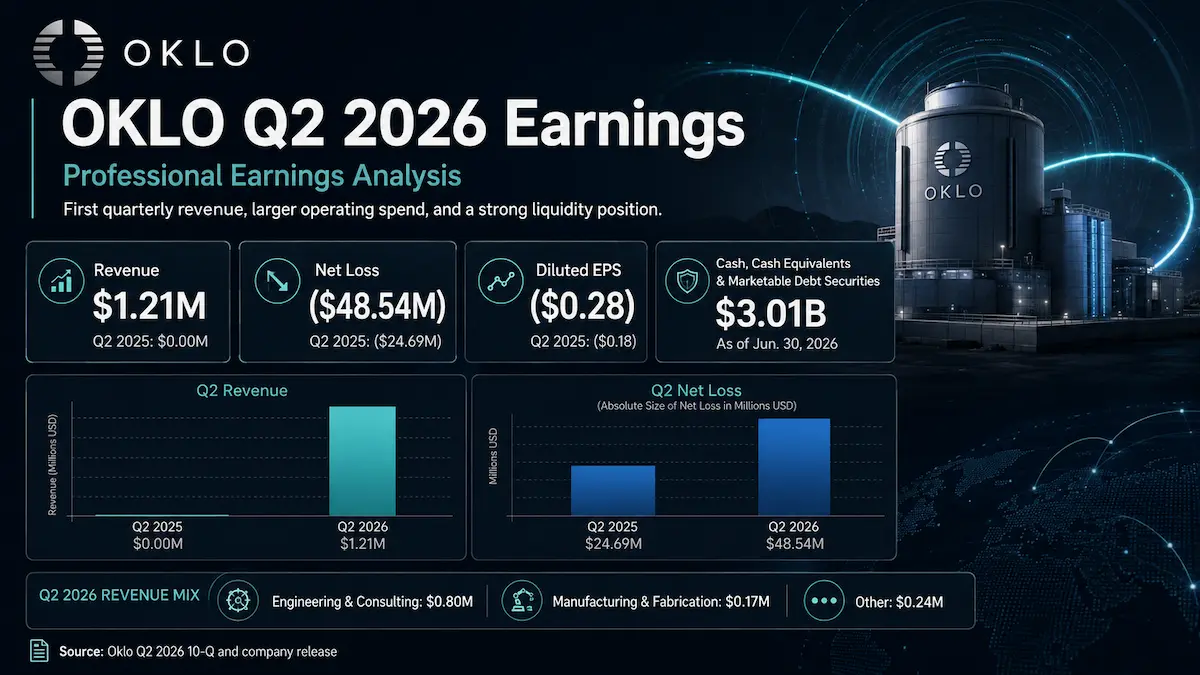
- Oklo reported Q2 2026 revenue of $1.210 million versus zero a year earlier. The company itself classifies the percentage change as not meaningful because the prior-year base was zero, and the revenue primarily came from the June 2026 acquisitions of ARMEC and Creative Engineers rather than Aurora electricity sales.
- GAAP basic and diluted EPS was -$0.28, versus a FactSet estimate of -$0.16. Revenue materially exceeded the $91.42 thousand FactSet estimate, but the quality of that beat matters more than its percentage magnitude because it was acquisition-led and remains immaterial relative to Oklo’s development spending.
- Operationally, the most important milestone was Groves reaching first criticality in early August after a little over 11 months from groundbreaking. That strengthens the execution case, but it does not establish Aurora’s commercial unit economics or eliminate first-of-a-kind licensing, fuel, interconnection and construction risk.
- Management raised 2026 cash-used-in-operations guidance to $120 million-$150 million from $80 million-$100 million and PP&E purchase guidance to $400 million-$500 million from $350 million-$450 million. The stated purpose is greater delivery assurance around the 2028 Aurora-INL target, not an earlier commercial date.
- At $44.49 per share as of the August 10, 2026 close, OKLO is still valued primarily on probability-weighted future project economics. The June 30 balance sheet provides substantial liquidity, but the equity base also expanded materially during the first half of 2026.
1. Core Earnings Breakdown
Revenue and Profitability Analysis
Oklo’s Q2 2026 financial statements mark a transition from a zero-revenue development company to a company with reported revenue, but investors should distinguish reported growth from operational commercialization. Revenue was $1.210 million versus zero in Q2 2025. Because the comparison starts from zero, a year-over-year growth percentage is mathematically uninformative; Oklo appropriately labels the change “NM,” or not meaningful.
The company has one operating and reportable segment, so it would be incorrect to present Power, Fuel and Isotopes as separate GAAP revenue segments. The useful Q2 mix is instead the company’s disclosed revenue by service stream:
- Engineering and consulting services: $800 thousand, or 66.1% of Q2 revenue, calculated as $0.800 million / $1.210 million. This is strategically useful because it monetizes specialist nuclear capabilities and customer relationships, but it should not be capitalized in a valuation model as evidence of Aurora power economics.
- Manufacturing and fabrication services: $168 thousand, or 13.9% of Q2 revenue, calculated as $0.168 million / $1.210 million. The more important implication is vertical integration and supply-chain capability, not the current revenue contribution.
- Other revenue: $242 thousand, or 20.0% of Q2 revenue, calculated as $0.242 million / $1.210 million. At this scale and disclosure level, it is too small and insufficiently visible to support a durable growth extrapolation.
The provenance of the revenue is critical. Oklo disclosed that Q2 revenue primarily resulted from acquisitions completed during the first half of 2026. ARMEC, acquired on June 4 for aggregate consideration of approximately $20.462 million, brings precision manufacturing and mechanical-engineering capabilities. Creative Engineers, acquired on June 15 for approximately $12.918 million, adds chemical-process engineering expertise in sodium and alkali-metal systems. The combined preliminary purchase consideration was $33.380 million. In other words, the first reported revenue is real, but it is predominantly inorganic and does not represent the start of Aurora power sales.
Cost of sales was $721 thousand. Gross profit was therefore $489 thousand and gross margin was 40.4%, calculated as ($1.210 million – $0.721 million) / $1.210 million; this is calculated from company-reported figures, not a company-presented non-GAAP metric. The margin may be useful for tracking the acquired service businesses, but it is not a proxy for future powerhouse-level margins.
The spending profile moved much faster than revenue. R&D expense rose 244.2% year over year to $39.474 million, while G&A increased 106.7% to $34.205 million. Total operating expenses reached $74.400 million and GAAP operating loss widened to $73.190 million from $28.015 million. The implied GAAP operating margin was approximately -6,048.8%, calculated as -$73.190 million / $1.210 million. That percentage is economically awkward precisely because Oklo remains a pre-commercial developer: a conventional margin framework is not yet an appropriate primary valuation tool.
GAAP net loss was $48.536 million, versus $24.685 million in Q2 2025, and GAAP basic and diluted loss per share was $0.28. Net interest and dividend income of $23.209 million materially softened the gap between operating loss and net loss. Oklo did not present an adjusted EPS or adjusted operating-margin reconciliation in its Q2 2026 Form 10-Q or quarterly presentation. Accordingly, the -$0.28 figure used here is GAAP EPS; third-party pages that label it “adjusted EPS” should be treated cautiously.
Expectations vs. Actual Results
- Revenue: $1.210 million actual versus $91.42 thousand FactSet estimate — ✅ Beat. The dollar beat was approximately $1.119 million, and actual revenue was about 13.2 times the estimate.
- GAAP diluted EPS: -$0.28 actual versus -$0.16 FactSet estimate — ❌ Miss by $0.12 per share.
- GAAP operating margin: approximately -6,048.8%, calculated from company-reported figures. A reliable consensus operating-margin estimate was not available and should not be invented; given the tiny revenue base, the metric is also not decision-useful in the way it would be for a mature industrial company.
- Q3 2026 company guidance: Oklo did not issue quarterly revenue, EPS or operating-margin guidance. For full-year 2026, management increased expected cash used in operating activities to $120 million-$150 million and expected cash purchases of PP&E to $400 million-$500 million.
The revenue beat was not caused by an earlier-than-expected Aurora monetization event. It came from newly acquired engineering, consulting, manufacturing and fabrication activities. That makes the beat useful as evidence that Oklo can acquire capabilities that also produce customer revenue, but it does not change the near-term cash-flow profile of the core Aurora deployment program.
The EPS miss has a different interpretation. R&D and G&A are scaling ahead of commercial power revenue because Oklo is hiring engineers and technical staff, paying outside engineering and consulting providers, acquiring capabilities and advancing first-of-a-kind assets. For Q2, the more investable question is not whether the company optimized quarterly EPS; it is whether incremental spending converts into higher probability of meeting licensing, fuel, procurement, interconnection, construction and customer milestones.
The market’s first reaction supports that interpretation. OKLO closed at $48.42 on Friday, August 7, up 14.77% from the prior session despite the EPS miss. The stock then fell 8.12% on Monday, August 10 to $44.49. Even after that retracement, it remained about 5.5% above the approximately $42.19 pre-earnings close on August 6. The two-day path matters: the market initially rewarded operational de-risking and first revenue, then partially repriced the magnitude of the execution premium.
It would be too simplistic to describe the Monday decline as “sell the news.” A more defensible interpretation is that the initial milestone-driven re-rating met a second-order valuation test: 2026 cash-use guidance increased, full Aurora-INL project-cost guidance remains undisclosed, the first commercial powerhouse is still targeted for 2028, and the current revenue base is far too small to anchor the equity value. This is an inference from the reported facts and price action, not a cause disclosed by the company.
Earnings Call Highlights
“Groves is being treated as proof of Oklo’s deployment organization, not merely as a reactor-physics milestone.”
💡 Reading Between the Lines: Management wants investors and customers to transfer part of the execution credibility earned at Groves to the broader platform: procurement, construction, commissioning, authorization and operations. That transfer deserves some valuation credit, but not a one-for-one read-through to a 75 MWe commercial Aurora project, which has different scale, licensing, grid and economic requirements.
“Higher 2026 spending is intended to protect the 2028 Aurora-INL schedule, not move it forward.”
💡 Reading Between the Lines: This is a classic first-of-a-kind capital-allocation trade-off: spend earlier on long-lead procurement, grid interconnection and project activities to reduce critical-path risk. The bullish interpretation is higher schedule confidence; the counterweight is that total Aurora-INL project cost is still being narrowed with Kiewit and has not yet been fully guided.
“Fuel supply is being diversified across EBR-II recovered material, plutonium pathways, Centrus HALEU and future recycling.”
💡 Reading Between the Lines: Fuel flexibility is becoming a strategic differentiator because advanced-reactor deployment can be constrained by HALEU availability. However, investors should probability-weight the pathways: the Centrus arrangement remains an LOI pending a definitive agreement, and government material allocations remain subject to final agreements and processes outside Oklo’s full control.
“The first isotope-business revenue is more likely to come from the Idaho lab in early 2027 than from Groves.”
💡 Reading Between the Lines: Groves criticality should not be modeled as an immediate commercial-revenue ramp. Management framed Groves primarily as an execution and operating-capability asset, while the nearer monetization route may be isotope recovery, refinement and customer offtake through the NRC-licensed Idaho laboratory.
“Customer prepayments and project-level capital are becoming part of the financing architecture.”
💡 Reading Between the Lines: Meta and Equinix customer funding illustrates a route to shift part of project financing away from parent-company equity. If this structure scales, it can improve corporate capital efficiency; until then, investors must balance that optionality against the material equity issuance already used to finance the platform.
2. Deep Business Insights
Hidden Metrics That Matter
Metric 1 — the balance sheet is reducing the optical severity of the income statement loss. For the first six months of 2026, Oklo reported an operating loss of $124.166 million and net interest and dividend income of $44.548 million. The latter offset approximately 35.9% of the operating loss, calculated as $44.548 million / $124.166 million; this is calculated from company-reported figures. The implication for earnings quality is important: the gap between operating loss and net loss is being supported in part by yield on a large pool of recently raised capital, not by operating leverage. That interest income is economically valuable, but it should not be mistaken for progress in the profitability of the nuclear platform.
Metric 2 — liquidity and dilution are two sides of the same capital-allocation decision. Class A shares outstanding increased from 160.514 million at December 31, 2025 to 185.090 million at June 30, 2026, a 15.3% increase calculated as (185.090 million / 160.514 million) – 1; this is calculated from company-reported figures. Over the same period, cash, cash equivalents and marketable debt securities reached $3.006 billion, and management said its 2026 ATM programs had generated $1.9 billion of capital by the end of Q2. The liquidity materially improves the company’s ability to fund first-of-a-kind work, acquisitions and long-lead procurement, but the hurdle for that capital is straightforward: the probability-weighted value created by de-risking future projects must exceed the per-share cost of dilution.
Why might customers choose Oklo? The core proposition is not simply a reactor design. Oklo plans to build, own and operate powerhouses and sell electricity and heat directly to customers, which can reduce the need for the customer to become a nuclear developer and operator. The company is also attempting to integrate fuel sourcing, fabrication, recycling, manufacturing and project execution. For hyperscalers and industrial customers, that integration can be attractive if it converts into a simpler contracting interface, better fuel certainty and faster deployment.
There is also a credibility effect from Groves. According to Oklo, the privately financed, privately sited facility moved from greenfield groundbreaking to first criticality in a little over 11 months, giving the company an operating proof point that many advanced-nuclear peers do not yet have. Still, customers ultimately need bankable power economics, schedule certainty and regulatory confidence. Groves strengthens the execution argument; it does not, by itself, prove the levelized cost or return profile of an Aurora fleet.
Industry Chain Reactions
- ✅ Benefit — Centrus Energy (NYSE: LEU): Oklo’s June 2026 LOI contemplates domestically produced HALEU for multiple years of fuel needs for up to five Aurora powerhouses, with deliveries expected to begin in 2029. If converted into a definitive agreement and supported by prepayments, it would add a visible advanced-reactor demand channel for Centrus. The caveat is material: timing, volume, pricing and prepayment terms remain subject to negotiation.
- ❌ Face Pressure — NuScale Power (NYSE: SMR): The pressure is more likely to be relative valuation and execution-narrative pressure than an immediate earnings impact. If capital markets increasingly reward advanced-nuclear developers for demonstrated construction, operating capability, customer-funded deployment structures and integrated fuel planning, peers with a different commercialization model may face a higher burden of proof. This is not a claim that Groves directly displaces NuScale projects; the technologies, project sizes and commercial pathways differ.
Valuation Framework and Key Risks
At the August 10, 2026 closing price of $44.49, conventional earnings multiples are not useful for OKLO. The company has no commercial Aurora power revenue, quarterly service revenue is only $1.210 million, and near-term losses are dominated by development activity. A price-to-sales multiple based on Q2 revenue would therefore create false precision.
A more useful anchor begins with liquidity. Using the June 30 share count of 185.090 million and the $44.49 share price produces an illustrative equity value of approximately $8.23 billion, calculated from company-reported share data and the current market price. June 30 cash, cash equivalents and marketable debt securities of $3.006 billion equal approximately $16.24 per June 30 share, or about 36.5% of the $44.49 stock price; both are calculated from company-reported figures. Subtracting that liquidity from the illustrative equity value leaves roughly $5.23 billion of value being assigned above cash and securities to operating capabilities, development assets and future project economics. This is a valuation bridge, not a formal enterprise-value calculation, because it uses the quarter-end share count and does not net every liability or post-quarter balance-sheet change.
The appropriate buy-side framework is therefore a probability-weighted project NAV or DCF rather than a near-term P/E. The model should separately value the Aurora-INL project, the 1.2 GW planned Meta-supported Ohio campus, additional customer deployments, fuel-cycle assets and isotope optionality. Each asset should be discounted for licensing, construction, interconnection, fuel, financing and customer-contract maturity. The valuation should rise when milestones reduce one of those probabilities and fall when capital requirements increase without a commensurate improvement in expected project cash flows.
The highest-impact risks after Q2 are:
- Aurora-INL first-of-a-kind economics remain incompletely disclosed. Management said it is still narrowing the total project cost with Kiewit, so investors cannot yet underwrite a mature project-level return with confidence.
- Cash requirements are moving higher. The 2026 operating-cash-use and PP&E ranges were both increased, and second-half spending is expected to be heavier.
- Equity dilution remains a real per-share risk. The stronger balance sheet reduces financing risk but does not make capital free.
- Commercial agreements have different levels of firmness. The Meta prepayment is meaningful, but several fuel and customer pathways are still LOIs, MOUs or other preliminary arrangements that must convert into definitive contracts.
- Regulatory, fuel and grid-interconnection timing can move independently of company execution. Management specifically identified PJM interconnection turnaround time as an important watch point, while government fuel allocations and definitive supply agreements also involve external counterparties.
The valuation case becomes materially stronger if Oklo can hold the 2028 Aurora-INL target while disclosing financeable project economics, convert more customer and fuel arrangements into binding contracts, use project-level or customer capital to reduce corporate-equity requirements, and establish isotope revenue without distracting from Aurora execution. Conversely, a slippage in the 2028 path or evidence that first-of-a-kind costs require materially more parent equity would directly challenge the current execution premium.
3. Key FAQs
Did OKLO beat Q2 2026 earnings expectations?
The answer is mixed. Revenue of $1.210 million materially exceeded the $91.42 thousand FactSet estimate, but GAAP diluted EPS of -$0.28 was $0.12 worse than the -$0.16 estimate. For investors, the revenue beat should be interpreted cautiously because the revenue primarily came from acquisitions rather than Aurora power sales. The EPS miss reflects a rapidly expanding development and technical spending base.
Why did OKLO stock rise after Q2 2026 earnings despite an EPS miss?
The immediate market reaction indicates that investors placed more weight on operational de-risking than on quarterly EPS. OKLO gained 14.77% on August 7 as the market absorbed first reported revenue, Groves first criticality, fuel diversification, the unchanged 2028 Aurora-INL target and the $3.0 billion liquidity position. The stock then fell 8.12% on August 10, suggesting that valuation, higher spending guidance and unresolved first-of-a-kind economics remained important constraints. The stock still closed roughly 5.5% above its pre-earnings August 6 level.
When will Oklo generate commercial nuclear power and isotope revenue?
Management continues to target 2028 for its first Aurora powerhouse. That is a target, not a guaranteed commercial start date, and remains exposed to supply-chain, construction, licensing and other execution risks. On isotopes, management said during the Q2 call that the first isotope-business revenue is more likely to come from the Idaho laboratory in the first part of 2027 than from Groves; Groves is expected to progress through additional operating and commissioning work before producing R&D quantities at a later stage.
Source methodology note: Oklo’s Investor Relations site publishes the official Q2 2026 webcast and presentation but, as of August 11, 2026, does not publish a verbatim company transcript. Management-call points in this article are accurate paraphrases sourced from a third-party transcript and cross-checked against Oklo’s official Q2 presentation, Form 10-Q and webcast event materials; the third-party transcript is not presented as an official company transcript.
Primary sources: Oklo Q2 2026 financial results press release, Oklo Investor Relations — Events & Presentations, Oklo Q2 2026 Form 10-Q, and FactSet consensus data as surfaced by TradingView.
Disclaimer: This article/chart is for educational and informational purposes only and does not constitute investment advice of any kind. Past performance is not indicative of future results. Investors should independently evaluate their own risks.