
⚡ Key Takeaways
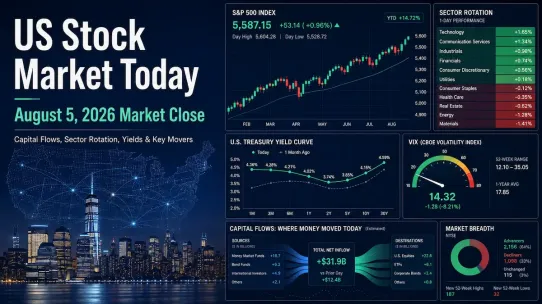
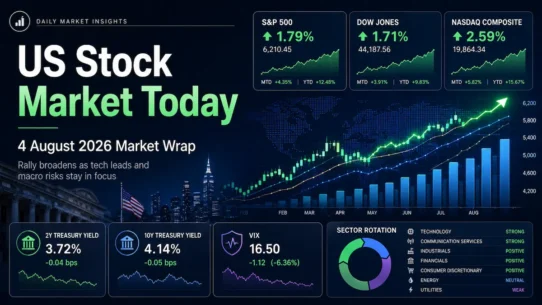
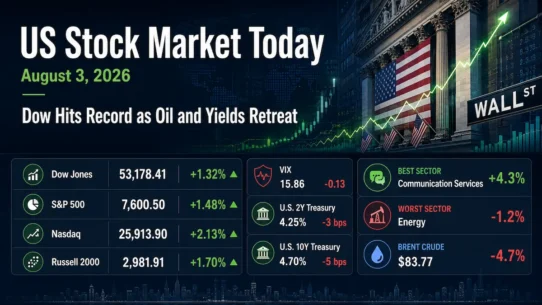
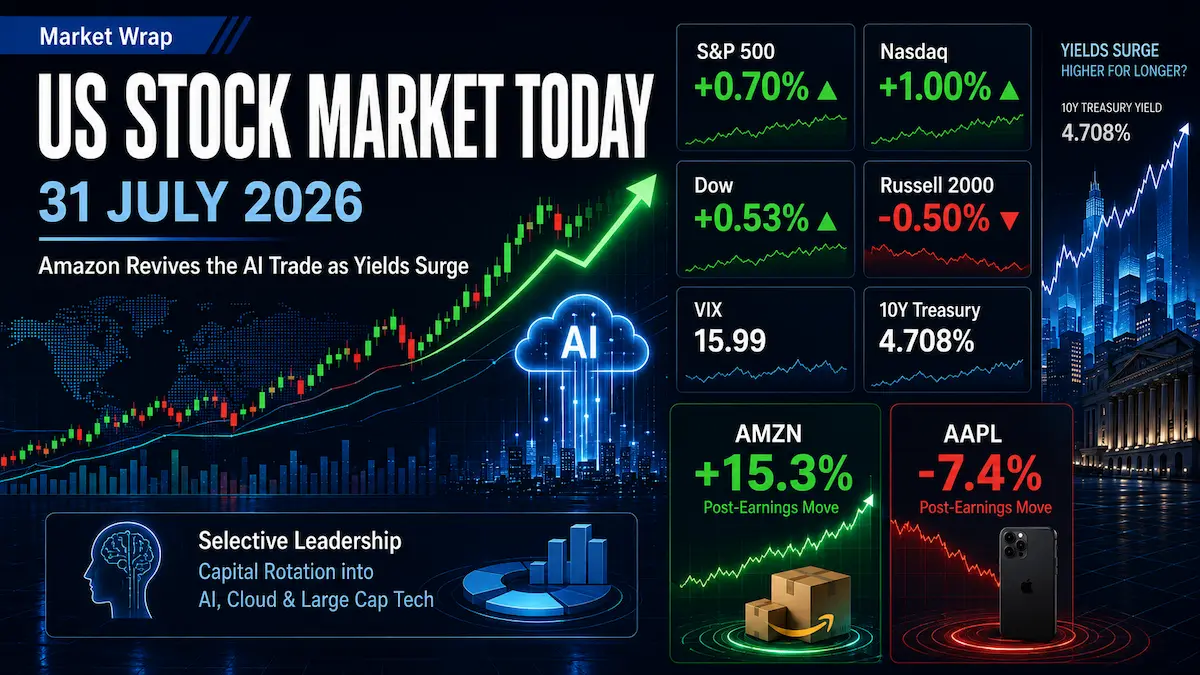
- The S&P 500 gained 0.70% to 7,489.72, the Nasdaq Composite rose 1.00% to 25,373.85, and the Dow advanced 0.53% to 52,485.03, while the Russell 2000 fell 0.50% to 2,931.34.
- Amazon’s 15.3% post-earnings surge powered the index rebound, but Apple’s 7.4% decline and negative market breadth showed that capital remained concentrated in a narrow group of mega-cap winners.
- A firmer 0.9% quarterly Employment Cost Index and hawkish Federal Reserve commentary lifted Treasury yields, even as the VIX fell 6.44% to 15.99.
1. Market Capital Flows
Consumer Discretionary was the strongest S&P 500 sector, rising about 6.1% as Amazon’s earnings-driven rally dominated the complex. Materials was the weakest sector, falling roughly 2.7%, with Linde’s post-earnings selloff adding to pressure from higher yields and renewed concern over cyclical demand. Information Technology slipped 0.54% as Apple’s decline offset strength elsewhere in the growth trade.
Capital-flow logic: Institutional money rewarded visible AI monetization rather than indiscriminate AI exposure. Amazon converted infrastructure spending into faster AWS growth and strong operating profitability, while Apple was penalized for a less convincing forward setup. With declining stocks outnumbering advancers by about 1.3 to 1 and small caps finishing lower, this was a mega-cap factor rally—not a broad-based risk-on move.
2. Decoding Market Movers
Amazon (AMZN): AI Spending Earns Market Validation
Amazon shares jumped 15.3% after its official Q2 2026 release showed net sales of $200.6 billion, up 20% year over year. AWS revenue increased 37% to $42.23 billion, while AWS operating margin reached 39.4%. Consolidated operating income was $27.46 billion, equivalent to a 13.7% operating margin.
Reported diluted EPS was $5.75, although investors should note that net income included $53.4 billion of non-operating pre-tax income, primarily related to Amazon’s investment in Anthropic. For Q3, management guided to revenue of $197 billion to $202 billion and operating income of $22.5 billion to $26.5 billion.
The commercial takeaway is that the market accepted Amazon’s heavy AI capital expenditure because AWS growth accelerated and margins remained robust. The principal risk is cash conversion: trailing-12-month free cash flow was negative $7.6 billion as infrastructure investment expanded.
Apple (AAPL): A Strong Quarter Meets a Higher Forward Bar
Apple fell 7.4% despite reporting fiscal Q3 2026 revenue of $109.4 billion, up 16%, diluted EPS of $2.02, and a 50.1% gross margin. The quality of the beat was less clean than the headline suggested: favorable tariff refunds added about two percentage points to gross margin and approximately $0.11 to EPS.
Management indicated September-quarter revenue growth of 9% to 11%, while processor and memory constraints linked to AI data-center demand complicated the supply and cost outlook. Investors therefore rotated away from a backward-looking earnings beat and focused on whether Apple can protect margins as component scarcity intensifies.
3. Macro Indicators & Market Outlook
The VIX closed at 15.99, down 6.44%, signaling lower near-term equity hedging demand. The rates market moved in the opposite direction: the two-year Treasury yield rose 5.4 basis points to 4.28%, while the 10-year yield climbed about 4.5 basis points to 4.708% after touching 4.747%, its highest level since January 2025.
The second-quarter Employment Cost Index increased 0.9% quarter over quarter and 3.4% year over year, reinforcing the view that labor-cost inflation remains sticky. Final July University of Michigan consumer sentiment improved to 55.2 from 49.5 in June, but stronger activity and hawkish Federal Reserve commentary also reduced confidence in near-term policy easing.
Upcoming Economic Data & Outlook:
- ISM Manufacturing PMI for July (August 3, 2026)
- U.S. Employment Situation for July (August 7, 2026)
Market Insights:
The index-level rally remains vulnerable because price leadership is narrow, Treasury yields are rising, and small-cap participation is weak. A sustained 10-year yield above the 4.75% area, a hotter-than-expected payroll report, renewed oil-driven inflation, or evidence that AI capital spending is not producing comparable revenue growth could trigger a reversal.
Trading & Investment Strategy:
Favor companies with verifiable earnings quality, pricing power, and a clear link between capital expenditure and incremental cash generation. Avoid treating a strong index close as confirmation of broad market health. Stagger entries, reduce exposure to names that have become technically extended after earnings gaps, and watch the equal-weighted S&P 500, Russell 2000, credit spreads, and Treasury yields for confirmation before increasing portfolio beta.
4. Key FAQs
Why did the US stock market rise on July 31, 2026?
The major indexes rose because Amazon’s 15.3% gain revived confidence in AI-driven cloud demand and had an outsized impact on market-cap-weighted benchmarks. However, weak breadth and a lower Russell 2000 showed that the advance was concentrated rather than market-wide.
Why did Amazon stock jump after AMZN Q2 2026 earnings?
Investors focused on 37% AWS revenue growth, a 39.4% AWS operating margin, and solid company-wide operating income. Those figures provided stronger evidence that Amazon’s AI infrastructure spending is translating into revenue and profit growth, although negative trailing free cash flow remains an important counterweight.
What could reverse the US stock market rally next week?
The main reversal risks are a further rise in Treasury yields, unexpectedly strong labor data that increases the probability of tighter monetary policy, renewed energy-price inflation, and disappointing forward commentary from large technology companies. Broader participation would be needed to make the rally more durable.
Data sources: Reuters market reporting; Cboe Global Markets; U.S. Bureau of Labor Statistics; University of Michigan Surveys of Consumers; Amazon Investor Relations; Apple Newsroom; Institute for Supply Management.
Disclaimer: This article is intended solely for the exchange of investment ideas and does not constitute investment advice of any kind.