
Key Takeaways
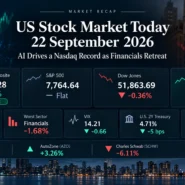
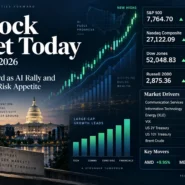
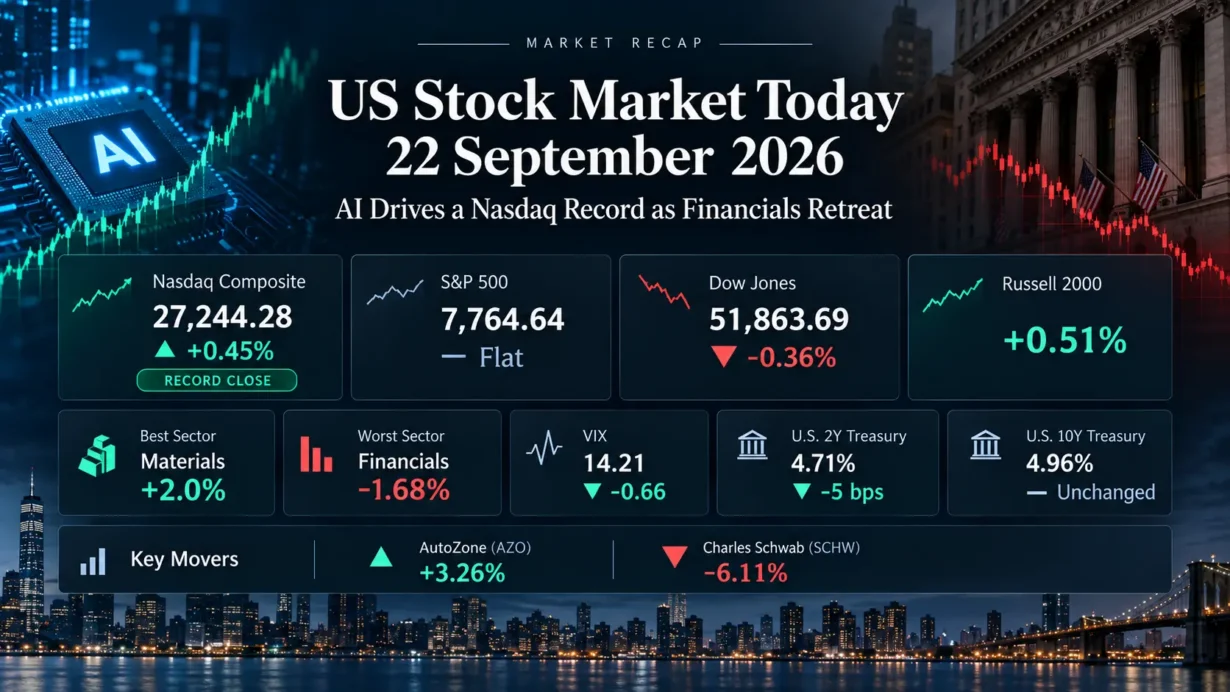
- The Nasdaq Composite advanced 0.45% to a second consecutive record close of 27,244.28, while the S&P 500 was virtually unchanged at 7,764.64 and the Dow lost 0.36% to 51,863.69. The Russell 2000 gained 0.51%, showing that participation extended beyond mega-cap technology.
- Materials led the S&P 500’s 11 sectors, rising approximately 2%, while financials fell 1.68%. AI-related semiconductor strength contrasted with pressure on banks and businesses facing potential AI-driven competition.
- AutoZone rose 3.26% after reporting fiscal fourth-quarter EPS of $56.05, although temporary tariff refunds materially supported its 53.3% gross margin. Charles Schwab dropped 6.11% amid a broader financial-sector selloff.
- The Cboe VIX declined 0.66 point to 14.21. Official U.S. Treasury rates showed the two-year yield down five basis points to 4.71% and the 10-year unchanged at 4.96%, against the backdrop of the Federal Reserve’s September 16 rate increase.
1. Market Capital Flows and Sector Rotation
September 22 was a rotation session rather than a market-wide surge. The Nasdaq’s 0.45% advance reflected continued demand for AI infrastructure, with Micron Technology up approximately 5% and Sandisk nearly 7%. Meanwhile, the Dow’s 0.36% loss and a virtually flat S&P 500 exposed weakness outside the chip trade. The Russell 2000’s independently reported 0.51% gain modestly exceeded the Nasdaq’s, complicating any claim that only mega-cap stocks attracted buying. Reuters’ closing report and the Associated Press’ final index figures provide the closing benchmarks.
Materials were the strongest S&P 500 sector, gaining approximately 2%; financials were the weakest, losing 1.68%, followed by communication services at approximately -0.8%. Six of 11 sectors declined. Cyclical leadership was therefore selective: materials advanced while financials sold off. Growth-oriented semiconductor shares outperformed, yet smaller companies and a traditional value-heavy materials sector also participated; financial-sector weakness prevented a uniform value-stock rebound. Falling oil prices eased one inflation-related concern but did not produce an across-the-board defensive rotation. Reuters’ cross-asset closing recap confirms the sector leadership.
Market breadth underscored that distinction. Roughly as many S&P 500 constituents advanced as declined, despite total U.S. exchange volume of 17.9 billion shares versus a 20-session average of 16.3 billion. The combination suggests unusually active two-way repositioning, not uniformly improving risk appetite. Source: Reuters, September 22 close.
Institutional Flow Insight: A plausible portfolio explanation is selective exposure to AI capital spending and economically sensitive materials alongside reduced exposure to intermediary businesses whose long-run fee economics could face AI competition. Lower two-year Treasury yields may also have offered some valuation relief, while still-elevated long-term rates constrained enthusiasm for duration-sensitive assets. These are interpretations of price action, not verified institutional fund-flow data. With quarter-end approaching, rebalancing and risk-budget adjustments could amplify dispersion, but the closing tape alone cannot establish that they occurred.
2. Decoding the Biggest Market Movers
AutoZone (AZO)
AutoZone closed at $2,894.73, up 3.26% in regular trading, after publishing fiscal fourth-quarter results for the 16 weeks ended August 29, 2026. Net sales rose 5.6% to $6.6 billion, GAAP diluted EPS increased to $56.05 from $48.71, and gross margin reached 53.3%, up 182 basis points. Constant-currency companywide same-store sales increased 1.5%, with domestic comps up 1.6%. The reported margin improvement requires qualification: tariff refunds contributed 145 basis points, and year-over-year noncash LIFO effects contributed another 105 basis points. Source: AutoZone’s September 22 earnings release. Source: regular-session closing quote.
Management’s fourth-quarter earnings-call transcript, cross-checked against its official webcast, identifies a $96 million tariff-refund benefit worth $4.43 per diluted share. Domestic commercial sales rose 8.6%, while do-it-yourself same-store sales fell 0.6%. The investment question for automotive aftermarket retailers is therefore whether commercial distribution gains and new-store productivity can sustain underlying earnings once one-time margin benefits normalize. AutoZone’s closing advance was smaller than gains cited in several intraday reports; the 3.26% figure is the regular-session result, not its intraday peak.
Charles Schwab (SCHW)
Schwab finished at $100.35, down 6.11%, as financials became the session’s weakest sector. Reuters linked the pressure on online brokers and other consumer-facing platforms partly to investors’ concern that increasingly capable AI agents could challenge existing customer relationships; bank shares also retreated. That is a competitive-risk narrative, not evidence that Schwab reported a new earnings shortfall or disclosed measurable customer losses on September 22. Source: Reuters’ closing account. Source: Schwab-hosted market quote.
The distinction matters because Schwab’s latest reported quarterly fundamentals were stronger than the stock’s one-day move might imply: its July 21 second-quarter release showed $7.072 billion in revenue, $1.54 in GAAP diluted EPS and a 51.9% GAAP pretax profit margin. Management also discussed investment in AI-enabled client tools on that quarter’s earnings call. Tuesday’s selloff therefore highlights uncertainty over the durability and valuation of brokerage economics, while the decline in major bank shares spread the pressure across the financial sector. Source: Schwab’s official second-quarter release.
3. Macro Indicators and Market Outlook
The official Cboe VIX closed at 14.21, down 0.66 point, or 4.44%, from 14.87. Lower option-implied S&P 500 volatility was consistent with an orderly, nearly unchanged broad index, even as individual sectors diverged sharply. It does not establish that investors abandoned downside hedges or that geopolitical risk disappeared.
According to the Treasury’s official daily par-yield series, the two-year yield fell from 4.76% on September 21 to 4.71% on September 22, while the 10-year held at 4.96%. The 10-year-minus-two-year spread consequently widened from 20 to 25 basis points. This official daily comparison is distinct from intraday bond quotes. Short-end easing may reflect a marginal repricing of the policy path, while a steady 10-year leaves longer-term inflation, growth and term-premium risks unresolved; one day’s movement cannot isolate those drivers. The Federal Reserve’s September 16 decision had raised its target range by 25 basis points to 3.75%–4.00%, keeping the policy backdrop restrictive.
Brent crude settled at $99.25 a barrel after briefly dropping below $98, according to the Associated Press. Relief from oil prices supported the rate-sensitive growth narrative, but continuing Middle East supply uncertainty left the inflation channel vulnerable to reversal.
Upcoming Economic Data & Catalysts:
- August New Residential Sales (Release date: September 24, 2026, 10:00 a.m. EDT): The U.S. Census Bureau’s official release calendar confirms the date. Sales, inventories and pricing will test housing demand under elevated mortgage rates and provide a read-through to homebuilders and other rate-sensitive cyclicals.
- August Advance Durable Goods Orders (Release date: September 25, 2026, 8:30 a.m. EDT): The Census Bureau’s scheduled release will help investors assess factory demand and business investment, with implications for industrial earnings and the growth-versus-inflation debate.
Separately, September’s U.S. flash manufacturing and services PMIs are scheduled for September 23, according to the published weekly economic calendar; their price and employment components warrant attention, although they are not included among the two government-calendar events listed above.
Market Insights: The session was neither a purely mega-cap rally nor a broad risk-on advance: semiconductor leadership and a modest small-cap gain coexisted with approximately even S&P 500 breadth, falling financials and lower implied volatility. A renewed rise in oil or 10-year yields, weaker breadth beneath further Nasdaq records, disappointing underlying margins or a shift in earnings revisions could interrupt that balance.
Trading & Investment Strategy: Treat the dispersion as a portfolio-construction issue. Keep single-theme and single-name exposures within predetermined risk limits; stage purchases rather than chase semiconductor gaps; and evaluate materials, financials and quality growth using normalized earnings rather than a single day’s return. For tactical positions, define invalidation levels and exit discipline before entry. Maintain liquidity for upcoming data and avoid assuming that low VIX readings eliminate event risk.
4. Key FAQs About the US Stock Market Today
Why did the US stock market move on September 22, 2026?
AI-related chip buying lifted the Nasdaq to a record, while potential AI competition and pressure on banks pulled financials lower. Softer oil prices and a five-basis-point decline in the official two-year Treasury yield provided some macroeconomic relief, leaving the S&P 500 essentially unchanged.
Which sectors performed best and worst in the US stock market on September 22, 2026?
S&P 500 materials led with an approximately 2% gain; financials fell the most, down 1.68%. Selective cyclical buying and concern about financial-sector business models produced divergent results rather than a uniform growth-to-value rotation.
What should investors watch after the US stock market close on September 22, 2026?
Monitor September 23 flash PMIs, the officially scheduled September 24 new-home-sales release and September 25 durable-goods report, alongside the two-year/10-year yield spread, oil prices, VIX and whether S&P 500 breadth improves relative to the Nasdaq. For company fundamentals, distinguish repeatable operating performance from AutoZone’s tariff-refund benefit and track any substantiated changes to brokerage customer economics.
Disclaimer: This article is intended solely for the exchange of investment ideas and does not constitute investment advice of any kind.