

Key Takeaways
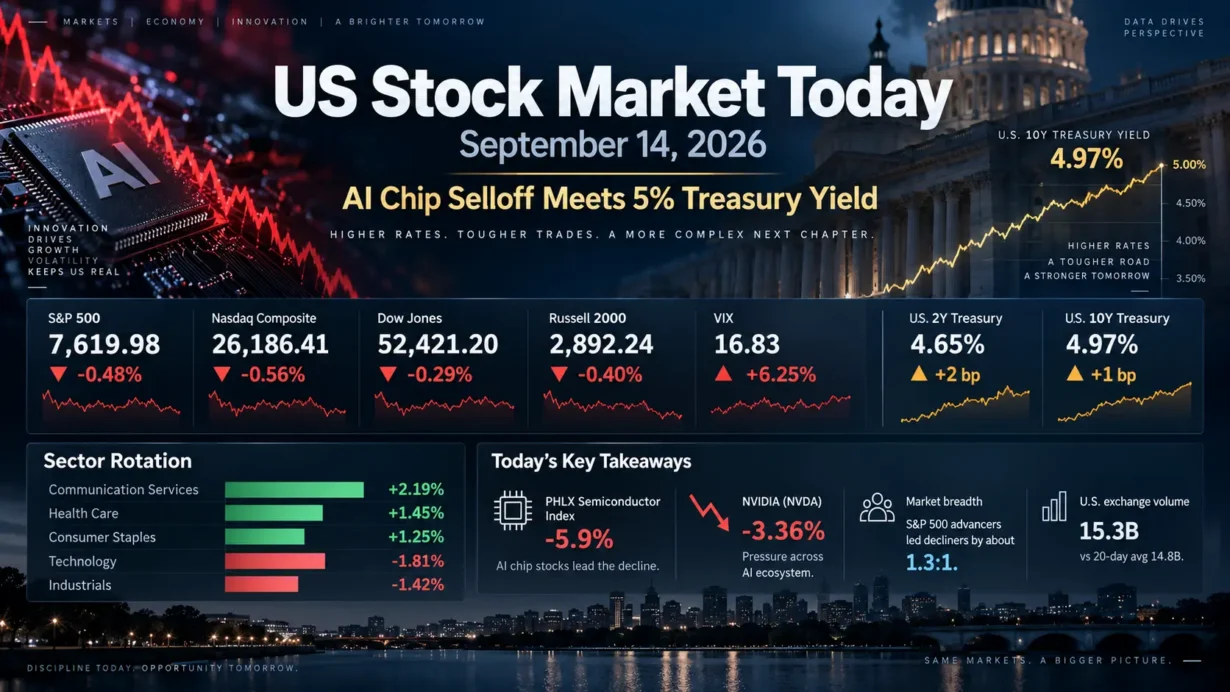
- The S&P 500 fell 0.48% to 7,619.98, the Nasdaq Composite lost 0.56% to 26,186.41, the Dow Jones Industrial Average declined 0.29% to 52,421.20, and the Russell 2000 slipped 0.40% to 2,892.24.
- AI-hardware risk was the principal index drag: the PHLX Semiconductor Index dropped 5.9% and NVIDIA fell 3.36% after leading AI executives called for slower development on safety grounds. Software and cybersecurity shares moved sharply higher, showing rotation within growth rather than a uniform technology liquidation.
- Market breadth was better than the headline indexes suggested. Advancers outnumbered decliners in the S&P 500 by about 1.3-to-1, while U.S. exchange volume reached 15.3 billion shares versus a 20-session average of 14.8 billion.
- Cboe’s VIX spot index ended at 16.83, up 0.99 points or 6.25%. U.S. Treasury official daily par yields were 4.65% for the 2-year and 4.97% for the 10-year, up 2 and 1 basis points, respectively, from September 11; the 10-year briefly traded above 5% intraday.
1. Market Capital Flows and Sector Rotation
Monday’s tape was weaker at the capitalization-weighted index level than it was underneath the surface. Eight of the 11 S&P 500 sectors declined, with Reuters/LSEG reporting the S&P 500 Information Technology sector down 1.68% and Industrials down 1.44%. Using the Select Sector SPDRs as directly tradable sector proxies, Communication Services led with XLC up 2.19%, followed by Health Care at 1.45% and Consumer Staples at 1.25%, while Technology was the weakest at minus 1.81% and Industrials fell 1.42%. The Russell 2000’s 0.40% decline was smaller than the S&P 500’s 0.48% loss and the Nasdaq’s 0.56% drop, so small caps modestly outperformed large-cap benchmarks even though they still finished lower.
The style message was not a clean growth-to-value rotation. Semiconductor and AI-infrastructure growth stocks were sold aggressively, but software, cybersecurity and communication-services platform companies rallied. Cyclicals were generally soft, with Industrials and Materials under pressure, while Health Care and Staples benefited from defensive demand. Utilities nevertheless fell 1.34% through the XLU proxy as higher bond yields challenged rate-sensitive equities. That cross-current makes “duration and AI-capex repricing” a better description than a simple growth-versus-value call.
Breadth argues against characterizing the session as indiscriminate risk-off. S&P 500 advancers exceeded decliners by roughly 1.3-to-1, and total U.S. exchange volume of 15.3 billion shares was above the prior 20-session average of 14.8 billion. At the same time, the Nasdaq recorded 202 new lows against 47 new highs, showing that stress remained meaningful beneath the growth-heavy index even as the broader S&P 500 participation picture was positive.
Institutional Flow Insight: The most defensible inference from the price action is intra-equity reallocation rather than wholesale de-risking. Positive S&P breadth, relative small-cap resilience and a VIX still below 20 are inconsistent with a market-wide liquidation. A near-5% 10-year Treasury yield raises the discount rate on long-duration cash flows, while the AI-safety debate introduced a separate terminal-demand risk for semiconductor and data-center spending. Those conditions can rationally encourage institutions to trim high-beta hardware exposure and rotate toward software, cybersecurity, cash-generative communication-services platforms and selected defensive earnings. This is an inference from market behavior, not confirmed fund-flow data. September 14 was also mid-month rather than a month- or quarter-start rebalance date, so calendar rebalancing is unlikely to be the primary explanation.
2. Decoding the Biggest Market Movers:
NVIDIA (NVDA)
NVIDIA closed at $210.96, down 3.36% in the regular session. The immediate catalyst was macro-thematic rather than a new NVIDIA earnings release: calls from leading AI executives to slow AI development on safety grounds raised concern that the pace of future model training, data-center construction and accelerator demand could be reassessed. That distinction matters because NVIDIA’s latest official operating data remain exceptionally strong. In its August 26 Q2 FY2027 release, the company reported revenue of $96.221 billion, up 106% year over year; Data Center revenue was $89.0 billion, up 117%; GAAP gross margin was 75.0%; and GAAP diluted EPS was $2.46. Management guided Q3 FY2027 revenue to $108.0 billion, plus or minus 2%, with GAAP and non-GAAP gross margin of 74.0%, plus or minus 50 basis points. The official earnings-call transcript also reiterated that the Q3 outlook assumes no Data Center compute revenue from China.
The investment implication is that Monday’s selloff was primarily a repricing of long-duration AI-capex, policy and safety risk against a still-strong current earnings base, not evidence that NVIDIA had reported a deterioration in demand. The PHLX Semiconductor Index fell 5.9%, while Micron lost more than 5% and Broadcom and AMD each fell more than 4%, making the move a sector-level valuation and narrative shock. Because semiconductor leaders carry large weights in major benchmarks, that concentration was sufficient to pull the Nasdaq and S&P 500 lower even with positive S&P breadth.
Bank of America (BAC)
Bank of America closed at $59.47, down 5.14%, after CEO Brian Moynihan spoke at the Barclays Global Financial Services Conference, an event listed on the bank’s Investor Relations calendar. Moynihan said third-quarter investment-banking fees were expected to decline by at least 10% year over year, with roughly $1.6 billion to $1.8 billion indicated versus about $2.0 billion in the year-earlier quarter, while sales and trading revenue was expected to be approximately flat year over year. The message represented a sharp deceleration from the latest reported quarter: Bank of America’s official Q2 2026 release showed $31.6 billion of revenue, $9.1 billion of net income, $1.21 of diluted EPS and 17.0% return on tangible common equity. Q2 investment-banking fees rose 50% year over year and sales-and-trading revenue rose 33%. The bank’s official Q2 earnings page also provides its webcast transcript alongside the earnings release, presentation and SEC filing.
The market reaction was therefore best read as a reset in forward fee visibility rather than a balance-sheet or credit event. Bank of America’s downgrade in near-term capital-markets momentum also weighed on large-bank sentiment, but the Financial Select Sector SPDR fell only 0.38%, far less than BAC itself. That divergence suggests the market treated the warning as company-specific earnings-mix risk with a broader read-through for investment-banking expectations, not as evidence of systemic financial-sector stress.
Together, NVIDIA and Bank of America illustrate the day’s two most important equity repricing channels: uncertainty over the duration of AI infrastructure spending and weaker visibility into high-margin capital-markets fees. Yet the simultaneous strength in software, cybersecurity, communication services and selected defensives explains why the cap-weighted indexes fell while S&P 500 breadth remained positive.
3. Macro Indicators and Market Outlook
Cboe’s official September 14 VIX spot reading was 16.83, up 0.99 points or 6.25% from the prior close. The rise was directionally consistent with lower equity indexes and greater demand for near-term protection ahead of the Federal Reserve decision, but the absolute level remained below the 20 area commonly associated with a more pronounced volatility regime. The combination of a higher VIX and positive S&P breadth is consistent with concentrated event hedging and index-level risk management rather than outright market panic.
The U.S. Treasury’s official daily par yield curve showed the 2-year yield at 4.65% on September 14, up 2 basis points from 4.63% on September 11, while the 10-year yield rose 1 basis point to 4.97% from 4.96%. The 10-year briefly exceeded 5% intraday for the first time since 2023 before retreating. With the front end rising slightly more than the long end, the 2s10s spread narrowed by about 1 basis point to roughly 32 basis points. That modest bear-flattening is consistent with renewed policy sensitivity at the front end, while the still-elevated long end reflects a mix of inflation risk, resilient nominal growth, heavy public and corporate borrowing and term-premium concerns. A single day’s yield move should not be interpreted as a certain Federal Reserve rate path.
Inflation and energy remained relevant to the equity rotation. The Bureau of Labor Statistics reported on September 11 that August CPI rose 0.4% month over month and 3.4% year over year, while core CPI rose 0.3% on the month and 2.4% over 12 months. Brent crude then settled 1.0% higher on September 14 at $105.68 a barrel amid renewed concern over Middle East supply disruptions. Higher energy prices can pressure margins and inflation expectations simultaneously, helping explain why bond yields remained a constraint on equity duration even as some defensive sectors gained.
Upcoming Economic Data & Catalysts:
- Advance Monthly Sales for Retail and Food Services, August 2026 (Release date: September 16, 2026): The Census Bureau is scheduled to release the report at 8:30 a.m. ET. Investors will use the data to assess the resilience of household demand and the balance between growth and inflation risk, both of which can affect Treasury yields and earnings expectations.
- Federal Open Market Committee Decision and Press Conference (Release date: September 16, 2026): The Federal Reserve’s two-day meeting runs September 15-16, with the policy statement due at 2:00 p.m. ET and the press conference at 2:30 p.m. ET. The rate decision, policy language and updated economic projections will be central to the market’s pricing of the policy path and the term structure of rates.
Only officially scheduled post-September-14 catalysts are listed above; neither item had been released at Monday’s close.
Market Insights:
The September 14 decline was not a broad collapse in risk appetite. Positive S&P breadth, modest Russell 2000 relative resilience and strength in communication services, software and defensives point to a concentrated drawdown led by semiconductor and AI-infrastructure exposure, with additional pressure from large banks. The signal would become more concerning if the 10-year yield were to sustain a move materially above 5%, breadth were to turn decisively negative, earnings estimates were cut across sectors, the FOMC delivered a policy surprise, or the VIX established a sustained break above 20. Conversely, stabilization in yields without deterioration in earnings revisions would reduce one of the key valuation headwinds. These are conditional risk markers, not forecasts.
Trading & Investment Strategy:
Risk management should take precedence over chasing the day’s largest moves. Investors with strategic exposure to AI hardware can consider staged position sizing rather than adding all at once before a major policy catalyst, while software and cybersecurity gains should also be treated cautiously after sharp one-day repricing. Sector selection should emphasize earnings visibility, balance-sheet quality and sensitivity to rates: Health Care and Staples offered defensive characteristics on Monday, while Utilities demonstrated that not all defensives are insulated from higher yields. For shorter-horizon positions, define thesis-invalidating levels and stop-loss parameters before entry, keep position sizes consistent with realized volatility, and avoid using leverage to compensate for uncertainty around the FOMC and long-end yields.
4. Key FAQs About the US Stock Market Today
Why did the US stock market move on September 14, 2026?
U.S. stocks fell mainly because AI-safety calls triggered a sharp semiconductor selloff, the 10-year Treasury yield briefly moved above 5%, and higher oil prices kept inflation and Federal Reserve policy risk in focus. Bank of America’s weaker third-quarter investment-banking fee outlook added pressure to financials. The decline was concentrated rather than uniform, as S&P 500 breadth remained positive and software, cybersecurity and communication-services shares outperformed.
Which sectors performed best and worst in the US stock market on September 14, 2026?
Communication Services was the strongest major sector theme, while Technology was the weakest. As investable proxies, XLC rose 2.19% and XLK fell 1.81%; Health Care gained 1.45% and Consumer Staples 1.25%, while Industrials lost 1.42%. Reuters/LSEG’s underlying S&P 500 sector data independently showed Information Technology down 1.68% and Industrials down 1.44%. The rotation reflected strength in platform, software and defensive earnings against heavy semiconductor selling and pressure from higher yields.
What should investors watch after the US stock market close on September 14, 2026?
The next major checkpoints are August retail sales at 8:30 a.m. ET on September 16 and the FOMC decision at 2:00 p.m. ET the same day. Investors should also monitor whether the 10-year Treasury can remain below or re-establish itself above 5%, whether positive S&P breadth persists, whether VIX moves into a sustained higher-volatility regime, and whether AI-hardware companies or their major customers alter capital-spending commentary. None of those signals guarantees the next market direction, but each can materially change risk premia and sector leadership.
Disclaimer: This article is intended solely for the exchange of investment ideas and does not constitute investment advice of any kind.