



Key Takeaways
- Stanley Druckenmiller’s central warning is that the U.S. Treasury risks confusing liquidity management with price management after doubling long-end buyback operations from $2 billion to at least $4 billion per operation.
- His bigger point is not about a single buyback program. It is about preserving the information content of long-term Treasury yields, which he views as the market’s most important fiscal discipline mechanism.
- The initial bond rally after the August 19 announcement quickly faded, reinforcing his argument that technical intervention cannot sustainably overpower deficit, inflation and supply fundamentals.
- For investors, the most important signal is the long end of the yield curve: persistently high 20- and 30-year yields can pressure rate-sensitive equities while supporting hedges linked to fiscal credibility and currency debasement concerns.
- The practical portfolio question is no longer simply “when will rates fall?” but “what is causing rates to fall?” A decline driven by credible fiscal repair is fundamentally different from one driven by temporary official support.
1. Reconstructing the Core Thesis
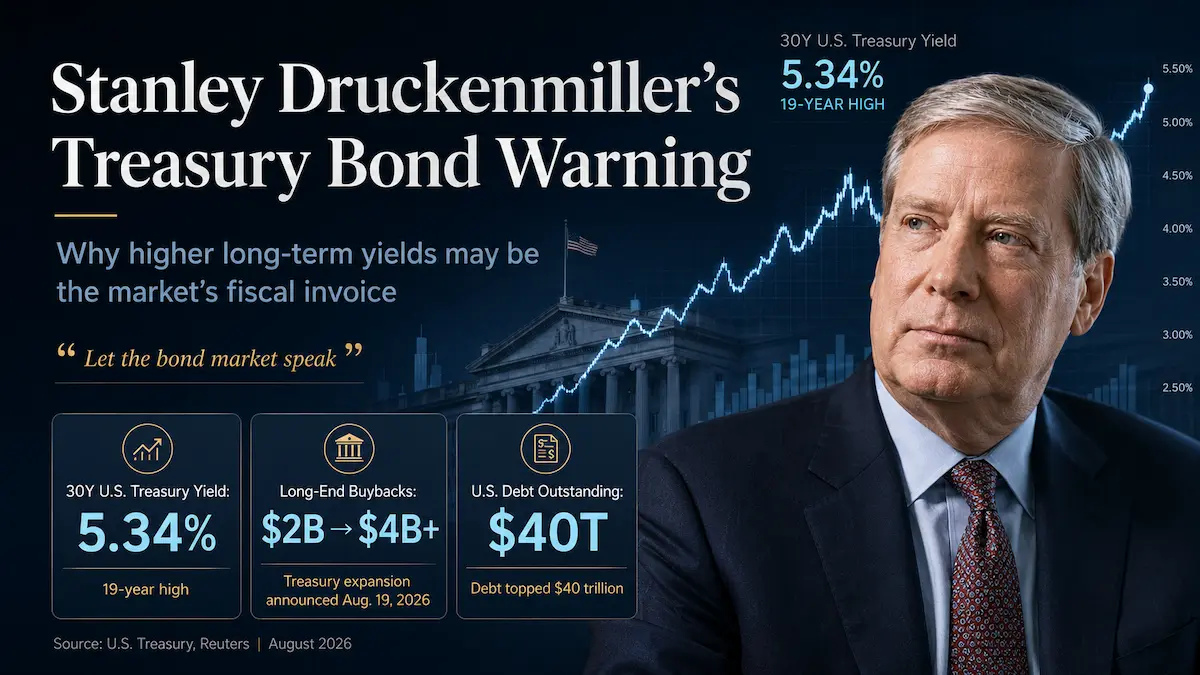
Among the most consequential Wall Street interventions of the past week, Stanley Druckenmiller’s August 24 public critique of the U.S. Treasury stands out for one reason: it attacks the policy mechanism now sitting directly between fiscal stress and asset prices. The legendary macro investor argued that the Treasury’s decision to expand long-dated bond buybacks risks masking, rather than solving, the market’s message on U.S. borrowing costs. His remarks landed only days after the Treasury officially doubled the maximum size of buybacks for 10- to 30-year nominal securities from $2 billion to at least $4 billion per operation, effective September 9 through November 4.
“The long-term Treasury yield is the most important price in the world.”
The commercial logic behind this statement is straightforward but profound. The long end of the Treasury curve is not merely a government funding rate. It is a global discount-rate anchor for mortgages, corporate debt, infrastructure, private equity valuations, real estate capitalization rates and long-duration equities. When the 30-year yield rises, it is often telling investors that the market demands more compensation for inflation, fiscal supply, policy uncertainty or term risk. Suppressing that signal may lower borrowing costs temporarily, but it can also delay the policy adjustments needed to improve the underlying fundamentals.
Treasury buybacks risk becoming “price management,” not liquidity management
Treasury’s official rationale is liquidity support in longer-dated nominal securities. Druckenmiller’s objection is that the timing matters. The expansion was announced after the 30-year Treasury yield had climbed to its highest level since 2007, creating the appearance that officials were reacting to the level of yields rather than to a breakdown in market functioning. That distinction is critical. Liquidity operations repair trading mechanics; price management attempts to influence the clearing price itself. Investors price those two regimes very differently.
“If the 30-year must trade at 5.5% to clear, that isn’t a crisis. It is an invoice.”
This is the most investable line in Druckenmiller’s argument. A high long-bond yield can be painful, but pain is not the same thing as dysfunction. If investors demand a materially higher return to absorb heavy Treasury issuance, large fiscal deficits and inflation risk, the yield is functioning as a price discovery mechanism. The implication is that policymakers should address the primary deficit and debt trajectory rather than treat every rise in long-term yields as a market failure requiring intervention.
Technical support cannot permanently beat fiscal fundamentals
The market response strengthens this point. The August 19 buyback announcement initially pushed long-dated yields lower, but much of the move reversed quickly. That is exactly the pattern investors should expect when a policy tool changes near-term demand for bonds without changing the expected path of deficits, inflation or future issuance. In other words, the intervention can alter the tape before it alters the thesis.
The real risk is credibility, not just yield volatility
Druckenmiller’s deeper warning is institutional. U.S. Treasuries occupy a privileged position because investors broadly trust the market’s liquidity, rule framework and price discovery. If repeated interventions are perceived as attempts to defend politically desirable yield levels, the required term premium could rise rather than fall. That would be an adverse feedback loop: efforts to suppress borrowing costs could eventually make investors demand more compensation for holding long-duration sovereign risk.
2. Industry Chain and Sector Impact
Potential beneficiary: gold miners, with Newmont (NYSE: NEM) as a liquid proxy
Druckenmiller did not explicitly recommend gold or Newmont in this latest intervention, so this is a portfolio inference rather than a direct stock call. The logic is that doubts about fiscal discipline, policy credibility and real purchasing power tend to strengthen demand for non-sovereign stores of value. Gold rallied toward three-month highs as the bond-market debate intensified, illustrating how quickly investors can rotate from nominal duration into hard-asset hedges when they interpret official bond support as a form of financial repression or debasement risk. For Newmont, the transmission channel is higher realized gold prices against a relatively sticky cost base, which can expand mine-level margins and free cash flow if the bullion move is sustained.
Potential pressure: long-duration REITs such as American Tower (NYSE: AMT) and Prologis (NYSE: PLD)
Persistently elevated long-end Treasury yields raise the opportunity cost of owning yield-oriented equities and can pressure real estate valuations through higher capitalization rates and refinancing costs. High-quality REITs are not automatically bearish simply because yields rise, but their valuation multiples become harder to defend when investors can earn materially higher risk-free returns in long-dated Treasuries. The key distinction is whether yields are rising because growth is accelerating or because fiscal and term-premium risk is rising. Druckenmiller’s warning is focused on the latter, which is the less constructive setup for rate-sensitive balance sheets.
3. Practical Investor Strategy
1) Trade the cause of the yield move, not the direction alone
A rally in long Treasuries after an official buyback announcement is not equivalent to a rally driven by lower inflation, slower nominal growth or credible fiscal consolidation. Investors should separate policy-induced duration rallies from fundamental duration rallies. If yields fall while inflation expectations, fiscal issuance and the deficit outlook remain sticky, the move deserves a lower confidence score and a tighter risk budget.
2) Keep duration exposure conditional until fiscal credibility improves
Investors do not need to make an all-or-nothing call on bonds. A more robust framework is to keep core liquidity in short-duration instruments while adding long-duration exposure only when the macro evidence improves. The bullish confirmation would be a sustained decline in long yields accompanied by softer inflation, lower term premium, improved auction demand and a credible fiscal path—not merely larger Treasury buybacks.
3) Use the 30-year yield as a cross-asset risk trigger
Druckenmiller’s framework turns the long bond into a practical portfolio dashboard. If the 30-year yield continues to rise despite expanded buybacks, investors should assume the market is demanding a higher fiscal risk premium and stress-test long-duration equities, leveraged real estate and highly indebted companies. If the long end stabilizes because fiscal expectations genuinely improve, the opposite rotation becomes more attractive: duration, REITs and other rate-sensitive assets can re-rate quickly once the discount-rate pressure eases.
4. Frequently Asked Questions
What did Stanley Druckenmiller say about U.S. Treasury bond buybacks in August 2026?
Druckenmiller argued that expanding long-dated Treasury buybacks after a surge in yields risks looking like price management rather than ordinary liquidity support. His central objection is that higher long-term yields are carrying information about fiscal deficits, debt supply and investor confidence, and that policymakers should address those fundamentals instead of attempting to mute the market signal.
Why does Stanley Druckenmiller call the long-term Treasury yield the most important price in the world?
Because the long-term Treasury rate feeds directly into the discount rate used across global finance. It influences mortgage costs, corporate borrowing, real estate capitalization rates, private-market valuations and the present value of future corporate earnings. A structurally higher long yield can therefore compress valuations across multiple asset classes even if the Federal Reserve is not raising short-term policy rates.
Which stocks or sectors could be affected if long-term U.S. Treasury yields stay high?
Rate-sensitive REITs and other long-duration equities may face valuation pressure if long yields remain elevated because of fiscal risk and term premium. Conversely, gold-linked equities such as Newmont can benefit if investors increasingly seek hedges against fiscal credibility concerns, inflation risk or currency debasement. These are scenario exposures, not guarantees, and company-specific fundamentals still matter.
Source: Stanley Druckenmiller’s “Let the Bond Market Speak”, Reuters’ August 25, 2026 coverage, and the U.S. Treasury’s August 19, 2026 buyback announcement.
Disclaimer: This article is for informational purposes only and does not constitute investment advice.