




Key Takeaways
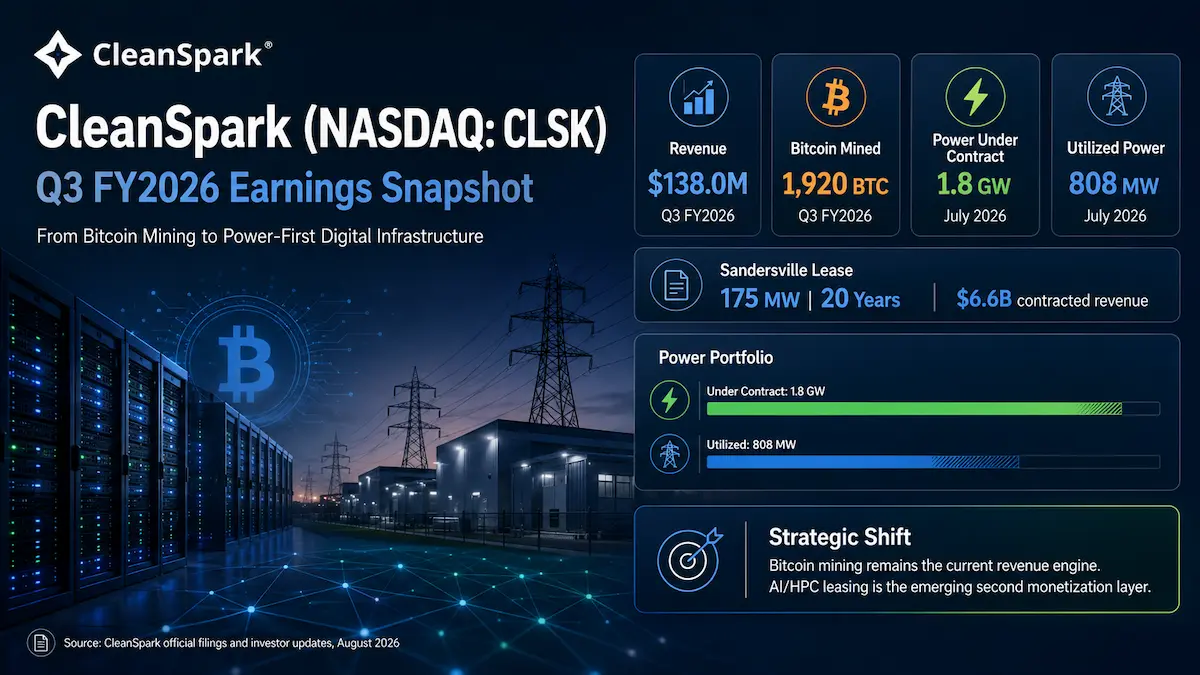
- CleanSpark’s current revenue engine remains Bitcoin mining. Fiscal Q3 2026 revenue was $138.0 million, entirely reported as Bitcoin mining revenue, while AI/HPC had generated no revenue as of June 30, 2026.
- The company’s most important corporate gene is not Bitcoin itself but the ability to acquire, energize, operate and reallocate scarce power infrastructure. Bitcoin can monetize power immediately; AI/HPC leases can potentially monetize the same power with longer contractual duration and lower commodity exposure.
- The strongest potential moat is a cost-and-infrastructure advantage built around grid-connected power, self-operated data centers, development expertise and site control. CleanSpark reported roughly 1.8 GW of contracted power by July 2026, but scale alone should not be confused with a durable moat.
- The July 2026 Sandersville transaction is the clearest proof point of the strategy: a 175 MW critical IT load, 20-year triple-net lease with approximately $6.6 billion of expected contract value and annual escalators. However, deliveries are not expected to begin until Q4 2027, and the project still carries financing, construction and delivery risk.
- The principal risks are Bitcoin price and network competition, heavy miner depreciation, large future data-center capital requirements, project execution, leverage and tenant concentration. CleanSpark has validated one major AI/HPC lease, not yet a diversified leasing platform.
1. Business Model Breakdown
Bitcoin mining: converting electricity into a globally priced digital commodity
The legacy CleanSpark business model is economically straightforward but operationally demanding. The company buys or controls data-center capacity, installs specialized ASIC mining machines, purchases electricity and contributes computing power to a mining pool. In return, it receives Bitcoin rewards based largely on its share of contributed hashrate. Revenue is therefore driven by two variables that management cannot fully control: the quantity of Bitcoin earned and the market price of Bitcoin when revenue is recognized.
For the three months ended June 30, 2026, CleanSpark generated $138.0 million in Bitcoin mining revenue. It mined approximately 1,920 Bitcoin net of pool fees at an average recognized price of about $71,881 per Bitcoin. The company’s average hashrate in June was 42.6 EH/s, equal to roughly 4.36% of global network hashrate at quarter-end. The mining pool relationship itself does not create meaningful customer lock-in: CleanSpark disclosed that it contributes all computing power to a single pool operator, Foundry, under a contract terminable at any time by either party.
The key economic variable is power. In fiscal Q3 2026, energy expense at owned facilities was approximately $85.3 million, or 61.8% of Bitcoin mining revenue, with an average power price of about $0.053 per kWh. Direct energy cost per Bitcoin was approximately $44,317, while total direct cost including miner depreciation was approximately $96,277 per Bitcoin. That figure exceeded the quarter’s average revenue per Bitcoin mined. The implication is important: even a mining operation with competitive electricity and efficient machines can show positive cash contribution before depreciation while still consuming substantial economic capital through rapid hardware obsolescence.
This is why Bitcoin mining should be viewed as a high-fixed-cost commodity conversion business rather than a software-like margin model. There is no recurring subscription revenue, no proprietary protocol toll and no structural pricing power over Bitcoin. CleanSpark can outperform primarily through lower power cost, better uptime, higher fleet efficiency, disciplined machine procurement, curtailment decisions and superior capital allocation.
AI/HPC infrastructure: monetizing power through long-duration leases
The emerging business model changes the revenue architecture. Instead of using every available megawatt to produce Bitcoin, CleanSpark is beginning to develop AI and HPC data-center infrastructure for third-party tenants. The company states that these arrangements can provide data-center space, power, environmental controls, physical security and connectivity. In July 2026, CleanSpark signed its first major infrastructure lease at Sandersville, Georgia, with an undisclosed leading global technology company.
The Sandersville lease covers 175 MW of critical IT load for an initial 20-year term, with two five-year extension options. CleanSpark disclosed approximately $6.6 billion of expected contract value over the initial term, annual escalators and approximately $11.6 billion of expected contract value if both extensions are exercised. It also described the structure as a true triple-net lease, meaning the tenant is responsible for the operating costs, charges, indemnities and expenses associated with the leased premises. Management estimates average annual NOI contribution at roughly $330 million over the initial term, with a contribution margin near 100%.
Those economics are strategically attractive because they replace a portion of variable, Bitcoin-linked revenue with long-duration contracted infrastructure cash flow. They are not yet realized economics. Deliveries are expected to begin in Q4 2027, and the company must still finance, construct and deliver the project. Management has estimated landlord project costs of approximately $10 million to $12 million per MW of critical IT load. Applied to 175 MW, that implies roughly $1.75 billion to $2.10 billion of landlord project cost before considering the exact timing of spend and financing structure. Compared with approximately $330 million of average annual NOI contribution, the headline development economics appear attractive, but the realized return will depend on construction cost, debt terms, delivery timing, escalators and any rent abatements.
The platform strategy: power first, workload second
CleanSpark’s platform strategy is best described as power-first compute infrastructure. The company acquires or controls land, utility relationships, interconnection capacity and data-center sites; it then chooses how to monetize that capacity. Bitcoin mining can serve as a relatively fast monetization mechanism because CleanSpark controls its own mining fleet. AI/HPC leasing can potentially produce longer-duration and more financeable cash flows when a suitable tenant is secured.
The Sandersville conversion illustrates the logic. CleanSpark has stated that Bitcoin mining at the site will continue until the AI lease commences, after which power will be diverted to the AI campus and mining activity will cease, with the existing mining operation expected to be fully decommissioned during fiscal 2028. In other words, management is treating Bitcoin hashrate as one workload competing for scarce megawatts rather than as an untouchable corporate identity. The objective is to maximize economic output per unit of power and invested capital.
This is also visible in Texas. By July 2026, the company’s Texas portfolio totaled 718 acres with up to 885 MW of secured and planned power capacity: roughly 285 MW at the Sealy/Austin County campus and an initial 300 MW at Brazoria with potential expansion to 600 MW. The same technology tenant that signed Sandersville entered an exclusivity arrangement covering the Texas portfolio. That is strategically meaningful, but it should not be mischaracterized as contracted backlog. The official disclosure supports an exclusivity arrangement and letter of intent, not a completed long-term lease for Texas.
Capital allocation as part of the model
CleanSpark also operates an increasingly complex balance-sheet strategy. It held 13,931 Bitcoin as of July 31, 2026, while using a mix of spot sales, option exercises and collateralized financing tools to manage liquidity. In November 2025, the company issued $1.15 billion of 0.00% convertible senior notes due 2032, using part of the proceeds for a $460 million share repurchase and allocating the remainder toward land, power, data-center development, repayment of Bitcoin-backed credit balances and general corporate purposes.
This capital-market access is strategically useful because large AI data-center projects require billions of dollars of upfront investment. However, financing capacity is not the same as free capital. As of June 30, 2026, CleanSpark reported approximately $1.8 billion of long-term debt and only $0.8 billion of stockholders’ equity. The company’s future economics therefore depend not only on attractive project-level returns, but also on whether those returns remain comfortably above its cost of capital after leverage, dilution and execution risk.
2. Deep Dive into Economic Moats
Applying Buffett-style moat analysis requires separating durable economic advantages from simple scale, growth or market enthusiasm. CleanSpark does not currently possess a classic software-style moat. Its product is not protected by network effects, its mining output is fungible, and its brand does not give it pricing power over Bitcoin. The strongest case rests on cost advantages and scarce infrastructure, with an emerging layer of contractual switching costs in AI/HPC.
Intangible Assets: useful capabilities, but not yet a dominant moat
CleanSpark has accumulated practical expertise in power procurement, site development, construction, utility coordination, mining operations and fleet optimization. It also has operating history across Georgia, Tennessee, Mississippi and Wyoming, plus development positions in Texas and South Dakota. These capabilities matter because large-load power projects require more than buying land; they require interconnection work, permits, equipment procurement, utility negotiations and credible execution.
However, these capabilities should not be overstated as proprietary intangible assets. CleanSpark does not have an exclusive technology standard, indispensable intellectual property or a consumer brand that supports premium pricing. Competitors can hire engineering talent, acquire sites and negotiate utility agreements. The economic value of CleanSpark’s know-how comes from execution speed and accumulated relationships, not legal exclusivity. This is an advantage, but not by itself a wide moat.
Switching Costs: weak in mining, potentially meaningful in HPC
Bitcoin mining has very low customer switching costs because there is effectively no differentiated end customer. CleanSpark’s mining pool contract can be terminated by either party, and Bitcoin produced by one efficient miner is economically indistinguishable from Bitcoin produced by another. That means CleanSpark cannot lock in demand through product integration or workflow dependency.
AI/HPC infrastructure can create a different dynamic. Once a hyperscale tenant deploys production-grade compute into a customized, power-dense campus, moving that workload may require new power availability, networking, equipment migration, engineering validation and operational disruption. A 20-year lease also contractually raises the cost of switching. Yet investors should distinguish tenant-level switching costs from company-wide moat. CleanSpark has one disclosed major infrastructure lease today. The switching-cost argument becomes substantially stronger only if the company proves it can repeat the model across multiple campuses and tenants.
Network Effects: essentially absent
CleanSpark has no meaningful network effect in the Buffett sense. More Bitcoin mining capacity does not make CleanSpark’s service more valuable to another customer. More data centers do not automatically create a self-reinforcing user network. Scale can lower overhead per megawatt and improve procurement leverage, but those are scale economies, not network effects. Treating hashrate growth as a network effect would be analytically incorrect.
Cost Advantages: the strongest and most defensible moat candidate
The strongest moat candidate is the combination of controlled power, owned or leased infrastructure, self-operation and capital-efficient development. As of June 30, 2026, CleanSpark reported approximately 1,817 MW of contracted power capacity, and by July it described its portfolio as roughly 1.8 GW under contract with 808 MW utilized. Its mining fleet averaged approximately 15.8 J/TH efficiency at June quarter-end, while owned-facility power cost averaged about 5.3 cents per kWh during the quarter.
The important advantage is not simply that those numbers are large. It is that a meaningful portion of the portfolio is already grid connected, operating or progressing through utility development. In a power-constrained data-center market, the scarce resource is increasingly not land or servers but deliverable electricity at scale. A competitor trying to replicate CleanSpark’s position must secure land near suitable transmission, obtain interconnection rights, complete utility studies, negotiate power arrangements, finance infrastructure, procure long-lead equipment, build a credible operating organization and then attract a tenant willing to underwrite the site.
The GRIID acquisition illustrates how CleanSpark has used M&A to buy both operating infrastructure and future power optionality. Completed in October 2024, the transaction expanded CleanSpark’s position in Tennessee and the Tennessee Valley Authority service territory, adding geographic and power-supply diversification and a development pipeline that management said could exceed 400 MW. That strategy can shorten time-to-power relative to building every project from scratch.
The same infrastructure can also support a real-options advantage. CleanSpark can mine Bitcoin while a site is operating, then redirect power to a higher-value workload if an AI/HPC lease offers superior risk-adjusted economics. A pure greenfield data-center developer may carry land and interconnection costs for years before rent begins; a miner can potentially monetize part of that capacity during the waiting period. That does not eliminate construction or capital risk, but it can improve asset utilization and strategic flexibility.
Whether this advantage is durable enough to support long-term excess returns remains an open question. Electricity prices can change, peers can acquire comparable sites, and AI tenants can bargain aggressively because they control enormous procurement budgets. The moat becomes durable only if CleanSpark repeatedly acquires power below replacement value, develops campuses on time, keeps its cost of capital competitive and converts those assets into leases at returns materially above financing costs. Sandersville is an important validation point, but one transaction is evidence of a possible moat rather than proof of a wide one.
3. Business Inflection Points & Future Catalysts
The strategic turning point: from energy technology to Bitcoin, then from Bitcoin to power-first compute
CleanSpark’s corporate history is unusually relevant to its current strategy. The company was incorporated in 1987, later operated as Stratean and adopted the CleanSpark name in 2016 while pursuing energy and microgrid-related businesses. The foundational pivot occurred in December 2020 with the acquisition of ATL Data Centers, which brought CleanSpark into Bitcoin mining. By June 2022, management had classified the legacy energy operations as discontinued and committed the company to Bitcoin mining. The following years were defined by site acquisitions, fleet expansion and vertical integration, including the 2024 acquisition of GRIID Infrastructure and additional Tennessee facilities.
The most consequential current inflection, however, arrived in July 2026 with the Sandersville lease. That transaction changed the economic identity of the asset base. Before Sandersville, CleanSpark’s infrastructure value was demonstrated principally by how much Bitcoin it could mine. After Sandersville, at least one sophisticated technology customer was willing to sign a 20-year contract tied to CleanSpark’s power and data-center development capability. The strategic message is that management now intends to monetize infrastructure across workloads rather than maximize hashrate for its own sake.
Catalyst 1: Sandersville moves from signed lease to operating cash flow
The first catalyst is execution of the Sandersville build. The transmission mechanism is straightforward: 175 MW currently associated with a Bitcoin-oriented campus can be converted into long-duration contracted rent with annual escalators and a triple-net cost structure. If delivered on schedule, this could reduce CleanSpark’s dependence on Bitcoin price, network difficulty and miner replacement cycles while improving the durability of cash flow.
The observable indicators are project financing, procurement of long-lead equipment, construction milestones, disclosed capex per MW, ready-for-service timing, lease commencement, actual rent recognition and any rent abatements. CleanSpark said in August 2026 that it had ordered and prepaid long-lead items and fully funded the anticipated equity portion of the project, which reduces but does not eliminate execution risk.
The principal failure modes are also explicit in the company’s SEC filing: inability to raise sufficient project debt on acceptable terms, delays by the third-party construction lead, equipment shortages, permitting or power delays, cost overruns and failure to meet lease milestones. These risks matter because missed milestones can lead to rent abatements or termination. The project is therefore a de-risking event only as each construction and financing milestone is completed.
Catalyst 2: Texas exclusivity converts into binding hyperscale leases
The second catalyst is commercialization of the Texas portfolio. The same tenant associated with Sandersville has an exclusivity arrangement covering 718 acres and up to 885 MW of secured and planned power capacity across CleanSpark’s Texas sites. If those discussions convert into binding leases, CleanSpark could demonstrate that Sandersville is a repeatable platform rather than a one-off project.
The transmission mechanism would be a re-rating of undeveloped land and power from speculative capacity into contracted infrastructure backlog. A signed lease can also improve project-finance availability because lenders can underwrite tenant credit, rent duration and project economics rather than relying primarily on Bitcoin cash flow. The most important indicators are signed lease capacity, tenant identity or credit quality if disclosed, contract duration, rent escalators, project cost per MW, financing terms, utility energization milestones and delivery schedules.
The main risk is that exclusivity never becomes a definitive lease. A letter of intent is not equivalent to contracted revenue. The Texas opportunity also increases customer concentration if the same tenant anchors multiple campuses, and it may require billions of dollars of additional capital. Grid interconnection, transmission upgrades, permitting and equipment availability can all delay monetization.
Catalyst 3: Bitcoin mining recovers from compressed unit economics
Bitcoin mining remains the near-term cash engine, so any improvement in mining economics can help fund the infrastructure transition. The mechanism is positive operating leverage: if Bitcoin price and transaction-fee revenue improve faster than network competition and power cost, the spread between revenue per mined Bitcoin and direct energy cost expands. Cleaner cash generation can reduce the need for external financing and allow management to preserve more strategic optionality.
The metrics to watch are monthly Bitcoin production, average and operational hashrate, fleet efficiency in J/TH, global network hashrate, power cost per kWh, energy cost per Bitcoin, Bitcoin treasury levels and the portion of production sold. In fiscal Q3 2026, CleanSpark’s energy cost per mined Bitcoin was approximately $44,317 against average revenue per Bitcoin of roughly $71,692 before pool-fee adjustments in the company’s cost analysis, but miner depreciation pushed total direct cost materially above revenue. That gap shows why a simple “Bitcoin price above electricity cost” framework is incomplete.
The risks are a sustained increase in global hashrate, weaker Bitcoin prices, higher energy costs, accelerated ASIC obsolescence and the diversion of premium power capacity from mining into AI/HPC. The last risk is strategically nuanced: a reduction in hashrate could be negative for mining revenue but positive for shareholder economics if the displaced megawatts earn higher risk-adjusted returns under long-term leases.
Catalyst 4: project financing validates the cost of capital
The final catalyst is not a revenue event but a financing event. CleanSpark’s ability to fund multibillion-dollar data-center projects at the project level will determine whether the AI strategy creates value or simply enlarges the balance sheet. A well-structured debt package tied to contracted tenant cash flows could preserve parent liquidity and reduce equity dilution. Conversely, expensive debt, restrictive covenants or large parent guarantees could absorb much of the apparent project return.
Investors should monitor debt size, coupon or financing spread, amortization, loan-to-cost, covenant packages, recourse to the parent, required equity contributions and the relationship between project yield and financing cost. The company’s zero-coupon 2032 convertible notes provide unusual near-term cash-interest flexibility, but they also contribute to leverage and potential future dilution. Capital structure is therefore part of the operating thesis, not a secondary accounting detail.
4. Key FAQs
How does CleanSpark make money in 2026?
CleanSpark currently makes money primarily by mining Bitcoin. It operates ASIC miners at company-controlled data centers, contributes hashrate to a mining pool and receives Bitcoin rewards that are recorded as revenue at market value. For the quarter ended June 30, 2026, all reported revenue was Bitcoin mining revenue. The company has also signed a major AI/HPC infrastructure lease, but deliveries are expected to begin in Q4 2027, so that business had not yet contributed reported revenue as of June 30, 2026.
Is CleanSpark a Bitcoin mining company or an AI data center company?
Today it is financially still a Bitcoin mining company, but strategically it is becoming a diversified digital-infrastructure developer. The more accurate description is a power-first compute platform: CleanSpark controls land, power and data-center assets and can allocate those assets between Bitcoin mining and third-party AI/HPC workloads. The Sandersville lease is the first large-scale proof that this strategy can produce contracted non-Bitcoin revenue, but the transformation will not be complete until those leases begin generating cash and are replicated across additional sites.
What is CleanSpark’s biggest competitive advantage versus other Bitcoin miners?
The best-supported advantage is infrastructure control rather than hashrate alone. CleanSpark has built a large portfolio of self-operated sites, contracted power and development pipelines, including exposure to multiple U.S. power markets. That control can improve mining cost management and gives the company the option to redirect megawatts toward AI/HPC when leasing economics are more attractive. The advantage is meaningful because grid-connected, high-density power can take years and significant capital to reproduce, but it should be considered an emerging cost-and-infrastructure moat rather than a proven wide moat.
5. Conclusion
CleanSpark’s corporate gene is the monetization of electricity through compute. The company’s historical path—from energy technology, to Bitcoin mining, to a broader digital-infrastructure platform—looks less like a sequence of unrelated pivots when viewed through that lens. The common denominator is power: finding it, contracting it, developing around it and directing it toward the workload with the highest expected return on capital.
The company’s most defensible advantage is therefore not Bitcoin inventory, brand recognition or raw hashrate. It is the combination of power access, self-operated infrastructure, development capability and the strategic option to switch workloads. That can become a meaningful moat because large-scale, grid-connected power is difficult and time-consuming to replicate. But the moat is still narrow and execution-dependent. Mining remains commoditized, network effects are absent, and CleanSpark has only one major signed AI/HPC lease so far.
The next phase will be decided by conversion rather than announcements: Sandersville must be financed and delivered, Texas exclusivity must become binding contracts, and project returns must exceed CleanSpark’s increasingly important cost of capital. If management can repeatedly convert low-cost or under-monetized megawatts into long-duration, investment-grade infrastructure cash flow while using Bitcoin mining as a flexible interim workload, CleanSpark could evolve into a materially more durable business. If it cannot, the company will remain heavily exposed to the volatile economics of Bitcoin mining while carrying a much larger capital base.
Primary and Official Sources
- U.S. SEC — CleanSpark Form 10-Q for the quarter ended June 30, 2026
- U.S. SEC — CleanSpark Form 10-K for the fiscal year ended September 30, 2025
- CleanSpark Investor Relations — Q3 FY2026 Results
- CleanSpark Investor Relations — Sandersville 20-Year Data Center Lease
- CleanSpark Investor Relations — July 2026 Operational Update
- CleanSpark Investor Relations — Brazoria County Texas AI/HPC Expansion
- CleanSpark Investor Relations — Completion of GRIID Infrastructure Acquisition
- CleanSpark Investor Relations — ATL Data Center Acquisition and Real Estate Purchase
- CleanSpark Investor Relations — $1.15 Billion Zero-Coupon Convertible Notes Due 2032
Disclaimer: This article is intended solely for business logic discussion and corporate research purposes, and does not constitute investment advice of any kind.