



Key Takeaways
- Applied Digital is no longer best understood as a crypto-hosting company or a GPU cloud operator. Its core strategy is to secure power-advantaged sites, build high-density AI data centers, and monetize them through long-duration leases with hyperscale customers.
- The economic engine is recurring base rent, not headline revenue growth. In fiscal 2026, tenant fit-out services generated $270.6 million of HPC revenue but only about a 4.6% gross margin based on reported segment costs, while the company reported a 91% non-GAAP net operating income margin on HPC base rent.
- The most credible moat is an emerging cost-and-time advantage built around power access, interconnection rights, standardized data center design, prequalified supplier relationships, and repeatable delivery. It is not a classic network effect, and the company has not demonstrated that its cooling technology alone creates an unassailable intellectual-property barrier.
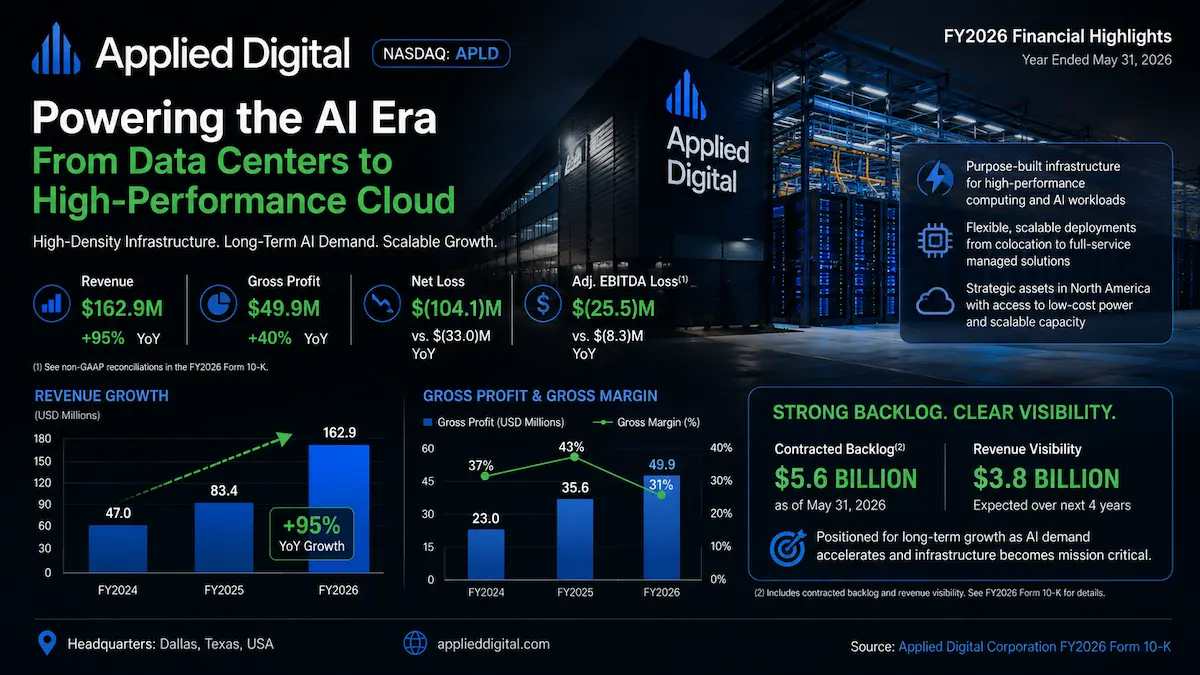
- As of May 31, 2026, Applied Digital had approximately 1.41 GW of contracted critical IT load across five AI Factory campuses, representing about $36.2 billion of base-term contracted revenue. By June 30, 2026, only 175 MW at Polaris Forge 1 was live, making construction execution the central bridge between contracted value and realized cash flow.
- The principal risks are capital intensity, customer concentration, project delivery, power and interconnection execution, and financing costs. Applied Digital reported roughly $5.0 billion of debt at May 31, 2026, while HPC capital expenditures reached about $3.0 billion in fiscal 2026.
1. Business Model Breakdown
From a public shell to a power-first AI infrastructure platform
The legal predecessor of Applied Digital Corporation dates to 2001, but the operating business investors recognize today effectively began in 2021, when the company changed its name to Applied Blockchain and entered next-generation data center hosting. Its first North Dakota facility came online in February 2022, and the company completed a Nasdaq initial public offering that year. In November 2022, the name changed again to Applied Digital, reflecting management’s intention to broaden beyond cryptocurrency infrastructure into high-performance computing.
The decisive strategic change came in 2023. Applied Digital launched a cloud business, opened a smaller HPC facility, and began developing a 100 MW AI-oriented data center at its Ellendale, North Dakota campus. In 2024, it sold a non-core 200 MW Texas site and raised additional capital, including a $160 million private placement involving NVIDIA and other investors. The strategic thesis was increasingly clear: the scarce asset was not the GPU itself, but the ability to turn large blocks of power into operational, high-density compute infrastructure.
That thesis became economically material in 2025. Applied Digital signed long-term leases with CoreWeave at what is now Polaris Forge 1, then added another 150 MW lease with CoreWeave and a separate 200 MW lease with an investment-grade hyperscaler at Polaris Forge 2. In 2026, the company expanded the model to additional campuses, separated its cloud business into publicly traded ChronoScale, and signed further long-term leases at Delta Forge 1, Polaris Forge 3, and Delta Forge 2. The result is a company whose corporate identity has shifted from crypto infrastructure operator to leveraged AI data center developer, owner, and landlord.
The core revenue engine: long-duration HPC data center leases
Applied Digital’s HPC Hosting Business designs, constructs, owns, and operates purpose-built data centers for AI and other accelerated-compute workloads. The customer supplies the compute demand; Applied Digital supplies the physical infrastructure required to make that compute viable at scale: land, power delivery, electrical systems, cooling, data halls, redundancy, network access, and operating support.
The most important revenue stream is base rent under long-term operating leases. As of May 31, 2026, the company reported approximately 1,410 MW of contracted critical IT load across five campuses and approximately $36.2 billion of contracted revenue over the initial 15-year lease terms. The leases are described by the company as take-or-pay and non-cancellable, with termination for convenience requiring payment of the remaining contractual value. That structure materially improves revenue visibility once a facility is delivered and the lease economics commence.
However, contracted revenue should not be confused with current revenue, cash on hand, or risk-free backlog. The facilities must still be completed, energized, accepted by the customer, and operated within contractual requirements. At the end of June 2026, 175 MW was live at Polaris Forge 1 versus roughly 1.41 GW under contract. In other words, the company has already solved much of the demand problem but still has to solve a very large construction, financing, and commissioning problem.
Revenue quality matters more than revenue growth
Fiscal 2026 illustrates why investors should separate recurring rental economics from lower-margin construction-related revenue. The HPC Hosting Business generated $385.3 million of segment revenue, including $270.6 million of tenant fit-out services and $114.7 million of data center rental and other revenue. The fit-out services carried $258.1 million of reported service cost, implying only about $12.5 million of gross profit, or roughly a 4.6% gross margin by calculation from the company’s reported figures.
That makes tenant fit-out economically closer to a construction and installation service than to the durable earnings stream that should define the platform. By contrast, fiscal 2026 HPC base rental revenue was approximately $99.8 million and the company reported $90.4 million of non-GAAP net operating income, equivalent to a 91% NOI margin before depreciation, interest, corporate overhead, and other excluded items. Tenant recoveries also reimburse many operating expenses, including power costs, which can make the property-level rental model highly attractive once a campus is stabilized.
The implication is important: a sophisticated reading of the Applied Digital business model should prioritize live megawatts, base rent, property-level NOI, lease duration, development yield, and cost of capital. Total reported revenue can be distorted by fit-out activity that is strategically necessary but structurally lower margin.
Legacy blockchain hosting: cash flow, not the growth story
Applied Digital still operates approximately 286 MW of legacy data center hosting capacity in Jamestown and Ellendale, North Dakota. This business provides energized infrastructure to a single crypto-mining customer. In fiscal 2026 it generated $154.4 million of segment revenue and $48.3 million of segment profit. Management has said the remaining contract term was approximately one and a half years as of May 31, 2026, and expects this segment to decline in relative importance as HPC grows.
The legacy business remains useful because it can contribute operating cash flow while the AI data center portfolio scales. But it should not be mistaken for the strategic moat. It has customer concentration, limited remaining contract duration, and a different end-market risk profile from the hyperscaler lease platform.
ChronoScale separation: removing a mismatched capital cycle
Applied Digital separated its cloud services business in May 2026 by contributing it to the company that became ChronoScale, which now trades publicly under the ticker CHRN. Applied Digital retained approximately 97% ownership immediately after the transaction and reported approximately 96% ownership at fiscal year-end. Because of that majority ownership, ChronoScale remained consolidated in Applied Digital’s GAAP results, even though the company excludes ChronoScale from the non-GAAP measures it uses to describe its core data center operations.
Strategically, the separation is logical. Owning GPU compute capacity is a shorter-duration, technology-obsolescence-sensitive business with utilization and hardware-cycle risk. Owning long-lived power-and-cooling infrastructure under 15-year leases is an infrastructure business with a very different duration and financing profile. Separating those layers lets Applied Digital concentrate corporate attention on physical AI infrastructure rather than compete simultaneously as landlord and compute operator.
The platform strategy: convert scarce power into financeable contracts
Applied Digital’s platform can be summarized as a four-step conversion process. First, originate sites where large blocks of power can be secured. Second, standardize the design so that a 100 MW to 150 MW data center can be built repeatedly rather than engineered from scratch. Third, sign long-term leases with large counterparties before or during construction. Fourth, finance the project with a combination of project debt, preferred equity, corporate capital, and customer-linked funding.
This model is designed to transform an initially speculative development asset into a long-duration infrastructure asset. Power rights and land are difficult to monetize at full value without a credible tenant. A hyperscaler lease improves financeability. Financing enables construction. On-time delivery creates operating history. Operating history can then improve customer confidence and potentially reduce the cost of capital for the next campus. The strategic ambition is therefore not simply to build data centers; it is to create a repeatable development-and-financing flywheel.
2. Deep Dive into Economic Moats
Cost Advantages: the strongest moat candidate
Under a Buffett-style framework, Applied Digital’s most credible moat is an emerging cost advantage rooted in power access and speed-to-market. AI data centers are increasingly constrained by electrical capacity, interconnection timing, transmission infrastructure, cooling requirements, and the availability of specialized equipment. Applied Digital states that it controls large sites with cost-competitive power and interconnection rights, and that securing these resources ahead of demand is a central competitive differentiator.
The advantage is potentially durable because competitors cannot manufacture grid capacity on demand. A rival may be able to copy a building design, but it cannot instantly recreate a site with hundreds of megawatts of deliverable power, utility agreements, zoning, community support, transmission access, equipment orders, and a hyperscaler-approved operating plan. Catching up can require years of utility studies, permitting, engineering work, land aggregation, substation development, and supplier commitments.
Applied Digital is also trying to compress construction time through a standardized AI Factory model. Its fiscal 2026 10-K describes a repeatable design, standardized power distribution and cooling architecture, prefabricated skids, modular construction, early procurement, and supplier relationships with companies including ABB, BASX, and Caterpillar. The company says this approach supports build cycles of roughly 12 to 18 months for 100 MW to 150 MW facilities. If those timelines can be reproduced across multiple states and campuses, the economic value is substantial because hyperscalers care intensely about time-to-power.
The latest operational evidence is encouraging but still limited. The first 100 MW facility at Polaris Forge 1 became operational in October 2025, and Applied Digital delivered another 75 MW phase on schedule by June 30, 2026. That is meaningful proof of execution. It is not yet proof that the same performance can be repeated across the entire 1.41 GW contracted portfolio. The moat should therefore be viewed as emerging rather than fully seasoned.
Switching Costs: meaningful after delivery, weaker before it
Switching costs are the second most defensible moat characteristic. A hyperscaler that has committed a large AI cluster to a purpose-built campus cannot casually move that workload to another site. The physical infrastructure is customized around power density, cooling, network topology, commissioning standards, and deployment schedules. Once a facility is live, moving a large GPU environment can impose capital costs, downtime risk, network reconfiguration, operational disruption, and new qualification work.
The contracts reinforce those economic switching costs. Applied Digital’s leases are long duration, take-or-pay, and non-cancellable according to its fiscal 2026 10-K. In addition, the company states that its standardized operating model is supported by master service and telecom agreements with leading hyperscalers that are difficult to obtain. Repeat business from the same high investment-grade hyperscaler across Delta Forge 1, Polaris Forge 3, and Delta Forge 2 suggests that prior commercial qualification may lower friction for subsequent projects.
There is an important limitation. Switching costs protect an operating asset more than a construction project. Before a campus is delivered, the customer can still be exposed to schedule risk, and Applied Digital remains exposed to contractual remedies, financing risk, cost overruns, and the possibility that changing technology requirements alter the facility specification. The moat becomes more valuable as live megawatts accumulate.
Intangible Assets: useful, but not yet a standalone fortress
Applied Digital has intangible advantages in customer qualification, engineering know-how, supplier relationships, and execution history. Management says its standardized design has been qualified by major hyperscalers. The company also markets proprietary waterless or closed-loop cooling approaches and high-density liquid-cooling architecture.
Those capabilities matter, but investors should distinguish technical competence from a legally protected moat. The official sources reviewed do not establish that Applied Digital possesses patents, exclusive licenses, or other intellectual property that would prevent well-capitalized competitors from developing comparable cooling or power-delivery systems. The stronger intangible asset is therefore institutional trust: the ability to pass hyperscaler diligence, obtain design approvals, sign repeat leases, and demonstrate that the construction organization can deliver.
Network Effects: largely absent
Applied Digital does not have a meaningful classic network effect. A new hyperscaler tenant does not automatically make the service more valuable to every other tenant in the way additional users strengthen a marketplace, payments network, or social platform. Fiber density, supplier scale, and operating experience can create ecosystem benefits, but those are better classified as scale efficiencies and execution advantages than true network effects.
This distinction matters because fast growth should not be mistaken for a moat. Applied Digital can create attractive economics without a network effect, but its long-run excess returns will depend on whether it can preserve development yields and delivery advantages as competitors race to secure the same power and hyperscaler customers.
Moat verdict: power plus execution, not scale alone
The strongest version of the Applied Digital moat is a bundled system: early power origination, utility relationships, site control, hyperscaler qualification, standardized high-density design, repeat supplier procurement, project financing access, and on-time delivery. None of those components is individually impossible to copy. The barrier lies in coordinating all of them fast enough to meet hyperscaler deployment schedules.
That can support above-average returns if Applied Digital continues to secure power before competitors, signs leases at attractive yields, controls construction costs, and finances stabilized projects below their unlevered development returns. It will not support durable excess returns if competitors bid away power economics, construction costs rise faster than rents, project debt remains expensive, or the company has to contribute too much equity per megawatt.
3. Business Inflection Points & Future Catalysts
The pivotal inflection: the 2023 HPC pivot, validated by the 2025 CoreWeave leases
The most important strategic inflection point was the decision in 2023 to move beyond blockchain hosting and build purpose-designed HPC infrastructure. The rename to Applied Digital in late 2022 signaled the intent, but 2023 was when capital allocation moved toward AI-oriented data centers. The pivot became commercially credible in May 2025 when CoreWeave signed leases for an aggregate 250 MW at Polaris Forge 1, followed by another 150 MW lease in August 2025.
That changed the company’s economic identity. Before the CoreWeave leases, Applied Digital had a development thesis. After the leases, it had a financeable, long-duration AI infrastructure asset with an anchor tenant. The subsequent leasing of Polaris Forge 2, Delta Forge 1, Polaris Forge 3, and Delta Forge 2 suggests that the original campus may be evolving into a repeatable platform rather than remaining a one-off project.
Catalyst 1: converting contracted megawatts into live base rent
The most powerful catalyst over the next one to two years is also the simplest: construction completion. At May 31, 2026, Applied Digital had approximately 1.41 GW of contracted critical IT load. By June 30, 2026, live capacity at Polaris Forge 1 had reached 175 MW. The remaining contracted portfolio is scheduled to come online in phases through the first half of 2028, subject to execution.
The transmission mechanism is direct. Each ready-for-service milestone converts construction-in-progress into an operating asset. Operating assets begin generating base rent and tenant recoveries. Because property-level NOI margins on the first operating HPC asset were high, a rising proportion of recurring base rent should improve the quality of consolidated earnings even if lower-margin fit-out revenue fluctuates.
Key observable indicators are live critical IT megawatts, ready-for-service dates, quarterly base rental revenue, HPC NOI, construction-in-progress balances, capital expenditures per delivered megawatt, customer acceptance, and any changes to stated delivery schedules. The main risks are equipment delays, utility and interconnection delays, permitting, labor shortages, construction cost overruns, commissioning failures, and changes in customer technical requirements.
Catalyst 2: proving that the franchise model works outside the first campus
Polaris Forge 1 proves that Applied Digital can deliver at least part of a large AI campus. The more important test is whether the same operating playbook works in different states, utility territories, labor markets, and climates. Polaris Forge 2, Delta Forge 1, Polaris Forge 3, and Delta Forge 2 are therefore not just growth projects; they are replication tests.
If multiple campuses reach service on schedule, the company gains something more valuable than incremental rent: a repeatable execution record. That can shorten future customer diligence, improve confidence in development schedules, deepen supplier relationships, and potentially improve financing terms. In infrastructure, a demonstrated ability to deliver the second, third, and fourth asset often matters more than the first.
Investors should track schedule adherence by campus, construction duration, standardized equipment usage, change-order frequency, customer renewals or expansions, and whether additional hyperscalers sign leases without requiring materially worse economics. The catalyst fails if the franchise model proves less portable than expected or if local utility, permitting, and construction conditions force each project to become effectively bespoke.
Catalyst 3: lower capital intensity per dollar of stabilized rent
Applied Digital’s opportunity is large, but the balance-sheet burden is equally large. The company reported approximately $5.0 billion of debt at May 31, 2026 and nearly $3.0 billion of fiscal 2026 HPC capital expenditures. Its project financings include secured notes with coupons ranging from 6.75% to 9.25%, while a revolving credit facility provides additional pre- and post-lease development liquidity.
A meaningful catalyst would be a declining amount of corporate equity required per new megawatt as the platform matures. Long-term investment-grade leases can make individual projects more financeable, while Macquarie Asset Management’s preferred-equity framework was designed to fund portions of hyperscaler projects. If Applied Digital can consistently pair signed leases with high loan-to-cost project debt and third-party preferred equity, the company may be able to retain meaningful common-equity ownership without funding every dollar of construction from public equity.
Observable indicators include project-level debt coupons and spreads, loan-to-cost ratios, corporate equity contribution per MW, preferred-equity draws, restricted-cash balances, debt-service coverage, and future common or preferred share issuance. The risk is that rising rates, construction delays, weaker credit markets, or tighter lender underwriting offset the benefit of long leases. A data center can have excellent property-level NOI and still produce mediocre equity returns if the capital stack is too expensive.
Catalyst 4: new power supply and customer diversification
Applied Digital reported an active development pipeline of more than 3 GW of gross utility power and an extended pipeline of more than 5 GW. It is also pursuing approximately 1.2 GW of front-of-the-meter natural-gas generation in the Dakotas through a relationship with Base Electron. Additional power can extend the runway for future campuses if it becomes deliverable on commercially attractive terms.
The transmission mechanism is power-to-contract conversion. A site with credible power delivery can be marketed to hyperscalers; a signed lease can unlock project financing; project financing can convert the site into a revenue-producing asset. The most valuable new leases would also diversify customer concentration. One undisclosed high investment-grade hyperscaler accounts for roughly $20 billion of the current $36.2 billion base-term contracted portfolio across Delta Forge 1, Polaris Forge 3, and Delta Forge 2, while CoreWeave accounts for approximately $11 billion at Polaris Forge 1.
Investors should monitor newly signed MW, tenant mix, contracted revenue per MW, power delivery dates, interconnection agreements, new-site utility commitments, and whether the company expands beyond its current small number of hyperscaler counterparties. For Base Electron specifically, the opportunity should be weighed against execution and related-party complexity. Applied Digital’s fiscal 2026 10-K states that it owned about 10% of Base Electron and had a $58.6 million related-party note receivable at May 31, 2026 after terminating an earlier project guarantee.
The catalyst can fail if AI infrastructure spending slows, utilities cannot deliver power on schedule, new generation faces permitting or transmission constraints, customer concentration increases rather than decreases, or competitors bid power and lease economics to unattractive levels.
What would invalidate the bullish operating thesis?
The most important disconfirming evidence would be repeated delivery slippage, materially higher construction cost per MW, weaker lease economics on new projects, increased reliance on dilutive corporate financing, or a sustained gap between reported contracted value and live capacity. A second warning sign would be deterioration in customer credit quality or amendments that materially weaken take-or-pay protections.
Applied Digital’s current position is unusual: demand visibility is already high, but the operating asset base is still comparatively young. That makes the next two years less about proving that hyperscalers want AI capacity and more about proving that Applied Digital can transform a large contracted pipeline into stabilized infrastructure at attractive returns on invested capital.
4. Key FAQs
How does Applied Digital make money from AI data centers?
Applied Digital primarily makes money by developing and owning high-density AI data centers and leasing that capacity to hyperscalers under long-term agreements. The highest-quality recurring revenue is base rent. The company also receives tenant recoveries for reimbursable operating costs and earns revenue from tenant fit-out procurement and installation services. The fit-out activity can create large reported revenue but carries much lower gross margins than recurring rent, so base rental revenue and NOI are more useful indicators of the long-term economics.
Is Applied Digital’s $36 billion contracted revenue guaranteed?
No. Applied Digital reported approximately $36.2 billion of base-term contracted revenue as of May 31, 2026, and its HPC leases are described as long-term, take-or-pay, and non-cancellable. Those are strong contractual protections, but the figure is not equivalent to cash or fully realized GAAP revenue. Applied Digital must still complete and deliver the contracted facilities, satisfy lease conditions, maintain operating performance, and remain exposed to counterparty credit risk. Renewal-option values are also separate and should not be treated as guaranteed.
What is Applied Digital’s main competitive advantage versus other AI data center developers?
The best-supported advantage is the combination of power access and execution speed. Applied Digital seeks large sites with cost-competitive power and interconnection rights, then applies a standardized high-density design, common supplier base, modular construction methods, and hyperscaler-qualified operating processes. The advantage becomes economically meaningful only if it continues to produce on-time delivery and attractive development yields. Scale by itself is not a moat, and the official information reviewed does not establish a standalone patent or network-effect barrier that competitors cannot replicate.
5. Conclusion
Applied Digital’s corporate DNA is best described as power-first infrastructure development. The company began its current operating life in blockchain hosting, but the strategic insight that now defines it is broader: in the AI era, access to deployable power, interconnection, cooling, land, and construction capacity can be scarcer than compute demand itself. Applied Digital is attempting to industrialize the conversion of those scarce inputs into long-term hyperscaler leases.
The emerging moat is therefore not simply that Applied Digital owns data centers. It is the possibility that the company can originate power earlier, qualify designs faster, procure equipment at scale, finance projects efficiently, and deliver high-density capacity on schedule. The first 175 MW of live capacity and repeat leasing across five campuses provide evidence that the model has traction. They do not yet prove that the entire contracted portfolio will be delivered at comparable speed and economics.
The central analytical question for the next phase is whether Applied Digital can turn roughly 1.41 GW of signed demand into a portfolio of stabilized assets whose property-level returns comfortably exceed the cost of debt, preferred capital, corporate equity, and maintenance investment. If it can, the company may evolve from a high-risk developer into a durable AI infrastructure platform. If construction costs, financing costs, or customer concentration overwhelm the lease economics, the apparent strength of the backlog will be less valuable than it looks.
Official Sources
- U.S. Securities and Exchange Commission — Applied Digital Fiscal 2026 Form 10-K
- Applied Digital Investor Relations — Fiscal Fourth Quarter and Full Year 2026 Results
- Applied Digital Investor Relations — Second Building Delivery at Polaris Forge 1
- Applied Digital Investor Relations — Delta Forge 2 210 MW Lease
- Applied Digital Investor Relations — Macquarie Asset Management Funding Partnership
- Applied Digital Investor Relations — ChronoScale Cloud Business Separation
- Applied Digital Investor Relations — 2022 Name Change and HPC Expansion Rationale
- Applied Digital Investor Relations — April 2026 Investor Presentation
Source note: The two non-CoreWeave hyperscaler identities were not disclosed by Applied Digital in the official sources reviewed for this article. No customer identity has been inferred from market rumors or third-party speculation.
Disclaimer: This article is intended solely for business logic discussion and corporate research purposes, and does not constitute investment advice of any kind.