


Key Takeaways
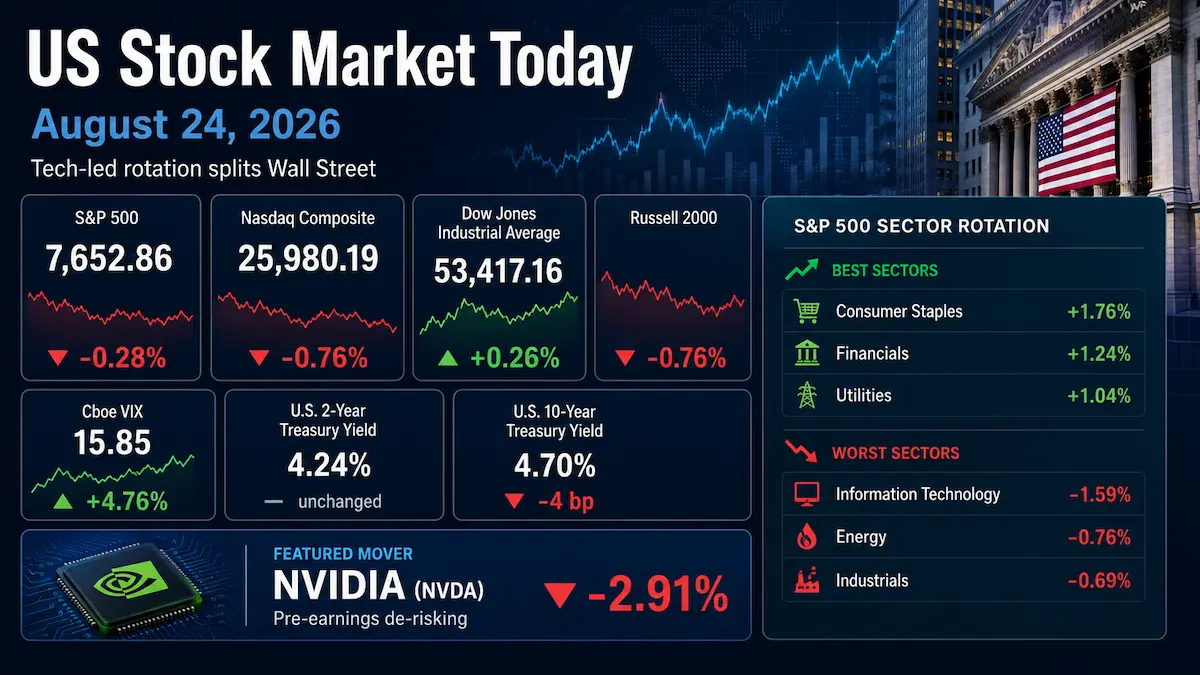
- The S&P 500 fell 0.28% to 7,652.86 and the Nasdaq Composite lost 0.76% to 25,980.19, while the Dow gained 0.26% to 53,417.16. The Russell 2000 fell 0.76%, showing that the session was not simply a large-cap-versus-small-cap trade.
- Consumer Staples led the S&P 500 sectors with a 1.76% gain, while Information Technology fell 1.59%. Financials rose 1.24% and Utilities gained 1.04%, highlighting a rotation toward defensive cash flows and less duration-sensitive exposure.
- Semiconductors were the main index drag ahead of NVIDIA earnings. NVIDIA fell 2.91%, Micron dropped 5.8% and Broadcom lost 2.6%, while eight of the eleven S&P 500 sectors still finished higher.
- Cboe VIX rose 4.76% to 15.85. The U.S. Treasury’s official CMT curve showed the 2-year yield unchanged at 4.24% and the 10-year yield down 4 basis points to 4.70%, producing a modest bull-flattening move rather than a clean policy signal.
1. Market Capital Flows and Sector Rotation
The August 24 tape was better described as a rotation than a broad liquidation. Consumer Staples was the best-performing S&P 500 sector at +1.76%, followed by Financials at +1.24% and Utilities at +1.04%. Information Technology was the clear laggard at -1.59%, while Energy fell 0.76% and Industrials declined 0.69%. That 3.35-percentage-point spread between Staples and Technology was the most important cross-sectional signal of the day: investors reduced exposure to the market’s highest-duration, AI-sensitive leadership while adding to businesses with steadier demand, cash-flow visibility or more favorable sensitivity to lower long-end yields.
Large-cap performance was internally divided. The Dow’s 0.26% advance contrasted with the S&P 500’s 0.28% loss and the Nasdaq Composite’s 0.76% decline. Small caps did not provide a risk-on confirmation, with the Russell 2000 also down 0.76%. The factor pattern was therefore consistent with value and defensive outperformance over long-duration growth, but it was not a clean small-cap or cyclical broadening trade. Consumer Discretionary still gained 0.29%, yet Energy and Industrials fell, reinforcing the view that investors were selectively rotating rather than uniformly buying economically sensitive assets.
Market breadth was mixed and less constructive than the sector count alone suggested. Decliners outnumbered advancers by 1.08-to-1 on the NYSE and by 1.5-to-1 on Nasdaq, where 1,955 stocks advanced and 2,934 declined. U.S. exchange volume totaled 14.36 billion shares versus a 20-session average of 16.5 billion. Eight S&P 500 sectors rose, but negative stock-level breadth and below-average volume indicate that the defensive rotation did not amount to a broad accumulation signal.
Institutional Flow Insight: One plausible interpretation is that institutions trimmed crowded semiconductor and AI exposure ahead of a dense event calendar while reallocating part of that risk budget toward defensive and financial exposures. Lower long-end Treasury yields improved the relative valuation backdrop for equities broadly, but they did not rescue technology because near-term earnings expectations and policy risk around AI infrastructure dominated. This should be treated as an inference from price action, not as confirmed fund-flow data. With NVIDIA earnings, PCE inflation data and Jackson Hole all clustered within the same week, reducing concentration risk before binary catalysts would also be consistent with disciplined portfolio construction.
2. Decoding the Biggest Market Movers
NVIDIA (NVDA)
NVIDIA closed at $208.48, down 2.91%. The move was not a reaction to newly released quarterly results: as of the August 24 close, NVIDIA had not yet reported fiscal second-quarter 2027 earnings. Its official Investor Relations calendar schedules those results for August 26 at 2:00 p.m. Pacific Time, or 5:00 p.m. Eastern Time. Monday’s decline instead reflected pre-earnings de-risking across semiconductors, concern over the exceptionally high bar embedded in AI expectations, and a broader policy debate over power demand and new data-center development.
The latest reported fundamentals remain exceptionally strong, which is precisely why the upcoming print carries such high index-level importance. NVIDIA’s official fiscal first-quarter 2027 release reported revenue of $81.615 billion, up 85% year over year, Data Center revenue of $75.2 billion, up 92%, GAAP gross margin of 74.9%, and GAAP diluted EPS of $2.39. The company guided fiscal second-quarter revenue to $91.0 billion, plus or minus 2%, with GAAP gross margin of 74.9%, plus or minus 50 basis points. The outlook assumed no Data Center compute revenue from China.
The latest official earnings-call transcript also showed that demand was broadening beyond the largest hyperscalers: fiscal first-quarter Hyperscale revenue was approximately $38 billion, or about half of Data Center revenue, while ACIE revenue was $37 billion and grew 31% sequentially; AI cloud revenue within ACIE more than tripled year over year. Those figures strengthen the structural AI demand case, but they also raise the execution bar. With NVIDIA carrying extraordinary weight in major benchmarks, even a modest re-rating can overwhelm gains elsewhere in the index. The simultaneous declines in Micron and Broadcom therefore matter: Monday looked more like a semiconductor risk-premium reset ahead of NVIDIA’s report than a stock-specific deterioration in NVIDIA’s disclosed fundamentals.
3. Macro Indicators and Market Outlook
Cboe VIX finished at 15.85, up 0.72 point or 4.76% from the prior close of 15.13. The direction was consistent with the S&P 500’s decline and suggests some increase in demand for downside protection ahead of earnings and macro catalysts. The absolute level, however, remained well below the stress regimes typically associated with disorderly equity deleveraging. The better interpretation is a moderate repricing of event risk rather than panic hedging.
The U.S. Treasury’s official daily par yield curve showed the 2-year CMT yield unchanged at 4.24% and the 10-year yield down 4 basis points to 4.70%. The 2s10s spread therefore narrowed to roughly +46 basis points from +50 basis points on August 21. That bull flattening can be consistent with lower long-run inflation or growth compensation, but Monday’s move also had an important market-technical component: investors were assessing reports that Treasury could use its cash balance to support larger long-dated debt buybacks. It would therefore be inappropriate to interpret a single day’s decline in the 10-year yield as a definitive change in the expected path of Federal Reserve policy.
Oil reinforced the sector rotation. WTI crude settled down 2.35% at $85.01 a barrel and Brent settled down 2.35% at $92.17 despite heightened U.S.-Iran economic pressure. Lower oil prices eased one near-term inflation channel and helped explain why defensive and rate-sensitive equities could hold up even as geopolitical risk increased. At the same time, the move directly pressured Energy, one of only three S&P 500 sectors to finish lower.
Upcoming Economic Data & Catalysts:
- Personal Income and Outlays, July 2026 (Release date: August 26, 2026): The Bureau of Economic Analysis will release income, spending and PCE inflation data at 8:30 a.m. Eastern Time. Investors will focus on whether inflation and consumption are consistent with the current level of front-end yields and whether the data alter the balance between inflation risk and growth resilience.
- Federal Reserve Chairman Kevin Warsh — Keynote Remarks at the 2026 Jackson Hole Economic Policy Symposium (Release date: August 28, 2026): The Federal Reserve calendar lists the speech for 10:00 a.m. Eastern Time. Markets will focus on Warsh’s policy reaction function, his assessment of inflation and growth, and any discussion of long-term yields or balance-sheet conditions.
Only events after the August 24 close that are confirmed on official schedules are included above. NVIDIA’s fiscal second-quarter results on August 26 are an additional corporate catalyst with unusually large implications for index leadership and the AI complex.
Market Insights:
The session was not a broad risk-off event. Eight of eleven S&P 500 sectors rose and the Dow advanced, but weakness in the market’s largest technology exposures was powerful enough to pull the cap-weighted S&P 500 lower. That concentration is the central portfolio message. A durable improvement would require either stabilization in semiconductors or stronger participation beneath the index surface. Risks that could reverse the defensive bid include a renewed rise in long-end yields, hotter-than-expected PCE inflation, a negative NVIDIA earnings or guidance surprise, weakening market breadth, or a volatility breakout that pushes the VIX materially above its recent range.
Trading & Investment Strategy:
Risk management is preferable to chasing either side of Monday’s rotation. Investors with heavy AI and semiconductor concentration can consider sizing positions around event risk rather than treating a one-day decline as an automatic entry signal. New exposure can be staged in tranches after earnings and inflation data clarify the next catalyst path. Defensive sectors may improve portfolio balance, but buying them after a sharp one-day relative move can create poor entry discipline. For tactical positions, predefined loss limits and smaller sizing around binary events are more important than conviction alone. Avoid excessive leverage, and require improving breadth or fundamental confirmation before treating the session as the start of a durable style regime change.
4. Key FAQs About the US Stock Market Today
Why did the US stock market move on 24 August 2026?
The market split because semiconductor and megacap technology weakness outweighed gains across most other S&P 500 sectors. Investors reduced risk ahead of NVIDIA earnings and PCE inflation data while also assessing U.S.-Iran economic pressure, Canada trade tensions and political resistance to AI data-center expansion. Falling long-term Treasury yields and lower oil prices cushioned the broader market, helping the Dow and defensive sectors outperform.
Which sectors performed best and worst in the US stock market on 24 August 2026?
Consumer Staples was the best S&P 500 sector, rising 1.76%, while Information Technology was the worst, falling 1.59%. Financials gained 1.24% and Utilities rose 1.04%, reinforcing a defensive and cash-flow-visibility rotation. Energy fell 0.76% as crude prices dropped sharply.
What should investors watch after the US stock market close on 24 August 2026?
The immediate catalysts are NVIDIA’s August 26 earnings, the BEA’s July Personal Income and Outlays report on August 26, and Chairman Kevin Warsh’s Jackson Hole keynote on August 28. Investors should also monitor whether the 10-year Treasury yield holds near 4.70%, whether Nasdaq breadth improves, and whether VIX remains contained. Confirmation across earnings, rates and breadth would be more informative than extrapolating Monday’s single-session rotation.
Disclaimer: This article is intended solely for the exchange of investment ideas and does not constitute investment advice of any kind.