


Key Takeaways
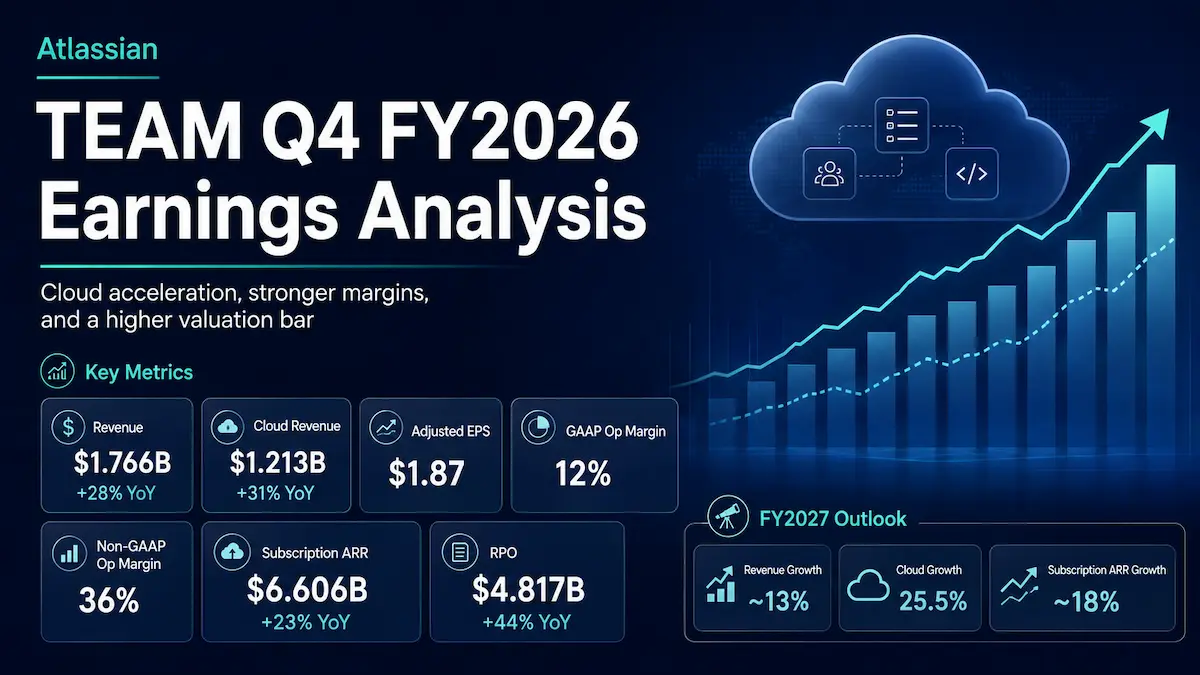
- Atlassian reported Q4 FY2026 revenue of $1.766 billion, up 28% year over year, versus roughly $1.66 billion expected by analysts tracked by FactSet. Adjusted diluted EPS was $1.87 versus $1.50 expected.
- Cloud revenue accelerated to $1.213 billion, up 31%, while Subscription ARR reached $6.606 billion, up 23%, and RPO rose 44% to $4.817 billion. Those metrics are higher-quality demand signals than the quarter’s unusually strong Data Center revenue.
- Profitability inflected sharply: GAAP operating margin was 12% and non-GAAP operating margin was 36%, versus Atlassian’s prior Q4 guidance of 4.5% and 30.5%, respectively. However, stock-based compensation remained economically material at $394.5 million, or 22.3% of revenue.
- FY2027 guidance separates underlying cloud momentum from accounting noise: Atlassian expects Subscription ARR growth of about 18%, Cloud growth of 25.5% and total revenue growth of 13%, while Data Center revenue is expected to decline 17%.
- TEAM shares traded at $149.27 at 10:14 a.m. EDT on August 7, 2026, up 35.49% from the prior close of $110.17. The rerating reflects a sharp reduction in perceived AI-disruption and seat-compression risk, but it also raises the valuation hurdle for FY2027 execution.
Atlassian’s fiscal fourth quarter ended June 30, 2026. The central investment question is not whether the quarter was strong; it was. The more useful question is how much of the upside represents durable cloud and enterprise demand, how much reflects Data Center revenue-recognition timing, and how much of the margin expansion should be capitalized in valuation. That distinction matters because the headline 28% revenue growth rate contains businesses with very different forward trajectories.
Core Earnings Breakdown
Revenue and Profitability Analysis
Total Q4 FY2026 revenue was $1.766469 billion, up 28% from $1.384344 billion a year earlier. The mix is increasingly cloud-centric, but Data Center still represented a meaningful portion of reported revenue and created a favorable near-term comparison that will reverse in FY2027.
- Cloud revenue was $1.213456 billion, up 31% year over year and equal to 68.7% of total Q4 revenue, calculated as $1.213456 billion divided by $1.766469 billion. Cloud is the strategically important engine because it concentrates Atlassian’s AI, Collections, enterprise governance and migration economics on the unified platform. Acceleration to 31% is therefore more valuable than an equivalent percentage point of growth from Data Center.
- Data Center revenue was $461.944 million, up approximately 21.3% from $380.776 million, calculated from company-reported figures, and represented 26.2% of Q4 revenue. The quality of this growth is lower than the headline suggests because Atlassian has been recognizing more upfront term-license revenue around the Data Center end-of-life transition and pricing changes. The FY2027 guide for a 17% decline confirms that investors should not annualize Q4 Data Center growth.
- Marketplace and other revenue was $91.069 million, up approximately 20.1% from $75.838 million, calculated from company-reported figures, and represented 5.2% of Q4 revenue. The ecosystem remains healthy, but the revenue model changes as customers migrate because Atlassian has historically had a lower take rate on Cloud Marketplace app sales than on Data Center apps. This makes Marketplace growth a useful adoption signal but not a clean one-for-one proxy for underlying customer spend.
Atlassian did not disclose a separate constant-currency or company-defined “operational growth” rate for these deployment categories in the Q4 earnings release. Accordingly, the growth rates above are reported year-over-year growth unless explicitly labeled as calculated. In this analysis, operational growth refers to the underlying business drivers—seat expansion, cross-sell, product adoption, migrations, pricing and enterprise deal activity—rather than a company-defined non-GAAP growth metric.
Profitability was the second major positive surprise. GAAP operating income was $210.723 million, producing a 12% operating margin versus a 2% operating loss margin a year earlier. Non-GAAP operating income was $636.340 million and non-GAAP operating margin reached 36%, up from 24%. GAAP gross margin improved to 87% from 83%, while non-GAAP gross margin reached 89% from 85%.
Free cash flow was $474.693 million, equivalent to a 27% margin, with operating cash flow of $479.141 million. This is strong liquidity generation, but investors should not treat free cash flow as fully free of equity-compensation economics: stock-based compensation is added back as a non-cash item in operating cash flow. The cash-flow result is therefore highly useful for balance-sheet capacity and capital allocation, while the GAAP/non-GAAP margin bridge remains important for evaluating the true economic cost base.
Expectations vs. Actual Results
- Revenue: $1.766 billion versus approximately $1.66 billion FactSet consensus — ✅ beat by roughly $106 million, or about 6%.
- Adjusted diluted EPS: $1.87 versus $1.50 FactSet consensus — ✅ beat by $0.37, or roughly 25%.
- GAAP operating margin: 12% versus Atlassian’s prior Q4 company guidance of 4.5% — ✅ beat by 750 basis points.
- Non-GAAP operating margin: 36% versus prior company guidance of 30.5% — ✅ beat by 550 basis points.
- Cloud growth: 31% versus prior company guidance of approximately 25.5% — ✅ ahead by about 5.5 percentage points.
- Data Center growth: approximately 21.3% calculated from reported dollars versus prior company guidance of 8.5% — ✅ materially ahead, but with lower-quality revenue-recognition timing.
- Marketplace and other growth: approximately 20.1% calculated from reported dollars versus prior company guidance of 6.5% — ✅ materially ahead.
There is no single reliable public consensus operating-margin figure in the primary earnings materials reviewed, so the clean margin comparison is against Atlassian’s own prior guidance rather than presenting an unverified Wall Street number as consensus.
The beat was broad rather than confined to EPS. Against Atlassian’s own prior Q4 revenue range of $1.653 billion to $1.661 billion, the $1.766469 billion result exceeded the $1.657 billion midpoint by about $109.5 million, or 6.6%. Cloud, Data Center and Marketplace growth all exceeded prior company assumptions. That matters because it reduces the probability that the quarter was produced solely by expense cuts.
Still, not every dollar of upside deserves the same multiple. Data Center benefited from upfront term-license revenue recognition and pricing while customers move toward Cloud. Atlassian had already warned that Data Center end-of-life behavior could pull revenue forward and create lumpiness. The cleaner evidence of business health is the combination of 31% Cloud growth, 23% Subscription ARR growth, 44% RPO growth, expanding enterprise contract sizes and improved GAAP profitability.
The margin beat also needs context. Q4 was the first full quarter after Atlassian’s Q3 restructuring actions. Management’s prior Q4 guidance already assumed approximately seven percentage points of GAAP operating-margin benefit and five percentage points of non-GAAP operating-margin benefit from employee and lease-related savings. Because the actual 12% GAAP and 36% non-GAAP margins still exceeded that post-restructuring guide by 750 and 550 basis points, respectively, the result represents more than a mechanically lower expense base. Revenue upside, cloud infrastructure efficiency and tighter cost discipline all contributed to the operating leverage.
For Q1 FY2027, Atlassian guided to revenue of $1.705 billion to $1.715 billion, Cloud revenue growth of approximately 28.5%, Data Center revenue decline of approximately 4%, Marketplace and other growth of approximately 12.5%, GAAP gross margin of 85%, non-GAAP gross margin of 87%, GAAP operating margin of 6.5% and non-GAAP operating margin of 28.5%.
For full-year FY2027, management expects Subscription ARR growth of approximately 18%, total revenue growth of approximately 13%, Cloud revenue growth of approximately 25.5%, Data Center revenue decline of approximately 17%, Marketplace and other revenue growth of approximately 12%, GAAP gross margin of 84.5%, non-GAAP gross margin of 86.5%, GAAP operating margin of 4.5% and non-GAAP operating margin of 25%.
The market reaction shows what investors cared about. TEAM closed August 6 at $110.17 and traded at $149.27 at 10:14 a.m. EDT on August 7, a 35.49% gain. That move is too large to attribute to a $0.37 adjusted-EPS beat alone. The market had been discounting a much more adverse scenario in which AI agents compress software seats, weaken SaaS pricing power and reduce the strategic value of traditional collaboration tools. Q4 pushed back against that thesis through faster Cloud growth, larger enterprise commitments, Rovo usage, better margins and guidance that still calls for mid-20s Cloud growth in FY2027.
The apparent contradiction between 28% Q4 reported revenue growth and 13% FY2027 total revenue guidance is also less bearish than it first appears. Data Center is expected to swing from approximately 21% growth in Q4 to a 17% decline for the full year, while Cloud is still guided to 25.5% growth and Subscription ARR to 18%. The market therefore appears to be placing greater weight on Cloud, ARR, enterprise adoption and margin durability than on the reported consolidated growth rate alone.
Earnings Call Highlights
The following points use verified management disclosures and accurate strategic summaries from Atlassian’s Q4 earnings materials and call framework rather than introducing unverified verbatim transcript language.
Management’s core AI message is that Teamwork Graph is the context layer that can make agentic AI more accurate, faster and more economical; Atlassian’s MCP Server and Teamwork Graph CLI surpassed 1 million monthly active users.
💡 Reading Between the Lines: Atlassian is not trying to win by owning the foundation model. Its moat is the permissioned organizational context embedded across Jira, Confluence, service workflows, code and third-party tools. If outside agents increasingly need trusted enterprise context, Atlassian can remain strategically relevant even when the winning model or agent interface changes.
Enterprise commitment is moving up the contract-size curve: Atlassian reported a record quarter for $1 million, $3 million and $5 million annual contract value deals, with $3 million-plus ARR customers growing more than 50% and $5 million-plus customers growing more than 70% year over year.
💡 Reading Between the Lines: This is evidence that the enterprise go-to-market buildout is producing wallet consolidation, not merely more small-team subscriptions. Larger and longer contracts support RPO and can improve sales efficiency over time, but they also introduce greater deal-timing sensitivity and procurement risk.
Rovo adoption has progressed from reach to depth: more than 80% of the Fortune 500 use Rovo, and management reported Rovo-assisted actions increasing more than 50% year over year, translating into millions of customer hours saved each month.
💡 Reading Between the Lines: The monetization thesis depends less on charging separately for a chatbot and more on using AI to increase platform adoption, edition upgrades, Collections penetration, seat expansion and eventually consumption. The key model variable is whether usage growth continues to translate into ARR expansion faster than AI inference costs grow.
Management is steering investors toward Subscription ARR as a cleaner measure of underlying growth while Data Center accounting creates reported-revenue timing distortions; FY2027 guidance calls for ARR growth of about 18%, Cloud growth of 25.5% and Data Center decline of 17%.
💡 Reading Between the Lines: The reported top line will be noisier during the on-premise-to-cloud transition. A valuation framework anchored only to year-over-year consolidated revenue risks understating Cloud momentum in FY2027, but ARR must actually deliver near the 18% guide for that normalization argument to hold.
Atlassian paired growth with a commitment to GAAP profitability, but FY2027 guidance still contains a 19-percentage-point stock-based-compensation bridge between GAAP and non-GAAP operating margin.
💡 Reading Between the Lines: Cost discipline is real, but the 25% guided non-GAAP operating margin should not be treated as equivalent to a 25% economic margin. Investors will need to see stock-based compensation fall as a percentage of revenue, not merely slower headcount growth, for the GAAP and adjusted valuation frameworks to converge.
Deep Business Insights
Hidden Metrics That Matter
First, the earnings-quality gap is unusually important. Q4 stock-based compensation was $394.475 million. Dividing $394.475 million by $1.766469 billion of revenue gives 22.3% of revenue, calculated from company-reported figures. The Q4 GAAP operating margin was 12% and the non-GAAP operating margin was 36%, a 24-percentage-point gap. Stock-based compensation alone accounts for 22 percentage points of the reconciliation, with acquired-intangible amortization accounting for roughly another two points.
This does not invalidate the adjusted margin. Non-GAAP margin is useful for analyzing cash operating efficiency and period-to-period cost leverage. But for valuation, the equity compensation cannot be treated as economically free. Atlassian repurchased $359.294 million of stock in Q4 and $1.800485 billion in FY2026, which helps offset dilution, yet buybacks used to neutralize equity compensation are a real capital allocation cost. The fact that Q4 diluted weighted-average shares were 253.399 million versus 262.884 million a year earlier shows that the repurchases did reduce the share base, but the cost of doing so should remain inside the investor’s economic model.
Second, the product-mix transition is more advanced than the consolidated growth rate suggests. Cloud represented 68.7% of Q4 revenue, calculated as $1.213456 billion divided by $1.766469 billion, while Data Center represented 26.2%, calculated as $461.944 million divided by $1.766469 billion. With FY2027 Cloud growth guided at 25.5% and Data Center guided to decline 17%, the mix should continue shifting toward the cloud platform even if total reported revenue growth decelerates materially.
RPO adds another useful lens. At $4.817 billion, RPO grew 44% year over year versus 23% growth in Subscription ARR. RPO equaled approximately 72.9% of Subscription ARR, calculated as $4.817 billion divided by $6.606 billion from company-reported figures. The divergence signals longer-duration enterprise commitments, although RPO is not a perfect demand measure during the Data Center transition because upfront revenue recognition can change how obligations move through the balance sheet.
Why do customers choose Atlassian? The answer is increasingly broader than Jira. The company serves more than 350,000 customers and over 85% of the Fortune 500, and its platform connects structured work, knowledge, service workflows, code, collaboration and AI through a shared context layer. For large enterprises, the differentiator is the ability to deploy human and agentic workflows with permissions, audit trails, governance and organizational context already attached.
The enterprise product roadmap also removes adoption barriers. Atlassian launched Isolated Cloud into general availability for regulated workloads, expanded AI administration controls, added HIPAA coverage for Rovo and is pursuing a multi-cloud architecture. The commercial implication is important: enterprise customers no longer have to choose between broad AI functionality and the security or governance requirements that previously kept some workloads on Data Center. That supports both migration and cross-sell.
Teamwork Collection is another structural advantage. Bundling Jira, Confluence, Loom and Rovo can raise average revenue per user while simultaneously reducing a customer’s need for overlapping point solutions. This creates an economic flywheel: more products create more context in Teamwork Graph; more context improves the usefulness of AI; better AI increases the incentive to standardize more workflows on Atlassian. The risk is that competitors can attack the same consolidation budget, so the moat has to show up in retention, expansion and enterprise deal growth rather than product breadth alone.
Industry Chain Reactions
- ✅ Benefit — Alphabet (NASDAQ: GOOGL): Atlassian and Google Cloud have a multi-year strategic partnership under which Atlassian is expanding its multi-cloud footprint, bringing core cloud apps to Google Cloud alongside AWS and enabling procurement through Google Cloud Marketplace. Continued Atlassian Cloud migration and AI workload growth are a positive second-order signal for Google Cloud infrastructure and marketplace consumption. The read-through is strategically positive but not large enough by itself to move Alphabet’s consolidated financial model.
- ❌ Face Pressure — ServiceNow (NYSE: NOW): Atlassian is pushing Service Collection beyond ITSM into employee and cross-functional service management while adding Rovo, Teamwork Graph context and enterprise governance. Q4’s larger enterprise deals and Atlassian’s positioning in IT service management increase share-of-wallet competition. This is not evidence that ServiceNow’s growth must slow, but it raises the competitive bar on price-to-value, AI workflow integration and cross-department consolidation.
Valuation Framework and Key Risks
At 10:14 a.m. EDT on August 7, 2026, TEAM traded at $149.27, up 35.49% from the prior close. Using Q4 diluted weighted-average shares of 253.399 million as a rough capitalization proxy—not a live period-end diluted share count—implies an equity value of approximately $37.8 billion. Adding $989.560 million of long-term debt and subtracting $1.239512 billion of cash gives a rough enterprise value of about $37.6 billion.
Atlassian’s FY2027 total revenue guidance of approximately 13% growth applied to FY2026 revenue of $6.572308 billion implies roughly $7.43 billion of FY2027 revenue, calculated from company-reported figures and company guidance. On the rough capitalization proxy above, TEAM trades at approximately 5.1 times forward sales and approximately 5.1 times forward enterprise value to sales.
Using the same share-count proxy and the August 6 closing price of $110.17, the pre-earnings market-cap-to-forward-sales ratio would have been approximately 3.76 times. The post-earnings move therefore added roughly 1.33 turns of forward sales multiple in a single session. That is a useful way to interpret the rally: the market did not simply lift near-term estimates; it materially reduced the discount rate applied to Atlassian’s AI, seat-compression and enterprise-execution risks.
The operating-income lens is more demanding. A 25% FY2027 non-GAAP operating margin on the implied $7.43 billion revenue base would produce approximately $1.86 billion of non-GAAP operating income, placing the rough enterprise value at about 20 times that figure. A 4.5% GAAP operating margin would imply only about $334 million of GAAP operating income and more than 110 times enterprise value to GAAP operating income. These are not earnings multiples—operating income is not net income or free cash flow—but the gap illustrates how strongly the valuation depends on whether stock-based compensation is treated as a recurring economic cost.
The current valuation can be supported if Cloud remains in the mid-20s, Subscription ARR holds near the 18% FY2027 target, enterprise contract sizes continue to scale and GAAP margin expands over a multi-year horizon. The stock is less forgiving after a 35% one-day rerating, however. Several risks now matter disproportionately:
- Cloud execution risk: FY2027 Cloud growth of 25.5% is the core multiple-supporting metric. A meaningful miss would reopen the AI-disruption and seat-compression debate quickly.
- ARR versus reported-revenue divergence: investors are being asked to look through Data Center accounting noise. If Subscription ARR also decelerates materially below the 18% target, the normalization thesis weakens.
- Data Center transition risk: the 17% expected decline is strategically healthy if it converts to Cloud, but migrations can create revenue-recognition, Marketplace take-rate and customer-timing volatility.
- Stock-based compensation: FY2027 guidance still embeds a 19-percentage-point SBC adjustment to operating margin. Sustainable GAAP profitability requires that burden to fall over time.
- AI monetization and inference economics: Rovo usage can strengthen cross-sell and retention, but rapidly rising agent activity also consumes compute. Teamwork Graph’s ability to improve answer quality with lower token use is therefore a gross-margin variable as well as a product feature.
- Enterprise sales-cycle risk: larger $1 million-plus, $3 million-plus and $5 million-plus contracts improve strategic relevance but can increase quarterly timing sensitivity, procurement complexity and macro exposure.
- Competitive risk: ServiceNow, Microsoft, Google and a growing set of AI-native workflow vendors can all attack pieces of the same enterprise budget. Atlassian’s open-platform strategy must convert context advantage into measurable retention, expansion and workflow consolidation.
- Capital allocation risk: FY2026 included approximately $1.23 billion of cash used for business combinations and $1.80 billion of share repurchases. The strategy can create value, but acquisitions and buybacks need to be evaluated against the continuing economic cost of equity compensation.
The post-earnings setup is therefore more balanced than the share-price surge implies. Q4 materially improved the fundamental evidence for the bull case, especially on Cloud, enterprise adoption and profitability. At roughly five times forward sales on the rough framework above, however, investors are no longer paying a distressed multiple for a broken SaaS narrative. The next leg of performance will require Atlassian to prove that FY2027’s lower reported growth is predominantly a mix and accounting transition rather than deterioration in underlying demand.
Key FAQs
Why did Atlassian TEAM stock jump after Q4 FY2026 earnings?
TEAM jumped because the quarter beat expectations across several variables at once. Revenue of $1.766 billion exceeded the roughly $1.66 billion FactSet consensus, adjusted EPS of $1.87 beat the $1.50 estimate, Cloud growth accelerated to 31%, GAAP operating margin reached 12%, Subscription ARR grew 23% and RPO grew 44%. At 10:14 a.m. EDT on August 7, 2026, shares were $149.27, up 35.49% from the prior close. The size of the move suggests investors were repricing AI-disruption and seat-compression risk, not merely reacting to an EPS beat.
What is Atlassian’s FY2027 guidance after Q4 2026?
For FY2027, Atlassian expects Subscription ARR growth of approximately 18%, total revenue growth of about 13%, Cloud revenue growth of about 25.5%, Data Center revenue decline of about 17%, Marketplace and other revenue growth of about 12%, GAAP gross margin of 84.5%, non-GAAP gross margin of 86.5%, GAAP operating margin of 4.5% and non-GAAP operating margin of 25%. For Q1 FY2027, revenue is guided to $1.705 billion to $1.715 billion with Cloud growth of approximately 28.5%.
Is Atlassian’s 36% non-GAAP operating margin sustainable on a GAAP basis?
Not at the same level under the current cost structure. Q4’s 36% non-GAAP operating margin compared with a 12% GAAP margin, and stock-based compensation of $394.475 million equaled 22.3% of revenue, calculated from company-reported figures. FY2027 guidance still assumes a 19-percentage-point SBC adjustment between GAAP and non-GAAP operating margin. The investment case improves materially if Atlassian can preserve cloud growth while reducing SBC as a percentage of revenue and expanding GAAP margins over time.
Primary source materials are available through Atlassian Investor Relations — Quarterly Results, including the company’s Q4 FY2026 earnings materials and earnings-call resources. The official Q4 FY2026 earnings release provides the reported financial results and guidance used in this analysis.
Disclaimer: This article/chart is for educational and informational purposes only and does not constitute investment advice of any kind. Past performance is not indicative of future results. Investors should independently evaluate their own risks.