
Key Takeaways
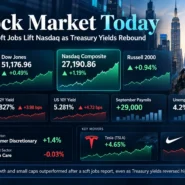
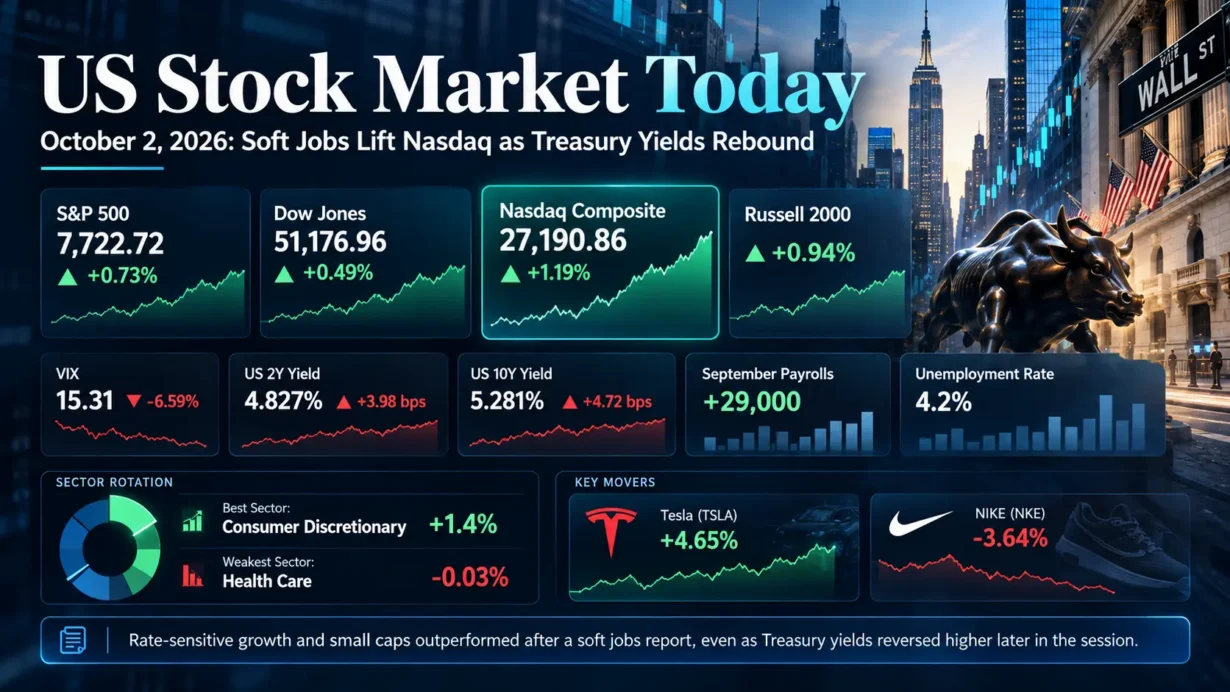
- The S&P 500 rose 0.73% to 7,722.72, the Dow gained 0.49% to 51,176.96, and the Nasdaq Composite advanced 1.19% to 27,190.86. The Russell 2000 added 0.94%, confirming participation beyond mega-cap stocks.
- September nonfarm payrolls increased by 29,000, the unemployment rate was 4.2%, and average hourly earnings rose 0.1% month over month and 3.0% year over year. July and August payrolls were revised down by a combined 60,000.
- Consumer Discretionary led the S&P 500 sectors with a 1.4% gain, helped materially by Tesla. Health Care was the laggard and the only sector to finish lower in the major sector-fund basket.
- The Cboe VIX closed at 15.31, down 6.59%, but Treasury yields reversed their initial post-jobs decline: late-session 2-year and 10-year yields stood at 4.827% and 5.281%, respectively.
1. Market Capital Flows and Sector Rotation:
Friday’s tape combined cyclical risk appetite with selective duration sensitivity rather than a uniform move into every rate-sensitive asset. Consumer Discretionary was the best-performing S&P 500 sector at +1.4%, while Health Care was the laggard; the corresponding S&P 500 Health Care sector ETF proxy finished down 0.03%, the only decline among the 11 major sector funds. Real Estate gained 0.4%. Growth leadership was clear from the Nasdaq’s 1.19% advance versus the Dow’s 0.49%, while the Russell 2000’s 0.94% gain showed that smaller companies also benefited from lower near-term tightening expectations. The mix favored growth and selected cyclicals over defensive exposure, while the weaker Dow performance pointed to relative underperformance from more value-heavy large-cap exposure.
Market breadth was positive but not as strong as the headline S&P 500 gain implied. Advancers led decliners by 1.67-to-1 on the NYSE and 1.34-to-1 on the Nasdaq, while U.S. exchange volume was 16.93 billion shares versus a 20-session average of 17.28 billion. The Invesco S&P 500 Equal Weight ETF rose 0.35%, less than half the capitalization-weighted S&P 500’s 0.73% gain. Internal quality was also mixed: the S&P 500 registered 11 new 52-week highs against 20 new lows, while the Nasdaq recorded 57 new highs and 224 new lows.
Institutional Flow Insight: A plausible institutional interpretation is that investors reduced near-term policy-tightening risk after the soft labor report while retaining exposure to companies with stronger earnings visibility and index weight. That would be consistent with simultaneous strength in mega-cap growth, small caps and Real Estate. However, the late-session rebound in Treasury yields and the equal-weight index’s lag argue against describing the session as a wholesale duration trade. Early-quarter rebalancing may also have contributed, but there is no direct evidence that rebalancing flows were the primary driver. With long yields still elevated, risk budgets are likely to remain sensitive to valuation, cash-flow durability and inflation risk.
2. Decoding the Biggest Market Movers:
Tesla (TSLA)
Tesla closed at $370.59, up 4.65%, after its official Investor Relations release reported third-quarter production of 464,391 vehicles, deliveries of 486,532 vehicles and energy-storage deployments of 13.7 GWh. Tesla explicitly noted that deliveries and storage deployments are only two measures of quarterly performance and should not be used as a proxy for financial results; Q3 financial results are scheduled for October 21. The latest reported financial quarter therefore remains Q2 2026, when Tesla recorded $28.236 billion of revenue, a 16.8% GAAP gross margin, a 1.4% operating margin and $0.32 of diluted GAAP EPS, with free cash flow of negative $1.092 billion. The stock reaction indicates that investors treated the delivery update as supportive for demand expectations, but the investment debate still turns on pricing, product mix, operating leverage and cash conversion rather than unit volume alone. Because Tesla is a major Consumer Discretionary constituent, its move materially strengthened sector performance and helped widen the gap between cap-weighted and equal-weight market returns.
NIKE (NKE)
NIKE closed at $33.87, down 3.64%, and was the worst performer in the Dow. The company’s fiscal Q1 2027 filing showed revenue of $11.213 billion, down 4% reported and 5% currency-neutral, gross margin of 42.8%, up 60 basis points, and diluted EPS of $0.48. NIKE Direct revenue fell 8% reported and 9% currency-neutral, while Greater China revenue fell 22% reported and 26% currency-neutral to $1.180 billion. Management’s formal FY2027 outlook calls for a high-single-digit revenue decline and adjusted diluted EPS of $1.15 to $1.35, excluding approximately $0.15 of Pace restructuring expense. The Pace program targets about $2.5 billion of cumulative savings through fiscal 2031, alongside roughly $1.0 billion of pre-tax charges through fiscal 2031. On the earnings call, management emphasized that growth in the performance portfolio is not yet large enough to offset pressure in Sportswear, Jordan Brand and Greater China. The selloff therefore matters beyond one stock: it reinforces a valuation distinction inside Consumer Discretionary between companies receiving credit for volume or growth momentum and brands still carrying channel-reset, geographic and execution risk.
3. Macro Indicators and Market Outlook
The Cboe VIX closed at 15.31, down 1.08 points or 6.59% from 16.39. That decline was directionally consistent with the equity rally and suggests less demand for near-term index protection after the employment report reduced the perceived risk of an immediate Fed hike. A sub-16 VIX does not remove macro risk, however; it simply shows that S&P 500 option-implied volatility compressed on the day.
Treasury trading sent a more complicated message. Reuters’ late-session marks put the 2-year yield at 4.827%, up 3.98 basis points, and the 10-year at 5.281%, up 4.72 basis points. Both yields initially fell after the payroll report and then reversed higher. The front end still reflected lower odds of an October rate increase: CME FedWatch pricing cited by Reuters put the probability of at least a 25-basis-point hike at 22.7%, down from 24.4% a day earlier and 64.2% a week earlier. But the higher closing-area yields show that one soft labor report did not eliminate inflation, growth or term-premium concerns. Using those late-session marks, the 2s10s curve remained positively sloped by roughly 45 basis points and steepened modestly on the day.
The macro trigger was unusually clean. The Bureau of Labor Statistics reported just 29,000 September payroll gains, a 4.2% unemployment rate, 0.1% monthly wage growth and 3.0% annual wage growth, while revising July and August payrolls down by a combined 60,000. That combination reduced pressure for immediate policy tightening without, by itself, establishing a new easing cycle.
Upcoming Economic Data & Catalysts:
- FOMC Minutes for the September 15-16 meeting (Release date: October 7, 2026): The Federal Reserve will publish the minutes at 2:00 p.m. ET. Investors will focus on the reasoning behind September’s 25-basis-point increase to a 3.75%-4.00% target range and on how policymakers weigh persistent inflation against softer labor-market momentum.
- Consumer Price Index for September 2026 (Release date: October 14, 2026): The Bureau of Labor Statistics will release CPI at 8:30 a.m. ET. The inflation mix will be central to whether Friday’s lower near-term hike probability can persist, and it could materially affect Treasury yields, equity duration and sector leadership.
Market Insights:
The session was broader than a pure mega-cap squeeze, because small caps outperformed the S&P 500 and advance-decline ratios were positive. It was not fully broad-based either: equal-weight performance lagged materially, and new lows exceeded new highs on both the S&P 500 and Nasdaq. The most important reversal risks are a renewed surge in long-term yields, further deterioration in breadth, downward earnings revisions, a volatility rebound or valuation compression in the market’s largest growth stocks.
Trading & Investment Strategy:
A risk-managed approach favors scaling exposure rather than chasing Friday’s strongest gaps. Investors can separate positions with visible earnings and cash-flow support from trades that depend mainly on lower yields, keep position sizes consistent with elevated rate volatility, and use predetermined stop-loss or thesis-break levels. New allocations can be staged across multiple sessions, with sector selection focused on balance-sheet quality and earnings durability. If long yields extend materially above Friday’s levels while equal-weight participation weakens, reducing gross exposure may be more prudent than adding leverage into a narrowing rally.
4. Key FAQs About the US Stock Market Today
Why did the US stock market move on 2 October 2026?
U.S. stocks rose primarily because September payroll growth slowed to 29,000 and prior months were revised lower, reducing expectations for an immediate Federal Reserve rate hike. The Nasdaq benefited most from growth-stock strength, while Tesla’s delivery update boosted Consumer Discretionary. The signal was not uniformly dovish, because Treasury yields reversed higher later in the session.
Which sectors performed best and worst in the US stock market on 2 October 2026?
Consumer Discretionary led the S&P 500 sector indexes with a 1.4% gain, helped by Tesla’s 4.65% advance. Health Care was the laggard and the only major sector-fund proxy to close lower, down 0.03%. The rotation favored growth and cyclical exposure over defensives, although the strong contribution from a few large stocks means the move should not be interpreted as uniform sector-wide risk taking.
What should investors watch after the US stock market close on 2 October 2026?
The next key macro checkpoints are the October 7 FOMC minutes and the October 14 CPI report. In markets, investors should watch whether the 10-year Treasury yield extends above the 5.28% area, whether equal-weight and new-high participation improves, and whether the VIX remains subdued. At the company level, Tesla’s Q3 financial results on October 21 will determine whether strong deliveries translate into acceptable margins and cash flow.
Disclaimer: This article is intended solely for the exchange of investment ideas and does not constitute investment advice of any kind.