
Key Takeaways
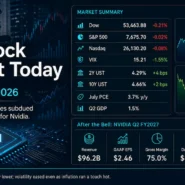
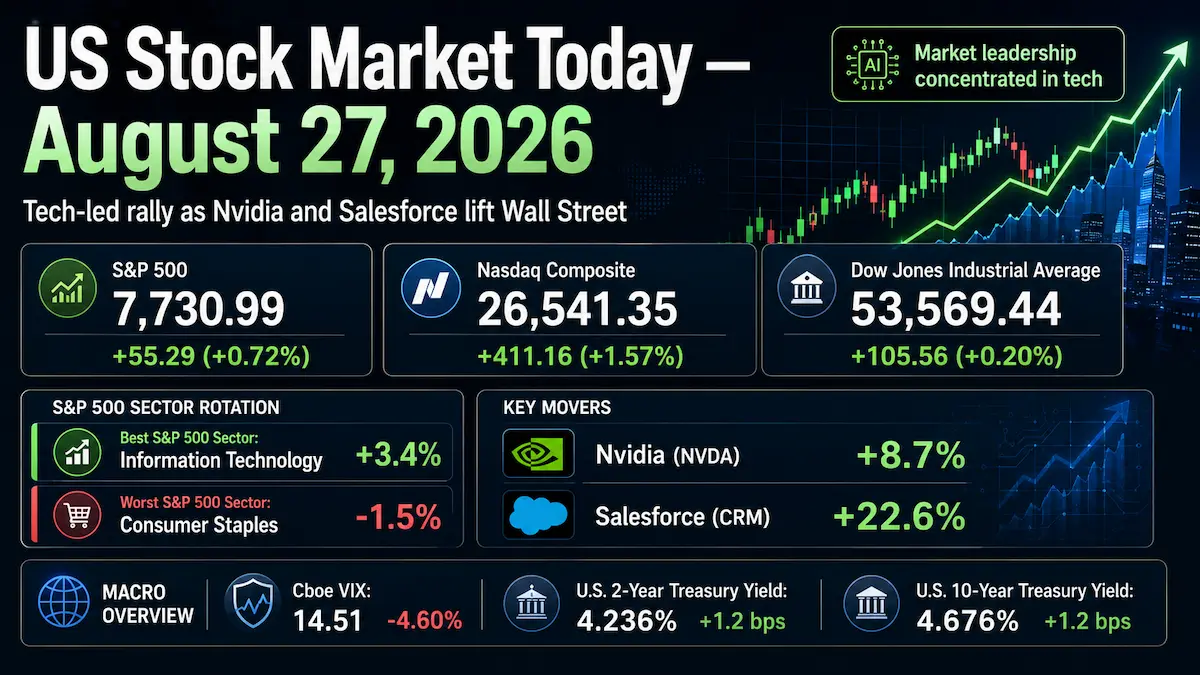
- The S&P 500 rose 0.72% to 7,730.99, the Nasdaq Composite gained 1.57% to 26,541.35, and the Dow added 0.20% to 53,569.44. The Russell 2000 rose only 0.3% to 3,014.34, underscoring the session’s large-cap growth bias.
- Information technology surged 3.4% and was the only positive S&P 500 sector. Consumer staples fell 1.5%, the worst sector, showing that index gains were concentrated rather than broad-based.
- Nvidia jumped 8.74% after reporting Q2 FY27 revenue of $96.221 billion and issuing Q3 revenue guidance of $108.0 billion, plus or minus 2%. Salesforce rallied 22.58% after stronger operating momentum and a higher FY27 revenue outlook.
- The Cboe VIX closed at 14.51, down 4.60%, while the 2-year and 10-year Treasury yields edged up to about 4.236% and 4.676%, respectively. Lower equity volatility therefore coincided with slightly tighter, not easier, rate conditions.
- Initial jobless claims fell to 203,000, while the July advance goods trade deficit widened to $118.8 billion. The data did not deliver a clean disinflationary or growth-slowdown signal ahead of Fed Chair Kevin Warsh’s Jackson Hole remarks.
1. Market Capital Flows and Sector Rotation
The defining feature of Thursday’s session was concentration. S&P 500 information technology gained 3.4%, while all ten other major sectors finished lower. Consumer staples fell 1.5%, the weakest group, while energy declined 0.4% and was the least-negative sector. The pattern was not a conventional broad risk-on rotation: technology and AI-linked growth absorbed capital, but economically sensitive and defensive groups alike mostly lost ground.
Large-cap growth clearly outperformed small caps and value-oriented exposures. The Nasdaq’s 1.57% gain was more than five times the Russell 2000’s 0.3% advance, while the Dow rose just 0.20%. Within the S&P 500, software, semiconductors and other high-duration growth franchises drove the upside, whereas staples, health care and consumer discretionary stocks lagged. Exchange-level breadth was less extreme than sector breadth: declining issues outnumbered advancers by 1.02-to-1 on the NYSE, while Nasdaq advancers led decliners by 1.11-to-1. That combination is consistent with a market in which a relatively small group of high-weight winners had an outsized impact on capitalization-weighted indexes.
Institutional Flow Insight: The tape is consistent with investors reallocating toward companies offering unusually strong earnings visibility, AI infrastructure exposure and demonstrable monetization rather than simply increasing market-wide beta. The fact that Treasury yields rose modestly while technology outperformed suggests earnings revisions and company-specific cash-flow expectations overwhelmed the normal discount-rate headwind for growth stocks. With month-end approaching, benchmark rebalancing may also have amplified relative moves, but there is no public evidence confirming month-end flows as the primary driver. The more defensible conclusion is that risk budgets were being deployed selectively, not indiscriminately.
2. Decoding the Biggest Market Movers
NVIDIA (NVDA)
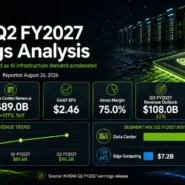
Nvidia closed up 8.74% at $227.98 after its official Q2 FY27 results reinforced the scale and persistence of AI infrastructure demand. Revenue reached $96.221 billion, up 18% sequentially and 106% year over year, while Data Center revenue was $89.0 billion, up 117% from a year earlier. GAAP and non-GAAP gross margins were both 75.0%. GAAP diluted EPS was $2.46 and non-GAAP diluted EPS was $2.22. For Q3 FY27, management guided to revenue of $108.0 billion, plus or minus 2%, with GAAP and non-GAAP gross margins of 74.0%, plus or minus 50 basis points; the outlook assumes no Data Center compute revenue from China.
The earnings call added an important medium-term signal: management described a preliminary FY28 revenue growth outlook of approximately 70% and explicitly characterized it as supply-constrained. That matters for capital allocation because the market is no longer debating only whether AI demand exists; it is increasingly pricing the ability to secure memory, power, networking, packaging and other scarce infrastructure inputs. Nvidia’s rally helped lift the Philadelphia Semiconductor Index 2.3% and materially supported the S&P 500 technology sector. The read-through for the broader AI complex is constructive, but the supply constraint also raises execution and margin risks if component costs rise faster than system economics improve.
Salesforce (CRM)
Salesforce closed up 22.58% at $252.05 after Q2 FY27 results showed better top-line momentum and improving forward visibility. Revenue was $11.345 billion, up 11% year over year. GAAP operating margin was 20.5% and non-GAAP operating margin was 34.1%. GAAP diluted EPS was $4.29 and non-GAAP diluted EPS was $5.90, although investors should note that gains on strategic investments materially boosted reported earnings, making recurring operating metrics more useful for assessing the core business. Current remaining performance obligation reached $33.5 billion, up 14% year over year in constant currency, while Agentforce and Data 360 ARR reached nearly $3.9 billion, up more than 210%.
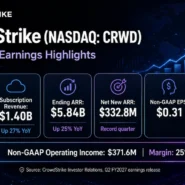
Management raised FY27 revenue guidance to $46.1 billion to $46.4 billion, representing 11% to 12% year-over-year growth, and maintained non-GAAP operating margin guidance at 34.3%. The strategic significance was larger than Salesforce alone. The stock’s surge, alongside a 20.5% gain in CrowdStrike and strength in other software names, reduced near-term fears that generative AI would automatically compress incumbent software economics. For software valuations, the session favored companies demonstrating both AI product adoption and durable recurring-revenue expansion rather than merely attaching an AI narrative to existing products.
3. Macro Indicators and Market Outlook
The Cboe VIX closed at 14.51, down 0.70 point or 4.60%. That decline was directionally consistent with the S&P 500’s advance, but it should not be interpreted as evidence of broad market participation. A capitalization-weighted index can experience lower implied volatility when a small number of mega-cap stocks rally strongly, even while sector dispersion remains elevated. Thursday therefore showed reduced index-level hedging pressure rather than an unambiguous all-clear signal across equities.
Treasury yields moved modestly higher. The 2-year yield rose about 1.21 basis points to 4.236%, while the 10-year yield increased about 1.22 basis points to 4.676%, leaving the 2s10s curve positively sloped by roughly 44 basis points. The near-parallel move suggests there was no dramatic one-day repricing of the Fed path or term premium. Instead, resilient weekly jobless claims and the prior day’s hotter-than-expected PCE inflation reading kept investors from treating strong equity earnings as a reason to price materially easier monetary conditions. The long end also remained sensitive to inflation and fiscal risk.
Oil added another macro constraint. U.S. crude settled 1.58% higher at $83.53 a barrel and Brent rose 2.12% to $89.70 amid renewed uncertainty over U.S.-Iran tensions and supply conditions. A sustained energy-price rebound would complicate the inflation outlook and could keep pressure on longer-duration assets even if corporate earnings remain strong.
Upcoming Economic Data & Catalysts:
- Federal Reserve Chair Kevin Warsh’s Jackson Hole remarks (Release date: August 28, 2026): The Kansas City Fed has scheduled the Chair’s remarks for 10:00 a.m. EDT. Investors will focus on how he frames persistent inflation, financial conditions and the Fed’s policy reaction function rather than assuming any single speech commits the FOMC to a near-term rate move.
- U.S. Employment Situation for August 2026 (Release date: September 4, 2026): The Bureau of Labor Statistics will release payrolls, unemployment and wage data at 8:30 a.m. ET. The report will be important for assessing whether weak July payroll growth was temporary and how labor-market conditions interact with inflation and rate expectations.
Market Insights:
The August 27 advance was driven primarily by a narrow set of large technology stocks rather than broad risk appetite. That distinction matters because index-level resilience can persist even while the median stock weakens, but it also makes the market more sensitive to earnings revisions in a small number of high-weight companies. Risks that could reverse the trend include a renewed jump in Treasury yields, deterioration in market breadth, negative AI-related earnings revisions, a policy surprise from the Fed, another oil-driven inflation shock, or a sustained breakout in implied volatility from the mid-teens.
Trading & Investment Strategy:
Risk management should take precedence over chasing large post-earnings gaps. Investors seeking additional technology exposure can consider staggered entries and emphasize businesses with realized revenue growth, recurring cash flows and balance-sheet capacity to fund AI investment. Position sizes should account for the unusually high concentration of index returns in a few names. Predefined loss limits, disciplined rebalancing and avoiding excessive leverage are particularly important when valuations depend on multi-year earnings delivery. For diversified portfolios, adding to technology beta is more defensible when funded by lower-conviction exposures rather than by simply increasing gross risk.
4. Key FAQs About the US Stock Market Today
Why did the US stock market move on 27 August 2026?
The S&P 500 and Nasdaq rose mainly because Nvidia’s results and official guidance reinforced confidence in AI infrastructure demand, while Salesforce’s earnings improved sentiment toward enterprise software. The move occurred despite slightly higher Treasury yields, resilient jobless-claims data and lingering inflation concerns, so the dominant force was corporate earnings rather than a broad easing in macro conditions.
Which sectors performed best and worst in the US stock market on 27 August 2026?
Information technology was the best S&P 500 sector, rising 3.4%, and was the only sector to finish positive. Consumer staples was the worst, falling 1.5%. The rotation favored earnings-backed technology growth over both defensive groups and most cyclical sectors, reinforcing the conclusion that the rally was concentrated rather than market-wide.
What should investors watch after the US stock market close on 27 August 2026?
The immediate catalyst is Fed Chair Kevin Warsh’s August 28 Jackson Hole address, followed by the August Employment Situation on September 4. Investors should also monitor whether the 10-year Treasury yield continues to rise, whether S&P 500 breadth improves beyond technology, and whether post-earnings gains in AI and software leaders hold without a corresponding rise in the VIX. A healthy continuation would benefit from broader participation; further index gains accompanied by weakening breadth would increase concentration risk.
Disclaimer: This article is intended solely for the exchange of investment ideas and does not constitute investment advice of any kind.