

Key Takeaways
- Solaris Energy Infrastructure has undergone a fundamental identity shift. The company that entered public markets in 2017 as Solaris Oilfield Infrastructure is increasingly a power-infrastructure platform whose economic engine is long-duration equipment leasing plus higher-value technical and operating services.
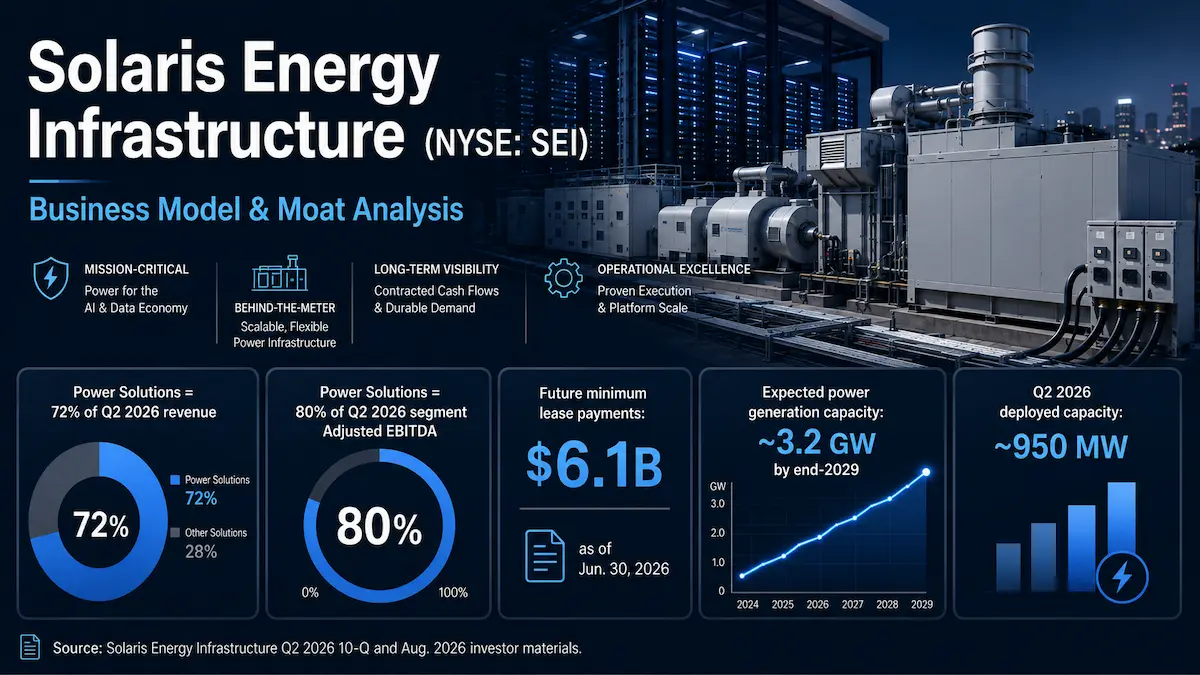
- The highest-quality part of the model is the contractualization of a capital-intensive asset base. At June 30, 2026, Solaris reported approximately $6.1 billion of future minimum lease payments under long-term lessor arrangements. That figure is not the same as backlog or guaranteed profit, but it materially improves revenue visibility relative to a conventional spot-oriented oilfield-services model.
- The most defensible moat is switching cost rather than brand or network effects. Once Solaris has engineered, installed, commissioned, integrated and operates mission-critical power infrastructure at a data-center site, replacing the provider becomes operationally disruptive, technically complex and potentially costly in downtime.
- The platform strategy is moving upstream and downstream across the power stack: generation, control and distribution, balance-of-plant equipment, batteries and energy-management systems, installation and commissioning, operations and maintenance, aftermarket repair, and selected fuel-management services. Each added layer can increase customer wallet share and deepen integration.
- The primary risks are equally structural: heavy capital requirements, rising debt service, execution risk on multi-hundred-megawatt projects, supplier concentration and unusually high customer concentration. In the second quarter of 2026, one customer accounted for 63% of company revenue.
Research cutoff: August 25, 2026. This analysis refers to Solaris Energy Infrastructure, Inc. (NYSE: SEI), not SEI Investments Company (Nasdaq: SEIC).
1. Business Model Breakdown
From oilfield logistics equipment to power infrastructure
Solaris was formed in 2014 around a very different problem: improving the handling and movement of proppant and other raw materials used in hydraulic fracturing. Its original business was essentially an equipment-enabled logistics model. The company designed and rented specialized systems, supported them with field technicians and software, and helped operators reduce bottlenecks during well completions. Solaris completed its IPO in May 2017 under the ticker SOI.
The defining strategic break occurred in 2024. Solaris agreed to acquire Mobile Energy Rentals for $200 million and, after closing the transaction in September, renamed itself Solaris Energy Infrastructure and changed its NYSE ticker to SEI. That transaction did more than add a new product line. It redirected capital allocation from oilfield logistics toward distributed power generation, giving Solaris an entry point into data centers, energy infrastructure and other commercial and industrial applications where access to electricity can be more valuable than access to the grid itself.
The transformation has accelerated since then. Solaris acquired HVMVLV in 2025 to add electrical control and distribution capabilities, acquired Genco Power Solutions in March 2026 to expand generation capacity and turbine delivery access, and acquired Global Energy Services Alliance in July 2026 to bring installation, commissioning, operations, maintenance and aftermarket capabilities further in-house. The result is a company that is trying to own more of the critical-path power stack rather than simply rent generators.
How Solaris actually makes money
The Solaris Energy Infrastructure business model now has two reportable segments: Solaris Power Solutions and Solaris Logistics Solutions. Their economic profiles are increasingly different.
Solaris Power Solutions provides power generation, control and distribution infrastructure to data centers, energy customers and other commercial and industrial users. Monetization is built around equipment leasing and service revenue. Under its leasing arrangements, payments are generally fixed through the lease term and recognized on a straight-line basis. For certain turbine arrangements, operations and maintenance activities are bundled with the equipment lease for accounting purposes. Newer contracts also include broader scopes such as balance-of-plant equipment, energy storage, energy-management systems, infrastructure support and, in at least one 2026 agreement, natural-gas procurement and management on a cost-plus basis.
This matters because Solaris is not primarily selling electricity into a merchant market. The economic logic is closer to infrastructure-as-a-service: deploy large amounts of capital into mission-critical power assets, secure multi-year contractual payments, then layer engineering and operating services around those assets. The customer gains speed-to-power and outsourced technical execution; Solaris seeks a return on invested capital through fixed lease economics, utilization and incremental service scope.
In the second quarter of 2026, company-wide leasing revenue was approximately $105.7 million and service revenue was approximately $113.7 million. Within Power Solutions specifically, leasing revenue was approximately $105.7 million and service revenue was approximately $52.6 million. The segment produced approximately $158.3 million of revenue and $96.4 million of segment Adjusted EBITDA, implying a segment Adjusted EBITDA margin of roughly 61% based on reported figures. That margin should not be confused with free-cash-flow margin: the business is highly capital intensive, and depreciation, financing costs and growth capital expenditures are economically significant.
Solaris Logistics Solutions remains the legacy cash-generating franchise. It designs and manufactures specialized systems used to manage raw materials at oil and gas well-completion sites and provides field support, software, last-mile and mobilization services. In the second quarter of 2026, Logistics generated approximately $61.1 million of revenue and $24.8 million of segment Adjusted EBITDA. It remains relevant, but management’s capital allocation has decisively shifted toward Power Solutions.
The underlying profit algorithm
The core earnings algorithm is increasingly straightforward. First, Solaris secures or orders generation equipment and associated electrical infrastructure. Second, it contracts those assets to customers under multi-year rental arrangements. Third, it expands the commercial scope around each site by adding control, distribution, energy storage, installation, commissioning, operations, maintenance and other ancillary services. Fourth, it attempts to reuse the technical platform, supplier relationships and financing capacity across additional projects.
The model works best when three conditions are present simultaneously: high equipment utilization, long contract duration and disciplined capital deployment. Contract length lowers cash-flow volatility. Utilization spreads fixed ownership and support costs over a larger revenue base. Broader service scope can lift revenue per megawatt without requiring Solaris to compete purely on equipment rental price.
The contractual profile is already becoming economically material. As of June 30, 2026, Solaris disclosed approximately $6.1 billion of future minimum lease payments expected under long-term lessor arrangements, including leases already commenced and leases expected to commence in the future. This is an important visibility metric, but it should not be treated as equivalent to guaranteed cash flow: project timing, customer performance, contract terms, execution and the cost of funding the associated asset base still determine realized returns.
2. Deep Dive into Economic Moats
Solaris should not be assigned a wide moat simply because demand for AI power is strong, its fleet is expanding or its revenue is growing rapidly. Those are favorable industry conditions, not durable competitive advantages. A proper moat test asks whether competitors can reproduce the economics, how expensive it would be to displace Solaris after deployment, and whether the advantage survives a more normal supply-demand environment.
Switching Costs: the strongest emerging moat
The most credible moat is switching cost. Large behind-the-meter power systems are not commodity rental boxes once deployed at scale. They can involve hundreds of megawatts of generation, control systems, transformers, switchgear, batteries, emissions equipment, fuel interfaces, plant controls, software, commissioning, maintenance procedures and site-specific operating protocols. For an AI data-center customer, the relevant product is not simply a turbine; it is dependable power availability tied to a highly valuable computing asset.
That creates a meaningful asymmetry. Before deployment, customers can compare multiple technologies and providers, and Solaris itself acknowledges that sales cycles can be lengthy. After a provider has engineered and commissioned the system, however, replacement can require requalification, equipment substitution, electrical redesign, new commissioning procedures and operational migration. The theoretical ability to switch remains, but the practical cost can become significant because the penalty for disruption is measured in lost uptime rather than just equipment-rental expense.
Long-term contracts reinforce this operational switching cost with contractual duration. In 2026, Solaris expanded one AI-related project to approximately 660 MW under a 10-year base term with an eight-year extension option. Another approximately 640 MW project carries a 10-year initial term with a five-year extension option. These arrangements do not make Solaris impossible to replace, but they reduce the frequency at which the customer can economically rebid the entire stack.
For a competitor to overcome this advantage, it must do more than quote a lower monthly rental rate. It must demonstrate sufficient equipment capacity, engineering depth, commissioning capability, operating reliability, balance-sheet support and confidence that a transition will not endanger a mission-critical load. That raises the effective hurdle for displacement.
Intangible Assets and Technical Integration: moderate today, potentially stronger over time
Solaris’ second-most defensible advantage is a developing base of technical know-how, operating experience and embedded customer relationships. This is not a classic brand moat, and it is not fully proprietary. Skilled engineers can be hired away, competing turbine platforms exist and many components of the power stack are manufactured by third parties. The company itself identifies equipment reliability, technical expertise, bundled service capability, capacity, safety, experience and price as key competitive variables.
However, the acquisitions of HVMVLV and GESA change the quality of the offering. HVMVLV moved Solaris deeper into electrical control and distribution, while GESA added installation, commissioning, life-of-asset operations, maintenance and aftermarket repair across a broad range of generation technologies. These capabilities can shorten handoffs between vendors and give Solaris more control over project execution. The intangible asset is therefore less about patents and more about accumulated integration capability across a complex physical system.
The durability test is whether that know-how converts into repeatable project outcomes: on-time delivery, higher uptime, lower lifecycle operating friction and repeat business from sophisticated customers. If customers repeatedly expand scope after initial awards, the evidence for an intangible execution moat strengthens. The August 2026 disclosure that three long-term contracts had been expanded, adding more than $100 million of expected annual Adjusted EBITDA, is directionally supportive. It is still too early, however, to treat execution reputation as an impregnable franchise.
Network Effects: essentially absent
There is no meaningful network effect in the traditional sense. A new Solaris customer does not automatically make the service more valuable to every existing customer. Scale can improve procurement, labor utilization, financing access and service coverage, but those are scale economies or execution benefits, not network effects. Investors should not apply software-platform economics to a physical infrastructure business simply because the customer base includes AI companies.
Cost Advantages: possible, but not yet proven as a structural moat
Solaris may be developing a cost and time advantage through fleet scale, turbine delivery positions, integrated services and access to capital. In March 2026, the company acquired Genco and additional turbine delivery slots, increasing its planned generation capacity. By June 2026, management expected total power generation capacity to reach approximately 3.2 GW by the end of 2029, with the majority already committed under commercial agreements.
The strategic value of that capacity is partly temporal. When grid interconnection or utility infrastructure takes too long, the provider able to deliver reliable behind-the-meter power sooner can create enormous economic value for the customer. Solaris’ competitive edge may therefore be better described as a time-to-power advantage than a proven lowest-cost advantage.
That distinction is important. Delivery slots, supplier access and financing can be competed away over time. Larger utilities, independent power producers, equipment-rental companies and well-capitalized infrastructure sponsors can add capacity. A durable cost moat would require evidence that Solaris consistently delivers a lower lifecycle cost or higher return on capital than capable peers. The available public record does not yet prove that. For now, cost advantage should be classified as emerging rather than established.
3. Business Inflection Points & Future Catalysts
The decisive inflection point: the 2024 Mobile Energy Rentals acquisition
The acquisition of Mobile Energy Rentals was the most consequential strategic turning point in Solaris’ history. Before the transaction, the company’s economic identity was tied to North American well-completion activity. After the acquisition, management had a credible pathway into distributed power, and the company explicitly repositioned itself as Solaris Energy Infrastructure.
The financial mix now confirms that this was not merely a rebranding exercise. In the second quarter of 2026, Power Solutions represented 72% of total revenue and 80% of total segment Adjusted EBITDA. In 2025, Power Solutions had already become the larger segment by revenue and earnings contribution. The corporate center of gravity has moved from moving sand to delivering electricity infrastructure.
Catalyst 1: conversion of contracted megawatts into revenue and cash earnings
The largest near-term catalyst is execution on the substantial contracted power portfolio scheduled to ramp from late 2026 through 2028. Solaris averaged approximately 950 MW of power capacity earning revenue in the second quarter of 2026, while its contracted and on-order capacity is materially larger. The approximately 660 MW Hatchbo project is expected to commence revenue recognition and deployment in the first quarter of 2027 and scale through 2028. The separate approximately 640 MW technology-customer project is scheduled to begin deployments in late 2026 and also scale through 2028.
The transmission mechanism is direct: more deployed megawatts should raise fixed leasing revenue; expanded balance-of-plant, battery and operating scope should add service revenue; and higher utilization of the technical organization can create operating leverage. If project execution remains disciplined, the earnings mix should become increasingly dominated by long-duration Power Solutions contracts.
Observable indicators include average megawatts earning revenue, Power Solutions revenue, Power Solutions segment Adjusted EBITDA, future minimum lease payments, deferred revenue, capital expenditures versus deployment schedules and the percentage of capacity committed under contract. A particularly important quality indicator is whether customer concentration falls as the second and third major AI customers begin contributing material revenue.
The principal risks are schedule slippage, equipment delivery delays, commissioning problems, interconnection or site-readiness issues, cost overruns, supplier bottlenecks and customer-specific delays. Customer concentration amplifies these risks. One customer represented 63% of second-quarter 2026 revenue and 68% of accounts receivable at June 30, 2026. A delayed project for a dominant customer can therefore affect both growth and working capital disproportionately.
Catalyst 2: higher wallet share through full-lifecycle power services
The second catalyst is the expansion from generation rental into a more complete lifecycle offering. The strategic sequence is visible: generation capacity from MER and Genco, power control and distribution through HVMVLV, expanded balance-of-plant and battery scope in 2026 contracts, and installation, commissioning, O&M and aftermarket capability through GESA.
The economic mechanism is attractive if executed well. A customer that already trusts Solaris to deliver the generation asset may prefer one accountable party for electrical integration, startup, ongoing operations and maintenance. That can increase revenue per installed megawatt, create more recurring service income and deepen switching costs. It can also create a third-party aftermarket business that monetizes GESA’s technical expertise even where Solaris does not own the generation assets.
Observable indicators should include growth in Power Solutions service revenue, ancillary-service contribution, segment Adjusted EBITDA per deployed megawatt, evidence of third-party O&M and aftermarket revenue, repeat scope expansion from existing customers, and operating expense growth relative to service gross profit. The August 2026 disclosure that second-quarter Power Solutions Adjusted EBITDA increased 34% sequentially, primarily because of higher ancillary service revenue, is an early signal that scope expansion can matter economically.
Execution risk is substantial. Vertical integration can create complexity as quickly as it creates value. Solaris must retain specialized personnel, integrate acquisitions, coordinate more project stages and avoid becoming the party responsible for every failure point without receiving adequate pricing. GESA also introduces international operating exposure. If integration costs rise faster than customer wallet share, the platform strategy could dilute returns rather than enhance them.
Catalyst 3: a possible quality re-rating as the earnings base becomes more contracted
The third catalyst is not a specific product launch; it is a change in how the business may be economically classified. A company dominated by spot-oriented oilfield activity typically receives a cyclical valuation framework. A company dominated by long-duration infrastructure contracts with visible minimum lease payments can be analyzed differently because earnings visibility, asset duration and customer behavior differ.
Solaris is moving in that direction, but the transition is incomplete. The company reported approximately $6.1 billion of future minimum lease payments at June 30, 2026, versus approximately $2.2 billion at year-end 2025. Power Solutions is already the dominant earnings contributor. Management also completed approximately $2 billion of financing transactions in May 2026, including $1.3 billion of 6.375% senior notes and a $650 million revolving credit facility, to fund the growth program and replace more expensive acquisition financing.
The transmission mechanism for a quality re-rating would be a higher proportion of earnings from contracted power, rising customer diversification and evidence that cash returns on deployed assets exceed the cost of capital after maintenance spending and interest expense. Investors should monitor Power Solutions’ share of total EBITDA, debt and interest coverage, free cash flow after growth capital expenditures, dilution from equity and convertible securities, and the ratio of contracted cash inflows to committed capital spending.
The risk is that contract duration can create the appearance of infrastructure quality without guaranteeing attractive equity economics. Solaris is spending heavily: capital expenditures in the first six months of 2026 exceeded $835 million, with the overwhelming majority directed to Power Solutions. The company also carries substantial debt and convertible securities. If AI infrastructure demand slows, project returns disappoint, financing costs remain elevated or equipment becomes oversupplied, a higher-quality revenue mix may not translate into a higher-quality return on invested capital.
What could invalidate the thesis
The central bear case is not simply that AI spending slows. A more important failure mode would be that Solaris wins long-duration contracts but earns inadequate returns after funding costs, depreciation, maintenance and execution risk. In that scenario, revenue visibility rises while economic value creation does not.
Other thesis breakers include major customer defaults or renegotiations, persistent concentration around one or two counterparties, turbine or electrical-equipment supply constraints, large project delays, weaker-than-expected equipment residual values, accelerated grid availability that reduces the urgency of behind-the-meter solutions, lower-cost competing technologies, material regulatory restrictions on gas-fired generation, and integration failures across newly acquired technical businesses.
4. Key FAQs
How does Solaris Energy Infrastructure make money from AI data centers?
Solaris primarily monetizes AI data-center demand by deploying behind-the-meter generation and related electrical infrastructure under multi-year rental arrangements, then adding technical services around the asset base. The company earns fixed lease payments for power equipment and can also earn service revenue from balance-of-plant systems, energy storage, installation, commissioning, operations, maintenance and other infrastructure support. The commercial logic is to sell speed, reliability and outsourced execution rather than merchant electricity exposure.
What is Solaris Energy Infrastructure’s competitive moat in behind-the-meter power?
The strongest moat is switching cost after deployment. Large data-center power systems are site-specific and operationally critical, so replacing an incumbent provider can require technical redesign, recommissioning and exposure to downtime. Solaris is also building an integration advantage by combining generation, distribution, batteries, energy-management systems and lifecycle services. However, the moat is still emerging: network effects are essentially absent, and a permanent structural cost advantage has not yet been proven.
Is Solaris Energy Infrastructure still an oilfield services company?
Partly, but that description is increasingly incomplete. Solaris Logistics Solutions still serves oil and gas well completions and remains profitable, yet Power Solutions has become the dominant business. In the second quarter of 2026, Power Solutions generated 72% of total revenue and 80% of total segment Adjusted EBITDA. The more accurate description is a power-infrastructure company with a legacy oilfield-logistics franchise.
5. Conclusion
Solaris Energy Infrastructure’s corporate gene is pragmatic infrastructure engineering rather than pure technology. The company began by solving physical bottlenecks in oilfield logistics and has carried the same operating philosophy into electricity: identify a constrained part of the industrial value chain, own or control specialized equipment, wrap services around the equipment and monetize reliability.
The 2024 acquisition of Mobile Energy Rentals changed the addressable market and the duration of the cash-flow model. Subsequent acquisitions have broadened Solaris from generation rental into a more integrated power platform spanning electrical distribution, balance-of-plant equipment, batteries, installation, commissioning, operations, maintenance and aftermarket support. The strategic objective is clear: become embedded in the customer’s critical power architecture early enough that Solaris captures more economics over the full asset lifecycle.
The investment-quality question is therefore not whether demand for AI power is strong; that is already visible. The more important question is whether Solaris can convert scarce equipment access and rapid deployment into durable switching costs and attractive returns on a very large capital base. If contract execution, customer diversification and post-capex cash returns improve together, the business can increasingly resemble contracted infrastructure. If debt, concentration and project complexity grow faster than economic returns, the same strategy can magnify downside.
At this stage, Solaris has a credible emerging moat, not a fully proven one. The next one to two years should provide unusually clear evidence because several large projects are moving from contract signing into deployment. The most informative metrics will be deployed megawatts, recurring lease payments, service revenue per megawatt, customer concentration, free cash flow after capital expenditures and returns earned relative to the company’s rising funding cost.
Primary Sources
- U.S. SEC — Solaris Energy Infrastructure Form 10-Q for the quarter ended June 30, 2026
- Solaris Energy Infrastructure Investor Relations — Second Quarter 2026 Results and Contract Expansions
- U.S. SEC — Solaris Energy Infrastructure 2025 Form 10-K
- Solaris Energy Infrastructure Investor Relations — Completion of Mobile Energy Rentals Acquisition and Corporate Renaming
- Solaris Energy Infrastructure Investor Relations — 900 MW Capacity Expansion and Genco Acquisition
- Solaris Energy Infrastructure Investor Relations — Approximately $2 Billion of Growth Financing and Contract Expansion
- Solaris Energy Infrastructure Investor Relations — Global Energy Services Alliance Acquisition
- Solaris Investor Relations — 2017 Initial Public Offering Pricing
- Solaris Energy Infrastructure — Official Corporate Website
Disclaimer: This article is intended solely for business logic discussion and corporate research purposes, and does not constitute investment advice of any kind.