

⚡ Key Takeaways
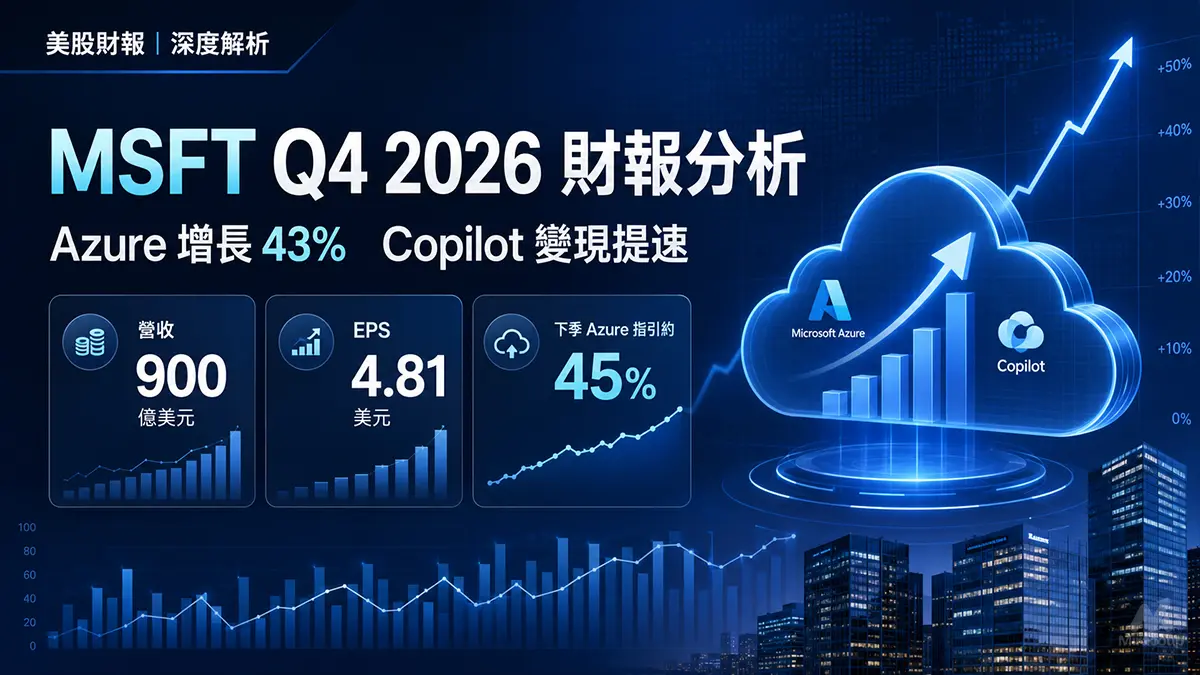
- Microsoft delivered a clean operational beat: Q4 FY2026 revenue reached $90.01 billion, up 18% year over year, while adjusted EPS of $4.74 exceeded the $4.24 consensus estimate.
- Azure is accelerating rather than normalising: Azure revenue grew 43%, versus approximately 40% expected, while management guided for roughly 45% constant-currency growth in Q1 FY2027.
- The key debate has shifted from AI demand to AI returns: commercial RPO reached $678 billion, but quarterly capital expenditure rose to $41 billion and free cash flow fell to $19.6 billion.
Microsoft reported its fiscal fourth quarter ended June 30, 2026, with results that materially changed the investment debate around the company. The headline was not simply another revenue and EPS beat. The more important development was the simultaneous acceleration of Azure, rapid adoption of Microsoft 365 Copilot and evidence that infrastructure efficiency gains are being converted into revenue almost immediately.
The print substantially reduced near-term concerns that Microsoft’s AI capital expenditure cycle was running ahead of monetisation. However, after the sharp post-earnings share-price rerating, investors must now distinguish between genuine operating leverage and accounting or investment-related benefits that may not repeat.
Part 1: Core Earnings Breakdown
1. Revenue and Profitability Analysis
- Total revenue: $90.01 billion, up 18% year over year and 17% in constant currency.
- Gross profit: $60.48 billion, representing a gross margin of approximately 67.2%.
- Operating income: $40.60 billion, up 18%, producing an operating margin of approximately 45.1%.
- GAAP net income: $35.77 billion, up 31%.
- GAAP diluted EPS: $4.81, up 32%.
- Adjusted diluted EPS: $4.74, up 23%, excluding the impact of Microsoft’s OpenAI investments.
Microsoft disclosed that several discrete items added approximately $0.27 to diluted EPS relative to its previous guidance, including a $3.2 billion gain on its Anthropic investment and lower-than-expected voluntary retirement expenses, partially offset by severance and Xbox impairment charges.
A rough normalisation therefore puts underlying EPS near $4.47. That figure would still exceed the $4.24 consensus estimate, indicating that the quarter was not merely an investment-marking exercise. The underlying businesses also delivered a meaningful beat.
Business Segment | Q4 FY2026 Revenue | Share of Total Revenue | Year-over-Year Growth | Short Assessment |
|---|---|---|---|---|
Intelligent Cloud | $39.31 billion | 43.7% | 32% | The primary growth engine, driven by 43% Azure growth and immediate monetisation of newly available computing capacity. |
Productivity and Business Processes | $37.85 billion | 42.0% | 14% | A high-quality result supported by Microsoft 365 Copilot, E5 and early E7 adoption, rather than basic seat expansion alone. |
More Personal Computing | $12.85 billion | 14.3% | -4% | Windows and Xbox remained a drag, but the segment is now too small to offset the strength of Microsoft’s cloud and productivity franchises. |
Bottom line: Microsoft is increasingly a cloud, enterprise software and AI consumption company. The weakness in PCs and gaming matters to earnings quality, but no longer determines the direction of the group.
2. Expectations Versus Actual Results
Metric | Actual Result | Expectation | Variance | Result |
|---|---|---|---|---|
Total revenue | $90.01 billion | $87.62 billion consensus | +$2.39 billion, or +2.7% | ✅ Beat |
Adjusted diluted EPS | $4.74 | $4.24 consensus | +$0.50, or +11.8% | ✅ Beat |
Operating margin | 45.1% | Approximately 44.0% implied by the midpoint of prior management guidance | Approximately +110 basis points | ✅ Beat |
Azure revenue growth | 43% | Approximately 40% consensus | Approximately +300 basis points | ✅ Beat |
The operating-margin comparison uses the midpoint of Microsoft’s previous revenue, cost-of-revenue and operating-expense guidance. The implied margin was approximately 44.0%, compared with an actual result of 45.1%.
Q1 FY2027 Management Guidance
Metric | Q1 FY2027 Guidance | Investment Interpretation |
|---|---|---|
Total revenue | $89.85 billion to $90.95 billion | The $90.40 billion midpoint was above the pre-earnings market consensus of approximately $89.66 billion. |
Productivity and Business Processes | $36.70 billion to $37.00 billion | Growth of 11% to 12%, with Microsoft 365 commercial cloud expected to accelerate later in FY2027. |
Intelligent Cloud | $40.95 billion to $41.25 billion | Growth of 33% to 34%, indicating that cloud momentum should strengthen further. |
Azure growth | Approximately 45% in constant currency | A powerful signal that Azure’s Q4 acceleration was not a one-quarter timing benefit. |
More Personal Computing | $12.20 billion to $12.70 billion | Continued pressure from PC demand, component inflation, elevated inventory and difficult Windows comparisons. |
Operating margin | Relatively flat year over year | Management expects infrastructure and product efficiencies to offset much of the AI investment burden. |
Capital expenditure | More than $50 billion | Microsoft remains in an aggressive capacity build-out despite improving efficiency and utilisation. |
For the full FY2027 year, Microsoft expects double-digit revenue and operating-income growth, operating expenses to rise by a mid-to-high-single-digit percentage, operating margin to decline by less than one percentage point and free cash flow to remain positive.
3. Earnings Call Highlights
- “Demand continues to exceed available supply.” 💡 Reading Between the Lines: Azure growth is still being limited by infrastructure availability rather than customer demand. Because additional CPU and GPU capacity is monetised almost immediately, faster deployment and better utilisation can translate directly into incremental quarterly revenue.
- “Any given model at any given time is swappable.” 💡 Reading Between the Lines: Microsoft does not want Azure’s economics to depend on one external model provider. By separating customer data, memory, context and agent orchestration from the underlying model, Azure can become the neutral enterprise control layer for OpenAI, Anthropic, Mistral, open-source and Microsoft’s own models.
- “It’s seat plus usage.” 💡 Reading Between the Lines: Microsoft is evolving from fixed software licensing into a hybrid licence-and-consumption model. This can materially expand ARPU and total addressable market, although heavier usage may pressure gross margins until pricing and infrastructure efficiencies catch up.
Part 2: Deep Business Insights
1. Hidden Key Metrics the Market Should Not Ignore
Commercial RPO Quality Is More Important Than the 84% Headline Growth
Microsoft’s commercial remaining performance obligation reached $678 billion, up 84% year over year. However, the more important disclosures were:
- Commercial RPO still increased 25% when OpenAI was excluded.
- All sequential RPO growth came from customers outside the leading frontier-model companies.
- Approximately 30% of RPO will be recognised during the next 12 months, with that portion up 37% year over year.
- The portion expected to be recognised beyond 12 months increased 112%.
This addresses one of the largest bear arguments surrounding Microsoft: that its cloud backlog may be overly concentrated in a small number of AI laboratories. The quarter instead showed broadening enterprise demand across industries, customer sizes and geographies.
Free Cash Flow Is the Real Constraint on the AI Investment Story
Operating cash flow increased 30% to $55.4 billion, yet free cash flow declined to $19.6 billion after $35.8 billion of cash property and equipment expenditure. Total quarterly capital expenditure, including finance leases, reached approximately $41 billion.
Roughly two-thirds of capital expenditure went toward shorter-lived assets, primarily CPUs and GPUs. This provides Microsoft with more flexibility than a conventional long-duration infrastructure build: management can slow hardware purchases more quickly if demand weakens. The trade-off is a higher ongoing reinvestment requirement because these assets have shorter economic lives.
Investors should not interpret the reduction in calendar-year 2026 reported capital expenditure from approximately $190 billion to $175 billion as a genuine spending cut. Management explicitly stated that the change largely reflects the extension of estimated data-centre useful lives from 15 to 25 years, causing more future leases to be classified as operating leases rather than finance leases. The underlying investment plan was described as unchanged.
Why Enterprise Customers Choose Microsoft
Microsoft’s differentiation is not based on having the single best foundation model. Its competitive advantage is the ability to combine multiple models with enterprise data, identity, security, governance, development tools and existing workflows.
- Model choice: Azure offers more than 11,000 models and allows customers to select models according to cost, latency, quality and compliance requirements.
- Distribution: Microsoft already controls critical enterprise interfaces through Microsoft 365, Teams, GitHub, Dynamics, Windows and security products.
- Enterprise context: Fabric, Foundry, Work IQ and Microsoft’s database services connect agents to structured and unstructured corporate data.
- Governance: Agent 365 extends identity, security, audit, observability and financial controls to AI agents.
- Customer IP protection: Microsoft is positioning the model as a replaceable input while customers retain control of their data, context, workflows and accumulated institutional knowledge.
This architecture lowers the perceived risk of vendor or model lock-in while increasing the practical switching costs around Microsoft’s broader enterprise platform.
2. Supply-Chain Read-Through
✅ NVIDIA: Direct Beneficiary, but Custom Silicon Is a Long-Term Counterweight
Microsoft said it plans to be among the first cloud providers to deploy NVIDIA’s next-generation Vera Rubin rack-scale infrastructure. With more than $50 billion of Q1 FY2027 capital expenditure planned and customer demand still exceeding capacity, NVIDIA should continue to benefit from hyperscale accelerator, networking and system demand.
The caveat is that Microsoft is simultaneously investing in its own Maia silicon and model-efficiency improvements. These initiatives are unlikely to displace NVIDIA in the near term, but they could gradually reduce Microsoft’s dependency on the highest-cost third-party accelerators and limit supplier pricing power.
✅ AMD: Improving Position Across Both GPU and CPU Workloads
Microsoft also intends to deploy AMD Helios infrastructure and emphasised that CPUs remain important for running enterprise agents. This creates a broader opportunity for AMD across accelerators, server CPUs and integrated rack-scale systems.
For AMD, Microsoft represents more than a conventional hardware customer. Azure adoption can validate AMD’s platform for enterprise AI workloads and potentially improve demand from other cloud providers and large corporate buyers.
3. Valuation Framework and Potential Risks
At the latest quoted price of approximately $451.10 following the earnings reaction, Microsoft had a market capitalisation of approximately $3.36 trillion. Based on FY2026 GAAP EPS of $17.95, the shares traded at roughly 25.1 times trailing earnings. Using adjusted FY2026 EPS of $17.28, the multiple was approximately 26.1 times.
That valuation is not excessive in isolation for a company delivering double-digit revenue growth, Azure acceleration and substantial recurring revenue. However, the approximately 15.6% one-day share-price rally means the market is no longer pricing Microsoft merely as a defensive software compounder.
The current valuation increasingly assumes:
- Azure can sustain growth near the mid-40% range despite a substantially larger revenue base.
- Microsoft 365 Copilot can move beyond pilot deployments and become a meaningful seat-plus-consumption business.
- Infrastructure efficiency, custom silicon and model optimisation can protect margins during the capital expenditure cycle.
- The $678 billion commercial backlog converts into revenue without major cancellations, renegotiations or customer-concentration issues.
- Free cash flow can recover as the timing gap between infrastructure investment and AI monetisation narrows.
Key Risks
- Cash-conversion risk: Revenue and operating income may remain strong while free cash flow stays under pressure from sustained infrastructure expenditure and lease payments.
- Margin risk: Higher Copilot and GitHub usage increases compute costs. Usage-based pricing and efficiency improvements must scale quickly enough to preserve software-like margins.
- Capacity-cycle risk: Demand currently exceeds supply, but an eventual slowdown could leave Microsoft with underutilised data-centre capacity or less favourable returns on hardware purchased at elevated prices.
- Model commoditisation: Cheaper and increasingly capable open models may reduce the value captured at the model layer, placing more pressure on Microsoft to monetise orchestration, data and applications.
- Execution risk: Microsoft’s model-agnostic strategy requires Foundry, Fabric, Agent 365, Microsoft 365 and GitHub to operate as an integrated platform rather than a collection of loosely connected products.
- Legacy-business weakness: Windows OEM and Devices revenue is expected to fall sharply in FY2027, while Xbox remains in a restructuring phase following revenue declines and impairment charges.
Buy-side conclusion: Q4 FY2026 was a high-quality operating beat that validated Microsoft’s AI infrastructure and monetisation strategy. Azure acceleration, broad-based RPO growth and rapid Copilot adoption support a structurally stronger earnings outlook. The remaining investment debate is no longer whether Microsoft has AI demand, but whether the company can convert that demand into attractive incremental returns on capital while sustaining free-cash-flow quality.
At approximately 25 times trailing GAAP earnings, Microsoft can justify its valuation through continued execution. Nevertheless, after the post-earnings rerating, the margin for disappointment has narrowed materially. Future upside will require evidence that AI consumption, not one-off investment gains or accounting changes, is driving durable earnings and cash flow.
Part 3: Key FAQs
Did Microsoft beat Q4 2026 earnings expectations?
Yes. Microsoft reported Q4 FY2026 revenue of $90.01 billion versus the approximately $87.62 billion consensus estimate. Adjusted EPS was $4.74 versus $4.24 expected. Azure revenue growth of 43% also exceeded the approximately 40% market expectation.
What is Microsoft’s Q1 FY2027 revenue and Azure growth guidance?
Microsoft guided for Q1 FY2027 total revenue of $89.85 billion to $90.95 billion, representing year-over-year growth of 16% to 17%. Azure revenue is expected to grow approximately 45% in constant currency, while Intelligent Cloud revenue is expected to reach $40.95 billion to $41.25 billion.
Is MSFT stock expensive after the Q4 2026 earnings report?
At approximately $451.10 per share, MSFT traded at roughly 25.1 times FY2026 GAAP EPS and 26.1 times adjusted EPS. The valuation is supportable if Azure maintains strong growth and Copilot monetisation expands, but the sharp post-earnings rerating leaves the shares increasingly sensitive to weaker cloud growth, margin pressure or disappointing free-cash-flow conversion.
Source: Review Microsoft’s official FY2026 Q4 earnings release and the official earnings call transcript.
Disclaimer: This article/chart is for educational and informational purposes only and does not constitute investment advice of any kind. Past performance is not indicative of future results. Investors should independently evaluate their own risks.