
Key Takeaways
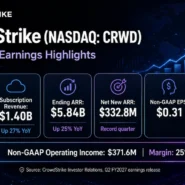
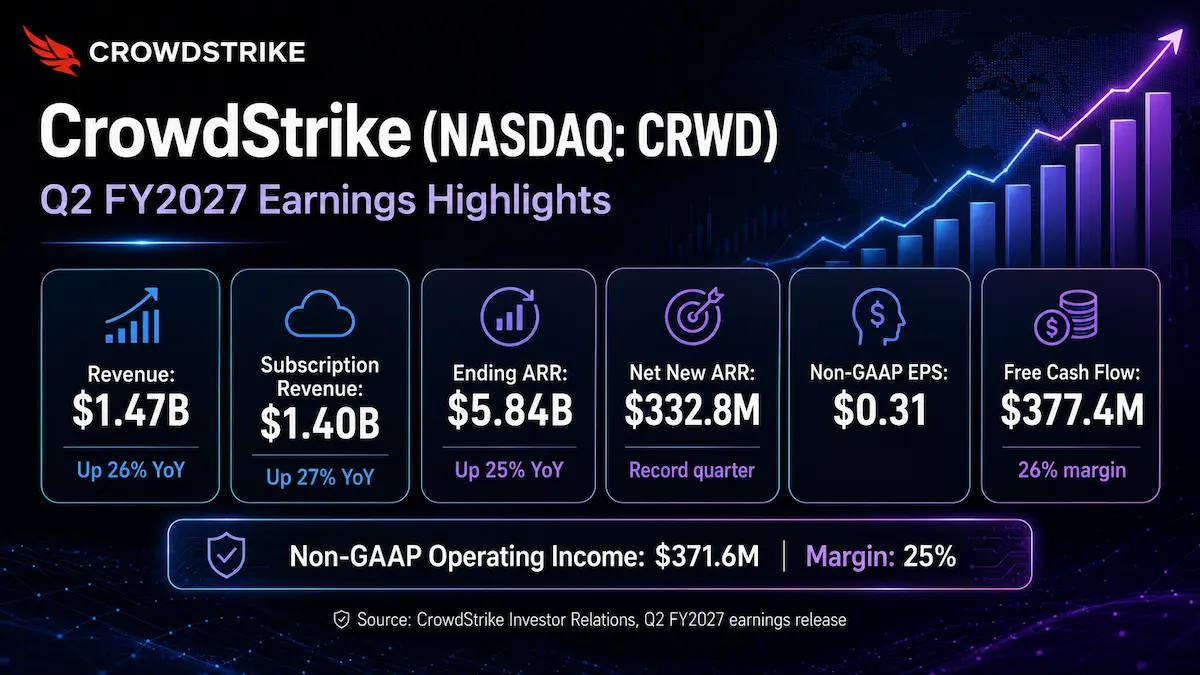
- CrowdStrike reported Q2 FY2027 revenue of $1.4709 billion, up 26% year over year, with non-GAAP diluted EPS of $0.31 and a roughly 25% non-GAAP operating margin.
- Ending ARR reached $5.84 billion, up 25%, while record net new ARR rose 51% to $332.8 million. Management lifted full-year net new ARR growth guidance to approximately 34% at the midpoint.
- Falcon Flex became a major monetization engine: ending ARR from Flex accounts exceeded $2.29 billion, up 101%, and standard-to-Flex conversions produced more than 40% average ending ARR uplift.
- Growth is broadening beyond endpoint: Next-Gen SIEM exceeded $695 million of ending ARR, Cloud Security exceeded $905 million, Next-Gen Identity exceeded $585 million, and AIDR ending ARR nearly tripled quarter over quarter.
- CRWD surged 20.5% to $227.96 on August 27, 2026. The fundamental acceleration justified a rerating, but the resulting valuation now embeds an unusually high bar for sustained ARR growth, margin expansion and pipeline conversion.
Verification note: CrowdStrike’s Investor Relations site publishes the official Q2 FY2027 earnings release, presentation and earnings webcast, but it does not currently provide a company-authored text transcript. The management commentary below is therefore presented as verified paraphrase and was cross-checked against the official webcast listing and multiple independent transcripts rather than represented as an official CrowdStrike transcript.
1. Core Earnings Breakdown
Revenue and Profitability Analysis
CrowdStrike’s Q2 FY2027 quarter, ended July 31, 2026, showed a rare combination for a company already operating at scale: revenue growth accelerated, net new ARR growth accelerated much faster than reported revenue, gross margin expanded, operating leverage improved, free cash flow set a Q2 record, and management raised its forward ARR outlook again. That combination matters more than a routine EPS beat because it suggests that AI-related security demand is translating into signed recurring business rather than remaining a marketing narrative.
- Total revenue: $1.470897 billion, up 25.8% year over year from $1.168952 billion. The investment implication is that CrowdStrike is not merely defending a high-growth base; reported revenue growth has now reaccelerated sequentially for several quarters, supporting the argument that the post-2024 slowdown was cyclical rather than structural.
- Subscription revenue: $1.400291 billion, up 27.0% year over year and representing approximately 95.2% of total revenue, calculated from company-reported figures as $1.400291 billion divided by $1.470897 billion. This mix makes expansion, retention and module adoption far more important to the equity story than professional-services growth.
- Professional services revenue: $70.606 million, up about 7.0% year over year from $66.007 million and an all-time quarterly record. The segment remains small in revenue terms, but management framed AI readiness and incident response work as a funnel into higher-value software cross-sell, making services strategically more important than its revenue contribution suggests.
- Ending ARR: $5.84 billion, up 25% year over year. Net new ARR was $332.8 million, up 51% and more than $45 million above the high end of management’s prior guidance. This is the quarter’s most important demand indicator because ARR acceleration is a leading signal for future subscription revenue.
- Non-GAAP subscription gross margin: 81%, versus 80% a year ago; GAAP subscription gross margin was 78%, versus 77%. The improvement shows that cloud optimization and scale benefits are arriving even as CrowdStrike invests aggressively in AI and platform expansion.
- Non-GAAP operating income: $371.6 million, up 46% from $255.0 million. Non-GAAP operating margin was approximately 25%, up about 350 basis points year over year. This is important because the business is demonstrating operating leverage while revenue growth is reaccelerating, an unusually favorable combination for a premium-growth software valuation.
- Free cash flow: $377.4 million, up 33% from $283.6 million, equal to roughly 26% of revenue. Operating cash flow was $530.3 million. The cash profile supports management’s claim that higher AI and platform investment does not require sacrificing cash generation.
The product mix also reveals why the quarter was stronger than the headline revenue number alone suggests. Cloud Security exceeded $905 million in ending ARR and grew more than 29% year over year. Next-Gen SIEM exceeded $695 million and grew more than 60%. Next-Gen Identity exceeded $585 million and grew more than 33%. CrowdStrike reported that these three businesses together exceeded $2.18 billion of ending ARR and grew more than 39%. AIDR, its AI Detection and Response offering, nearly tripled ending ARR quarter over quarter, although the company did not disclose an absolute AIDR ARR figure.
The investment significance is diversification. Endpoint remains the distribution anchor, but increasingly the value of that endpoint footprint is the ability to activate identity, SIEM, cloud, exposure management, data protection and AI-security modules through one architecture. That expands wallet share without requiring CrowdStrike to win an entirely new customer for every incremental product sale.
Expectations vs. Actual Results
- Revenue: $1.4709 billion vs. approximately $1.44 billion consensus — ✅ Beat. The beat was about $30.9 million, or roughly 2.1%, versus the analyst consensus cited by Reuters/LSEG and FactSet-based market reports.
- Non-GAAP diluted EPS: $0.31 vs. $0.29 consensus — ✅ Beat. The $0.02 beat equates to roughly 6.9% upside versus consensus.
- Non-GAAP operating margin: approximately 25.3% actual vs. approximately 24.1% implied by prior company guidance midpoint — ✅ Beat. The actual margin is calculated from company-reported figures as $371.6 million divided by $1.470897 billion. The comparison margin is calculated from the midpoint of CrowdStrike’s prior Q2 operating-income guidance of $345.6 million to $349.1 million divided by the midpoint of prior Q2 revenue guidance of $1.436 billion to $1.442 billion. A consistent primary-source Wall Street operating-margin consensus was not publicly available, so the prior company-guidance midpoint is used rather than an unverified estimate.
The real source of the beat was not cost cutting. Revenue exceeded management’s own prior range, subscription revenue grew faster than total revenue, net new ARR accelerated 51%, Flex conversion drove materially higher ARR, and gross margin expanded. Operating expense efficiency then amplified the top-line upside. CFO Burt Podbere said the operating-income outperformance reflected stronger revenue execution, gross-margin expansion and greater operating efficiency, including productivity gains from internal automation and AI.
For this stock, the market is likely to care more about net new ARR, Flex adoption, product-level ARR growth and forward pipeline than about the two-cent EPS beat. EPS matters because it confirms operating leverage, but CrowdStrike’s valuation is ultimately anchored to the durability of recurring revenue growth. The strongest evidence in the quarter was therefore the combination of $332.8 million net new ARR, record new-logo net new ARR, higher retention metrics, record Flex activity and a record Q3 pipeline.
Management’s Q3 FY2027 guidance calls for ARR of $6.1844 billion to $6.1884 billion, revenue of $1.5232 billion to $1.5292 billion, non-GAAP operating income of $372.7 million to $375.9 million and non-GAAP diluted EPS of approximately $0.31. FactSet consensus before the report was approximately $1.51 billion of Q3 revenue and $0.31 of EPS, so the revenue guide came in above expectations while EPS was broadly in line.
For full-year FY2027, CrowdStrike raised revenue guidance to $5.9911 billion to $6.0111 billion, ARR guidance to $6.6030 billion to $6.6119 billion, non-GAAP operating income to $1.4972 billion to $1.5084 billion and non-GAAP diluted EPS to $1.25 to $1.26. Full-year net new ARR is now expected at $1.350 billion to $1.359 billion, implying approximately 34% year-over-year growth at the midpoint. Management said that is 1,150 basis points above its initial annual net new ARR growth outlook and roughly $116 million higher than the initial net new ARR dollar outlook.
The stock reaction was fully aligned with the underlying results rather than contradictory. CRWD rose 20.5% on August 27 to close at $227.96 after initially gaining more than 10% in extended trading. That outsized move indicates that investors were rewarding the ARR reacceleration and raised outlook, not merely the reported revenue and EPS beat. In other words, this was not a case of strong headline numbers masking weaker guidance or a “sell the news” reaction. The risk has instead shifted to valuation: after the rerating, future quarters must now sustain a much higher level of execution to justify the price.
Earnings Call Highlights
Management characterized Q2 as the strongest quarter in CrowdStrike’s history and said the business had moved from an AI-security inflection point into measurable acceleration.
💡 Reading Between the Lines: Management is trying to establish that AI security is already visible in ARR rather than being a future product cycle. For valuation purposes, the key test is whether Q3 and FY2028 net new ARR remain elevated after the initial burst of AI-security urgency.
Falcon Flex became the center of the commercial model: the top ten deals were Flex transactions, more than 935 Flex accounts were added in Q2, and standard-to-Flex conversions generated more than 40% average ending ARR uplift.
💡 Reading Between the Lines: Flex is functioning as a monetization architecture, not just a pricing package. It reduces procurement friction and makes multi-module expansion easier, but it also raises investor expectations that large contractual commitments will convert efficiently into recognized revenue and durable renewals.
Management said AIDR is a separate, incremental, separately priced module rather than a replacement for EDR, while AIDR ending ARR nearly tripled quarter over quarter.
💡 Reading Between the Lines: This is crucial for the long-term model because it suggests AI security can add wallet share on top of the endpoint base instead of cannibalizing it. If that pattern persists, CrowdStrike’s effective addressable market expands faster than the underlying endpoint category.
Management emphasized its first-party security data as a moat and argued that Next-Gen SIEM can be activated quickly because CrowdStrike-generated telemetry is already inside the Falcon platform.
💡 Reading Between the Lines: The competitive advantage is not simply a better SIEM interface; it is data gravity plus lower deployment friction. That can compress time-to-value and pricing for legacy SIEM vendors while making Falcon harder to displace once multiple modules share the same telemetry layer.
CFO Burt Podbere highlighted a record Q3 pipeline and raised FY2027 net new ARR growth guidance by another 630 basis points to approximately 34% at the midpoint.
💡 Reading Between the Lines: Pipeline and ARR are the most important leading indicators in the quarter. The raise suggests Q2 upside was not treated as a one-off, but the premium valuation now requires that this pipeline convert with limited slippage and without sacrificing gross margin or sales efficiency.
2. Deep Business Insights
Hidden Metrics That Matter
Hidden Metric 1: Falcon Flex already touches more than 39.2% of total ending ARR. This is calculated from company-reported figures as more than $2.29 billion of ending ARR from accounts that have adopted Falcon Flex divided by $5.841 billion of total ending ARR. Because the company disclosed Flex ARR as “more than” $2.29 billion, 39.2% is a minimum estimate rather than an exact ceiling.
That penetration is strategically significant. Flex customers can consume multiple Falcon modules under a broader commercial commitment, reducing the administrative friction of separate purchases. CrowdStrike reported more than 2,900 Flex customers, more than 630 accounts that had re-Flexed at least once, a 25% average ending ARR uplift on the first re-Flex, and a 53% average ending ARR uplift for customers that had re-Flexed at least twice versus their initial Flex starting point. These figures suggest that Falcon Flex is becoming a repeatable expansion mechanism rather than a one-time contract conversion.
Hidden Metric 2: Cloud Security, Next-Gen SIEM and Next-Gen Identity together represent at least 37.3% of total ending ARR. This is calculated from company-reported figures as more than $2.18 billion divided by $5.841 billion. The three businesses grew more than 39% year over year, substantially faster than total ARR growth of 25%.
This matters because it changes the quality of the growth story. CrowdStrike no longer needs endpoint market-share gains alone to support a premium multiple. It can use endpoint distribution to sell faster-growing adjacent modules into the same customer environment. Customers appear willing to consolidate because the Falcon platform combines one lightweight agent, shared telemetry, integrated threat intelligence, runtime visibility, identity controls and a common commercial framework. The practical customer benefit is faster deployment and fewer point products; the economic benefit to CrowdStrike is higher attach rates, larger contracts and greater switching costs.
The platform’s first-party data advantage is also difficult to reproduce. Endpoint telemetry continuously generates proprietary security signals, which can improve detection models and feed SIEM, identity and AI-security use cases. Management’s claim is that the company is a “net data creator”: the platform produces new security data rather than merely ingesting third-party logs. That creates a feedback loop in which installed base, telemetry volume and product breadth reinforce one another.
Industry Chain Reactions
- ✅ Benefit — Accenture (NYSE: ACN): CrowdStrike said Accenture standardized on Falcon for its new SMB-focused Accenture Edge business, while CrowdStrike’s broader GSI business grew nearly 50% year over year. The direct financial impact on a company of Accenture’s size may be modest, but the trend supports demand for consulting-led security modernization, AI-readiness work and platform-consolidation projects that can expand services revenue around CrowdStrike deployments.
- ❌ Face Pressure — Palo Alto Networks (NASDAQ: PANW): The competitive pressure is analytical rather than a company-disclosed customer displacement. CrowdStrike reported rapid growth in Next-Gen SIEM, cloud security and exposure management, all categories where Palo Alto Networks competes, and management described a major SIEM win over an unnamed “firewall-first” product. CrowdStrike did not identify the displaced vendor, so it would be inappropriate to claim that this specific deal was taken from Palo Alto Networks. The broader risk is category overlap: if Falcon’s endpoint data advantage keeps lowering SIEM and cloud-security adoption friction, platform competition becomes more intense.
Valuation Framework and Key Risks
CRWD closed at $227.96 on August 27, 2026. Using approximately 1.01826 billion shares outstanding reported by MarketBeat, the implied equity value is about $232.12 billion. CrowdStrike reported $5.014 billion of cash and cash equivalents and $746.2 million of long-term debt at July 31, implying an approximate enterprise value of $227.85 billion. This enterprise-value calculation is based on company-reported balance-sheet figures and the cited market-cap inputs.
At the midpoint of FY2027 revenue guidance, approximately $6.001 billion, the stock trades at roughly 38.0 times enterprise value to FY2027 revenue, calculated from company-reported guidance and the market-value inputs above. Against the midpoint of FY2027 ending ARR guidance, approximately $6.607 billion, enterprise value is about 34.5 times guided ending ARR. Those are exceptionally high multiples for a company growing revenue in the mid-20% range, even with strong margins and a large security platform opportunity.
Management continues to expect at least a 30% full-year free-cash-flow margin on the higher FY2027 revenue guide. Applying the minimum 30% margin to the $6.001 billion revenue midpoint implies at least approximately $1.80 billion of FY2027 free cash flow, calculated from company-reported guidance. At the August 27 market capitalization, that equates to a free-cash-flow yield of at least roughly 0.78%, or no more than roughly 129 times price to that minimum free-cash-flow level. The point is not that this is the only valid valuation method; it is that the current price already capitalizes a large amount of future growth.
The valuation therefore assumes several things simultaneously: ARR growth remains well above 20%, newer product categories continue to outgrow the core, Falcon Flex sustains large ARR uplifts, non-GAAP operating margin keeps trending toward the FY2029 target range of 28% to 32%, and free-cash-flow margin advances toward the long-term target of 34% to 38%. If only one of those pillars weakens, multiple compression could offset otherwise solid absolute earnings growth.
- Valuation risk: A roughly 38x forward enterprise-value-to-revenue multiple leaves little room for a normal deceleration. A quarter that would be considered “good” for most software companies could still disappoint CRWD shareholders if net new ARR or pipeline growth slows materially.
- ARR conversion risk: Falcon Flex is producing large contractual ARR uplifts. Investors should distinguish ARR expansion from the timing of reported revenue and cash realization; stronger contractual commitments are positive, but they are not identical to current-period revenue.
- GAAP versus non-GAAP risk: Q2 non-GAAP operating income was $371.6 million while GAAP operating loss was $33.2 million. The $404.8 million difference is calculated from company-reported figures and highlights the continuing importance of stock-based compensation, amortization and other excluded items when assessing economic profitability and dilution.
- Execution and product risk: CrowdStrike’s July 19, 2024 incident remains explicitly listed in the company’s risk disclosures. As more security functions consolidate on one platform, operational resilience becomes more valuable but the potential blast radius of product defects also becomes strategically important.
- M&A and integration risk: CrowdStrike’s goodwill increased materially through recent acquisitions, and management said the planned acquisition of XM Cyber’s technology assets will contribute no ARR or revenue to FY2027 guidance. Investors should therefore avoid attributing near-term revenue upside to that transaction before integration and commercialization are proven.
- Competitive risk: Microsoft, Palo Alto Networks, SentinelOne and other security vendors remain well-capitalized competitors across endpoint, SIEM, identity, cloud and AI security. CrowdStrike’s data and platform advantages are meaningful, but customer consolidation can work in both directions.
The central valuation question is therefore not whether CrowdStrike is executing well; Q2 clearly says it is. The harder question is how long 25%-plus ARR growth and expanding margins can coexist. At the current price, the market is treating CrowdStrike less like a conventional cybersecurity software vendor and more like a potential infrastructure layer for enterprise AI security. That framing can support a premium multiple, but only if AIDR, SIEM, identity and cloud become durable second growth curves rather than temporary beneficiaries of an unusually urgent security cycle.
3. Key FAQs
Did CrowdStrike beat Q2 2027 earnings expectations?
Yes. CrowdStrike reported Q2 FY2027 revenue of $1.4709 billion versus approximately $1.44 billion of analyst consensus and non-GAAP diluted EPS of $0.31 versus $0.29 consensus. The more important upside was in net new ARR, which reached a record $332.8 million and grew 51% year over year.
What is CrowdStrike’s Q3 FY2027 revenue and EPS guidance?
CrowdStrike guided Q3 FY2027 revenue to $1.5232 billion to $1.5292 billion and non-GAAP diluted EPS to approximately $0.31. It also guided Q3 ending ARR to $6.1844 billion to $6.1884 billion and non-GAAP operating income to $372.7 million to $375.9 million. The revenue range was above the approximately $1.51 billion FactSet consensus available immediately after the report.
Is CRWD stock expensive after Q2 2027 earnings?
On conventional software valuation metrics, yes. At the August 27 close of $227.96, CRWD’s approximate enterprise value was about $227.85 billion, which is roughly 38 times the midpoint of FY2027 revenue guidance. That valuation can still be supported if CrowdStrike sustains elevated ARR growth, Falcon Flex expansion, AI-security monetization and margin improvement, but it leaves little protection if growth normalizes faster than investors expect.
For the official financial data, see CrowdStrike’s Q2 FY2027 earnings release and quarterly results page with the official webcast and presentation. Analyst-consensus figures were cross-checked against Reuters/LSEG coverage and FactSet-based market reports.
Disclaimer: This article/chart is for educational and informational purposes only and does not constitute investment advice of any kind. Past performance is not indicative of future results. Investors should independently evaluate their own risks.