

重點總結
- Palantir monetizes enterprise software through hosted subscriptions, on-premises software bundled with ongoing operations and maintenance services, and professional services. It is not an advertising, hardware, or consumer-data monetization business.
- The economic engine is expansion, not merely customer acquisition: Palantir enters a high-value operational problem, connects data and decision workflows through its Ontology, and then seeks to widen deployment across users, functions, and missions.
- The most defensible moats are switching costs and mission-grade intangible assets. Classic network effects are limited, while a structural cost advantage has not been demonstrated.
- The 2023 deployment of Artificial Intelligence Platform, or AIP, was the strategic inflection point because it turned Palantir’s existing data, governance, deployment, and workflow stack into an execution layer for generative and agentic AI.
- The central risks are execution against unusually high growth expectations, contract optionality and termination rights, long enterprise sales cycles, competition from large software vendors and internal development, customer concentration, and continued stock-based compensation.
Palantir Technologies has evolved from a specialist software provider for U.S. intelligence operations into a broader operating-system vendor for government and commercial institutions. Its corporate gene is not simply “data analytics” and not simply “artificial intelligence.” The company’s core design principle is to connect fragmented data, institutional logic, security permissions, analytical models, human decisions, and real-world actions inside a governed operating layer.
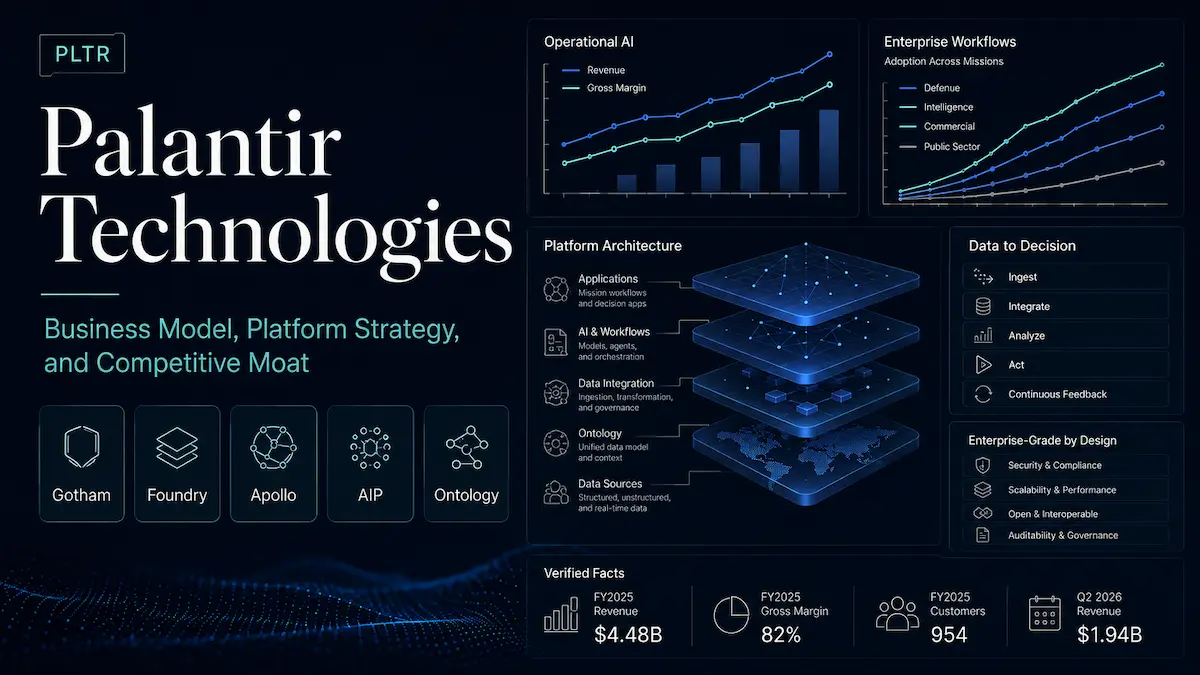
Confirmed fact: Palantir was founded in 2003 and initially built software for the U.S. intelligence community. Its principal platforms are Gotham, Foundry, Apollo, and AIP, with the Palantir Ontology functioning as a common operational layer across the stack.
Management statement: Palantir argues that AIP can connect third-party large language models and other AI systems to customer data and operations while preserving the legal, ethical, security, and human-review controls required by the customer. This is a company claim about product differentiation, not independently proven market supremacy.
Analytical inference: Palantir’s most important competitive position is emerging above the foundation-model layer. Rather than depending on ownership of the largest model, it seeks to become the governed execution environment in which multiple models, data systems, applications, and operators coordinate decisions. If foundation models continue to commoditize, that architecture could strengthen Palantir’s bargaining position because model choice becomes an input rather than the product’s sole source of value.
Unverified market expectation: It is not established that current growth rates, margin expansion, or management’s “sovereign AI” thesis will persist for multiple years. Public filings verify recent performance and management guidance, but they do not prove durable category dominance or future shareholder returns.
1. Business Model Breakdown
What Palantir Actually Sells
Palantir sells software access and the operating support required to keep that software useful inside complex organizations. According to its 2025 Form 10-K, revenue is generated from three contractual forms: subscriptions to Palantir-hosted software environments, software subscriptions deployed in customer-controlled environments with ongoing operations and maintenance services, and professional services. Revenue from the core hosted and on-premises offerings is generally recognized ratably over the contractual term.
This accounting model matters. Palantir does not capture the full economic value of a multiyear contract as immediate revenue. New bookings, renewals, and expansions feed recognized revenue over time, creating visibility but also producing a lag: deterioration in new contract activity may not appear immediately in reported revenue, while a surge in bookings may take time to flow through the income statement.
Palantir does not provide a complete public revenue split by Gotham, Foundry, Apollo, AIP, hosted cloud, on-premises software, and professional services. Any precise product-level revenue mix presented without additional disclosure would therefore be unverified. The company instead reports two operating customer segments: government and commercial.
Confirmed fact: In 2025, Palantir generated $4.48 billion of revenue. Government customers contributed $2.40 billion, or 54%, while commercial customers contributed $2.07 billion, or 46%. U.S. customers represented 74% of total revenue. In the second quarter of 2026, total revenue reached $1.94 billion, up 93% year over year; U.S. commercial revenue was $764 million and U.S. government revenue was $809 million.
The Four-Platform Architecture
Gotham is designed for defense, intelligence, and other mission environments where operators must synthesize data, understand evolving conditions, and act under strict security controls. Foundry is the foundational data-operations platform for commercial and government workflows. It connects data engineering, analytics, applications, and operational decision-making. Apollo is the deployment and continuous-delivery layer that allows Palantir software, and increasingly customer software, to run across public cloud, private cloud, on-premises, and constrained edge environments. AIP adds model access, agent-building tools, evaluations, controls, and human approval points for production AI workflows.
The Ontology is the connective tissue. It maps an institution’s data and logic into operational objects, relationships, permissions, actions, and workflows. In practical terms, a manufacturer can represent plants, machines, orders, inventory, workers, suppliers, and production constraints inside a common operating model. An AI agent can then query that model or propose an action without bypassing the underlying authorization, lineage, and audit structure.
Analytical inference: This is why Palantir should be analyzed less like a stand-alone dashboard vendor and more like a configurable enterprise operating layer. The value proposition is not merely better visualization. It is the reduction of organizational latency between observing a condition, deciding what it means, authorizing a response, and executing that response across existing systems.
How the Revenue Flywheel Works
The commercial logic can be summarized as land, prove, operationalize, and expand. Palantir often begins with a high-value use case or short pilot. Its AIP bootcamp model is intended to place customer data and a real workflow into a working environment in days rather than beginning with a long theoretical consulting study. If the initial deployment creates measurable value, Palantir seeks to add more users, data domains, applications, decisions, and operating units.
The expansion phase is economically important because the customer has already absorbed part of the integration, security, training, and organizational-change burden. Each additional workflow can reuse the Ontology, permissions, data pipelines, deployment infrastructure, and user knowledge established during earlier deployments. This can increase revenue faster than the cost required to serve the account, although complex customer environments and field support requirements can limit scalability.
Confirmed fact: Palantir reported 954 customers at the end of 2025. Its top three customers represented 16% of 2025 revenue and had been customers for an average of ten years. Average trailing-12-month revenue from the top 20 customers reached $93.9 million, up from $64.6 million a year earlier. These figures support the existence of deep account expansion, but they also demonstrate meaningful concentration.
Profitability Logic and the Quality of Earnings
Palantir’s software model produces high gross margins because the same core codebase can support multiple customers, while subscription revenue is recognized over time. The company reported an 82% GAAP gross margin for 2025. Based on the Q2 2026 earnings release, quarterly gross profit of $1.64 billion on $1.94 billion of revenue implies a gross margin of approximately 84.7%.
Operating leverage has accelerated. Q2 2026 GAAP operating income was $912 million, equal to a 47% operating margin. However, adjusted figures should not be confused with GAAP economics. The same quarter included $265 million of stock-based compensation, equivalent to approximately 13.7% of revenue. Stock-based compensation is noncash in the current period, but it is an economic cost to shareholders through dilution or the cash required to offset dilution.
Analytical inference: Palantir’s underlying profit engine is strongest when three conditions occur together: customers expand onto reusable platform infrastructure, deployment effort per incremental use case declines, and operating-expense growth remains below revenue growth. The model is less attractive when each new contract behaves like a bespoke engineering project requiring extensive implementation labor.
2. Deep Dive into Economic Moats
Moat One: Switching Costs Embedded in the Operating Model
Palantir’s strongest moat is not the difficulty of exporting a table of data. It is the operational cost of replacing a system that has become interwoven with data pipelines, permissions, business logic, analytical models, applications, human procedures, and write-back actions into other enterprise systems.
Once a customer has built an Ontology representing how the organization works, replacement requires more than selecting another database or AI model. A competitor or internal team must reconstruct data lineage, governance policies, object definitions, workflow dependencies, user interfaces, model evaluations, audit controls, deployment processes, and integrations with systems of record. It must then migrate users without interrupting operations or creating unacceptable security and compliance risk.
The switching cost is therefore organizational as well as technical. Users learn to make decisions through Palantir applications; operators and managers embed workflows into standard operating procedures; security teams approve access models; and executives begin relying on the resulting operational picture. The more actions the platform coordinates, the more disruptive a replacement becomes.
Evidence supporting this moat includes the ten-year average tenure of Palantir’s top three 2025 customers, rising average revenue among its top 20 customers, and the company’s disclosure that existing-customer expansion is a major growth driver. However, Palantir does not disclose a conventional SaaS net revenue retention metric in the cited filings. The strength of the switching-cost moat is therefore a reasonable inference from account longevity and expansion, not a directly verified retention statistic.
Moat Two: Mission-Grade Intangible Assets and Institutional Trust
Palantir’s second defensible asset is accumulated credibility in high-consequence environments. The company’s history in intelligence and defense, its capacity to deploy across cloud, on-premises, and edge infrastructure, and its focus on granular access controls create a body of mission knowledge that is difficult to reproduce quickly.
This is not equivalent to a legal monopoly. Palantir’s own filings acknowledge intense competition from large enterprise software vendors, government contractors, systems integrators, emerging companies, and software built internally by customers. Its patents and trade secrets may help, but software intellectual property can be challenged, worked around, or independently recreated.
The more durable intangible asset is the combination of product credibility, procurement familiarity, security architecture, and experienced personnel who understand how to implement software in sensitive operational settings. A new competitor must not only build comparable functionality; it must survive lengthy evaluation cycles, satisfy technical and institutional requirements, demonstrate reliability, and earn trust from buyers whose cost of failure can be substantially greater than the software contract.
Confirmed fact: In July 2025, the U.S. Army announced an enterprise agreement with Palantir that consolidated numerous software and data requirements under a common framework. The Army later described the arrangement as consolidating 75 separate contracts to accelerate delivery, remove unnecessary fees, and streamline procurement. The framework can reduce friction, but it should not be read as guaranteed revenue: government task orders, funding, options, and termination rights remain material.
Why Network Effects Are Not the Core Moat
Palantir does not exhibit a verified classic demand-side network effect comparable with a social network, payment network, marketplace, or communications platform where each additional external participant directly raises utility for all other participants. Customers generally operate in segregated environments with strict data controls, and the commercial proposition emphasizes customer control rather than pooling proprietary operating data across enterprises.
There may be learning effects. Palantir can reuse software components, implementation patterns, industry knowledge, and product improvements across deployments. Those advantages can improve product quality and speed, but they are better described as cumulative know-how and economies of scope than as a pure network effect.
Why High Gross Margin Is Not Automatically a Cost Advantage
An 80%-plus gross margin demonstrates attractive software economics, but it does not by itself prove a durable cost advantage. Hyperscale cloud providers and larger enterprise vendors may have lower infrastructure costs, broader distribution, larger sales forces, or the ability to bundle competing functionality.
Palantir’s potential advantage is not being the cheapest provider of storage, compute, or foundation models. It is reducing the total time and institutional risk required to move from fragmented data to a governed operational workflow. That is a value and execution advantage. It becomes a cost moat only when the customer’s avoided integration expense, project failure risk, and time-to-decision are persistently greater than Palantir’s contract price.
Can the Moat Support Long-Term Excess Returns?
The moat can support high incremental margins and durable account expansion if Palantir remains embedded in mission-critical workflows, continues to shorten deployment time, and prevents its platform from becoming a costly services-heavy architecture. Competitors must bear the expense of recreating technical integration, operational context, security credibility, and customer trust.
However, a strong business moat does not guarantee superior investment returns at every market valuation. Long-term shareholder outcomes depend on the price paid for the stock, dilution, capital allocation, competitive response, and whether growth expectations already embedded in the valuation exceed future execution. This article evaluates corporate economics rather than issuing a valuation conclusion.
3. Business Inflection Points & Future Catalysts
The Strategic Inflection Point: AIP Changed the Product and the Go-to-Market Motion
Palantir’s most consequential strategic turning point was the 2023 deployment of AIP. Before AIP, Gotham and Foundry already integrated data, analytics, workflows, and operations. AIP converted that installed architecture into a controlled environment for large language models, AI agents, and automations.
The strategic importance was not that Palantir created a proprietary frontier model. Instead, AIP was designed to connect multiple third-party, open-source, self-hosted, and commercial models to the Ontology and to customer operations. This placed Palantir at the control and execution layer, where model outputs can be evaluated, permissioned, reviewed by humans, and translated into actions.
AIP also altered distribution. Bootcamps seek to compress the time from demonstration to a functioning customer workflow. This is strategically significant because Palantir’s historic weakness was an intensive, long, and unpredictable enterprise sales process. A faster proof-to-production cycle can expand the addressable customer set and improve sales productivity, but only if pilots reliably convert into durable contracts.
Catalyst One: Commercial AIP Expansion and Production AI Agents
Transmission mechanism: A successful bootcamp can establish an initial workflow, after which the customer may purchase a production deployment and expand into additional functions. Because AIP is bundled with or connected to Foundry, Gotham, Apollo, and the Ontology, an AI use case can pull through broader platform consumption rather than remain a stand-alone chatbot license.
Observable indicators: U.S. commercial revenue growth; U.S. commercial total contract value and remaining deal value; the number and size of deals; customer count; average revenue among large customers; the conversion of pilot activity into recognized revenue; and gross-margin stability as deployment volume rises. In Q2 2026, U.S. commercial revenue grew 149% year over year to $764 million, U.S. commercial TCV reached $2.13 billion, and U.S. commercial remaining deal value reached $6.24 billion.
Execution risks: The reported contract metrics assume options are exercised and contracts are not terminated, while many agreements contain termination provisions. Enterprises may fail to move prototypes into production, develop competing internal systems, choose bundled offerings from larger vendors, or restrict AI deployment because of security, regulation, or uncertain return on investment. Palantir must also prove that rapid bootcamps do not create a support burden that scales as fast as revenue.
Catalyst Two: Defense Modernization and Sovereign AI Demand
Transmission mechanism: Governments and allied institutions increasingly require AI systems that can operate with sensitive data, role-based permissions, human oversight, sovereign infrastructure, and disconnected or edge environments. Palantir’s Gotham-AIP-Apollo architecture is positioned to combine decision support, deployment flexibility, and operational control. Enterprise procurement frameworks can lower the friction required to add users, missions, and software modules.
Observable indicators: U.S. government revenue growth; funded task orders rather than contract ceilings; contract backlog and noncancelable remaining performance obligations; expansion within Army and other defense programs; allied-government deployments; and evidence that procurement consolidation shortens sales cycles. Q2 2026 U.S. government revenue grew 90% year over year to $809 million.
Execution risks: Government contracts are subject to budget cycles, policy changes, protest risk, security requirements, option decisions, and termination for convenience. A large contract ceiling is not equivalent to guaranteed revenue. Political scrutiny, procurement reform emphasizing price, competing defense-software vendors, and changes in geopolitical priorities can slow or redirect spending.
Management statement: Palantir’s chief executive described the latest demand environment as a “sovereign AI” revolution and argued that customers want control over their data, operations, and decisions. This characterization may explain management’s strategic priorities, but the scale and duration of the market remain unverified.
Catalyst Three: GAAP Margin Expansion and Cash Conversion
Transmission mechanism: Subscription revenue recognized over multiyear terms can compound while research, general administration, and core platform development grow more slowly. If Palantir can standardize deployments, automate implementation, and use partners without sacrificing quality, incremental revenue should carry high contribution margins.
Observable indicators: GAAP operating margin, not only adjusted operating margin; stock-based compensation as a percentage of revenue; operating cash flow; adjusted free cash flow reconciliation; accounts-receivable growth relative to revenue; cloud-hosting and field-service costs; and the relationship between recognized revenue, remaining performance obligations, customer deposits, TCV, and remaining deal value. Q2 2026 produced a 47% GAAP operating margin and $1.22 billion of operating cash flow.
Execution risks: Margin gains may reverse if sales hiring, customer support, cloud costs, defense implementation, or product investment accelerate. Cash flow can also differ from normalized earnings because of billing timing, customer deposits, working capital, taxes, and stock-based compensation. A company can produce strong adjusted free cash flow while still creating meaningful per-share dilution.
What Could Invalidate the Catalyst Thesis?
The catalyst thesis would weaken if U.S. commercial TCV and remaining deal value decelerate before recognized revenue, if customer expansion becomes dependent on increasingly labor-intensive services, if commercial AIP projects remain pilots, if government awards fail to convert into funded orders, or if GAAP margin expansion relies primarily on stock-based compensation exclusions.
A second invalidation path is architectural. Palantir’s position assumes that enterprises value a unified operational layer more than a collection of lower-cost point products. If open standards, internal developer platforms, hyperscaler bundles, or specialized applications make orchestration and governance materially easier, customers may reduce reliance on a single vendor.
4. Key FAQs
How does Palantir make money from AIP and Foundry?
Palantir monetizes AIP and Foundry through software subscriptions delivered in Palantir-hosted or customer-controlled environments, typically with ongoing operations and maintenance services, plus professional services when required. The company generally recognizes core platform revenue over the contract term. AIP’s commercial purpose is to create production AI workflows that increase consumption of the broader Palantir stack, including the Ontology, Foundry data operations, Apollo deployment, and domain applications. Palantir does not publicly disclose a verified stand-alone AIP revenue figure in the cited filings.
What is Palantir’s strongest competitive moat versus data platforms and enterprise AI vendors?
Palantir’s strongest moat is the switching cost created when its Ontology, applications, security permissions, data pipelines, and action workflows become embedded in daily operations. Its second moat is mission-grade trust and implementation know-how in sensitive environments. The moat is not simply superior data storage, a proprietary large language model, rapid growth, or brand awareness. A competing vendor must recreate the customer’s operational model and prove that migration will not disrupt decisions, security, compliance, or mission continuity.
Is Palantir’s government revenue more durable than its commercial revenue?
Government revenue can be durable because missions are long-lived, security requirements are demanding, and successful platforms may expand across programs. However, it is not contractually risk-free. Government budgets change, awards can be delayed, options may not be exercised, and many contracts can be terminated for convenience. Commercial revenue may have faster expansion potential but faces enterprise budget scrutiny, internal development, and intense software competition. The more useful distinction is not government versus commercial; it is funded, noncancelable, deeply embedded recurring work versus optional contract value that has not yet converted into recognized revenue.
5. Conclusion
Palantir’s enterprise gene is the conversion of institutional complexity into an operational software model. Gotham supplied the original mission context, Foundry extended the architecture into commercial operations, Apollo solved continuous deployment across heterogeneous infrastructure, and AIP turned the stack into a governed execution environment for models and agents. The Ontology binds those elements together by representing the organization’s data, logic, permissions, decisions, and actions.
The company’s most credible moat is not ownership of customer data or a classic network effect. It is the accumulated switching cost created when Palantir becomes part of how an institution operates, reinforced by intangible trust in environments where failure is expensive. That moat can support pricing power, expansion, and high incremental margins, but only if Palantir keeps implementation scalable and remains technologically relevant as competitors improve.
Recent financial performance confirms exceptional operating momentum, including rapid U.S. commercial and government growth and substantial GAAP margin expansion in Q2 2026. Management’s full-year guidance and sovereign-AI thesis remain forward-looking. The decisive research question is whether current contract activity converts into durable, funded, production-scale usage faster than competitive alternatives reduce the cost of building comparable operational AI systems.
Source:
Palantir Q2 2026 Earnings Release, SEC Exhibit 99.1
Palantir 2025 Annual Report on Form 10-K, U.S. SEC
Palantir Q1 2026 Quarterly Report on Form 10-Q, U.S. SEC
Palantir Official Platform Overview
Palantir Artificial Intelligence Platform
U.S. Army Enterprise Agreement Announcement
Disclaimer: This article is intended solely for business logic discussion and corporate research purposes, and does not constitute investment advice of any kind.