

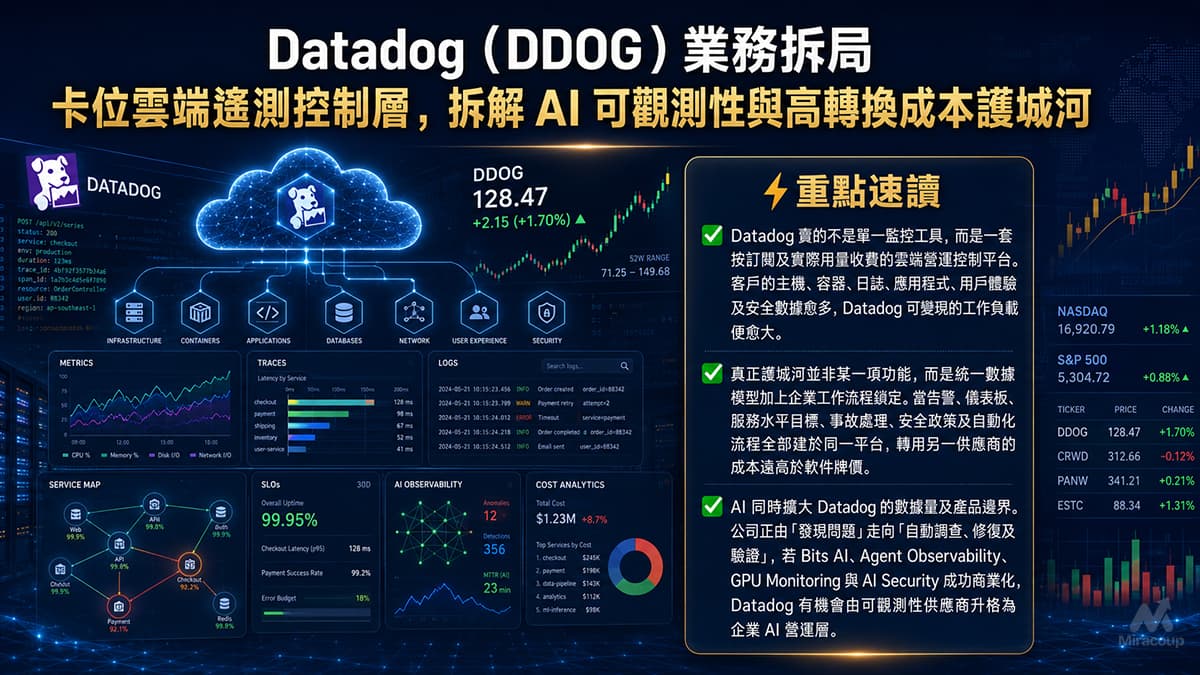
⚡ 重點速讀
- Datadog is not selling a single monitoring tool, but rather a cloud operations control platform that charges based on subscriptions and actual usage. The more hosts, containers, logs, applications, user experiences, and security data a client has, the larger the workload Datadog can monetize.
- Its true moat is not any single feature, but rather a unified data model combined with enterprise workflow lock-in. When alerts, dashboards, service-level objectives (SLOs), incident management, security policies, and automated workflows are all built on the same platform, the cost of switching to another vendor is far higher than the software's sticker price.
- AI simultaneously expands Datadog's data volume and product boundaries. The company is shifting from "problem discovery" to "automated investigation, remediation, and verification." If Bits AI, Agent Observability, GPU Monitoring, and AI Security are successfully commercialized, Datadog has the opportunity to upgrade from an observability vendor to an enterprise AI operations layer.
1. Deconstructing the Business Model
The essence of Datadog's business is centralizing highly fragmented enterprise technical telemetry data into a multi-tenant cloud platform, and monetizing it through analysis, correlation, alerting, security detection, and automated workflows. The data collected spans metrics, traces, logs, user sessions, security signals, database status, network traffic, and even the operational status of Large Language Models and AI Agents.
Its pricing structure is not a traditional "buy a license and use it unlimitedly," but primarily consists of monthly, annual, or multi-year subscriptions, billed according to the value units of different products. For example, infrastructure monitoring can be billed by the number of hosts, log management by data ingestion and indexed volume, while APM, Serverless, Synthetic Monitoring, user experience, and security products each have their respective usage metrics. Once a client exceeds their contracted usage, additional charges apply.
The advantage of this model is that revenue can grow in tandem with the client's cloud workloads. When enterprises add microservices, containers, GPUs, AI Agents, or digital transactions, it often drives up the volume of telemetry data simultaneously. In other words, Datadog doesn't need to fight for budgets from scratch every time; its usage revenue can directly "scale alongside the client's stack." Conversely, when the economy weakens or enterprises optimize cloud costs, usage may also slow down, making its quarterly growth more volatile than pure seat-based SaaS models.
Datadog's most important growth engine is a classic land-and-expand strategy. The company usually enters with infrastructure monitoring, APM, or log management, and then cross-sells network monitoring, digital experience, security, database monitoring, developer tools, incident management, product analytics, and AI products. Different modules can be adopted independently, but when placed within the same data model, they can automatically link frontend errors, backend traces, infrastructure anomalies, and security signals, making the value of a multi-product solution greater than the sum of its parts.
The numbers reflect this flywheel. Datadog's FY2025 revenue was approximately $3.427 billion, up 28% year-over-year, with a gross margin of around 80%; about three-quarters of the full-year revenue growth came from existing clients rather than new ones. By Q1 2026, the company's revenue surpassed $1 billion for the first time, up 32% year-over-year, with free cash flow of about $289 million. During the same period, about 56% of clients used four or more products, 35% used six or more, and 20% used eight or more, indicating that platform penetration continues to deepen.
Enterprise DNA Summary: Datadog doesn't rely on one-off large-scale system implementations to make money. Instead, it secures data entry points through low-friction deployments, and continuously increases the lifetime value of each client through usage growth, product cross-selling, and workflow integration.
2. Deep Dive into Core Moats
The market often oversimplifies Datadog's moat as "easy to use" or "nice interfaces," but such advantages are easily replicated. Using the Buffett framework, Datadog's structural barriers are not cost advantages, but rather the following two:
Moat 1: High Switching Costs Evolving from Being a Data Gateway
Datadog's Agents, tagging rules, service maps, dashboards, alert thresholds, incident escalation procedures, SLOs, security policies, and automated workflows gradually embed themselves into an enterprise's daily operations. Once the platform covers the entire tech stack, switching vendors isn't just about migrating historical data; it requires rebuilding years of accumulated operational context, accountability, and cross-departmental collaboration workflows.
More importantly, Datadog has expanded from DevOps tools to development, operations, security, product, data, and management teams. The more departments using it, the more stakeholders are involved in a replacement decision. This creates an "organizational-level switching cost": it might not be technically impossible to migrate, but the downtime risks, retraining, and incident liabilities incurred during an actual migration are enough to make large enterprises lean toward maintaining their current platform.
Moat 2: Unified Data Model, Integration Breadth, and Telemetry Scale
Datadog boasts over 1,000 out-of-the-box integrations and processes trillions of events per hour using a unified tagging and data model. Its value doesn't just lie in "collecting more data," but in its ability to correlate metrics, traces, logs, user behaviors, and security signals within the same context, piecing together clues scattered across multiple tools into a complete causal map.
This also forms a data flywheel in the AI era. General coding assistants primarily read source code, but Datadog's AI Agents can simultaneously access latency, errors, dependencies, resource consumption, and security signals in real production environments. As a result, the investigative conclusions or remediation solutions they propose have the potential to be closer to actual operating conditions than pure code models.
However, calling this advantage a "monopoly" would be inaccurate. Datadog doesn't possess strong network effects like social platforms where more users directly benefit other users; more precisely, its massive telemetry scale, cross-product data, and domain knowledge form a data learning effect and an R&D scale advantage.
Moat Level: A "deep but dynamic" moat. The switching costs and unified data platform are highly robust, but the company must continually invest in R&D to counter competition from Dynatrace, Cisco, Elastic, Grafana's ecosystem, and native tools from AWS, Azure, and Google Cloud. OpenTelemetry increases data portability, which also means relying solely on proprietary data collectors is no longer enough to lock in clients permanently.
Datadog also lacks an obvious cost advantage. Ingesting, processing, and retaining massive amounts of telemetry data requires paying third-party cloud infrastructure costs. The gross margin dropping from roughly 81% to 80% in 2025 illustrates that scaling does not automatically translate to infinite marginal profits. The company's pricing power must be built on faster troubleshooting, less downtime, and higher engineering productivity, rather than simply storing data.
3. Corporate Turning Points and Future Catalysts
Founded in 2010 by Olivier Pomel and Alexis Lê-Quôc, Datadog's initial core problem to solve was that development and IT operations teams used different tools, lacking a single source of truth during incidents. The company started with cloud infrastructure monitoring, launched APM in 2017, added log management in 2018, and for the first time brought the three pillars of observability—metrics, traces, and logs—onto the same platform.
The true strategic turning point was 2018, not the 2019 IPO itself. After unifying the three major telemetry data types, Datadog transformed from a single-point infrastructure monitoring product into a platform capable of continuously adding modules. Subsequently, the company sequentially entered user experience, network, security, databases, cloud costs, developer experience, service management, product analytics, and AI observability. Its business model also upgraded from "selling a tool" to "competing for the enterprise's entire tech operations budget."
Looking ahead one to two years, the most notable catalysts are primarily fourfold:
- AI workloads driving a structural increase in telemetry volume: Model invocations, GPUs, vector databases, and multi-step Agents will generate vast amounts of novel data. In Q1 2026, over 6,500 clients were already sending data from one or more AI integrations to Datadog, accounting for about 80% of the company's ARR. A crucial clarification: this does not mean 80% of ARR is directly generated by AI products, but rather that the company's largest clients have started deploying AI, providing fertile ground for subsequent cross-selling.
- Moving from observation to autonomous execution: Bits Detection, Bits Investigation, Bits Code, Bits Release, Bits Testing, and Bits Security Analyst are pushing Datadog from the information presentation layer to the execution layer. If the platform can reliably automate the discovery, investigation, remediation, and verification of issues, the value Datadog can capture will expand from monitoring budgets to engineering manpower, productivity, and security operations budgets.
- Numerous early-stage products entering the scaling phase: As of Q1 2026, only five of Datadog's 26 products had an ARR exceeding $100 million, and another three were between $50 million and $100 million; the remaining 18 were still in earlier stages. This signifies that the company's second curve of growth isn't just betting on a single AI product, but a whole portfolio of options available for cross-selling to existing clients.
- Regulated markets and first-party AI R&D: The FedRAMP High authorization unlocks highly sensitive workloads in the U.S. federal government and strengthens trust among regulated clients in finance and healthcare. The acquisition of Adaptive ML in June 2026 indicates that Datadog aims to utilize real production telemetry data to develop purpose-built Agents with domain knowledge and continuous learning capabilities, rather than relying entirely on external general-purpose models.
The key to its valuation isn't just whether the AI narrative can boost short-term revenue, but whether Datadog can prove that AI will simultaneously accelerate product adoption and usage among non-AI clients. In Q1 2026, revenue growth from non-AI clients accelerated to roughly 25%, while the overall gross retention rate remained at a high 90-95%. If these two trends continue, the market will more easily believe that Datadog is a beneficiary of AI infrastructure, rather than just being driven by a few high-consumption AI startups.
Conversely, investors should also monitor three counter-indicators: large clients proactively cutting log and telemetry costs, product adoption rates plateauing, and new AI features only improving user experience without generating independent willingness to pay. Datadog's moat is built on continuous innovation; if R&D pace lags, its high valuation premium will shrink faster than typical mature software stocks.
4. Frequently Asked Questions FAQ
What is Datadog's (DDOG) business model? How does the company primarily make money?
Datadog generates revenue primarily through cloud SaaS subscriptions and actual usage billing. Clients pay for products like infrastructure monitoring, APM, logs, security, user experience, developer tools, and AI observability; as host, container, log, or application workloads increase, client spending typically rises accordingly.
What is the difference between Datadog and Dynatrace, Cisco Splunk, Elastic, and Grafana?
Datadog's strengths are its cloud-native deployment experience, product breadth, and the unification of various telemetry data into a single platform. Dynatrace is competitive in automated topology and large enterprise environments; Cisco Splunk has deep roots in logs and security; Elastic and the Grafana ecosystem are more attractive in terms of openness, deployment control, and cost flexibility. Different enterprises have varying data scales, compliance requirements, and build-it-yourself capabilities, so there is no single winner for all situations.
Will AI observability become DDOG's next major growth engine?
The potential is significant, but the real opportunity isn't limited to selling LLM dashboards. The more commercially valuable direction is to simultaneously monitor GPUs, models, data pipelines, and AI Agents, and then utilize production environment telemetry to automate issue investigation and remediation. Datadog already possesses the client access and data foundation, but it still needs to prove that these AI features can generate recurring revenue rather than just serving as freemium add-ons for existing products.
Disclaimer: This article is for the purpose of business logic discussion and corporate research only, and does not constitute any form of investment advice.